Megatrend · Brain-Computer Interface
The tiny parts that have to survive inside a living human brain for decades
Every BCI brand you've heard of — Neuralink, Synchron, Precision — ultimately needs the real thing that "touches" brain tissue: electrodes thinner than a hair, materials that the blood and fluid in the brain won't corrode, and chips that can amplify microvolt-level signals without burning power. This is the "pick-and-shovel" layer of the BCI industry — the people selling the gold-mining gear, who get paid whether or not anyone strikes gold. And its hardest problem — making the parts survive in the brain for the long haul — is still unsolved.
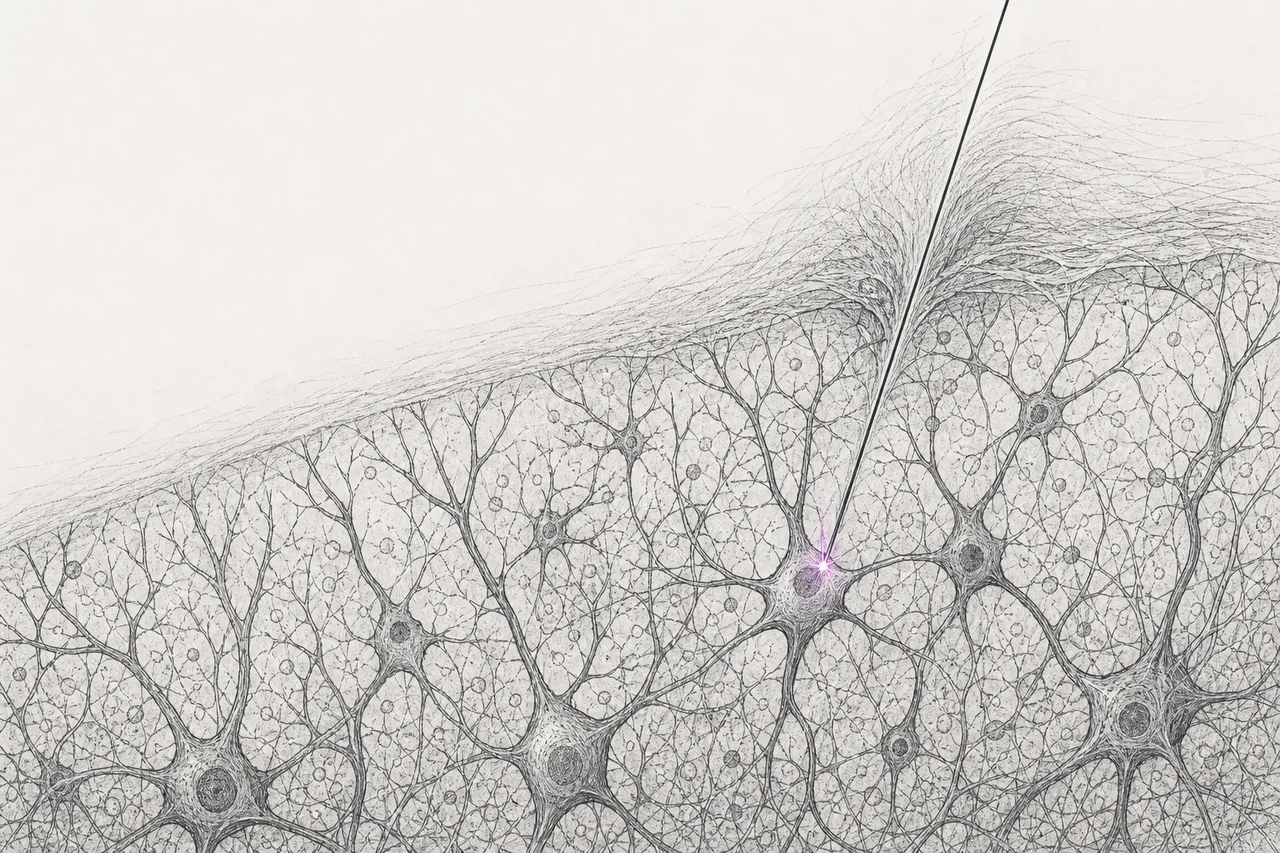
01What it is
When people talk about a "brain implant chip," we usually picture a famous brand like Neuralink. But really, one BCI is made of several layers, and the layer that actually touches brain tissue is a set of small parts with the technical name "implantable neural electrodes & sensing components" — this node is about those parts.
They are: a tiny electrode (microelectrode) that acts as the "ear," listening for a neuron's electrical sparks; a biocompatible material the body won't reject; a hermetic packaging that keeps body fluid from seeping in and destroying the electronics; and an amplifier chip (ASIC) that amplifies and converts the signal right there on the spot. On the megatrend map, this node is a sub-theme under Brain-Computer Interface, sitting in the supply-chain layer — it's the "hardware raw material" that every BCI brand has to assemble into a device.
Microelectrode = a micron-scale electrode used to "touch" a neuron to read or stimulate it · Biocompatible = a material that can sit inside the body without being toxic or being violently rejected · Hermetic packaging = sealing the electronics shut against moisture (the human body is a "warm saline" environment that corrodes things) · ASIC = a chip designed for one specific job — here, amplifying and converting the neural signal right where it's recorded
Put simply, if a BCI is a "camera for thoughts," this layer is the lens and image sensor — the part that decides whether the image is sharp or blurry, and how long it lasts before it fails.
02Why it matters — the "pick-and-shovel" logic
In the California gold rush, the people who really got rich mostly weren't the ones digging for gold — they were the ones selling picks, shovels, and jeans to the diggers. Because whether anyone struck gold or went bust, the gear seller got paid by every customer. This same logic is the heart of this node.
Today, nobody knows which BCI brand will win — Neuralink, Synchron, Precision Neuroscience, or one not yet born. But every brand needs the same durable electrodes, materials, and packaging. Whoever can make these parts well and make them last has a shot at winning no matter which end brand comes out on top.
And here's where this logic is especially strong: these very same parts already have a big, genuinely profitable market "today" — the market for neuromodulation, such as spinal-cord stimulators for chronic pain and deep brain stimulation (DBS) for Parkinson's. These devices use the exact same wires, electrodes, batteries, and sealed packaging as BCI. That market is on the order of ~$11 billion (implantable neurostim devices only) to ~$21 billion (the whole category) in 2026 — compared with the still-tiny market for BCI implant chips.
That means component makers don't have to wait for BCI to grow before they have revenue — they feed themselves on the already-mature neuromodulation market and then sell into BCI gradually as it grows. This is why the components layer is more interesting than many people think.
03How it works — and the 3 hardest problems
Start with what we want to "hear." When a single neuron "fires" a signal (called a spike, or action potential), it creates a truly tiny electric current — at the tip of the electrode, you can only measure it at the microvolt (µV) level, about one-millionth of a AA battery. The job of these parts is to catch a signal this small, amid all the surrounding "noise," and send it out clearly.
The sequence is simple in a diagram, but each step hides a brutal engineering problem:
Problem 1 — the electrode material has to be "steady and quiet." A microvolt-level signal means even a sliver of noise can drown it out. So the electrode has to be made of a material that conducts well, stores a lot of charge, and doesn't corrode in the body. The favorite materials are platinum-iridium (Pt-Ir) and a coating of iridium oxide (IrOx), which store more charge and resist corrosion better than cheap metals like tungsten or stainless steel.
Problem 2 — the packaging has to stay perfectly watertight for a decade. The human body is a "warm saline" that slowly seeps into every crevice. The moment moisture reaches the electronics, the device fails. That's why hermetic packaging and the sealed wire pass-through (feedthrough) are core technologies — and why companies that have made cardiac/neural stimulators for decades have an enormous edge.
Problem 3 — and this is the one still unsolved: scar tissue in the brain. The instant you insert something foreign into the brain, the body sees it as an enemy and starts "building a wall" around it with glial cells (a glial scar). This process is called the foreign-body response (FBR). The result is a thin layer of insulation between the electrode and the neurons, so the signal slowly fades and the electrical resistance slowly climbs over time — a signal that was sharp in the first month may vanish months or years later.
When a foreign object is embedded in brain tissue, immune cells and glial cells wrap it in a "scar" to wall it off from healthy tissue. This wall blocks the passage of charge, making the readable signal worse and worse over time — the main reason an implanted electrode "degrades" with time, and a problem researchers believe is still unsolved.
The fix being researched is to make the electrode "blend into the brain" as much as possible — smaller and softer (using a flexible polymer like polyimide instead of a rigid needle) so the body resists it less. This is why Neuralink uses polyimide "threads" thinner than a hair, instead of the old rigid needle.
04Where it sits in BCI
This node is the components layer of the BCI ecosystem — the hardware foundation the other layers have to build on top of. Here's the big picture, seen through its siblings under Brain-Computer Interface:
- Feeds Invasive BCI Systems directly: every deep-implant BCI system is built from this node's electrodes and parts — the most straightforward "supplier ↔ assembler" relationship there is
- Uses the same base as Neuromodulation: neurostimulators that treat disease use the same wires, electrodes, and sealed packaging — this is the "market today" that feeds the suppliers
- Hands off to Neural Signal Processing: the raw signal the electrode catches and the chip amplifies gets sent up to the processing/decoding layer, where AI turns it into commands
Critically, the ASIC that amplifies and converts the signal on the spot is exactly where BCI meets Semiconductors — a neural-recording chip has to amplify thousands of microvolt channels at once, at very low power (otherwise it gets hot enough to destroy brain tissue). This is a specialized, hard piece of analog chip design.
05Where it stands now
The reality in 2026 has two sides worth saying plainly.
The advancing side: channel counts have shot up. New-generation electrodes capture signals in far more detail, into the thousands of channels. The clearest example is Neuralink, whose N1 implant packs 1,024 electrodes across 64 polyimide threads (each thinner than a hair), cramming the whole system into a part roughly 23×18.5×2 mm, and reporting that it can capture spikes from about 70% of the electrodes in long-term animal trials — a leap from older technology with only a few hundred channels.
The side still stuck: most of the parts are made in-house at private companies + the degradation problem remains. Right now several leading BCI companies (Neuralink, Precision) make the electrodes and key parts themselves and are private companies not yet on the stock market. So the path to "invest in the components layer" through public stocks mostly goes the long way around — through medical-device makers that produce implantable parts, and contract manufacturers (CDMOs) that supply both the neuromodulation market and BCI.
06The road ahead
The first direction is "blend in better, last longer." Most research aims to make the electrode smaller, softer, and coated with a tissue-mimicking material (biomimetic coating) to reduce scarring. If anyone truly solves the FBR — keeping the signal stable for decades — that's the turning point that unlocks long-term commercial BCI for the whole industry.
The second direction is more channels and more wireless. The goal is to record from tens or hundreds of thousands of neurons at once, sending data out wirelessly and charging wirelessly, to cut the "wire through the skin" that's an infection risk. And that will only pressure the ASIC to do more processing on-device and burn less power.
The third direction is borrowing power from an already-grown market. Because the same set of parts can sell into neuromodulation, a market worth tens of billions, the makers have the capital and proven production lines to "upgrade" into BCI as it grows — unlike a startup that has to build everything from scratch.
07Challenges & risks
The first and biggest risk is that the biological-durability problem is still "unsolved." Let's be clear: as of today, nobody can reliably make an implanted electrode that delivers a stable signal for decades. The foreign-body response and the resistance that climbs over time are a real wall that research around the world is still hitting. If it isn't solved, the long-term BCI dream hits a ceiling.
The second risk is that the volume of BCI today is still tiny. The market for BCI implant chips actually being sold is still in the low billions, and most of it is still in clinical trials. So component makers' "real" revenue today comes mainly from the neuromodulation market — anyone investing purely on a BCI boom needs to understand it's still a thing of the future, not the present.
The third risk is that the cutting-edge parts are made in-house at private companies. When the leading BCI brands make their own electrodes, the value of the sharpest part may not reach public suppliers. And many of the key upstream material suppliers (such as Heraeus) are private too, leaving a limited "pure investment route" into this layer through the stock market.
The fourth risk is regulation and safety. Anything implanted in the brain has to pass strict, time-consuming approval. A single safety event (a wire coming loose, an infection, an electrode degrading until it has to be surgically removed) could shake confidence across the whole industry — this is an arena where "slow but sure" tends to beat "fast but risky."
In short: this node is the story of tiny parts that have to go and work in the harshest environment an engineer has ever faced — a living human brain. Whoever can keep these parts durable and quiet long enough will be the one laying the foundation for the whole BCI industry. And that's why this seemingly boring "pick-and-shovel" layer may be the single most important gate of the brain-computer revolution.