Megatrend · Longevity
The weight-loss shot that accidentally became the closest thing we have to an "anti-aging drug"
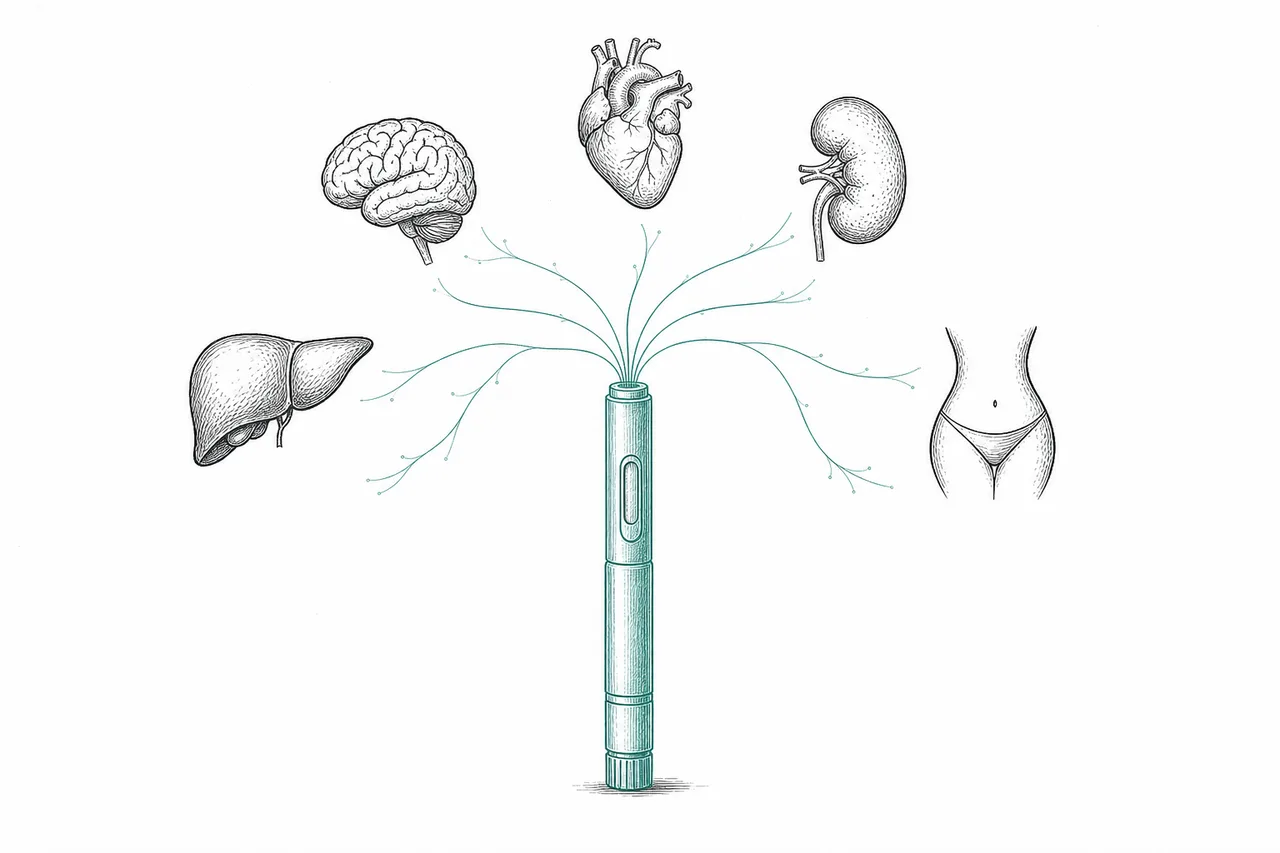
Ozempic, Wegovy, Mounjaro, Zepbound — we remember them as "skinny shots." But from the anti-aging world's angle, the story gets far more remarkable. This group of GLP-1 drugs is the closest thing humans have ever had to a provable "healthspan drug" — not because it's marketed as anti-aging, but because large trials found that a single drug lowers the risk of several diseases of old age at once: heart, kidney, liver, even sleep. This lesson tells that story through the longevity lens — and it'll be honest that it's not yet a miracle drug.
01What it is
Let's start with what everyone knows — Ozempic and Wegovy (the drug semaglutide from Novo Nordisk), and Mounjaro and Zepbound (tirzepatide from Eli Lilly) are injectables that let people lose more weight than ever before. They became famous as "skinny shots" and set off a global craze. But this lesson is not about losing weight.
This node — GLP-1 Healthspan Proxies — is a sub-theme under the megatrend Longevity & Life Extension, and the word "proxy" (a stand-in) is the key. The real home of GLP-1 drugs is in Biotech & Genomic Medicine and the world of diabetes and obesity — here we look at them through a longevity lens instead. The question isn't "how much weight do they take off," it's "do they let people grow old in good health for longer?"
Why call it a "proxy for healthspan"? Because of all the anti-aging approaches, most can still only be proven in mice or remain stuck in a test tube. But GLP-1 is the only group that's already approved, actually on sale, and backed by trials in tens of thousands of people showing it lowers the risk of several age-related diseases at once — the closest thing to a "healthspan drug" we have today. Not because it was designed to fight aging, but because it just happens to.
Lifespan = how many years you live · Healthspan = the years you're still "healthy" and free of chronic disease — the real goal of the longevity field is to extend healthspan, not just stretch out time alive · GLP-1 is a gut hormone released after you eat. These drugs are "mimics" of that hormone (GLP-1 receptor agonists) that keep working for days per shot.
02Why it matters — one drug, but it suppresses several diseases of old age at once
The heart of this is an idea in the longevity field called "compression of morbidity" — instead of treating each disease of old age after it shows up, we want something that suppresses the risk of several diseases at once, so people get sick later and stay sick for a shorter stretch at the end. And this is exactly what the GLP-1 data is starting to show.
The evidence that changed everything is Novo Nordisk's SELECT trial — it gave semaglutide to 17,604 people in 41 countries who were overweight/obese with existing heart disease but not diabetic. The result: it cut the risk of "major cardiovascular events" (heart attack, stroke, death from the heart) by 20% — and here's the key: this benefit didn't come from weight loss alone. It started showing in the first 3–6 months, before much weight came off — meaning the drug does something directly to the blood vessels and inflammation.
But what makes it truly a healthspan story is that it doesn't stop at the heart. The FLOW trial found that semaglutide cut the risk of "major kidney failure events" by 24% and lowered all-cause death by 20% in people with declining kidney function. Then came a string of FDA approvals in under a year: kidney decline in diabetic patients (Jan 2025), sleep apnea (Zepbound, Dec 2024 — the world's first drug for it), and severe fatty-liver disease MASH (Wegovy, Aug 2025 — the first indication that doesn't require an obesity diagnosis).
Step back and you see this is one drug lowering the risk of heart, kidney, liver, and sleep — all of them "diseases of old age." That's why longevity scientists started asking a bigger question: if a single drug can suppress this many diseases at once, is it "slowing aging" itself?
03How it works — suppressing several risks from one place
Picture it simply first. After you eat, your gut releases the hormone GLP-1 to tell your body "you're full now" — it signals the pancreas to release just the right amount of insulin, tells the brain you're full, and slows the stomach's digestion. GLP-1 drugs "mimic" this hormone, but they keep working for weeks per shot instead of vanishing in minutes like the natural hormone.
The straightforward result is eat less + burn better → weight drops. In the SURMOUNT-1 trial, tirzepatide produced an average 22.5% weight loss (top dose), and 63% of people lost more than 20% of their body weight — numbers that used to require stomach surgery.
But what makes it a healthspan story isn't just the scale — because GLP-1 receptors aren't only in the stomach, they're all over the body: in blood vessels, kidneys, liver, and brain. So when the drug works, it lowers inflammation, tunes metabolism, and cuts visceral fat (the bad fat that drives chronic disease) — in several places at once. This is why the heart benefit starts showing before much weight comes off.
Visceral fat = the fat wrapping the organs in your abdomen (different from fat under the skin). It drives chronic inflammation and diseases of old age, and GLP-1 is especially good at cutting it · Compression of morbidity = the idea that the goal of longevity isn't just to stretch your lifespan, but to shorten the "chronically sick" stretch before death — get sick later, stay sick shorter.
04Where it sits in the Longevity world
The megatrend Longevity & Life Extension has 7 approaches trying to slow aging, and almost all are still experimental — cellular reprogramming (Cellular Reprogramming), clearing out senescent cells (Senolytics), NAD+, and so on are all exciting but unproven in humans. What makes GLP-1 special is that it's the only approach in the group that's "already approved, actually on sale, and backed by evidence in tens of thousands of people" — so it's like a "proof of concept" that one drug really can suppress several diseases of old age.
- A close cousin of Metabolic Aging & Geroprotectors: that field uses old, cheap drugs (metformin, rapamycin) to "trick the food switch" into making the body think it's fasting — GLP-1 works through a similar metabolic system, but there's an important business difference: GLP-1 is still patented and makes enormous money, so companies will pay for trials of tens of thousands, while geroprotectors are generics no one wants to pay to prove
- Leans on Longevity Diagnostics & Aging Clocks to prove the "age" part: to claim a drug slows aging (not just weight), you need a "biological clock" to measure it — small studies found semaglutide cut "biological age" by 3–5 years in specific patient groups, but it's still preliminary data
- Feeds Longevity Clinics & Healthspan Services: anti-aging clinics worldwide increasingly prescribe GLP-1 to clients for healthspan, turning it into a key revenue stream for the clinic industry
- Sits on the foundation of Biotech & Genomic Medicine: this is the drug's "real home." Designing next-gen peptides (oral instead of injectable, dual GIP/GLP-1 agonists) is all the work of Biotech
- Complements Aging Population: the world is aging and the cost of treating seniors' chronic disease is soaring — a drug that lowers several diseases at once has enormous economic value at the public-health system level
Note the important difference: while geroprotectors are caught in the "good for people but hard to monetize" trap, GLP-1 is the opposite case — it made enormous money first, then accidentally turned out to work for longevity. That commercial success is exactly what pays for the giant trials, making it the best-evidenced anti-aging approach there is.
05Where things stand now & who the players are
Right now the GLP-1 market is exploding wide open. Its value is estimated broadly because it's growing so fast, but the big picture is going from about $50–58 billion in 2025–26 to roughly $130–180 billion in 2035 (CAGR ~9–18% depending on the firm) — one of the largest drug groups in the history of the pharma industry, with almost the whole market held by two companies.
The biggest bet from the longevity angle — proving the "brain" effect — just stumbled. The phase 3 EVOKE/EVOKE+ trial testing semaglutide in early Alzheimer's couldn't beat placebo at slowing the disease's progression (even though some biological markers improved). It's an important warning that "suppressing the risk of several diseases" isn't the same as "curing every disease" — the brain is still a fortress that hasn't been conquered.

The new battleground is the "oral" pill instead of the injection, because it'll be easier to make and reach far more people — and this is exactly where new challengers start to get a foothold:
Beyond these four, Pfizer and Roche have jumped into the arena too (Roche bought a company to get into this market), along with contract manufacturers (CDMOs) and makers of injection pens/needles — the "pick-and-shovel" sellers who win no matter who comes out on top, because demand to manufacture this group of drugs is outstripping the world's production capacity.
06The road ahead
The first direction is "oral pills + wider gaps between shots" = vastly broader access. When orforglipron (Lilly) and oral Wegovy (Novo) hit the market, prices will fall, manufacturing gets easier, and the hundreds of millions who don't want to inject can finally reach it — if it really lowers the risk of age-related diseases at this scale, the effect on population-level healthspan would be enormous.
The second direction is proving "biological age" systematically. If the aging clocks field can measure accurately enough, and trials are designed to measure "aging" directly (not just one specific disease), we might get a real answer to whether GLP-1 slows aging — right now we only have indirect signals.
The third direction is fixing the muscle weakness. Companies are developing next-gen drugs that cut fat but preserve muscle (like ones paired with anti-myostatin agents), because losing muscle mass is a serious risk for seniors — if they solve it, GLP-1 moves one step closer to being a "true healthspan drug."
07Challenges & risks (straight up)
Before getting too excited, you have to look with a cool eye, because even the "anti-aging drug closest to reality" is still full of limits.

The first and most important risk — it hasn't been proven to extend "lifespan". What's proven is that it lowers the risk of several diseases (healthspan), which is great, but that's not the same as making people live longer. Anyone selling GLP-1 as an "immortality drug" is talking beyond the evidence — and EVOKE (Alzheimer's) failing is a reminder that it's not a magic drug that suppresses every disease.
The second risk is "loss of muscle mass". When weight drops fast, part of what's lost is muscle, not just fat — which runs against the longevity goal, because strong muscle is the heart of aging well (preventing falls, preserving metabolism). It has to be paired with weight training and enough protein, not just the drug alone.
The third risk is "taking it forever + side effects + price/access". When you stop the drug, weight and risk usually come back (trials saw weight return on stopping), meaning this is lifelong treatment. Gastrointestinal side effects (nausea, vomiting) are too much for many people to tolerate (Viking saw ~28% stop the drug), and most importantly, the price is still high and access is unequal — so the healthspan-level benefit remains concentrated among those who can afford it.
In short: the charm of this node is that it flips expectations — the anti-aging approach closest to reality didn't come out of a cutting-edge longevity lab, but from a "weight-loss drug" that made enormous money and then accidentally turned out to suppress several diseases of old age at once. Understanding this node means understanding that sometimes a field's biggest advance walks in through the back door of another field.