Megatrend · Space Economy
When NASA stopped flying itself and started paying private companies to “deliver cargo” to the Moon
Humans are going back to the Moon — but this time the model has changed completely. Instead of building every spacecraft itself, NASA now “buys a delivery service” from private companies, paying a fixed price and only when the cargo arrives. This is the start of a new economy: the business of shipping things to the Moon. It's still in its very first days, failing more often than it succeeds, and almost all the money still comes from the government — but the prize at the end has a name: “lunar ice.”
01What is it?
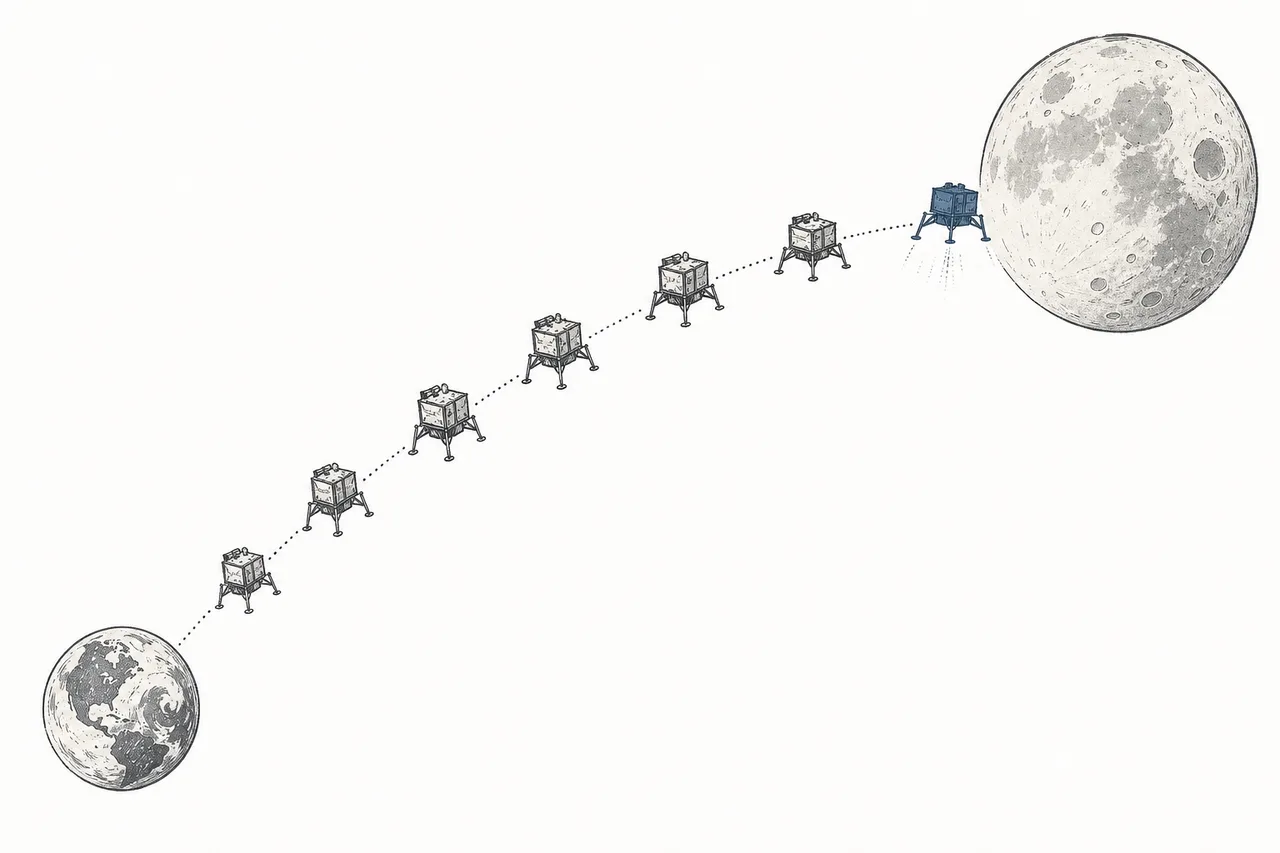
Picture the Moon getting its own “parcel delivery service.” You've got something you want to place on the lunar surface — a camera, an instrument, an exploration robot — and there's a company that takes your cargo, puts it on a rocket, lands it, and gets it there. That's what this node is about: the logistics of the Moon and of cislunar space (the region between Earth and the Moon).
It's about building a “supply chain” to and around the Moon — from the landers that touch cargo down, to the cislunar transports that run between Earth orbit and the Moon, to the communications and navigation systems around the Moon (like GPS and cell towers, but for the Moon). And the distant endpoint: mining resources on the Moon to use.
From cis- (“on this side of”) + lunar (“the Moon”) — literally “the region between Earth and the Moon.” It's a roughly 400,000-kilometer stretch of space beyond the usual satellite orbits but short of the other planets. This is the new “backyard” the space economy is expanding into.
On the megatrend map, this node is a sub-branch of Space Economy. Its definition is clear: “commercial transport, landers, and infrastructure for the Earth–Moon system, anchored by NASA's CLPS program.” That word CLPS is the key to the whole story — and we'll dig into it in the next chapter.
02Why it matters — a new road to the Moon
Humans haven't set foot on the Moon in over 50 years. The last time was Apollo 17 in 1972. Throughout the Apollo era, the U.S. government did everything itself — design, build, fly — on a scale of spending that simply couldn't be repeated. When the missions ended, the road to the Moon was left abandoned.
Today humans are going back, through NASA's Artemis program. But what's really changed isn't just “going back” — it's the way they're going back. NASA decided it would no longer build the small cargo landers itself, and would instead “buy the service” from the private sector — the way a company doesn't need its own trucks and just hires DHL to ship.
This is the birth of an entirely new market — “delivery to the Moon” that suddenly has a paying customer (the government) and private companies competing for the work. The market is still small but growing fast. Several research firms put the value of cislunar infrastructure at around $4 billion in 2023, growing to ~$10 billion by about 2030 (~13% a year). And in the bigger picture, the whole space economy could reach $2 trillion by 2040.
Why does this matter to the world economy? Because it turns the Moon from a “symbolic goal” into a “market” — with buyers, sellers, prices, and competition. For the first time in history, private companies can actually earn revenue from “working on the Moon.”
03How the CLPS model works
The heart of this trend is a program called CLPS (Commercial Lunar Payload Services). Think of it as a “new kind of contract” rather than any single rocket.
The old model (Apollo-style): NASA designs and pays to build the spacecraft at every step. All the risk and cost land on the government. · The new model (CLPS): NASA simply announces, “I've got cargo I want sent to the Moon — who can deliver?” and pays a fixed price to the private company that wins the job. The company builds the craft itself, lands it itself, carries the risk itself — full payment if it arrives, eat the loss if it doesn't.
Why does this model matter? Because it turns “risk” into something the private sector owns. NASA openly admits many trips may fail — and accepts that, because it's far cheaper than doing it itself, with some cargo not arriving as the trade-off. This is “buying many cheap lottery tickets” instead of “building one expensive thing you can't afford to drop.”
The size of this wallet is growing. In April 2026, NASA announced it would raise the CLPS contract ceiling from $2.6 billion to $4.2 billion to handle the rising number of flights. So far, NASA has awarded 11 delivery trips to five companies, totaling more than 50 cargo items.
04Where it sits in the Space Economy
This node is one piece of Space Economy — and it's inseparably linked to the other pieces:
- It always depends on Launch Services & Propulsion first: to send cargo to the Moon, you first need a rocket to lift it off Earth. Almost every CLPS mission relies on cheaper rockets (like SpaceX's Falcon 9) as the first gate — if the cost of getting to space doesn't fall, the lunar economy can't happen
- It extends toward In-Space Manufacturing & Stations: the long-term goal is to “set up a foothold” on and around the Moon — the Gateway station orbiting the Moon, and factories/bases on the surface. Logistics is what makes those possible
- It paves the way for Human Spaceflight: before you send “people” to live there, you have to send “things” first — tools, supplies, navigation systems. Robotic delivery craft are the scouts that open the road for humans to follow
And it reaches beyond the Space Economy, too: it's tightly tied to Defense & Geopolitical Fragmentation (because whoever controls the Moon first carries strategic weight), it depends on Critical Materials & Supply Chain (both the materials to build the craft and the dream of lunar minerals), and it leans more and more on AI — because landing on the Moon happens too fast for anyone on Earth to control in time (the signal takes about 2.6 seconds round-trip), so the craft has to decide to land on its own, autonomously.
05Where it stands now
This is the chapter that has to be the most honest, because the truth is — landing on the Moon is still brutally hard, and most attempts still fail. Run through the CLPS-era scorecard:
- Astrobotic “Peregrine” (Jan 2024): a fuel tank leaked after leaving Earth, it never reached the Moon, and had to be burned up in Earth's atmosphere — failure
- Intuitive Machines “IM-1” (Feb 2024): it landed successfully, the first U.S. craft to touch the Moon in 52 years — but a leg broke and it tipped nearly on its side — partial success
- Firefly “Blue Ghost 1” (Mar 2, 2025): the first private craft to land fully upright, operating on the surface for over 14 days — full success. This is the milestone that “proved the model actually works”
- Intuitive Machines “IM-2 / Athena” (Mar 6, 2025): the altimeter failed, it landed off-target, tipped over inside a crater, and ran out of battery in under 24 hours — partial success / failure
- ispace “Resilience” (Jun 5, 2025): the laser ranging sensor malfunctioned and it slammed into the ground — the company's second miss (its first crashed in 2023) — failure
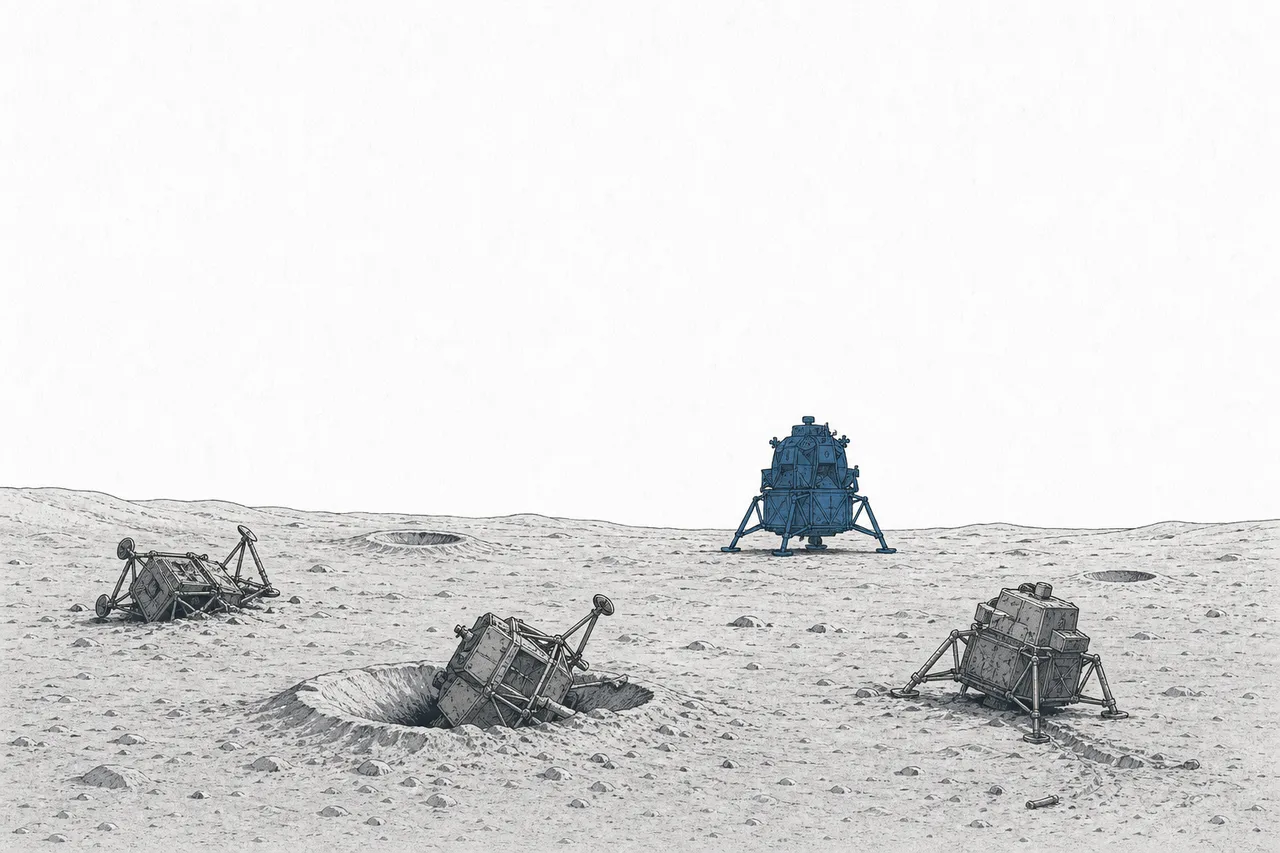
In short: of all the modern commercial landing attempts, only one (Blue Ghost 1) can be fully called a “clean success.” This is the real state of the trend — just starting, trial-and-error, with a very high price for getting it wrong. For 2026, NASA plans up to four landing missions from several players — a major test for the whole field.
So who are the real players? To be blunt, this trend is still “government-owned” at its core — almost all revenue comes from NASA contracts, and many of the players are still private companies that aren't on the stock market (like Astrobotic, Blue Origin). The ones that are listed still lose money and lean heavily on government work.
06The big prize: lunar ice + the U.S.–China race
Why invest so heavily in something that fails this often? Because at the end there are two big prizes worth the risk.
Prize one: ice At the Moon's south pole there are craters where sunlight never reaches, and hidden inside them is ice. It sounds ordinary, but in space, water is gold — because you can split water (H₂O) into hydrogen and oxygen, which is exactly rocket fuel.
The key here is the “cost of hauling things up from Earth.” Sending one kilogram of water from Earth to the Moon costs thousands of dollars. So if you can make fuel on the Moon itself, it's like having a “gas station” in the middle of space. Craft no longer have to carry all their fuel up from Earth, which changes the entire economics of space travel — this is what many call the “cislunar water economy,” and it could be the first serious business on the Moon.
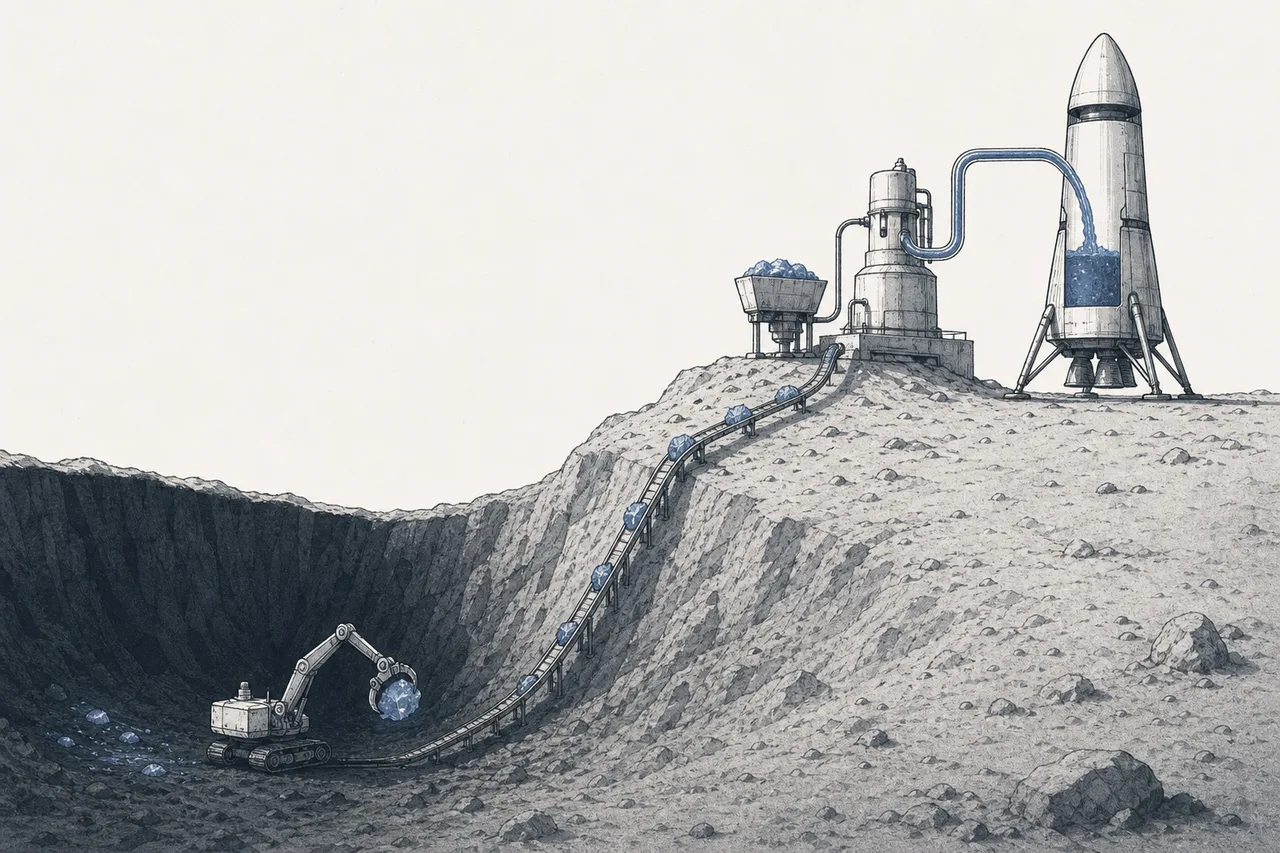
“Using resources in place” — the idea that instead of hauling everything up from Earth, you use what's already on the Moon (ice, soil, minerals) to make fuel, water, or building materials on the spot. This is the “holy grail” that would let a lunar base sustain itself — but it's still a thing of the future. No one has yet done it commercially.
Prize two (and the real driver): the U.S.–China race This isn't just about science — it's a geopolitical contest. On the U.S. side, through the Artemis program, the original plan was to land humans on the Moon in Artemis III in 2027. But in February 2026, NASA revised the plan — pushing the actual human landing to around 2028. Meanwhile, China aims to land its astronauts on the Moon by 2029–2030.
This race is why government money keeps flowing into the trend — because “who gets there first” carries enormous symbolic and strategic weight. And every robotic delivery flight today is laying the groundwork (testing landings, finding ice deposits, setting up communications) for the human race a few years out.
Another piece quietly taking shape is “the Moon's GPS and cell towers” — projects like ESA's Moonlight (five satellites: four for navigation, one for communications) and LunaNet (a shared NASA/ESA/JAXA standard) are about to build a permanent communications-and-navigation network around the Moon. The first relay satellite (Lunar Pathfinder) is set to start operating in 2026 — the “infrastructure” layer that every future mission will depend on.
07Challenges & risks
This is a trend where we have to talk about the risks as plainly as possible, because it's one of the most “just-getting-started” trends in the entire megatrend set.
Risk one — the technology is still brutally hard As we saw in Chapter 5, landing still fails most of the time. Every small mistake (a failed altimeter, a fuel leak) ends in the loss of an entire craft worth hundreds of millions of dollars. This isn't a business where you can easily “try and fix” — each attempt is expensive and slow.
Risk two — almost 100% reliant on government money This market still has almost no real “private customers.” Almost all revenue comes from NASA contracts. If the U.S. government budget gets cut, or political priorities shift (like the Artemis plan that's already been pushed back), the whole industry shakes immediately. This is still a “government-supported” economy, not one that can sustain itself.
Risk three — a very long horizon Big prizes like ice-and-fuel (ISRU) are a story for the next decade, not next year. Most companies in this group are still losing money and have to keep raising capital. People who come in expecting fast returns usually end up disappointed — this is an investment in a “long-term possibility” that may take another 10–20 years before we see a genuinely profitable lunar economy.
In short: we're watching the birth of a new industry in real time — the rawest, riskiest, most fall-prone phase. But it's also the phase laying the foundation of something that could be very big a generation from now. The CLPS model, where NASA pays private companies to deliver cargo, is a small seed that — if the ice prize is real — could one day grow into the “gas stations and ports” of the solar system. To understand this node is to understand how the human economy is stepping off this planet for the very first time.