Megatrend · Cloud & Digital Infrastructure
The three landlords who control the world's computers
Almost every app, website, and AI model you use runs on the machines of just three companies — Amazon (AWS), Microsoft (Azure), and Google Cloud. They're the "landlords" who rent out computing power to the whole world, and right now they're racing to invest at a scale business has never seen — nearly $725 billion in a single year — to build AI data centers fast enough to catch the biggest wave in tech history. This is the story of the oligopoly that props up the entire digital economy and all of AI.
01What it is — the big cloud landlords
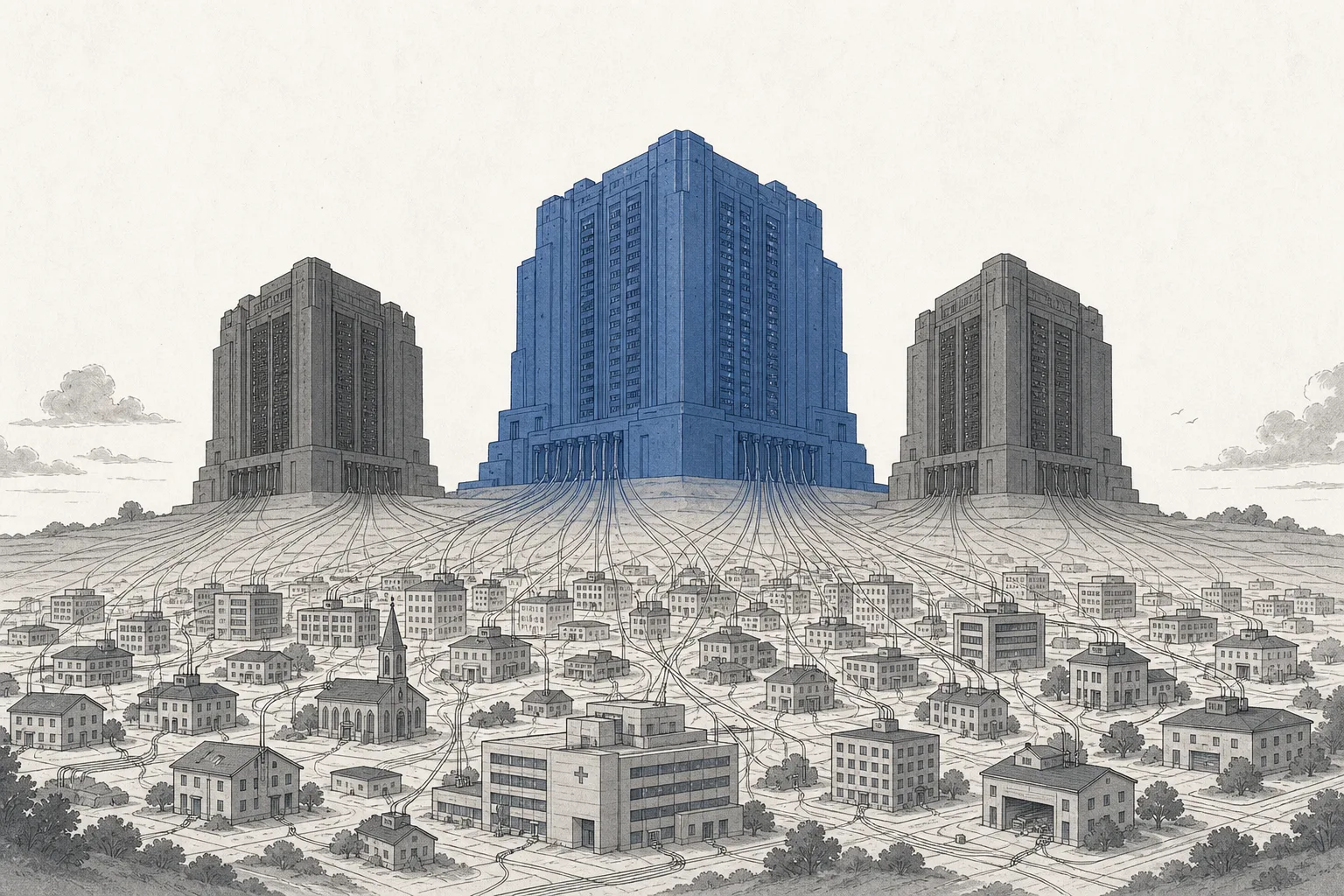
Imagine the world's computers weren't scattered across homes and companies, but pooled into a few giant warehouses — and anyone who wants to use one just "rents" it: order a thousand servers in the morning, hand them back in the evening, pay only for what you actually use. That's the cloud, and this node is about the owners of the biggest warehouses — the companies that build enormous data centers around the world and rent out the computing power to everyone.
The word "hyperscaler" means a provider operating at a scale an ordinary company simply can't match on its own — data centers with millions of servers, drawing as much power as a small city. And "mega-cap" is the biggest group within that: the Big Three — Amazon with AWS, Microsoft with Azure, and Alphabet with Google Cloud — plus rising challengers like Oracle and Chinese giants like Alibaba and Tencent. These aren't just tech companies; they're the "digital landlords" the whole world has to rent space from.
On the megatrend map, this node is the deepest branch under Hyperscale Cloud (IaaS / PaaS) within the big trend Cloud & Digital Infrastructure. It focuses specifically on the general-purpose cloud of the giants — the do-everything platform that sells "all of it, in one place." The sibling node right next door is Specialized / Developer Cloud, a smaller, specialized cloud aimed at developers and specific jobs — if you want the lean, compact challengers, that story lives in that node. This lesson stays focused on the "Big Three" that control the game.
The general-purpose cloud of the giants sells the two bottom layers · IaaS (Infrastructure-as-a-Service) = renting the "raw materials" — servers, storage, networking — like leasing bare land with utilities · PaaS (Platform-as-a-Service) = renting the "ready-made tools" that sit on top, like an auto-managed database or ready-to-use AI tools — so developers can build faster without assembling every piece themselves.
02Why it matters — the foundation of the digital economy and AI
The best way to understand why the cloud giants matter is to compare them to a power plant. A hundred years ago, every factory had to generate its own electricity — until a central "power grid" let you plug in and draw power. Factories stopped generating their own and focused on making products instead. The three cloud giants are that same "grid," but they deliver computing power. And because nearly every digital business in the world has to plug into this grid, whoever controls it controls the "toll" on the entire digital economy.
The scale of this grid is enormous and accelerating. In Q1 2026, the world spent about $119 billion on cloud infrastructure — in three months. Even more striking is the concentration: the Big Three together hold about 68% of the global market — AWS at ~30% in the lead, followed by Azure at ~25% and Google Cloud at ~13%. This is a true oligopoly: a market where a few large players hold near-total control.
Just as important as the size is that it's a profit machine for the tech giants. Take AWS: in Q1 2026 it earned $37.6 billion in revenue and $14.2 billion in operating profit — a margin of about 38%, high enough to be Amazon's main profit engine, even as the better-known retail business runs on razor-thin margins. Put simply, the seemingly ordinary business of "renting out machines" turns out to be surprisingly profitable, because once you're big enough, the cost per unit keeps dropping.
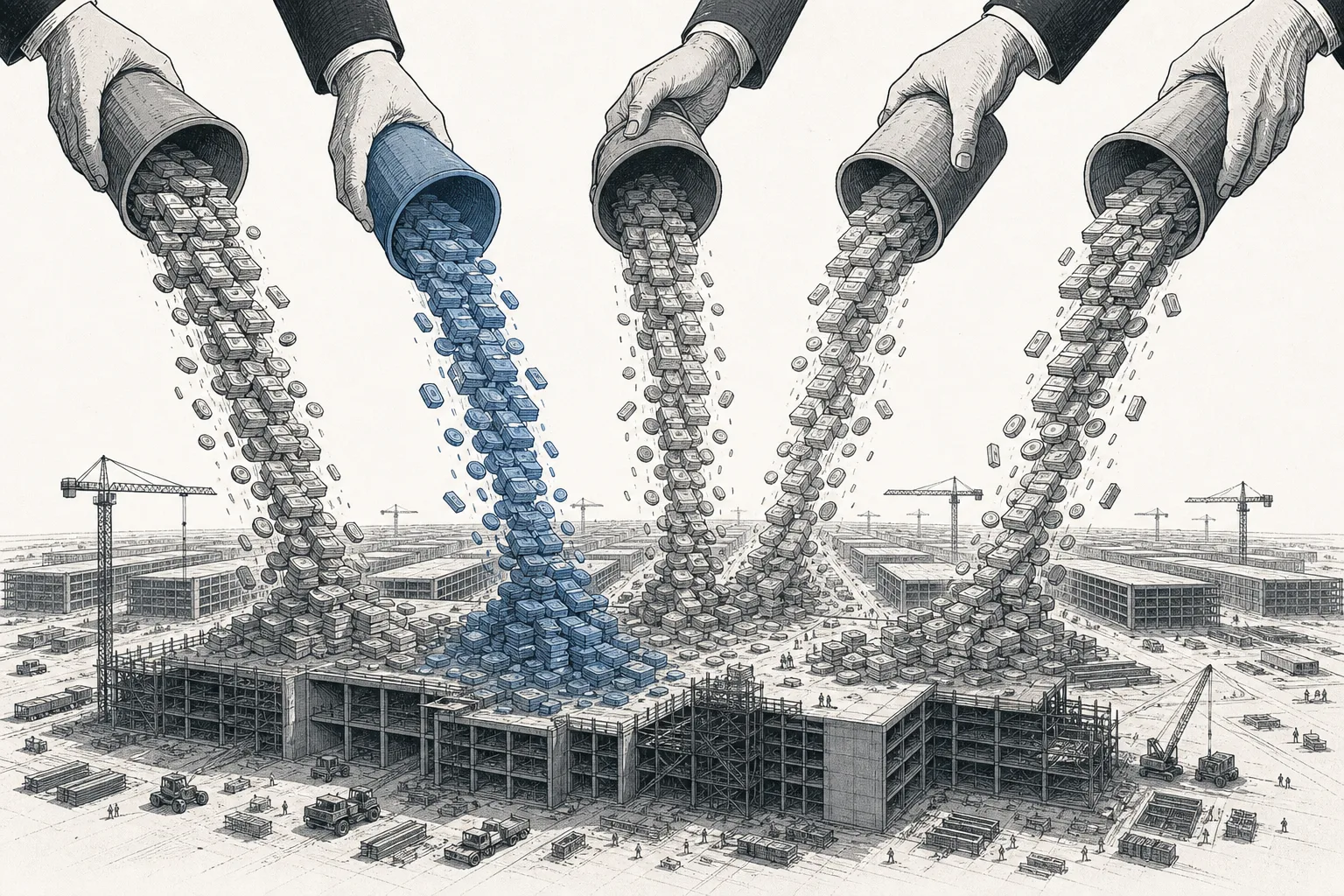
And this is exactly why their investment has become macroeconomic news. Because the AI wave demands enormous data centers and chips, the three giants (plus Meta) plan to pour in nearly $725 billion combined in 2026 — up about 77% from the year before, with roughly 75% going directly into AI infrastructure. This is one of the biggest investment races in business history — big enough to ripple through stock prices, electricity prices, and the world's chip supply chain.
03How it works — from data center to customer
Behind the simple-sounding phrase "renting the cloud" is a structure stacked in layers, from the real concrete building all the way up to the button you click in your browser. Let's walk from the bottom up, one layer at a time, to see how the cloud giants turn "a huge pile of machines" into "a service you turn on like a tap."
The heart of what makes this model so profitable is the virtualization layer and pay-as-you-go pricing. One physical machine is sliced up so many customers can rent it at once; run a server for ten hours and you pay for ten hours, shut it off and the billing stops. So two founders in a bedroom can reach the same level of computing power as a big bank — just open a credit card and start. And the more customers a cloud giant has, the more fully its machines are used and the lower the cost per unit drops — a cycle where the big keep gaining an edge over the small.
Another charm that makes customers "stick" is an unusually strong moat. Once a company puts terabytes of data onto one cloud, moving it out is expensive and painful (providers charge a lot to "egress" data out, but bring it in for free). And the deeper an engineering team writes its apps to rely on that provider's specific tools, the more migrating means rewriting almost everything — this is why the cloud giants' profits are unusually "durable," not just because they're big, but because customers find it hard to leave.
04How it connects in the ecosystem
The cloud giants don't stand alone — they're the "floor" that almost every digital trend is built on, and at the same time a "major customer" ordering from upstream. Let's look at how they intertwine with other trends.
- Intertwined with AI in a single spiral: modern AI has to run on the cloud, and AI demand is the engine that ignited the cloud's renewed growth — an inseparable two-way relationship. The cloud giants are the ones selling AI power to the world, and the profit from cloud is the money poured back into AI
- Buying Semiconductors by the mountain: every data center is a pile of chips — GPUs, CPUs, memory. Every cloud expansion is a giant chip order, which makes the cloud giants the chip industry's biggest customers and the ones setting the rhythm of the global chip cycle
- Different from specialized clouds: the Big Three sell "all of it, in one place" — hundreds of services to assemble, while specialized clouds sell "simplicity" and predictable pricing, suited to developers who don't want to drown in the giants' menu of a hundred options — the two worlds split different customer groups between them
- Heavily dependent on energy: AI data centers consume so much power they've become a new factor straining whole national grids — in some places, electricity limits have become a bigger cap on cloud expansion than money or chips
05Where it stands now
The biggest story of 2025–2026 is "AI reigniting the cloud." Many had feared the cloud was fully grown, but the AI wave flipped everything — and what's interesting is that the rankings are starting to shift. AWS is still number one, with growth accelerating to ~28% (its fastest in 15 quarters), reaching a run-rate of about $150 billion a year, while Azure grew ~40% and Google Cloud surged hardest at ~63% — the smaller ones grow faster off a lower base, but all three accelerated together because of AI.
The proof that demand is real is in the signed, contracted backlog (backlog/RPO) — money customers have committed to pay in the future. Microsoft has a commercial RPO as high as about $627 billion (roughly 45% from its OpenAI contract), while Google Cloud has a backlog of about $240 billion on a run-rate of ~$70 billion in revenue — these numbers are "money already in the queue," showing the enormous investment has real orders behind it, not just building on spec.
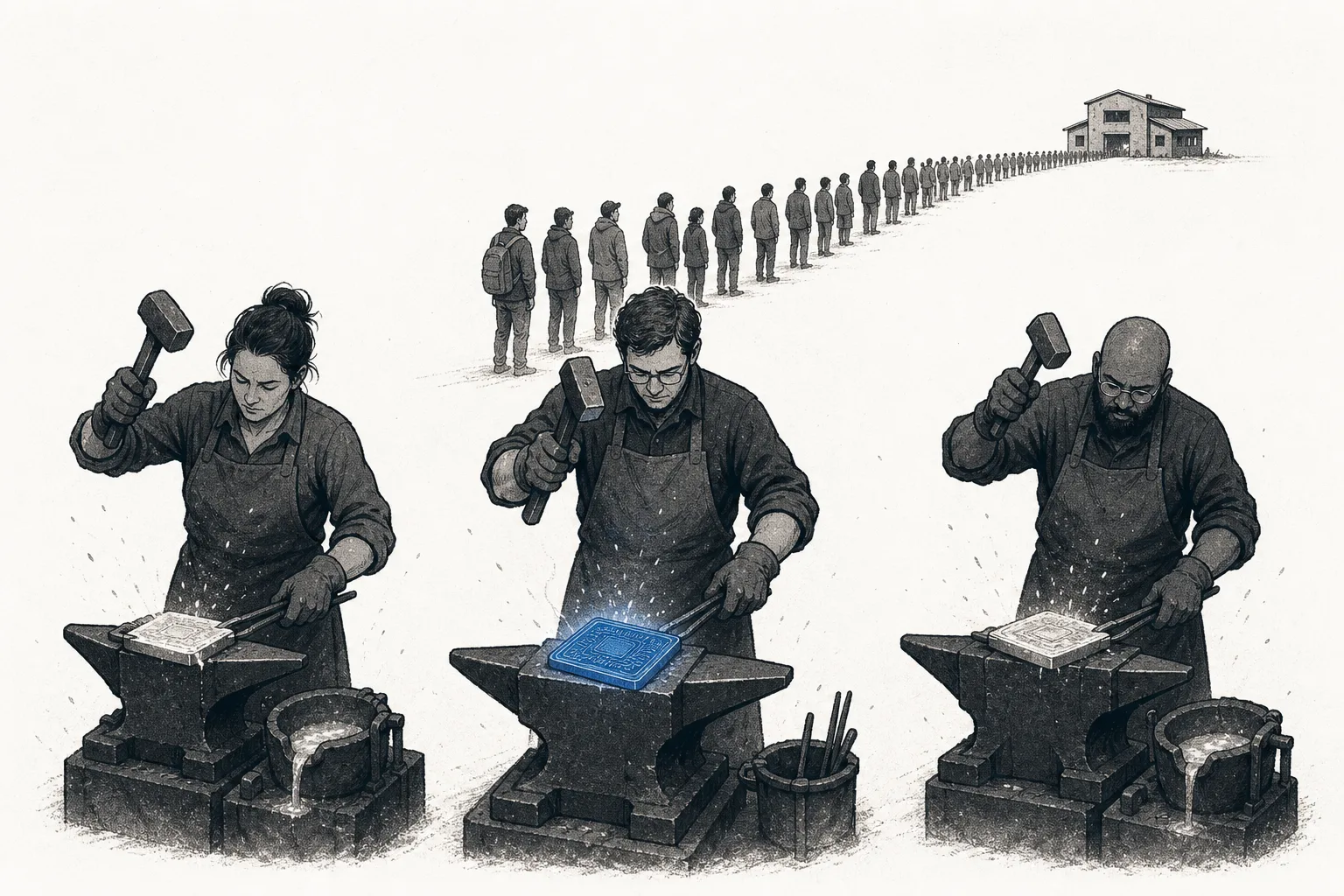
The hottest new battlefield is custom silicon. All three are racing to design their own AI chips to reduce their dependence on Nvidia, which takes a big slice of the profit — Amazon has Trainium (claimed to cut training costs 30–50% versus GPUs), Google has TPU (latest version named Ironwood), and Microsoft has Maia. This is the cloud shifting from "chip buyer" to partly "chip maker" — the more you control your own chips, the more you control cost and profit.
The challengers are lively too. Oracle (OCI), once seen as having missed the cloud train, has come roaring back with giant AI contracts that pushed its backlog past hundreds of billions of dollars. On the Chinese side, Alibaba Cloud dominates its home market and Tencent is another pillar of Chinese cloud — but in the global market, the game still belongs to the three American giants, who lead by a wide margin.
06The road ahead
The first direction is that the cloud becomes ever more "about AI." The main battlefield is shifting from "who rents servers cheapest" to "who has the best AI power and tools." Google Cloud and Oracle accelerated hard because of big AI deals, not the old kind of cloud. Whoever wins at the AI layer wins the whole cloud, because customers choose the provider that runs AI best and then put their other work in the same place.
The second direction is that custom silicon becomes the deciding factor. When the cloud's biggest cost is AI chips, whoever designs their own chips well (Trainium / TPU / Maia) has a lower cost per unit and fatter margins than rivals still paying full price for GPUs. Investing in chip design today is building the "moat" of profit five years out — and it's why the Big Three pour in vast sums even while remaining Nvidia's biggest customers.
The third direction is "data sovereignty" (sovereign cloud). Many countries, especially in Europe, are growing worried that their national data sits on American or Chinese clouds, and are pushing for clouds that store data domestically under local law. The Big Three are racing to build region-by-region data centers to meet this trend — geopolitics is becoming a factor in who wins which customers, not just price and technology anymore.
07Challenges & risks
The charm of the cloud giants — fat profits, sticky customers, accelerating growth — comes paired with risks baked into their very structure.
The first risk is investment so heavy it eats into profit (capex ROI). When every giant races to pour in nearly $725 billion a year combined, enormous depreciation and interest costs follow and squeeze future profit. The question Wall Street is asking louder and louder is, "Will real AI demand be worth the money poured in?" If it is, this is a multi-year supercycle, but if demand doesn't keep up with the investment, we could see overcapacity and squeezed margins.
The second risk is power and the grid. AI data centers consume so much electricity they're hitting the ceiling of grid capacity. In many areas, getting a power connection takes 4–10 years while a data center is built in 2–3 — power has become a real bottleneck slowing expansion. In 2026, there's also political pressure over electricity getting more expensive because of data centers, forcing every giant to promise to build or buy their own power for new centers — a new cost that was never in the old equation.
The third risk is concentration and the regulators' gaze. When the infrastructure of the entire internet is in the hands of just a few companies, an outage at a single data center can take down thousands of websites and apps at once (it's happened many times). On top of that, both the U.S. and Europe are starting to scrutinize monopoly, vendor lock-in, and "circular financing" — deals where tech giants invest in AI startups that turn around and rent their own cloud, making revenue look inflated in a circle — a policy and confidence risk that weighs on the whole group.
In short: this node is the three landlords who rent out computing to the whole world, becoming the foundation that the entire digital economy and AI are stacked on. What was once seen as fully grown suddenly came back as the hottest battlefield of the AI era — and understanding "who controls the tap that supplies power to the whole digital world" is understanding why this small node wields influence far beyond its size.