Megatrend · Critical Materials
You can mine the ore anywhere — but only a few places can “cook” it into battery metal
The nickel and cobalt that leave a mine aren't metal yet — they're wet laterite rock with only about 1–2% nickel in them. To end up in an EV battery, that rock first has to pass through giant plants that melt it or cook it in high-pressure acid until it becomes pure metal. And this “midstream” step the world overlooks is shockingly concentrated — Indonesia refines over 60% of the world's nickel, and China controls nearly 80% of cobalt refining. This is the real chokepoint of the battery-metal chain — and it runs on coal and leaves behind mountains of toxic waste.
01What nickel-cobalt smelting and refining are
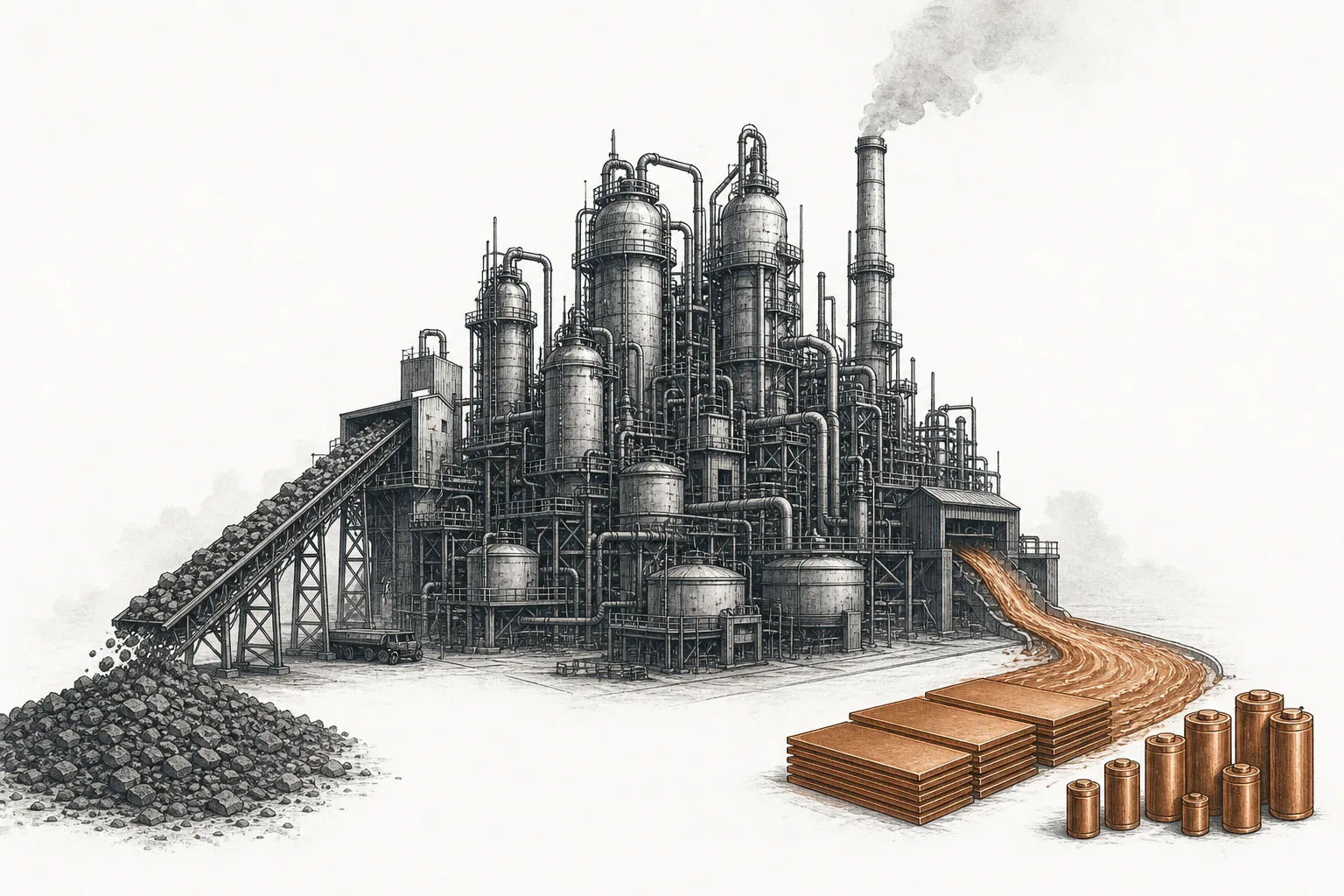
When we talk about nickel, we usually picture the red open-pit mines of Indonesia or the Philippines. But what comes out of those mines can't be used for anything yet — it's a wet “laterite” rock with only about 1–2% nickel in it; the rest is iron, magnesium, and other dirt. You can't put it straight into a battery or make stainless steel from it.
The players who turn that rock into “real metal” are the smelters and refineries — the midstream businesses that take ore from mines, melt it at high heat or cook it in high-pressure acid to drive off impurities, then refine it into products a battery plant or a steel mill can actually use — everything from pure nickel (Class 1) to battery feedstock like MHP and nickel sulfate. And the cobalt that usually comes mixed in with the nickel gets separated out at this same step.
Laterite = low-grade tropical nickel ore, ~1–2% nickel · RKEF = a rotary kiln + electric furnace that melts the ore into “nickel pig iron” (NPI)/ferronickel to feed stainless steel · HPAL = cooking the ore in sulfuric acid under high pressure to get MHP (mixed hydroxide precipitate) = a concentrated nickel-cobalt slurry that can be processed on into battery feedstock · Class 1 = pure nickel >99.8% (used in batteries/alloys) · Class 2 = low-grade nickel like NPI/ferronickel (used in stainless steel)
On our megatrend map, this step is a sub-branch of Nickel & Cobalt, under the Critical Materials & Supply Chain megatrend — it's the “second gate” the material passes through, after leaving the mine and before becoming battery chemicals (precursor) and, finally, battery cells. And as we'll see, it's the gate with the most “power” in the entire chain.
02Why the real chokepoint is the processing plant, not the mine
Here's what most people miss: nickel ore is spread across many countries — Indonesia, the Philippines, New Caledonia, Australia, Canada — while cobalt is concentrated in Congo (DRC). But processing — the step that turns rock into metal — is far more concentrated than mining, and it sits in the hands of just a few countries.
The nickel story is the story of Indonesia. In just a few years it built more than 40 nickel processing plants (combined capacity around 2.7 million tons/year), becoming the country that refines over 60% of the world's nickel in 2025 — up from almost nothing a decade ago. The cobalt story is the story of China, which barely mines any cobalt itself yet refines nearly 80% of the world's cobalt, importing ore from Congo to purify at home.
But there's a hidden layer underneath: even though most of the plants sit in Indonesia, roughly 80% of Indonesia's nickel refining capacity is owned by Chinese companies — China brought the capital, the technology, and the engineers to build plants on Indonesia's ore. Put simply, if you look at the “flag” on the plant it's Indonesia, but if you look at the “owner” it's almost all China. So the world's battery-metal processing power really concentrates along a single Indonesia–China axis.
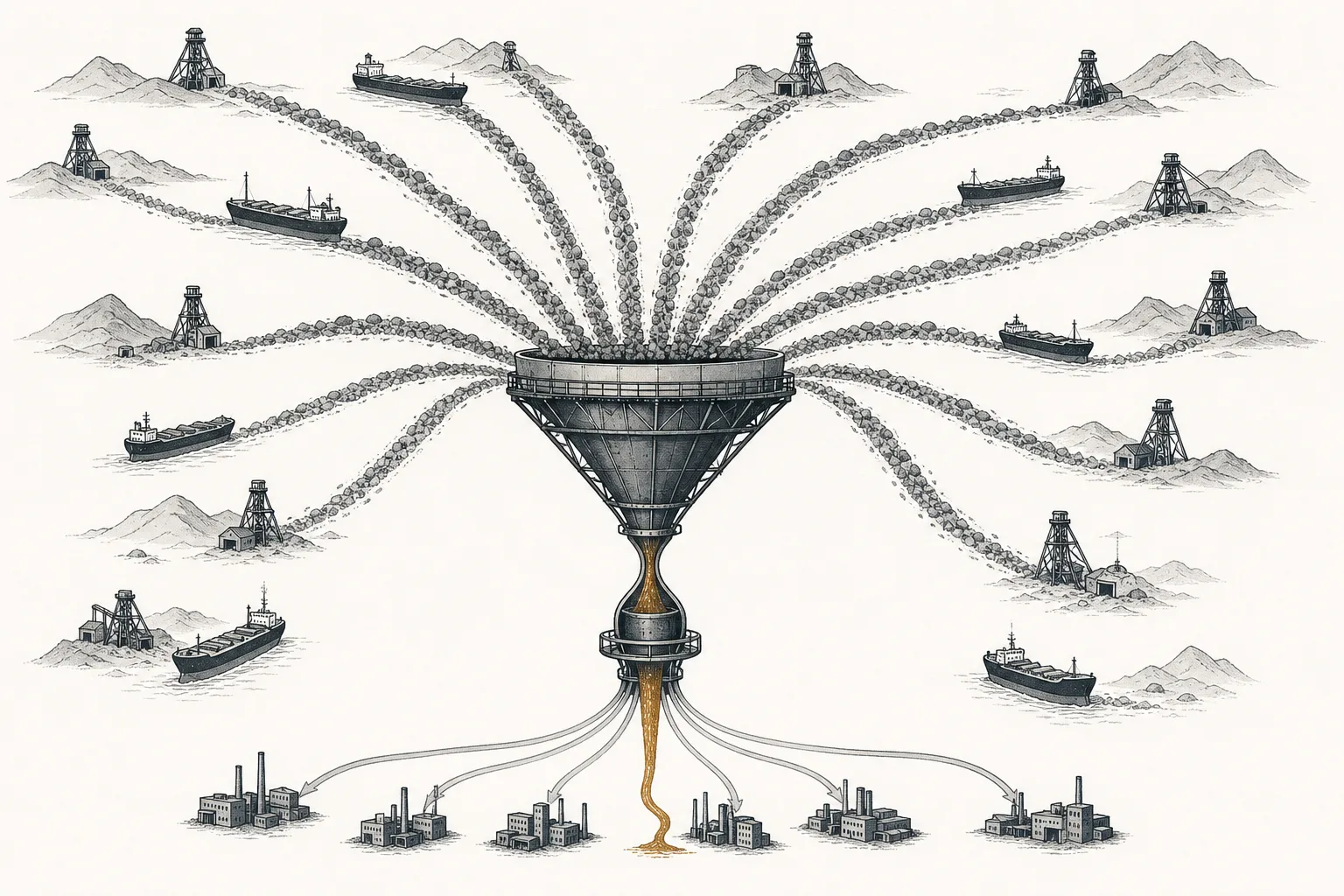
Why does this matter? Because nickel and cobalt are the heart of high-nickel EV batteries (NMC/NCA) and of the entire stainless steel industry. If you want to use these metals, almost every path runs through a processing plant — and most of those plants sit on the Indonesia–China axis. This is why a “boring” midstream step has become a strategic card in the energy transition.
03How it works: three routes from rock to metal
What makes this business complex is that the very same laterite rock can take several different routes, depending on what the end market wants — cheap stainless steel, or high-grade battery metal. Each route uses wildly different technology, cost, and pollution.
The first and oldest route is RKEF — melting the ore at high heat to get “nickel pig iron” (NPI) or ferronickel to feed the stainless steel industry. This is the biggest route, because stainless steel still eats about 68% of the world's nickel demand, and NPI has overtaken everything else as steel mills' main nickel feedstock — from about 40% in 2018 to roughly 70% in 2024.
The second route is HPAL — cooking laterite ore in sulfuric acid under high pressure and temperature to get a concentrated slurry called MHP, which is processed on into nickel sulfate, a direct battery feedstock. The key point: Indonesia only has laterite ore, not the high-grade sulfide ore that makes Class 1 easy — so HPAL is the “key” that unlocked Indonesia's jump from a stainless-steel supplier to a battery-metal supplier for the world. And because MHP can be processed straight into cathode material, it ties the whole “mine→battery” chain together in one place.
The third route is the matte shortcut — Chinese companies like Tsingshan once flipped the game by converting NPI (originally for stainless steel) into “nickel matte” to feed batteries. The upside is you can reuse existing plants; the downside is it emits about 3 times more carbon than HPAL per unit of nickel. So this route gets used mainly when battery prices spike, and it's a good example of how processing technology flexes with the market price.
04What it connects to
The processing plant is the “middle” of the nickel-cobalt chain, so it touches every stage around it. Upstream is Nickel & Cobalt Mining, which feeds it laterite; downstream is battery chemicals and precursor, which takes the MHP/sulfate and turns it into cathode material. And there's a “parallel path” running alongside — Nickel & Cobalt Recycling — because these metals can be pulled back out of old batteries, so many modern plants are designed to eat both ore and recycled feed.
More important still are the “mouths waiting to be fed” downstream. The battery metal leaving these plants is the lifeblood of the era's megatrends: it goes into Electrification & Mobility (EV batteries), it powers Energy Transition & Power Demand (grid-scale storage batteries), and even Robotics & Physical AI, which needs dense, high-energy batteries. Put simply, if the processing plants stall, the whole battery chain stalls with them.
05Where it stands now
2025–2026 is when this business hit two forces at once: Indonesia's massive capacity expansion, which flooded the market, and a fast-growing shift toward high-grade battery metal.
On volume, Indonesia built plants so fast that supply overwhelmed the market. The global nickel market ran a surplus of about 209,000 tons in 2025 and is expected to stay in surplus, at around 261,000 tons in 2026, pinning nickel prices to the floor — which squeezed high-cost Western producers out of the game while Indonesia's (lowest-cost) plants kept running.
On cobalt, the story runs the other way — HPAL in Indonesia gets cobalt as a “bonus” that comes attached to the nickel, which made Indonesia the world's second-largest cobalt producer (about 28,000 tons in 2024, up from 19,000 tons in 2023), though still behind Congo (DRC), which produces around 70% of the world's supply. This flood of cobalt coming out alongside the nickel is part of why cobalt prices fell so far that Congo had to impose export controls in 2025.
But the processing plants aren't having an easy time either — in 2025 several big HPAL producers like Huayou, Lygend, and Tsingshan cut output by at least 10% because the price of sulfur (HPAL's main input) spiked and squeezed their margins. It shows how sensitive this business is to input costs and the price cycle.
In this arena, the players split into two clear camps: the Indonesia–China axis processors that control volume and HPAL technology, and the traditional Class 1 refiners from Japan, Russia, and the West that lean on quality and full integration.
06The road ahead
Three forces will shape this business. First — the West wants the midstream back, but it's very hard to pull off. Realizing they lean too heavily on the Indonesia–China axis, the US and Europe are trying to build their own chains, but the most painful example is the Sonic Bay project by BASF (Germany) and Eramet (France) — a $2.6 billion nickel-cobalt refinery that was going to be the only 100% Western-financed plant in Indonesia — which was cancelled in 2024 as EV demand slowed and it couldn't compete on cost with China. It's a signal that chasing the share the Indonesia–China axis has built up won't be easy.
Second — the battery chemistry war will decide how far the HPAL route grows. As long as high-nickel NMC batteries still rule long-range cars and the premium market, HPAL/MHP has a place. But if LFP batteries (which use no nickel or cobalt) keep taking share, battery-metal demand grows more slowly — and plants that can flex between the stainless-steel line and the battery line will have the edge.
Third — carbon will become a trade condition. As Europe starts taxing imported carbon (CBAM) and automakers have to report carbon across the whole chain, nickel from coal-powered plants (nearly all of them in Indonesia) may lose out to nickel refined with clean energy — opening a door for low-carbon refiners like Japan or Canada to reclaim the value of “green nickel” in the premium market.
07Challenges & risks
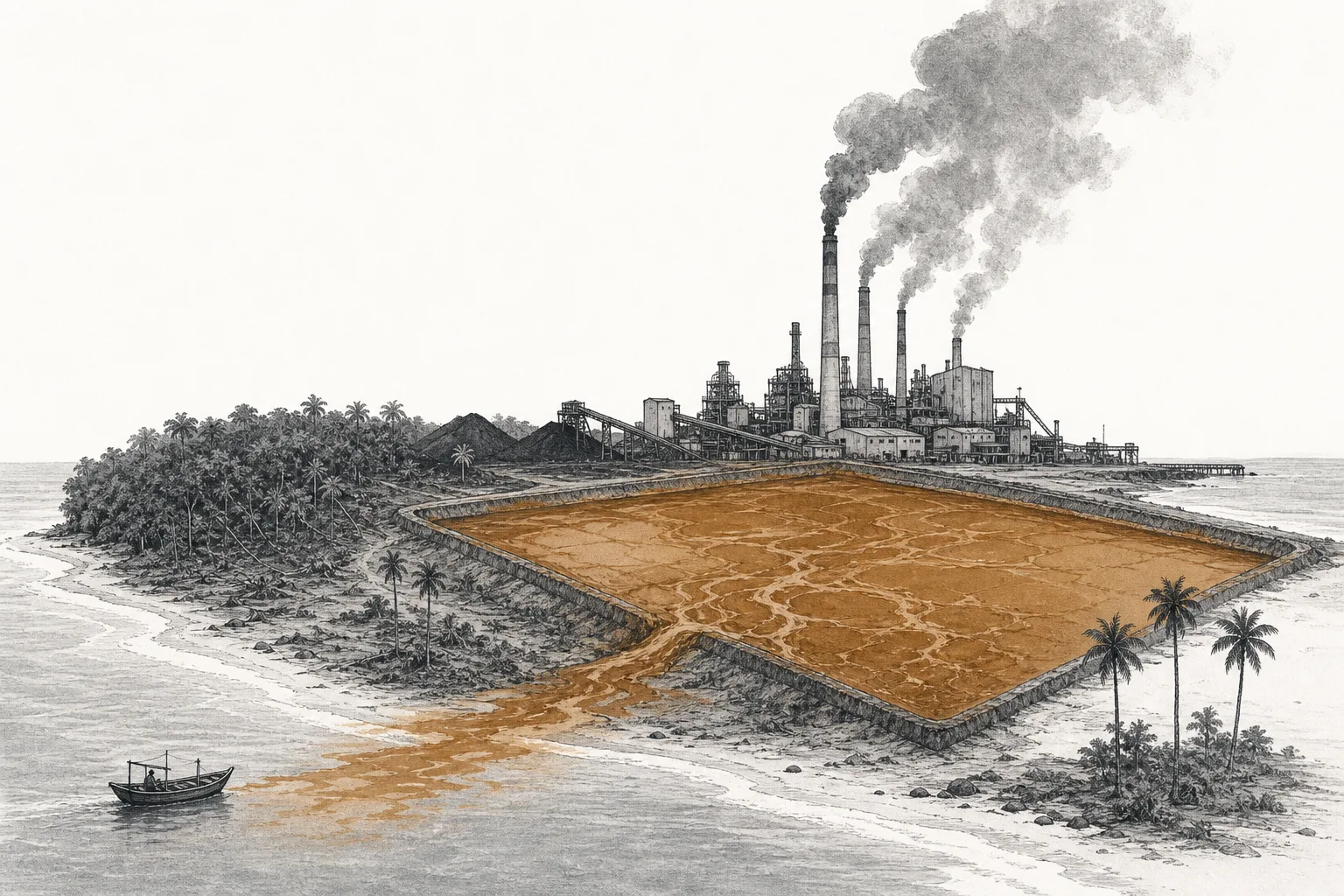
Enormous environmental cost. This is the weakest point of nickel processing. HPAL generates about 100 tons of waste per ton of nickel metal — a sludge laced with heavy metals and acid that has to be held in giant containment ponds, where a dam breach has already been reported in Indonesia; and originally several projects planned to dump the waste into the deep sea (before the government refused). On top of that, nearly every HPAL plant in Indonesia runs on power from coal, so the “clean metal” for EVs actually carries a heavy carbon and pollution footprint right from the source.
A brutal price cycle. Indonesia's too-fast capacity expansion has kept the market in surplus for years running, sinking nickel prices, wiping out high-cost processors, and forcing even low-cost HPAL producers to cut output when sulfur prices spike. Investing in this group means watching “who is the lowest-cost processor” and “where we are in the cycle” more than just the EV trend.
Geopolitical risk. When battery-metal processing concentrates along the Indonesia–China axis, the midstream becomes a strategic “card,” just as rare earths once were — export controls, quotas, or trade tensions could shake the whole world's battery chain overnight. And that's why this “boring” step of cooking rock into metal has become a real strategic battleground of the EV era.