Megatrend · Critical Materials
Two metals that almost nobody sets out to mine
Nickel and cobalt are the heart of the long-range EV battery — but digging them out of the ground is full of oddities. Nickel comes in two entirely different kinds of ore, mined in different ways, and almost nobody “mines cobalt directly” at all — it's just a by-product that comes up with copper mines. This is the story of the very “top of the stream” of the battery chain, where nearly the whole world's supply is concentrated in just two countries: Indonesia and Congo.
01What nickel and cobalt mining is
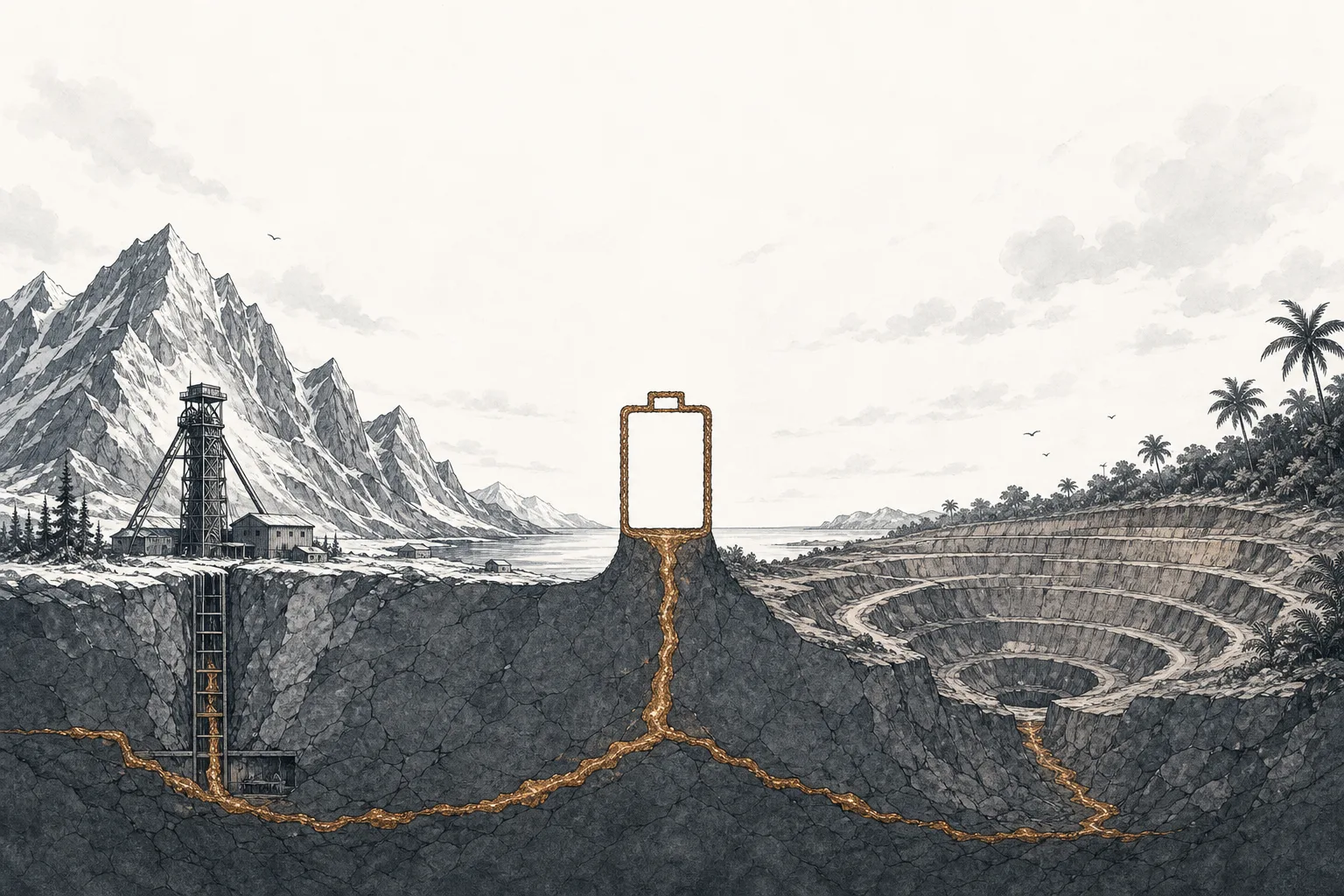
Picture two places at opposite extremes — one is a deep underground mine in Norilsk, in Russia's Arctic, where it's below freezing almost year-round; the other is a red surface mine in the tropical forest of Indonesia. Both dig up the same metal, nickel — but from different rock, by different methods, yielding output of wildly different quality. That's the first oddity of this business.
The second oddity is cobalt — the blue-gray metal that makes batteries more durable and safer. Almost nobody on Earth “sets out to mine cobalt,” because about 98% of the world's cobalt is just a by-product that comes up alongside copper or nickel mining. Only ~2% comes from mining cobalt directly.
The business of the “very top of the stream” of the nickel-cobalt chain is therefore the companies whose value comes from “ore still in the ground” — from exploring for deposits, to digging out the rock or soil that holds the metal, to grinding and concentrating it enough to pass on. What leaves the mine isn't shiny metal bars, but concentrate or a wet intermediate, waiting to be sent on for refining.
On our megatrend map, this step is a sub-branch of Nickel & Cobalt, under the Critical Materials & Supply Chain megatrend — it's the “first gate” where everything begins, before the ore flows into Smelting & Refining and is then turned into Battery Chemicals & Precursors. If the upstream mine stumbles, the whole line stumbles with it.
02Why it's the foundation of the battery era
The simple reason is that nickel and cobalt are two of the few metals that let a battery “store energy densely” — the more nickel you add, the farther the same-size battery goes, while cobalt keeps the cathode structure from breaking down easily. A world shifting to electric vehicles and clean-energy storage keeps needing more of this pair.
But you have to get the scale right. Global mine production of nickel in 2024 was around 3.6 million tons, and, oddly, batteries aren't the biggest user — stainless steel still eats about 65–70% of all nickel. Batteries are simply the “fastest-growing” slice. Cobalt is far smaller: the whole world produced only around 290,000 tons in 2024, and it leans on batteries as its main source of demand.
So the strategic importance isn't about how much money changes hands, but about “who controls the source.” Both nickel and cobalt are produced in shockingly concentrated ways — nickel from Indonesia, cobalt from the Democratic Republic of the Congo (DRC). That concentration makes prices swing violently on the decisions of just a few governments, and turns these two metals into “strategic raw materials” every great power wants in hand.
03Two ore streams + a by-product called cobalt (how it works)
The key to understanding this business is that nickel comes from two completely different kinds of ore, and each one leads to a different grade of output.
The first is sulfide ore — hard rock where nickel is bound to sulfur, usually deep underground in cold climates like Russia, Canada, and Australia. Its advantage is that it separates easily with traditional “smelting” (mine–smelt–refine) and yields the high-purity nickel called Class-1, which can go straight into batteries. The downside: these deposits have been heavily mined already and get scarcer every year.
The second is laterite ore — red soil weathered in the humid tropics, like Indonesia and the Philippines. Here nickel is spread through the soil rather than bound in lumps; it's easy to dig because it's at the surface, but far harder to separate the nickel out. Crucially, about 60% of the world's land-based nickel deposits are laterite — so the future of nickel lies in tropical red soil, not cold-climate hard rock.
Class-1 = pure nickel ≥99.8%, usable in batteries · Class-2 = low-grade nickel like ferronickel/NPI, used for stainless steel · HPAL (High-Pressure Acid Leaching) = boiling laterite soil with acid at high pressure and temperature to dissolve the nickel and cobalt out · MHP = the intermediate (mixed hydroxide precipitate) you get from HPAL, which can be upgraded to battery grade · NPI = nickel pig iron, cheap low-grade nickel for stainless steel
This is the mechanism that flipped the whole industry. It was long believed that “batteries must use Class-1 from sulfide only,” but HPAL technology let Indonesia turn red laterite soil into MHP and then upgrade it to battery grade at a much lower cost — and when HPAL boils laterite, the cobalt mixed in the soil dissolves out as a by-product too. That's why Indonesia doesn't just dominate nickel, but has simultaneously become the world's fastest-growing new source of cobalt.
04What it connects to
The mine is the “very top of the stream” of the nickel-cobalt chain — everything begins here and flows down. Concentrate and MHP from the mine are passed on to Smelting & Refining to be refined into pure metal, then to Battery Chemicals & Precursors, which turn it into nickel sulfate and cathode material. And there's a parallel line — Nickel & Cobalt Recycling — pulling metals from old batteries back into the system, easing the burden on the mines.
What's interesting is the relationship with the downstream megatrends. Ore from this mine supplies the electric era directly — into Electrification & Mobility (EV batteries), into Energy Transition & Power Demand (clean-energy storage), and into Defense & Geopolitical Fragmentation (nickel in military-grade alloys). In return, those trends are the force that drives demand, pushing the mines to dig faster.
05Where it stands now
The story of nickel and cobalt in 2023–2026 is the story of “two countries” that control the fate of the whole world — and the two have moved in strikingly opposite directions.
Nickel: Indonesia floods the market until the price collapses
In 2020, Indonesia banned all exports of raw nickel ore, forcing anyone who wanted the ore to build smelters inside the country. The result: Chinese capital rushed in to build enormous RKEF and HPAL plants, and Indonesia's share of nickel production jumped from about 16% in 2017 to over 61% of the world in 2024 — a single country producing about 2.2 million tons out of the world's 3.6 million.
Supply flooding the market sent the nickel price into a nosedive, from around $31,000 per ton in early 2023 down to about $16,000 per ton by late 2024 — down almost 47%, the lowest in more than four years. That price crash squeezed high-cost Western mines until they couldn't survive. The most famous example is BHP, which put its Nickel West mine in Australia on “pause,” pulling about 90,000 tons/year of capacity out of the market.
Cobalt: a by-product Congo controls almost entirely
Cobalt is the opposite. Rather than spreading out, it's even more concentrated than nickel — about 76% of the world's cobalt comes from the DRC alone (a record 290,000 tons in 2024), and almost all of it is a by-product of copper mines. Crucially, the market leader has changed hands — the Chinese company CMOC produced 114,165 tons of cobalt in 2024 (nearly double the year before), overtaking the West's Glencore to become the world's number one, with a ~31% share.
Cobalt has a knot that nickel doesn't: an ethical problem. Some of the cobalt in the DRC comes from “artisanal mining” — informal digging by hand with picks and bare hands. In 2014, UNICEF estimated about 40,000 children were working in the mines of southern DRC, many of them digging cobalt. Reports of dangerous conditions and child labor have pushed Western automakers and battery makers to “reduce cobalt” in their formulas and to audit sources more strictly.
In this arena, the real players split by the ore they mine: the cold-climate sulfide camp, the Indonesian laterite camp, and the Congo cobalt-by-product camp.
06The road ahead
The first direction is “laterite will swallow the world.” As good sulfide deposits run thin and HPAL proves it can turn red soil into battery grade at low cost, the future of nickel tilts ever more toward Indonesia. Indonesia is expected to produce about 800,000 tons of nickel a year as MHP from HPAL by 2025 — and as HPAL grows, Indonesia's cobalt by-product grows with it (topping 30,000 tons in 2024, up more than 80% in a single year), gradually reducing reliance on the DRC.
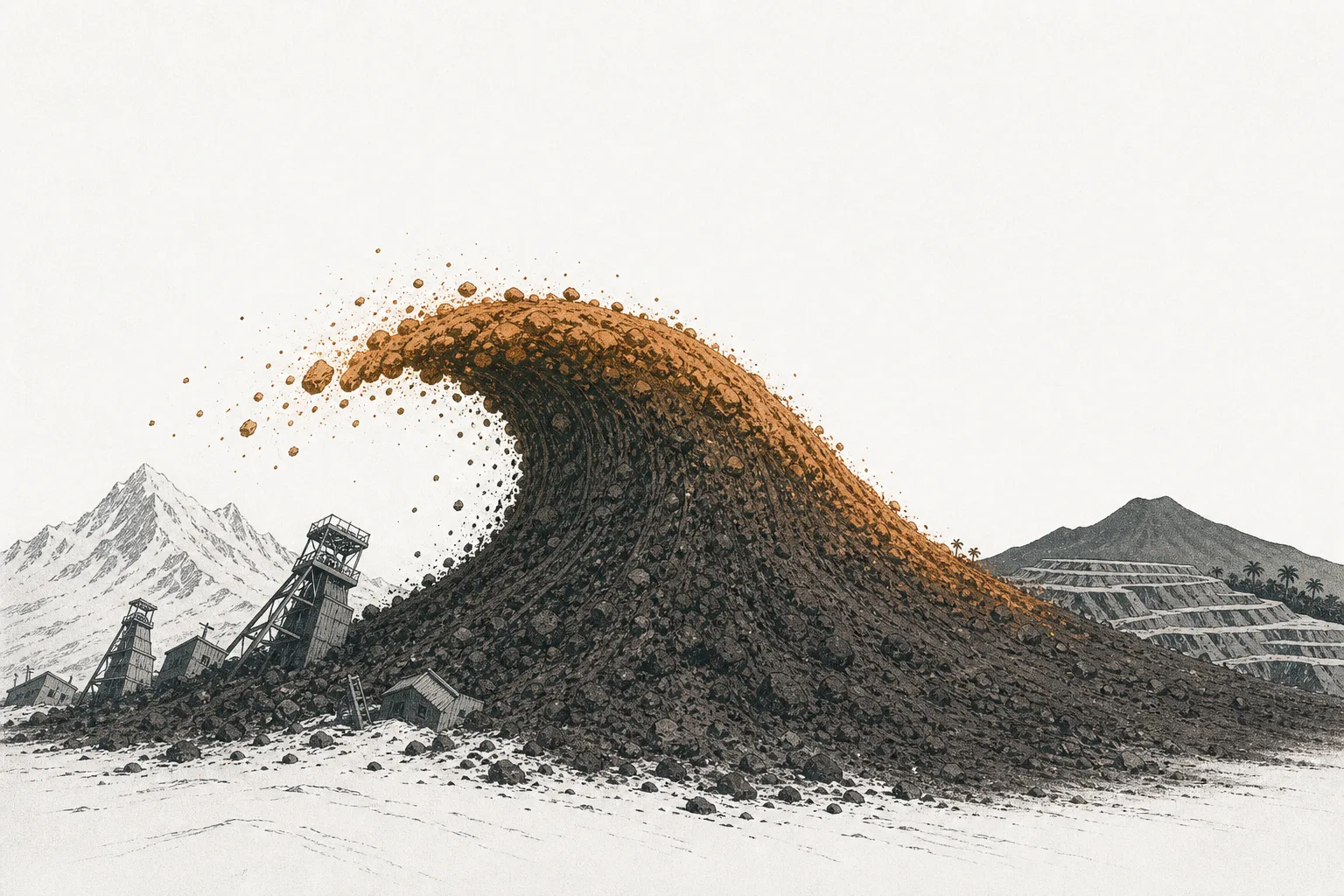
The second direction is the scramble to pull supply out of concentration. The West is trying to build a nickel/cobalt chain that doesn't depend on China and the DRC, through laws (like the sourcing conditions in the US EV tax credit) and support for new projects — but as long as Indonesia's costs stay the lowest, competing is very hard.
The third direction is the “urban mine.” As the first batches of NMC batteries reach end of life late this decade, nickel and cobalt from recycling will become a new supply that's cleaner and closer to the factories, especially for expensive, recycle-worthy cobalt — good for the planet, but another downward pressure on freshly mined ore prices. Some are even asking about extreme options like mining deep-sea nodules, which companies like TMC are pushing.
07Challenges & risks
Geopolitical concentration. When more than half of nickel comes from Indonesia, and ~76% of cobalt from the DRC (much of it processed by Chinese-owned capital), the decisions of just a few governments — export bans, quotas, tax hikes — can swing world prices overnight. These are commodities where “the risk isn't in the financial statements, but on the world map.”
Demand that could vanish to technology. Unlike copper, whose demand the electric era pulls for certain, nickel and cobalt risk being replaced by LFP batteries that use neither. Every time an EV switches to LFP, a chunk of demand for this pair disappears — so a miner has to bet not just on “will EVs grow,” but on “how much will the growing EVs still use this pair.”
A brutal price cycle and uneven costs. This is a full-blown commodity business; prices can swing from peak to trough in a few years. And because each ore stream's costs differ so much (Indonesian laterite is far cheaper than cold-climate sulfide), when prices are low, high-cost producers fall first — as BHP and several Australian mines found out. Investing in this group means watching “who is the lowest-cost producer,” more than just the EV trend.
Environmental and ethical costs. HPAL in Indonesia runs mainly on coal power and creates enormous waste, while cobalt from the DRC still carries the shadow of child labor and unsafe artisanal mines. Both are becoming real pressures from consumers and Western law — “you can dig it” doesn't always mean “you can sell it” in a world that audits sources more closely by the day.