Megatrend · Critical Materials
The most expensive metal in an old battery isn't in a mine — it's in a black powder called “black mass”
Every time an EV battery reaches the end of its life, there's still nickel and cobalt inside it — metals that once had to be dug out of Indonesia and Congo, the two most expensive and most geopolitically fraught metals in a battery. This business grinds old batteries into a “black powder” (black mass), then dissolves it in acid to pull the nickel and cobalt back out as pure “sulfate” that can feed a new battery plant directly. This is the story of the “urban mine,” battery edition — set to become the second supply line for this metal pair, and a shortcut that helps the West stop relying on mines in just a few countries.
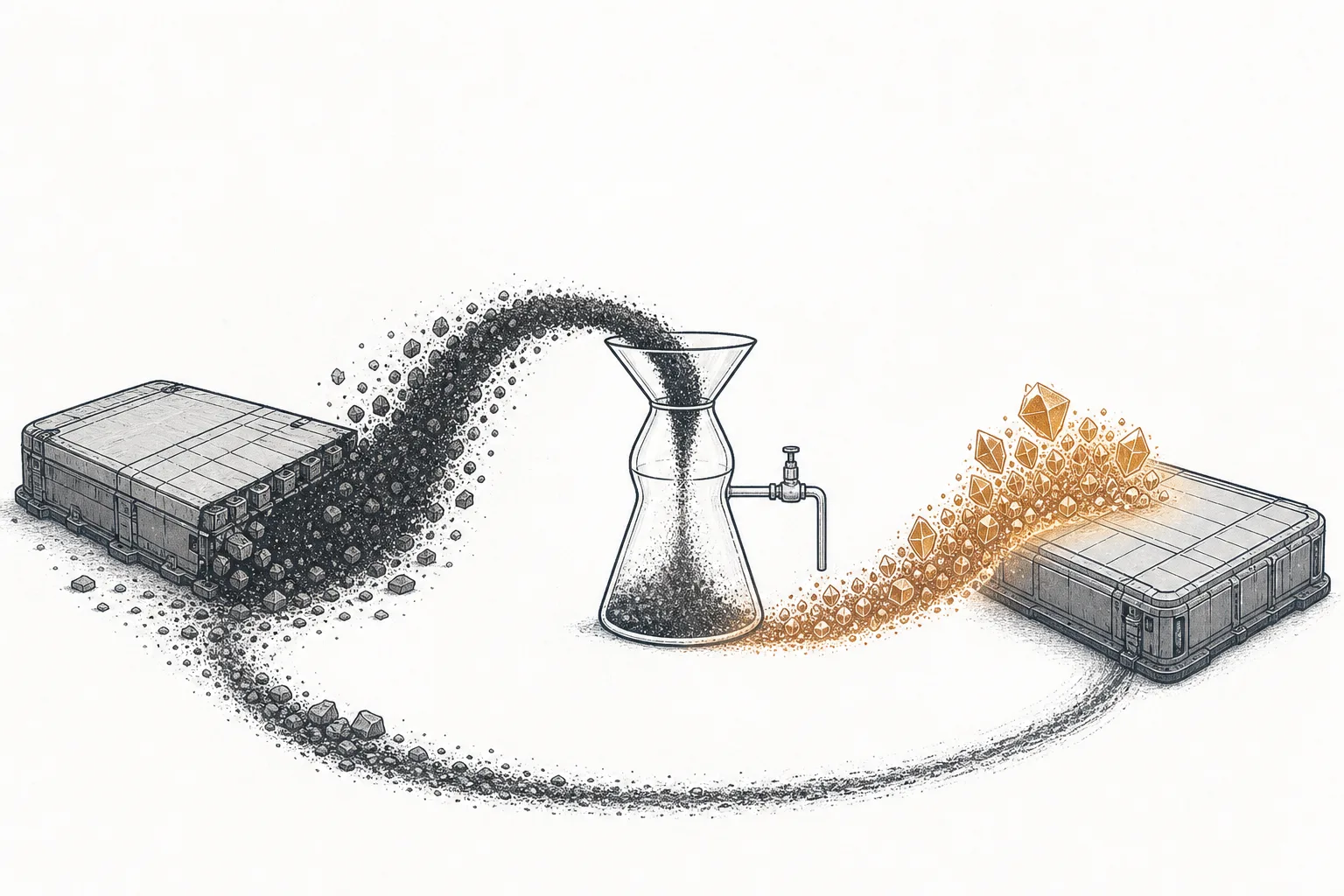
01What nickel-cobalt recycling is
Think of the battery in an EV, or the scrap trimmed off at a battery-cell plant. Packed inside is expensive metal — especially the two stars of this lesson: nickel and cobalt, the metal duo that lets a battery store a lot of energy and go far (told in full in the Nickel & Cobalt lesson). The business we're talking about today is “mining” these metals back out of dead batteries instead of digging them out of the ground.
The heart of it is something called “black mass”. When you discharge an old battery, shred it, and sieve out the plastic casing and structural metals (steel, aluminum, copper), what's left is a fine black powder holding almost all the valuable metal from the electrodes — nickel, cobalt, lithium, manganese, graphite. This pile of powder is the “high-grade ore” recyclers want, and the starting feedstock for the whole industry.
Black mass = the black powder from shredding batteries, holding nickel, cobalt, lithium, manganese, and graphite together · Nickel/Cobalt sulfate = the pure chemicals pulled back out of black mass, and the form a battery plant actually uses · Precursor (pCAM) = the “cathode precursor,” mixing nickel-cobalt-manganese in an exact ratio before it becomes cathode material in a battery · Urban mine = the “mine” of metal buried in things humans have already made and that are nearing end of life
On the megatrend map, this step is a sub-branch of Nickel & Cobalt, under the Critical Materials & Supply Chain megatrend — but it doesn't sit “upstream” like its mining-and-smelting siblings. It's the “circular shortcut” that pulls metal that's already been through the whole chain back into the system. Unlike its close cousin Lithium Battery Recycling, which looks at recycling the whole battery (especially recovering “lithium”), this lesson zooms in on recovering nickel and cobalt, the two most expensive metals and the ones that drive the economics of the whole industry.
02Why it matters (nickel and cobalt are the “money” in the black powder)
The first reason is pure money. In a pile of black mass, nickel and cobalt are the highest-value metals. By weight, black mass is about 10–30% nickel and 5–20% cobalt — several times more than lithium (2–7%). And because cobalt and nickel fetch a high price per kilo, these two are what make the battery-recycling business “worth it” in the first place. Put simply: without nickel and cobalt, the economics of battery recycling barely exist.
The second reason is bigger than money — it's geopolitics. Today over half the world's nickel comes from Indonesia, and about 76% of cobalt comes from a single country, the Democratic Republic of the Congo (DRC). Concentration this heavy makes prices swing on the decisions of a handful of governments (Congo banned cobalt exports in 2025 and the price doubled). So recycling is the only way the West can build a nickel-cobalt supply “at home,” without relying on mines in parts of the world it can't control.
And the third reason: the market is about to get big very fast. The global black-mass recycling market was worth about $17 billion in 2025, and many analysts expect it to grow to around $84 billion by 2035 — nearly 18% a year on average. The push comes from millions of EVs already sold that are starting to reach end of life, plus rules in Europe that require new batteries to contain a set share of “recycled material.”
03How it works (from black mass back to sulfate)
The heart of this business is the “closed loop” — the very same nickel and cobalt atoms travel from an old battery back into a new one. Let's follow how a single EV battery makes its way back to the “sulfate” a battery plant can actually use.
The step that's the real heart is step 3, “hydromet” (hydrometallurgy) — dissolving the black powder in sulfuric acid with a little hydrogen peroxide, at around 60–80°C, then separating the metals out one at a time by chemistry (solvent extraction) until you get pure nickel sulfate and cobalt sulfate, separated. This method is more precise and recovers more metal than the old “burn it” approach (pyrometallurgy) — research and leading players report recovering around 96% of the nickel and 94% of the cobalt or more, while recovering lithium is still harder and loses more.
And here's the secret to the profit: the best recyclers don't just sell plain “sulfate” — they process it on into “precursor” (pCAM), the cathode precursor that mixes nickel-cobalt-manganese in an exact ratio, ready to ship straight into a battery-cell plant. The higher you climb the chain toward the final product, the more value you add. This is why Chinese giants like GEM do both recycling and precursor production in a single company.
04What it connects to
Nickel-cobalt recycling is a “circular shortcut” running parallel to the main ore chain. It doesn't compete with Nickel & Cobalt Mining directly — instead it adds to supply where new mining is slow and concentrated. And it's tightly linked to Nickel & Cobalt Smelting & Refining, because recycled sulfate flows in and mixes with metal from mines before entering Battery Chemicals & Precursors — the destination that turns nickel-cobalt into real cathode precursor (many leading recyclers do this step in-house too).
The closest relative is in another megatrend: Lithium Battery Recycling — in fact these two steps often “happen in the same plant,” because shredding a single battery yields lithium and nickel-cobalt together. They differ only in angle: that lesson tells the story of recovering lithium and the overall picture of battery recycling, while this one zooms in on nickel and cobalt, the money-makers.
And the destinations “waiting to be fed” these recycled metals are all the era's megatrends: Electrification & Mobility (EV batteries are the biggest demand block), Energy Transition & Power Demand (grid energy-storage batteries), and even Artificial Intelligence (data-center backup power) — every bit of nickel-cobalt you can recycle is a bit that doesn't have to wait for a new mine.
05Where it stands now
In 2025, the price of black mass became something the whole industry watches — NCM523 powder traded at about $6.37 per kilo (April 2025) and looks set to climb with the cobalt price after Congo's export curbs. Battery scrap has become a “strategic raw material” everyone wants. But the plain truth is that right now China leads by a wide margin, in both capacity and technology.
The real leader is China's GEM, which positions itself as the world's “urban-mine king,” with recycling capacity in the hundreds of thousands of tons a year, recovering tens of thousands of tons of nickel and thousands of tons of cobalt a year, then processing it on into precursor fed into battery plants on the same line. Behind it are several more Chinese players that tie recycling directly to making battery materials.
The West is racing to catch up, pushed by policy that wants to cut reliance on China and the DRC. The US has American Battery Technology, building its own hydromet recycling plant to recover nickel/cobalt sulfate; Canada has Electra Battery Materials, building North America's first cobalt-sulfate refinery; trading giant Glencore acquired Li-Cycle in 2025 to control a cross-continent battery-recycling network; and Japan has Envipro, teamed up with Mitsubishi Materials. Overall, it's an arena where most of the real players are still private companies or only just turning a profit — but money and policy are pouring in.
06The road ahead
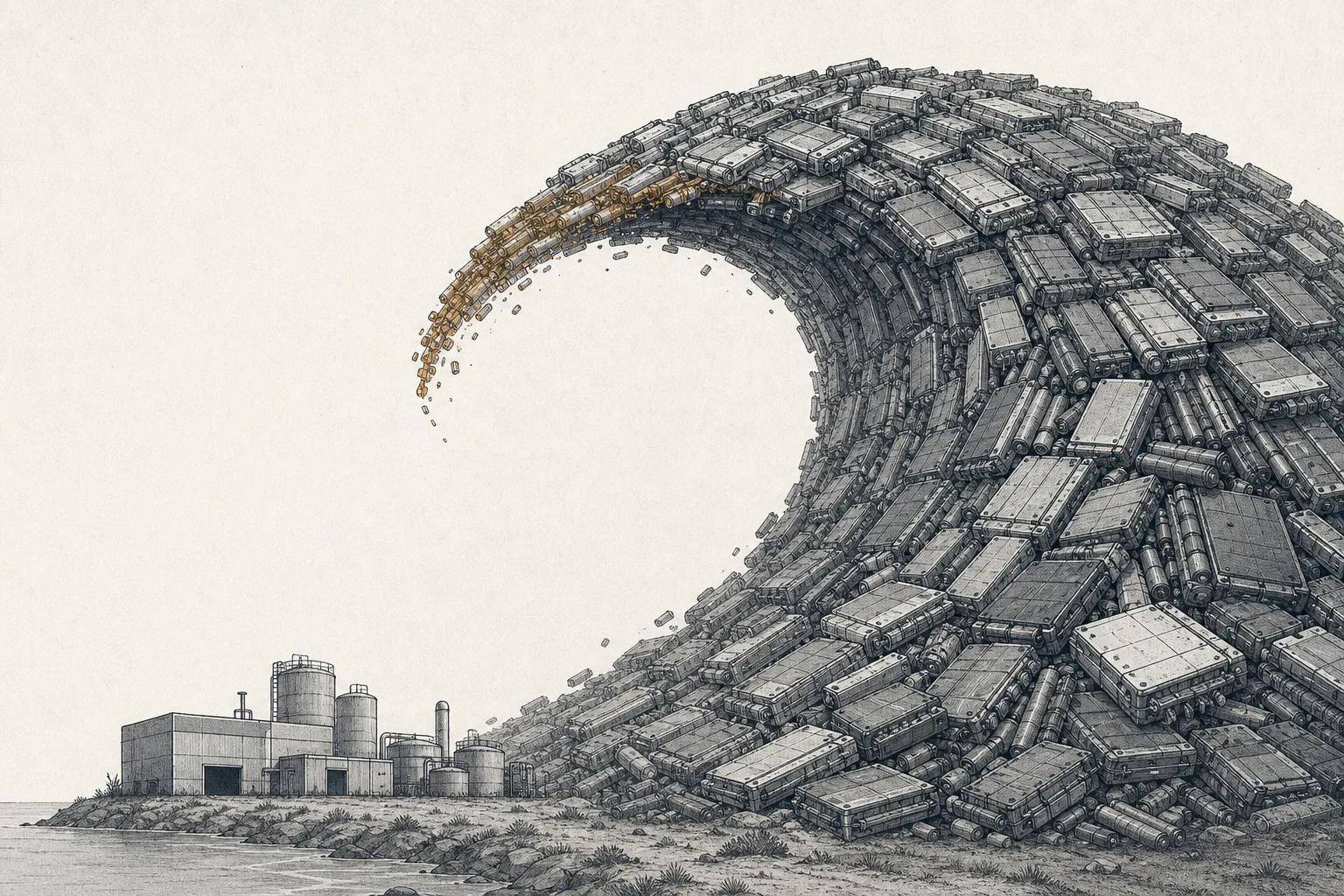
The biggest story of this business hasn't arrived yet — the “end-of-life wave”. An EV battery lasts about 10–15 years, which means the first batches of EVs sold in the early 2010s are starting to reach end of life. By 2030, around 318 GWh of batteries are expected to reach end of life worldwide, and the volume will keep climbing at double-digit rates through 2040, when it could hit several million tons a year. This is why players are racing to build recycling plants ahead of time — they're laying pipe to catch a wave that hasn't come yet.
But there are two truths to state plainly. First: in the short term, recycling can't close the gap, because the batteries reaching end of life “today” are far fewer than the batteries made “today.” The IEA estimates that even by 2040, recycled nickel will be only about 7% of total nickel supply, and cobalt about 12% — growing, but still a minority. The world will need both new mines and recycling side by side.
Second: the “battery chemistry war” is reshaping tomorrow's waste. LFP batteries (lithium-iron-phosphate), which use no nickel or cobalt at all, are rapidly taking EV market share (told in the Nickel & Cobalt lesson). That means in another 10 years, many of the batteries reaching end of life could be LFP with “nothing valuable” to recover — so the economics of recycling will have to adapt, leaning toward high-nickel batteries from premium cars and Western markets that still mostly use NMC.
07Challenges & risks
Not enough feedstock yet (the feedstock hasn't arrived). This is the biggest contradiction — lots of recycling plants have been built to wait for an “end-of-life wave” that hasn't arrived, forcing many of them to fight over limited “production scrap” from battery plants. The result is capacity that overshoots demand in the short term, so many companies are losing money or having to slow projects (Li-Cycle even went into bankruptcy before Glencore bought it).
Revenue tied to volatile global metal prices. A recycler's revenue depends directly on nickel and cobalt prices. When the nickel price sinks on Indonesia's oversupply (see the Nickel & Cobalt lesson), the economics of recycling get squeezed at once. So this business inevitably swings with the metal price cycle — it's not the “steady-profit” business many people assume.
The LFP shadow. Every time an EV switches from a nickel battery to LFP, tomorrow's battery waste has less “valuable” metal to recover. Over the long run this is structural pressure — the more LFP dominates the market, the more diluted the average value of the black mass flowing into the system.
Concentration in China and trade walls. Most of the world's recycling capacity and black-mass processing is in China. As black mass becomes a “strategic raw material,” several countries are starting to control exports (the US and EU are weighing limits on exporting battery scrap to keep it for domestic plants). So the cross-border flow of black powder is getting more and more politically entangled — what was once just “waste” has become a new battleground of the battery chain.