Megatrend · Critical Materials
Pure metal still can't go into a battery — until it passes the “chemical gate” China controls almost worldwide
We keep hearing about wars over nickel and cobalt mines, but the pure metal that leaves a smelter still can't go into a battery. It has to pass one more gate first — the one that turns metal into “sulfate salts,” then forms them into precursor and cathode (CAM) powder that can actually be loaded into a battery cell. This is the step “closest to the battery” in the nickel-cobalt chain, it eats the most of a cell's cost, and it's the step China quietly controls at around 85–90% of the whole world.
01What “battery chemicals and precursor” are
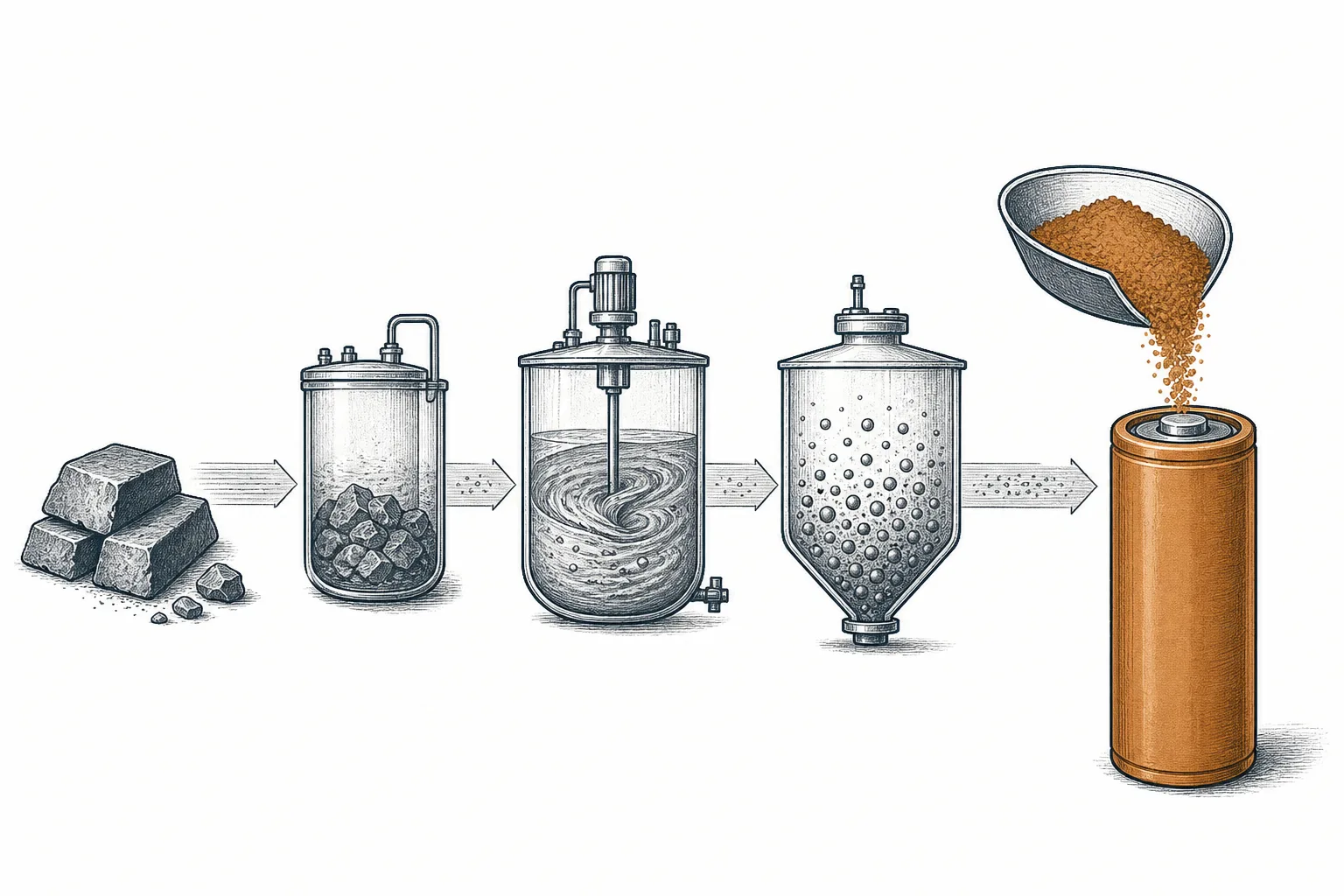
Picture a bar of pure nickel and a lump of cobalt fresh out of a smelter — high-grade metal traded as a commodity on the London Metal Exchange (LME). But here's what people rarely realize: you can't put these metal bars into a battery directly. A lithium-ion battery doesn't eat metal in lumps; it eats metal in a very specific “chemical form.”
The gate that turns metal into something a battery can eat is the battery chemicals & precursors business — plants that take nickel and cobalt, dissolve them into sulfate salts, then form them on into precursor and cathode (CAM) powder that a battery plant can load straight into a cell. This is the last gate of the nickel-cobalt line before the material enters a real battery plant.
Nickel/Cobalt sulfate = metal dissolved into a very high-purity “battery-grade” salt — the starting feedstock for the cathode · pCAM (precursor cathode active material) = the “cathode precursor,” made by co-precipitating nickel, manganese, and cobalt salts into round grains with an exact ratio · CAM (cathode active material) = the real “cathode powder,” made by firing pCAM with lithium · NMC / NCA = the most popular cathode formulas (nickel-manganese-cobalt / nickel-cobalt-aluminum) that lean mainly on this metal pair
To picture it, this chain runs like a short conveyor belt: metal bar → sulfate salt → pCAM (precursor) → CAM (cathode powder) → into the battery cell. Every step to the right, the material gets “closer to the battery,” adds more value, and gets technically harder — because a good cathode powder has to control grain size, purity, and metal ratio down to the nanoscale.
On our megatrend map, this step is a sub-branch of Nickel & Cobalt, under the Critical Materials & Supply Chain megatrend — it's the “end destination” the metal flows through, after leaving the mine (Nickel & Cobalt Mining) and the smelter (Nickel & Cobalt Smelting & Refining), before becoming the heart of a battery.
02Why this is the step “closest to the battery”
Mines and smelters are an “upstream” story — selling metal as commodity lumps, prices bobbing with the LME. But chemicals and precursor sit at the very end, right up against the heart of the battery, and that makes it the step with the most “power” in the nickel-cobalt line, for one simple reason: the cathode is the most expensive part of a battery cell.
Cathode material (CAM) eats about 40% of the material cost of a single battery cell — more than the anode, electrolyte, and separator combined. Which means whoever controls the cathode-powder step controls the “biggest cost block” of the entire battery industry — and controls the point where raw metal turns into real added value.
On top of that, this step is more “demand-connected” than the mine. When the world says EVs and energy storage will send nickel demand soaring, the point that demand slams into first is the plant that has to make sulfate salt and cathode powder fast enough to keep up with battery-plant orders. The nickel-sulfate market alone grew from about $8.4 billion in 2024 and is projected to reach $18.6 billion in 2032 (~12% a year) — far faster than the raw-metal market, because the added value lives here.
03How it works (from metal bar to cathode powder)
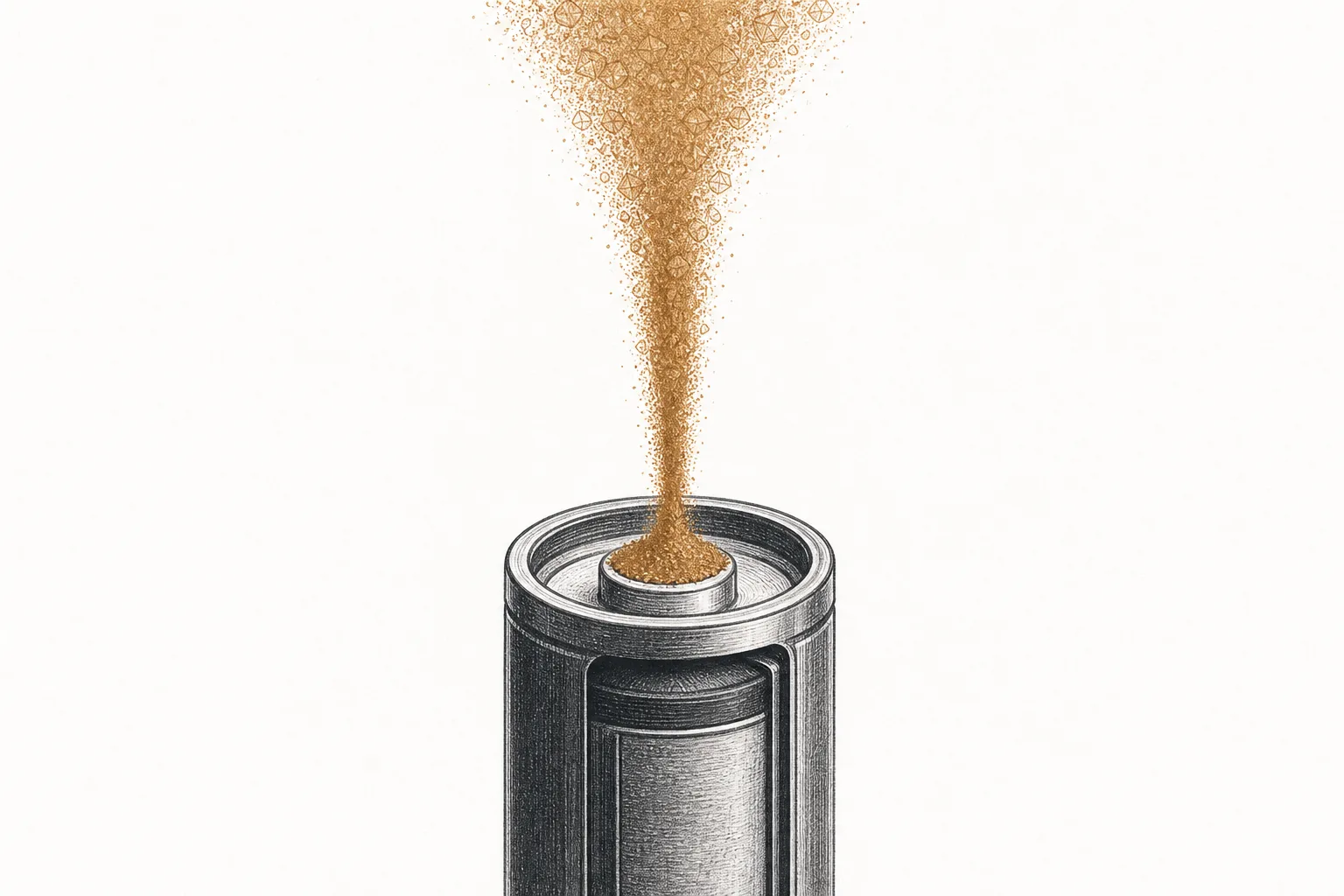
The heart of this step is “chemical transformation”, one step at a time — dissolving the metal, precipitating it, then firing it until you get a powder with properties exact enough to store and release electricity. Let's follow how a single bar of nickel becomes the powder in your car's battery.
The first step is making sulfate salt — dissolving nickel and cobalt into a solution, then purifying it to “battery grade” (impurities have to be down at the ppm level, because a tiny bit of foreign metal makes a battery degrade fast). In China, many plants take a shortcut, feeding in MHP (mixed hydroxide precipitate — the nickel slurry from Indonesia) to make sulfate directly, without going through pure metal, which is much cheaper.
The second step is making precursor (pCAM): mixing nickel, manganese, and cobalt salts in the formula's ratio, then “co-precipitating” them into tiny round grains with all three metals evenly embedded together. The final step is making CAM: firing the pCAM (calcination) with a lithium compound at high heat to get the real cathode powder — and this is exactly where the “great plants” separate from the “ordinary” ones, because controlling grain size, porosity, and crystal structure at the nanoscale is what gives you a battery that charges fast, goes far, and doesn't explode.
04What it connects to
The chemicals-and-precursor step is the “middle-to-late” gate of the nickel-cobalt line. Upstream is the metal from Nickel & Cobalt Smelting & Refining (and further back, Nickel & Cobalt Mining). There's an important shortcut — Nickel & Cobalt Recycling — because old batteries are processed into “black mass” and the nickel and cobalt are pulled back out to make fresh sulfate, so many chemical plants (like GEM) eat new metal and recycled feed interchangeably.
Downstream sit the real “mouths waiting to be fed”: cathode powder feeds straight into Electrification & Mobility (EV batteries) and Energy Transition & Power Demand (energy storage) above all — and because AI and data centers need enormous backup batteries and storage, it reaches into Artificial Intelligence and Cloud & Digital Infrastructure too. The ultra-high-nickel formulas also go to Defense & Geopolitical Fragmentation and Robotics & Physical AI, which need dense, high-energy batteries.
But the connection that decides this step's fate most of all is the battery chemistry the customer picks. If the world shifts to lithium-iron-phosphate (LFP), which uses no nickel or cobalt at all, demand for nickel-cobalt precursor shrinks — this is why this step “gets rich with high-nickel batteries but hurts when LFP arrives.” Read the full NMC-versus-LFP fight in the parent lesson, Nickel & Cobalt.
05Where it stands now
The big picture of this arena in 2025–2026 has two things you need to know. One is that China controls the chemicals and precursor step almost completely, even more than it controls mines or smelters — China made about 87% of the world's cathode-powder (CAM) capacity in 2024 and holds around 86% of ternary precursor (ternary pCAM), while cobalt-to-chemical processing is roughly three-quarters in Chinese hands. This is the real “chokepoint” of the battery chain — not just the ore, but the gate that makes the ore usable.
Two is the “high-nickel” fight that decides who gets the premium market. With LFP (lithium-iron-phosphate) having taken the mass market, nickel-cobalt cathode powder has retreated to hold the “high end” — long-range cars, premium cars, and cold-climate markets that need dense energy. So this arena competes on high-nickel formulas (like NMC 811, whose cathode is ~80% nickel) while steadily “cutting cobalt” to trim cost and ethical risk. The high-nickel cathode-powder (NMC 811) market grew from about $2.1 billion in 2024 and is projected to reach $4.2 billion in 2034.
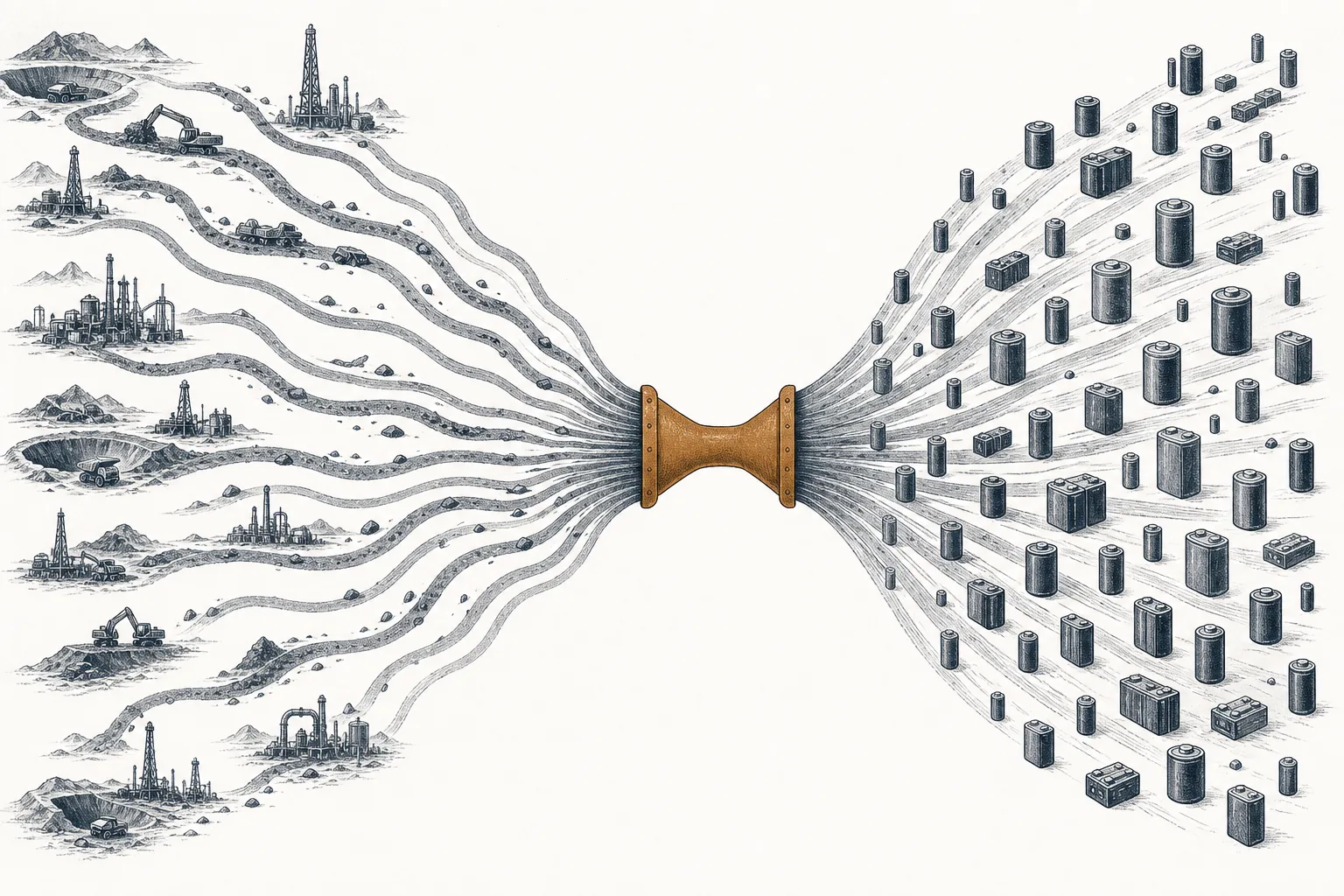
In this arena, the real players split into three groups: the Chinese processing giants that fuse mining, recycling, and chemicals together and control both precursor and sulfate; the non-China owners of high-nickel formulas in Japan and Korea that hold the premium market with high-quality cathode powder; and the Western players struggling to build a chain that isn't purely Asian.
06The road ahead
Three forces will shape this business. First — “more nickel, less cobalt”. Cathode formulas are climbing from NMC 811 toward “ultra-high-nickel” (90%+ nickel) to pack in more energy and cut out cobalt, which is expensive and ethically fraught. That means plants good at high-nickel formulas stay in the mainstream while plants that lean on cobalt get squeezed — good for battery-grade nickel demand, but slowly eating away at cobalt demand.
Second — the West wants the strategic chemical step back. Realizing the real chokepoint is precursor and CAM, not just the mine, the US, Europe, and Korea are backing chemical plants at home — through law (the sourcing conditions in the US EV tax credit) and deals like Umicore's JV with PowerCo to make CAM in Europe, or Ecopro BM opening a plant in Hungary. But as long as China's costs stay the lowest and its chain the most complete, catching up is very hard.
Third — “vertical integration” is the winners' game. Chinese players like Huayou and GEM are pulling the whole chain — from Indonesian mines (HPAL/MHP) to recycling to precursor and CAM — into a single company, because whoever controls the entire line controls cost and quality best. So the chemical step that was once just “the middle” has become the central axis of competition across the whole battery chain.
07Challenges & risks
Demand eaten away by LFP. The biggest risk is that nickel-cobalt precursor and CAM are tied purely to high-nickel batteries. Every time a car switches from NMC to LFP, a chunk of demand for both sulfate salt and nickel-cobalt precursor vanishes — especially cobalt, which is already being “dialed down” in the formulas. This is demand destruction that's actually happening, not theory.
Thin margins in an oversupply war. China raced to build precursor and CAM capacity faster than demand grew, and the result was oversupply and a price war in 2024–2025. Conversion fees got pushed down until plants making only ordinary-grade material had almost no profit left. Anyone without a high-nickel formula or a low-cost base from Indonesia gets hurt first.
Geopolitical concentration. With CAM ~87% and precursor ~86% in China, the chemical gate becomes a strategic “card” even more powerful than the ore itself — because even if the West mines its own nickel and cobalt, it still has to send them to China to turn into chemicals. Export controls on precursor technology, or the EV/energy chain having to find CAM sources outside China, are both a risk and an opportunity — and the reason this “boring” downstream chemical step has turned into one of the hottest battlegrounds of the energy transition.