Megatrend · Advanced Air Mobility
Take the pilot out of the flying taxi — and China started selling real tickets before anyone else
Most flying taxis still have a pilot sitting up front. But one camp flipped the idea around — take the pilot out from the start, let the aircraft fly itself with an onboard brain, and have a "ground command center" watch several of them at once from below. It sounds like a movie, but this is the point where the whole industry's economics flip — you don't have to hire scarce pilots, and you gain one more seat to sell. This lesson explains why "having no pilot" is the key, why China (led by EHang) reached commercial flight years ahead of the West, and the risks hidden behind an aircraft with no one at the controls.
01What it is — an aircraft that flies itself
Picture a flying taxi you hail through an app. It glides down in front of you, you climb in — and then you notice: there's no one in the cockpit, not even a yoke or controls. The aircraft closes the door, climbs into the sky, and takes you there on its own. This is autonomous / pilotless eVTOL — the branch that chose to cut "the pilot" out of the equation from the very start.
On the megatrend map, this node is a sub-branch of Passenger eVTOL OEMs (the makers of flying taxis that carry people), under the bigger trend Advanced Air Mobility. It's the "uncrewed branch" standing opposite its sibling, the Western side that still has pilots (Joby, Archer in the U.S.). The two branches build similar aircraft but bet on radically different philosophies of "how to get through the regulatory gate and reach revenue."
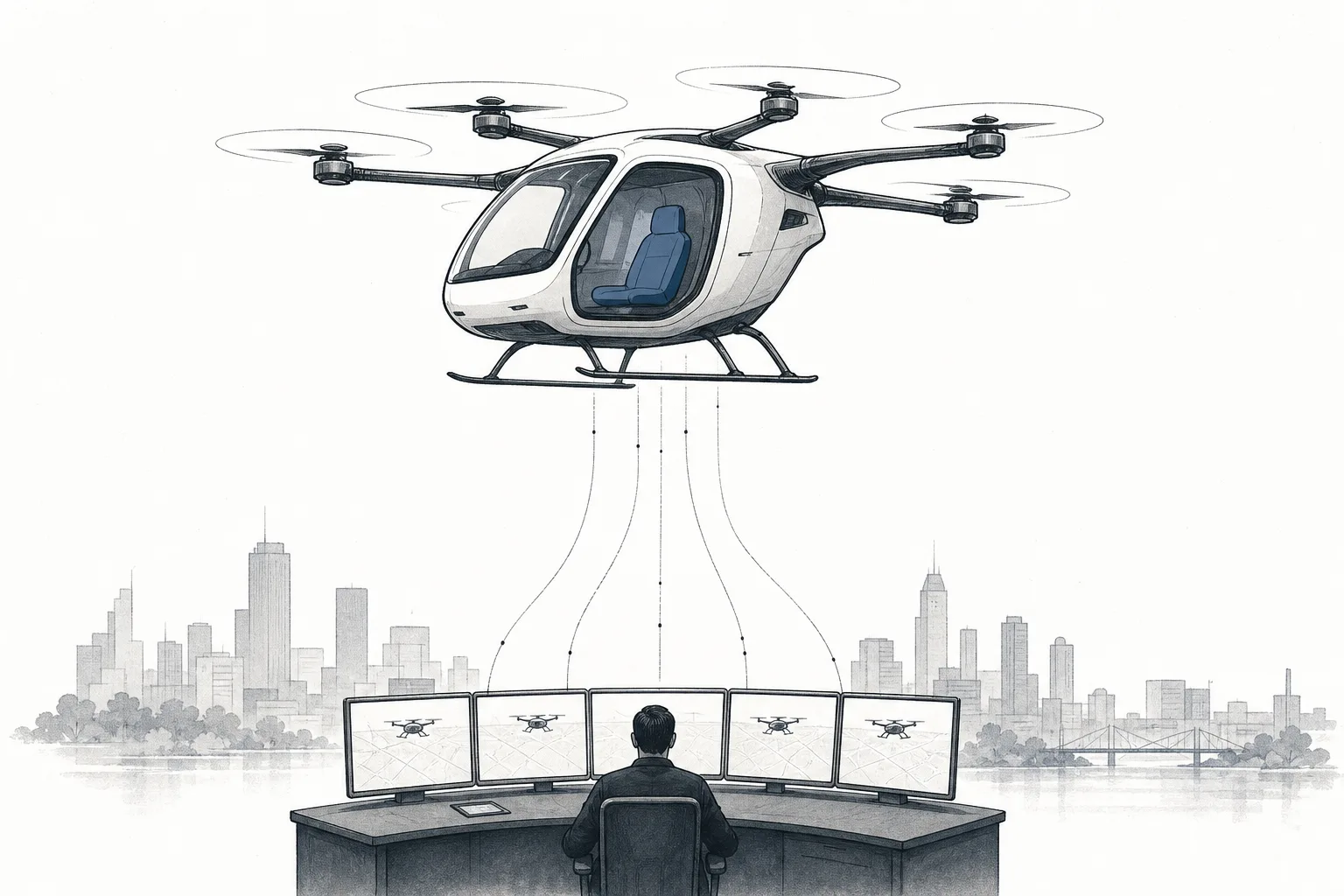
"Pilotless" here doesn't mean no human is involved at all — it means there's no pilot on board. The aircraft flies with its own brain (onboard autonomy), while the human moves to a "ground command center" where one person watches several aircraft at once. It's like an air traffic controller watching many planes from a tower — except now the "supervisor" and the "pilot" are the same person, on the ground.
Autonomy = the aircraft's ability to fly itself on plan and decide for itself, with no one holding the controls · Remote supervision = a human watching from the ground, ready to step in if needed (one person to many aircraft) · Detect-and-Avoid = a system that uses sensors to detect obstacles or other aircraft and dodge on its own — an essential skill once there's no pilot's eyes looking out the window.
02Why taking the pilot out changes everything
Here's a fair question — why go to the trouble of removing the pilot, when it's harder and scarier in most people's eyes? The short answer is economics. For a flying taxi to be cheap enough for ordinary people to actually use (not just the rich in helicopters), the pilot is the biggest and hardest cost to cut.
The numbers are clear — pilot wages run about 30–40% of the cost per flight. Take the pilot out and nearly half the cost per trip vanishes, and you skip the headache of "finding a pilot" in an industry that's already short on them — eVTOLs need thousands of specially trained pilots to scale a fleet across a city, and the world can't produce them fast enough. That's the "ceiling" that keeps the piloted model from scaling quickly.
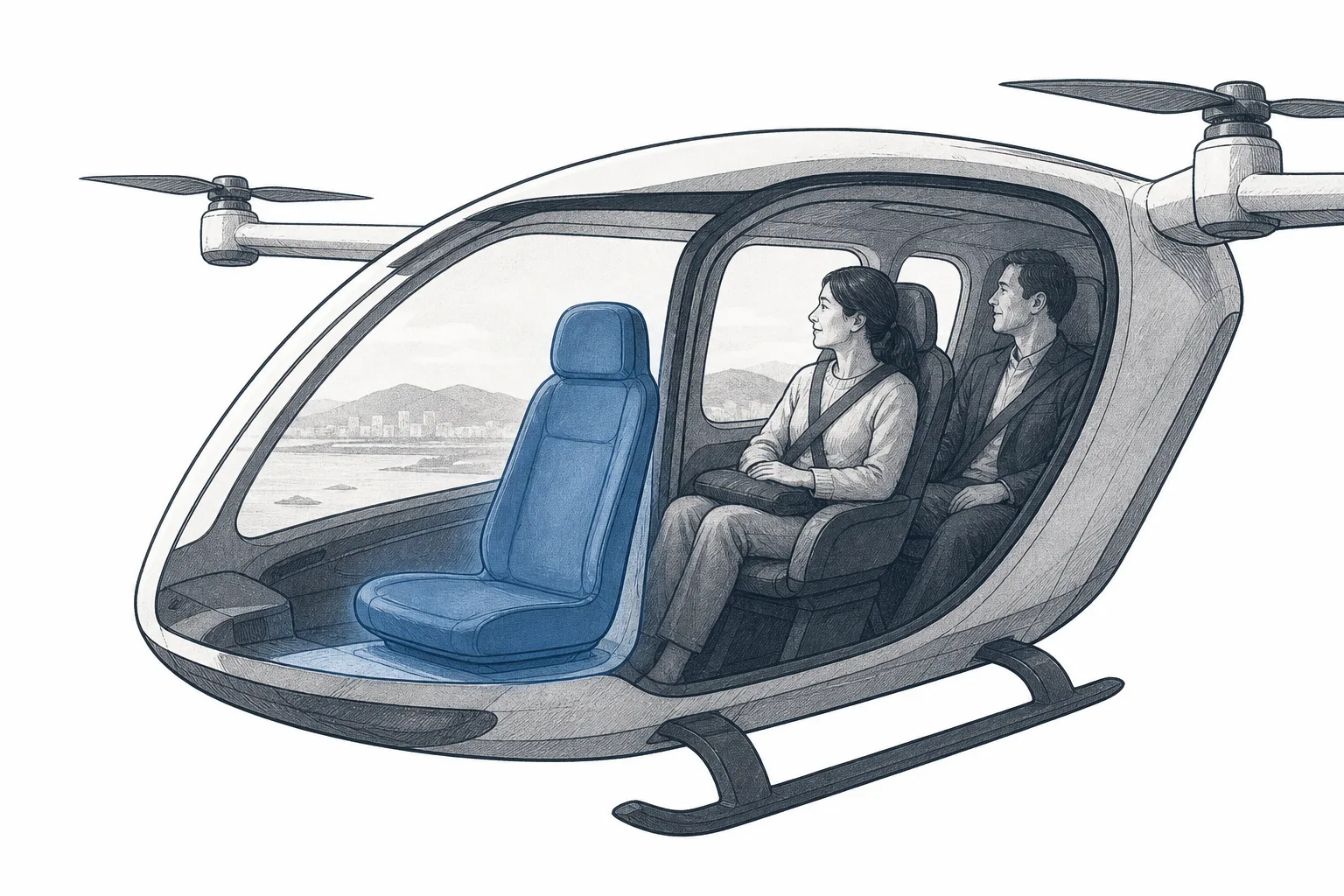
What people often miss is the "seat that comes back." In a small eVTOL that seats only 2, if one of them has to be a pilot, you can sell just one ticket. But with no pilot, both seats become paying passengers — revenue per flight instantly doubles, with the flying cost barely changed. For a business with razor-thin profit per flight, gaining a seat plus cutting the pilot cost is the difference between "losing money every trip" and "scraping a profit."
That's why even the Western side, which starts with pilots, agrees the endgame is pilotless — because if you don't eventually take the pilot out, the numbers never get pretty enough to be mass transit. So the question isn't "will it go pilotless," it's "who gets there first."
03How it flies itself — the onboard brain + the ground center
If there's no pilot on board, then who "flies"? The answer is a three-layer system working in concert. Let's walk through it piece by piece — how an uncrewed aircraft safely takes you from A to B.
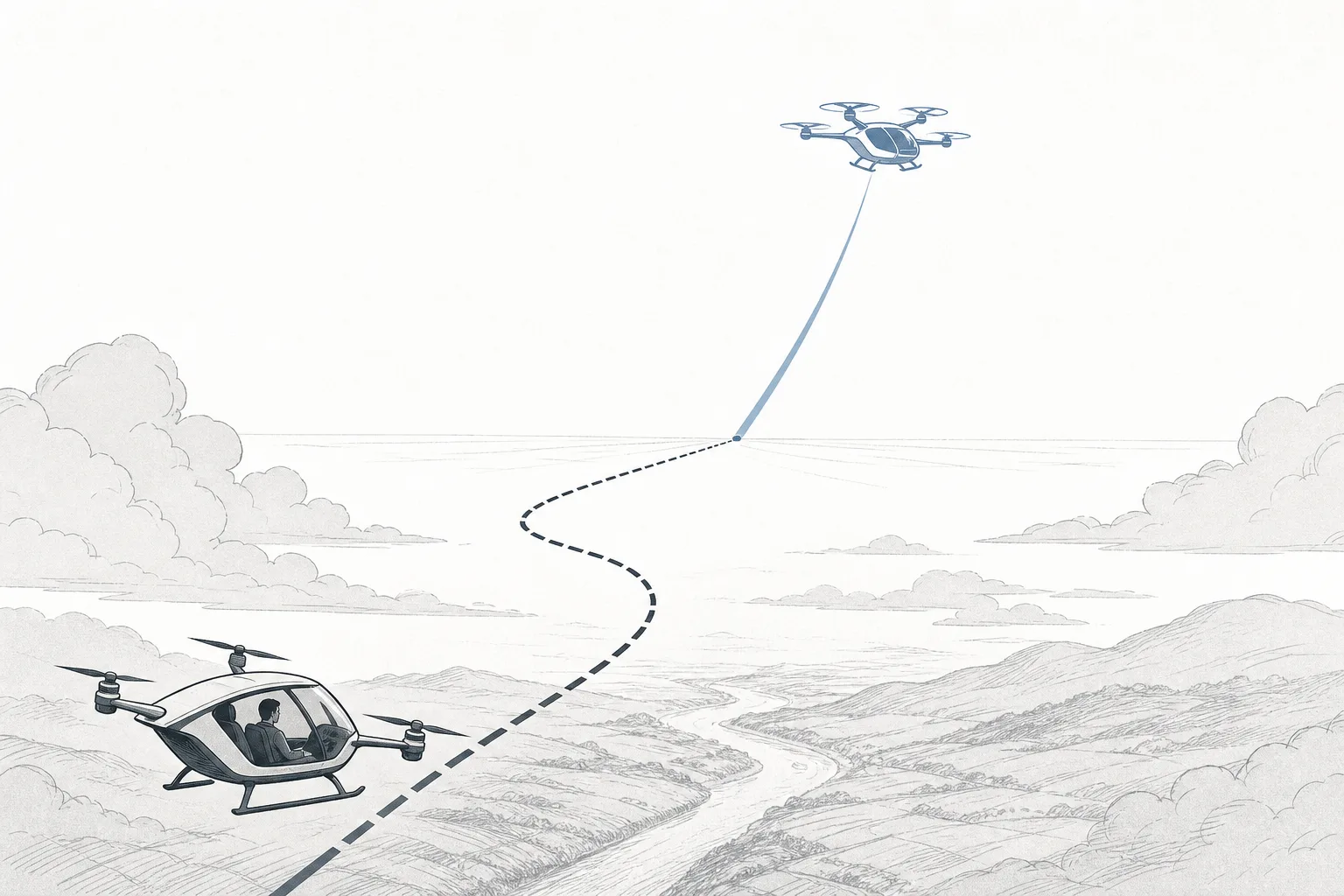
The first layer is the onboard brain — cameras, radar, and multiple sensors feed data to a flight computer running decision-making software. It knows its own position, plots the route, controls climb and descent, and crucially does detect-and-avoid — if a bird, a drone, or another aircraft comes in, it has to see and dodge on its own without waiting for a command, because there's no pilot's eyes looking out the window anymore. Everything needs redundancy stacked in several layers, in case any one part fails.
The second layer is the ground command center — the human hasn't gone anywhere, they've just moved to the ground. At this center one person watches screens showing the status of several aircraft at once, checks that each is fine, and stands ready to "step in" and order a landing or a route change if anything goes wrong. This is the key to the economics — from one pilot per aircraft to one person for many.
The third layer is integrating with air traffic — dozens of uncrewed aircraft can fly over a city at once only if there's a central system allocating airspace lanes so they don't collide, seeing every aircraft in real time. That's why this node will only truly scale once the airspace infrastructure follows — a smart aircraft alone isn't enough.
04How it connects to AI and robotics
An aircraft that "flies itself" is, in the end, a flying robot driven by AI. So this node doesn't stand alone — it leans inseparably on other trends.
- The core is artificial intelligence (AI): perceiving the surroundings, plotting the route, and deciding how to dodge in real time are all AI's work. The more accurate and reliable the perception model, the more safely the aircraft can fly itself — advances in AI from self-driving cars and vision AI carry straight over to this node
- An extension of robotics and Physical AI: the problem of "getting a machine to perceive the real world and move itself safely" is the same problem as robotics — sensor fusion, obstacle avoidance, safety redundancy. An uncrewed eVTOL is a robot that flies, borrowing much of its technology from this lineage
- Differs from its sibling, the piloted branch, right here: the West uses the pilot as a "ready-made safety system" to clear the rules easily first, then removes them later. This node instead lets software prove the safety from day one — harder on the regulatory front, but if it gets through, it jumps straight to better economics
- Depends on electrification and critical raw materials: like every eVTOL, it's tied to batteries, electric motors, and the rare-metals supply chain. What's special is it also eats extra compute and sensors, because it has to "think" in the pilot's place throughout the flight
05Where things stand now — China leads vs Wisk/Boeing
What has the Western aviation world thinking is this: the first "real commercial" uncrewed passenger eVTOL in the world wasn't born in the U.S. or Europe — it was born in China. And it's already flying, selling tickets, while the West is still in the test hangar.
The lead character is EHang. Its EH216-S is a 2-seat uncrewed multicopter that has earned the full set — type certificate + production certificate + airworthiness certificate + air operator certificate (AOC) — from China's aviation authority (CAAC), the first and only one in the world to complete the set for an uncrewed passenger eVTOL. On March 30, 2025, CAAC issued AOCs to two operators in Guangzhou and Hefei, opening the way to sell real tickets for short sightseeing flights.
What's stunning is the speed — EHang needed just about 31 months and over 40,000 test flights to earn the type certificate, against Western timelines usually described in "years." In the first half of 2025 alone, the EH216 family had already flown over 10,000 flights safely, and late in 2025 it even crossed the 22-kilometer Qiongzhou Strait in 18 minutes.
The West's real contender is Wisk Aero, a Boeing subsidiary that also chose pilotless from day one. Wisk's Generation 6 seats 4 people, with no cockpit or controls at all, designed to fly itself with a "Multi-Vehicle Supervisor" — one person overseeing up to 3 aircraft from the ground. Gen 6 first flew in December 2025 and added a second aircraft to the test program in May 2026 — the first uncrewed aircraft to seek an FAA passenger-carrying certificate in the U.S. But the road is still long, because Wisk is asking the FAA to certify it with "autonomous software as the evidence of safety" — the hardest argument in the industry.
On top of that, China's side has deep reserves — XPeng AeroHT (an affiliate of EV maker XPeng) has piled up over 7,000 flying-car reservations worldwide and aims for real production in 2026. Meanwhile, the U.S.'s Joby and Archer hold "pilotless plans" of their own (Joby bought the autonomy team Xwing to build a "Superpilot," and Archer is preparing to unveil an autonomy product in late 2026) — but both insist they'll start with pilots and remove them later.
06The future — can the West catch up?
The future of this node hinges on three forces pulling in different directions.
The first force is the size of China's market, backed by state policy. The Chinese government is pushing the "low-altitude economy" as a new growth engine for the country, with the CAAC putting this industry's value at about 1.5 trillion yuan (~$211 billion) in 2025 and over 3.5 trillion yuan by 2035. With demand, capital, and rules that open the way all in place, China can race ahead and build first — while the West is still stuck at the regulatory gate.
The second force is the West taking the "long way around". Joby and Archer intend to start with pilots to clear the FAA first, then upgrade to pilotless once both the technology and the rules are ready. Wisk, meanwhile, like China, chose to go straight at pilotless from the start. The big question is — how quickly will the FAA accept "software in place of a pilot"? Most analysts see full-scale commercial pilotless flight in the West as unlikely before the late 2030s, leaving China a lead of several years.
The third force is proving that "flying itself is genuinely safe." Every successful EHang flight and every Wisk test flight builds up the safety evidence bit by bit — because in the end, both regulators and the everyday public will only board a pilotless aircraft once they see enough safety statistics. This is a long game where the "number of safe flights" is the real currency.
07Challenges & risks
This node is one of the bets whose payoff could be enormous, but it's also packed with risks even more particular than the piloted branch.
The first risk is regulation and trust toward "an aircraft with no pilot." Convincing Western regulators (especially the FAA) that software is safe enough to replace a pilot is the hardest task in the industry. And just as hard is passenger trust — many ordinary people are still wary of boarding an aircraft with no human up front. A single accident could shake the whole industry's confidence, because the safety standard society demands of an "uncrewed aircraft" is even higher than for a self-driving car.
The second risk is concentration in China. This node's advantage right now is almost entirely on the Chinese side — the certificates, the real flights, the supportive policy. That's a double-edged sword: on one hand it's a tangible lead, on the other it means the fate of the whole branch is tied to a single market and a single regulatory system. Geopolitical tension, trade barriers, or a policy shift in China could all hit this node harder than a trend spread across many countries.
The third risk is dependence on a single product and the financial position. EHang, the branch's leader, sold 221 aircraft in 2025 (215 of them the single EH216 family), earning revenue of about $73 million, up 11.7% — but still posted a net loss of about RMB 231 million. Relying on one core product and not yet turning a profit means the company still has to prove it can scale from "short sightseeing flights" to "real travel in the city" that earns sustainably — and no one has walked that road to the end yet.
In short: this node is a bet that "taking the pilot out" will unlock the economics that turn flying taxis into genuine mass transit. Today, China has proven it can happen commercially, while the West is working toward the same point by a route that's safer in the eyes of regulators — and that difference in timing is the most compelling story of the whole branch.