Megatrend · Advanced Air Mobility
The West's flying taxi is close to really flying — one last gate left, and a race to see who runs out of money first
2026 is the year the West's "flying taxi" moved from a prototype in a video to an aircraft the FAA is about to actually certify — Joby is on the verge of its Type Certificate and plans to start flying in Dubai late this year, while Archer became the first to close FAA Phase 3 and was picked as the official air taxi of the LA28 Olympics. But this lesson tells it straight: the whole field still has almost no revenue and is burning cash hard — and why putting one "pilot" on board is the smartest strategy, not a weakness.
01What it is
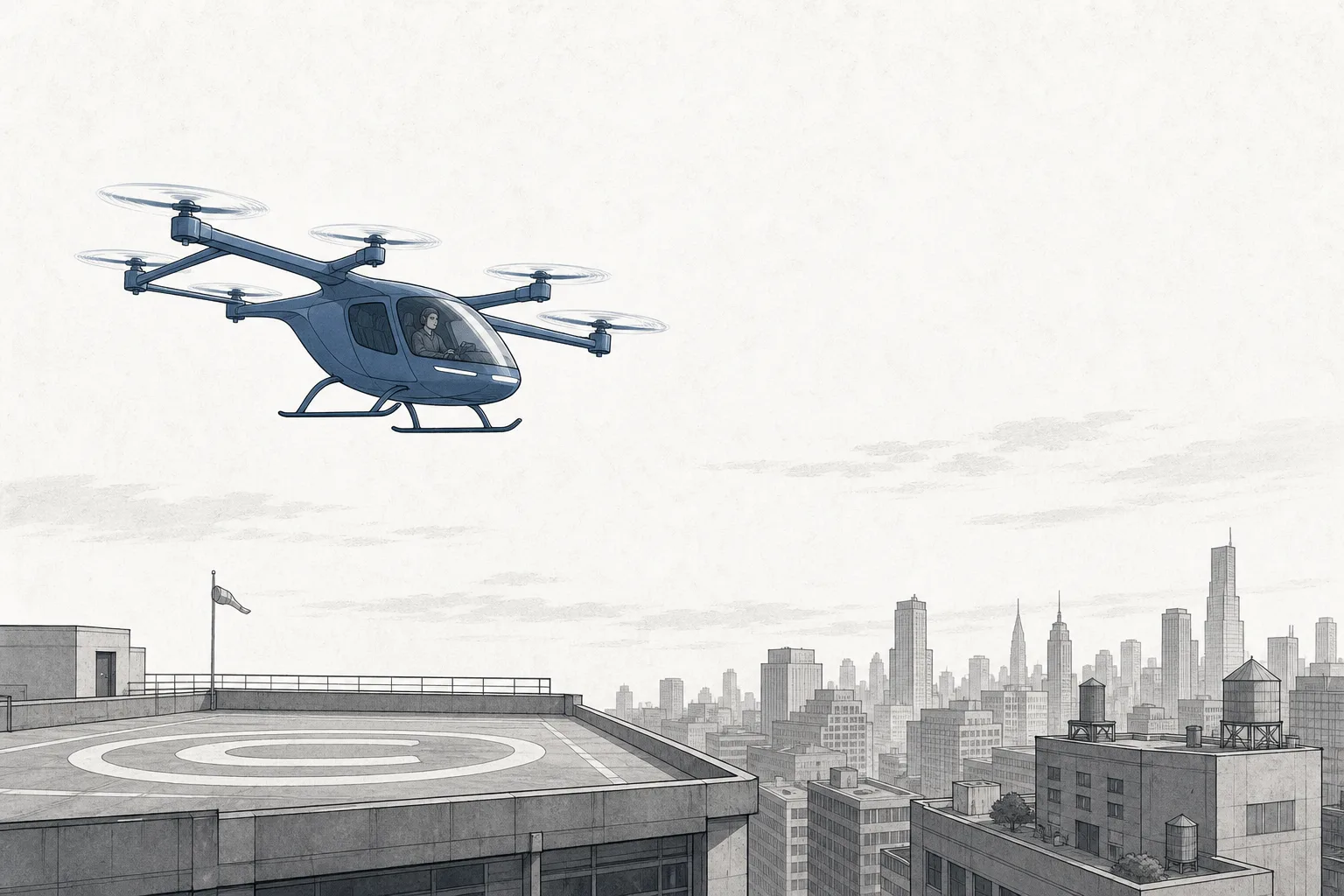
Picture a helicopter so quiet you can sit and talk. No roar of a combustion engine, no smell of fuel — just the sound of wind from lots of small propellers. That's an eVTOL (electric Vertical Take-Off and Landing — an electric aircraft that takes off and lands vertically). It lifts straight up like a helicopter, then once it's in the air it spreads its wings and glides forward like a plane. This node zeroes in on the Western companies building "piloted" aircraft for urban air taxis — in the U.S., Europe, and Brazil.
On the megatrend map, this node is one of two branches of Passenger eVTOL OEMs (the makers of the air-taxi aircraft itself), under the bigger trend Advanced Air Mobility. OEM stands for Original Equipment Manufacturer — the ones who actually build the aircraft, not the ones making parts or landing pads. This branch is the "star of the show": the aircraft itself.
"Piloted in the West" sounds backward, but it's actually a strategy. Companies like Joby, Archer, Vertical, and Eve choose to put one pilot on board their first models, because the safety rules of Western aviation authorities (the U.S. FAA and Europe's EASA) were built on the assumption that "a person must control the aircraft." Having a pilot lets them get certified faster. The sibling branch — pilotless eVTOLs — chose to cut the pilot from the start, a completely different philosophy that we'll compare in Chapter 4.
It's the stamp from an aviation authority saying "this model is safe enough to carry people" — the single gate standing between a company and its first dollar of revenue. Before passing it, every company is worth only "a prototype and a promise." The FAA splits this process into several phases/stages, and every stage usually takes longer than anyone expects — and that delay is the heart of every risk in this lesson.
02Why it matters — a multi-billion-dollar bet
The reason investors pour money into companies with no revenue at all is the size of the prize at the finish line. If it works, eVTOL solves the oldest problem in cities — traffic — by lifting travel into the sky. A trip from the airport to downtown that normally takes an hour on the road could shrink to 10–15 minutes in the air, at a price aimed closer to a luxury taxi than a private helicopter.
The eVTOL market is still small today — about $4–5 billion in 2024. But many research firms expect it to leap to roughly $23–29 billion by 2030, at a compound annual growth rate (CAGR) of 30%+. That number only happens if the aircraft pass certification and real commercial flights begin right around now — which is exactly what's about to happen in 2026.
But what makes this a real "bet" is the cash equation. These companies have to spend billions of dollars before their first dollar of revenue — research, flight testing, building factories, and a certification process that drags on for years. This is truly an "invest first, revenue many years later" business, which makes cash on hand as important as the technology — some have great tech but run out of money before the finish line, and that's that.
03How it flies — three moments that have to be exactly right
The heart of every eVTOL is something called "distributed electric propulsion" — instead of one big engine, it uses many small electric motors driving many propellers spread across the aircraft. There are three advantages: if one fails, the rest can still hold the aircraft up (safer) · small propellers spin slower than a single giant rotor, so it's much quieter than a helicopter · and there's no combustion engine that needs heavy maintenance, so repair and fuel costs drop.
But the real challenge isn't "lifting off." It's switching from hovering to flying forward on the wings. Let's walk through the three moments of a single flight:
The middle moment — called the "transition" — is what makes an eVTOL harder than both a helicopter and an ordinary plane, because it has to be both in one aircraft. As the propellers slowly tilt, the aircraft's weight has to pass smoothly from "propeller lift" to "wing lift." Botch that one second and the aircraft drops. That's why Joby is so proud of pulling off "transition with a real pilot on board," and it's the point the FAA scrutinizes most.
Why does "gliding on the wings" matter? Because hovering on propellers alone burns enormous energy — the battery drains fast. Catching the weight on the wings during cruise is what lets an eVTOL fly as far as ~100–150 miles, instead of just a few miles like a giant drone — but at the cost of more complex mechanics and harder certification.
04Where it sits in the ecosystem
The eVTOL aircraft is just one piece of a much bigger puzzle. It leans inseparably on other trends, and it differs clearly from its sibling branch.
- Its fate is tied to Electrification: the whole aircraft is electric motors and batteries — the same technology that powers EVs. If battery energy density improves, eVTOLs immediately fly farther and carry more. This is the "wall" that limits the whole field right now
- It needs chips and AI: the fly-by-wire control system that manages many propellers at once and handles the delicate transition relies on advanced software and sensors
- It uses special materials from the critical-materials supply chain: a lightweight carbon-fiber body and rare earths in the motors/batteries make it sensitive to the global supply chain
- It edges toward robotics and Physical AI: every company's long-term goal is to "remove the pilot" and fly autonomously — which is, literally, a flying robot
05Where it stands now
2026 is the moment of truth for the whole Western field — some are nearing the finish, some have slipped far back, and some have already fallen. The difference between them teaches the same lesson: in this game, cash on hand matters as much as technology.
Joby is out front. It has powered on the first aircraft built to certification standard, entered the FAA's final stage, and expects its Type Certificate around September 2026. What sets it apart is that Joby chose to launch commercial service in Dubai first — signing a 6-year operating-rights deal with the RTA and building its first four vertiports, including one at Dubai Airport (DXB). With a $2.5 billion cash runway and backing from Toyota and Delta, Joby has the room to wait out the gate.
Archer is right behind, and set a record as the first eVTOL company to close Phase 3 of the FAA's four-stage Type Certification process (April 2026). Its aircraft, Midnight, has strong partners — United Airlines placed a $1 billion pre-order and Stellantis (owner of Jeep/Peugeot) helps build it. The big news: Archer was chosen as the official air-taxi operator of the LA28 Olympics. Archer had about $1.8 billion in liquidity as of Q1 2026 but loses around $170 million a quarter — so getting certified fast is a matter of life and death for Archer.
Europe and Brazil move slower but carry long order books. Vertical Aerospace (UK) pushed its VX4's full-certification target back to around 2028 and needs roughly $700 million more, but holds about 1,450 pre-orders (worth about $6 billion), led by American Airlines with 350. Meanwhile Eve Air Mobility (a subsidiary of Brazilian aviation giant Embraer) has the biggest backlog in the field — about 2,900 aircraft, worth roughly $14.5 billion in total — aiming to enter service around 2027. Eve's edge is having a "parent" that has built real aircraft its whole life.
A new face is energizing the field — Beta Technologies went public (IPO) in New York in late 2025, raising over $1 billion at a valuation of about $7.4 billion. Beta's aircraft, ALIA, stands out for racking up tens of thousands of real test-flight miles, including the first all-electric passenger flight into JFK Airport — a sign that capital is still flowing into this field even as some players fall.
06The road ahead
The first direction is unlocking the West's first certification. If Joby gets its Type Certificate and starts flying in Dubai in 2026 as planned, it will be the "first proof" that the "piloted first" model really works, and it'll open the way for Archer, Vertical, and Eve to follow — because once a regulator has issued a first eVTOL certificate, the second tends to come faster.
The second direction is gradually removing the pilot. "A pilot on board" is only the first step. The long-term plan for nearly everyone is to shrink the pilot's role all the way to fully autonomous flight — which would slash the cost per trip (no pilot to pay for) and add sellable seats. Here the Western branch slowly edges toward what the pilotless branch did from the start.
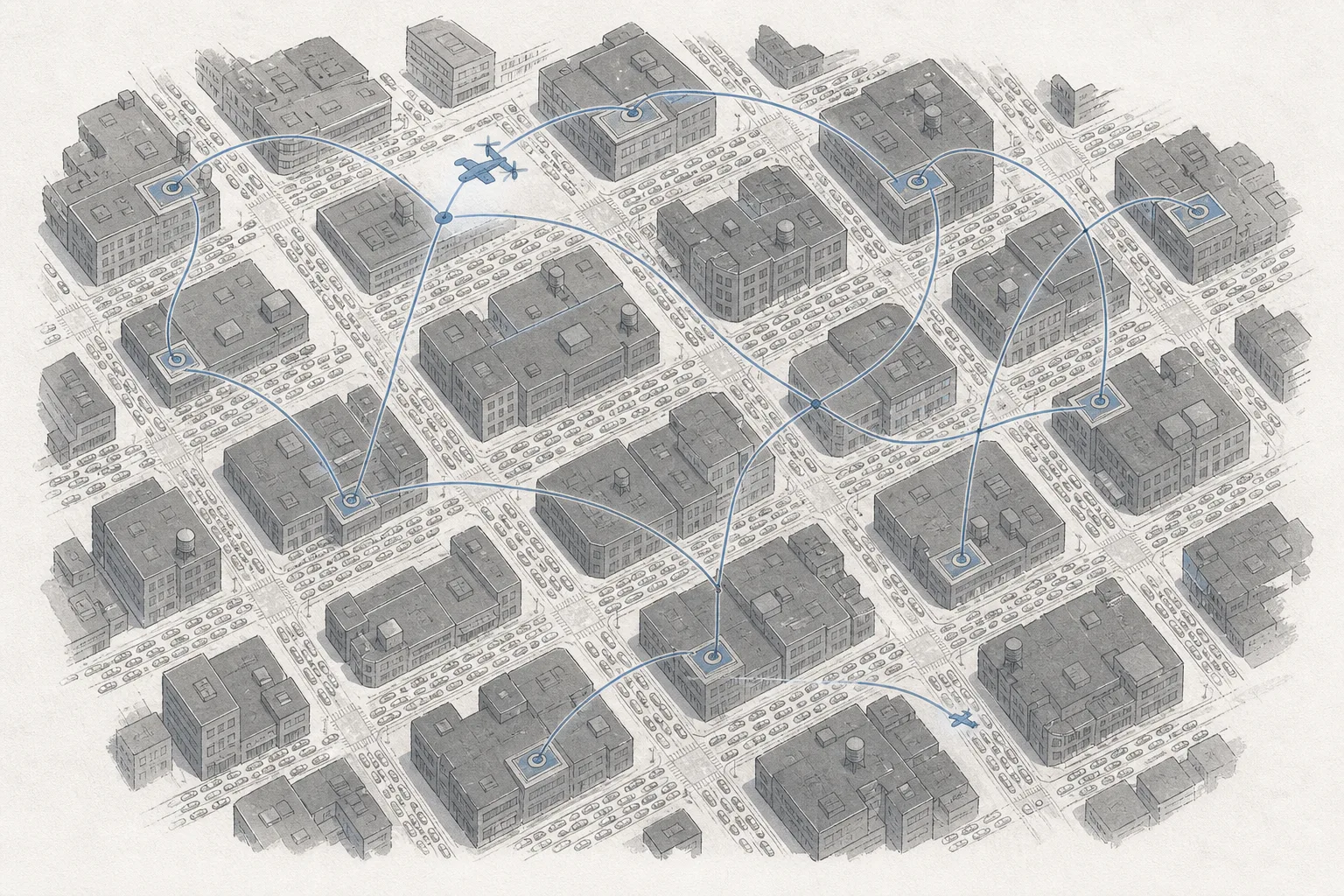
The third direction is infrastructure has to keep up. Even with a certified aircraft, you can't fly a network without vertiports and an urban airspace-management system to support it — which is why Joby is building its own vertiports in Dubai now, and why the whole trend's overview keeps stressing that "the aircraft alone isn't enough."
07Challenges & risks
The first and biggest risk is running out of money before the finish line. This lesson has real corpses to show — Germany's Lilium, once a European star, went bankrupt twice (October 2024 and February 2025) after funding deals collapsed again and again. Even though a new capital group tried to revive it with about €250 million in mid-2025, Lilium's story is a reminder that this node is not "build the aircraft and you win" — good tech but money runs out midway and it's over. And because every company is still burning cash before revenue, each new funding round tends to dilute existing shares.
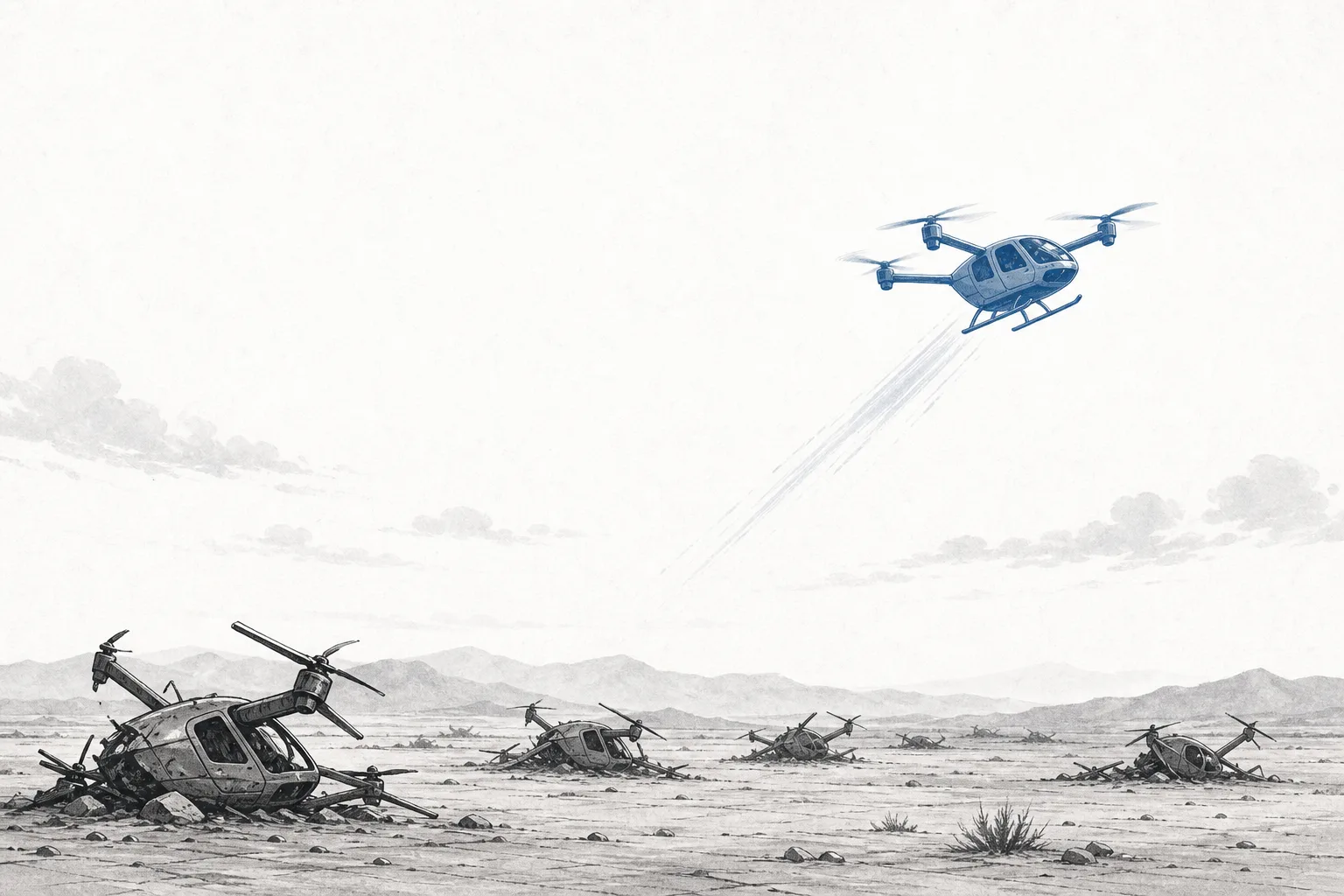
The second risk is a certification finish line that keeps running away. Nearly every company in the field has pushed its certification date back at least once (Vertical to 2028, Eve aiming for 2027). Every delay means more cash to burn and less investor confidence — and that delay is why many analysts have cut their long-term market-size estimates.
The third risk is the battery-and-range wall. Today's battery energy density limits eVTOLs to ~100–150 miles and a few seats, which makes the early business model narrow (short routes from airport to city). If batteries don't improve fast enough, expanding to longer routes or heavier loads simply can't happen — so this node is tied directly to the progress of battery technology.
In short: this node is the group of Western companies about to carry the "piloted flying taxi" across the line from science fiction into a real business for the first time in 2026, past aviation's hardest gate — safety certification. Having a pilot isn't backwardness, it's a shortcut through the law. And in this arena, the two things that decide everything are certification and cash.