Megatrend · Robotics & Physical AI
The motor spins blazingly fast but has no strength — and one tiny gear turns it into "an arm that holds still to a fraction of a degree"
Everyone talks about the AI "brain" of a robot. But what decides whether a robot arm can "pick up an egg without cracking it" isn't software — it's the high-precision reducer inside the joint. This part takes a motor that spins fast but weak and turns it into motion that's slow, hugely powerful, and steady to the level of an "arc-second." It's so hard to make that fewer than 5 companies in the world can do it at the top tier — and it's the most expensive part in nearly every robot. Whoever controls this gear controls the cost and the precision of the whole robotics industry.
01What it is (the high-precision reducer)
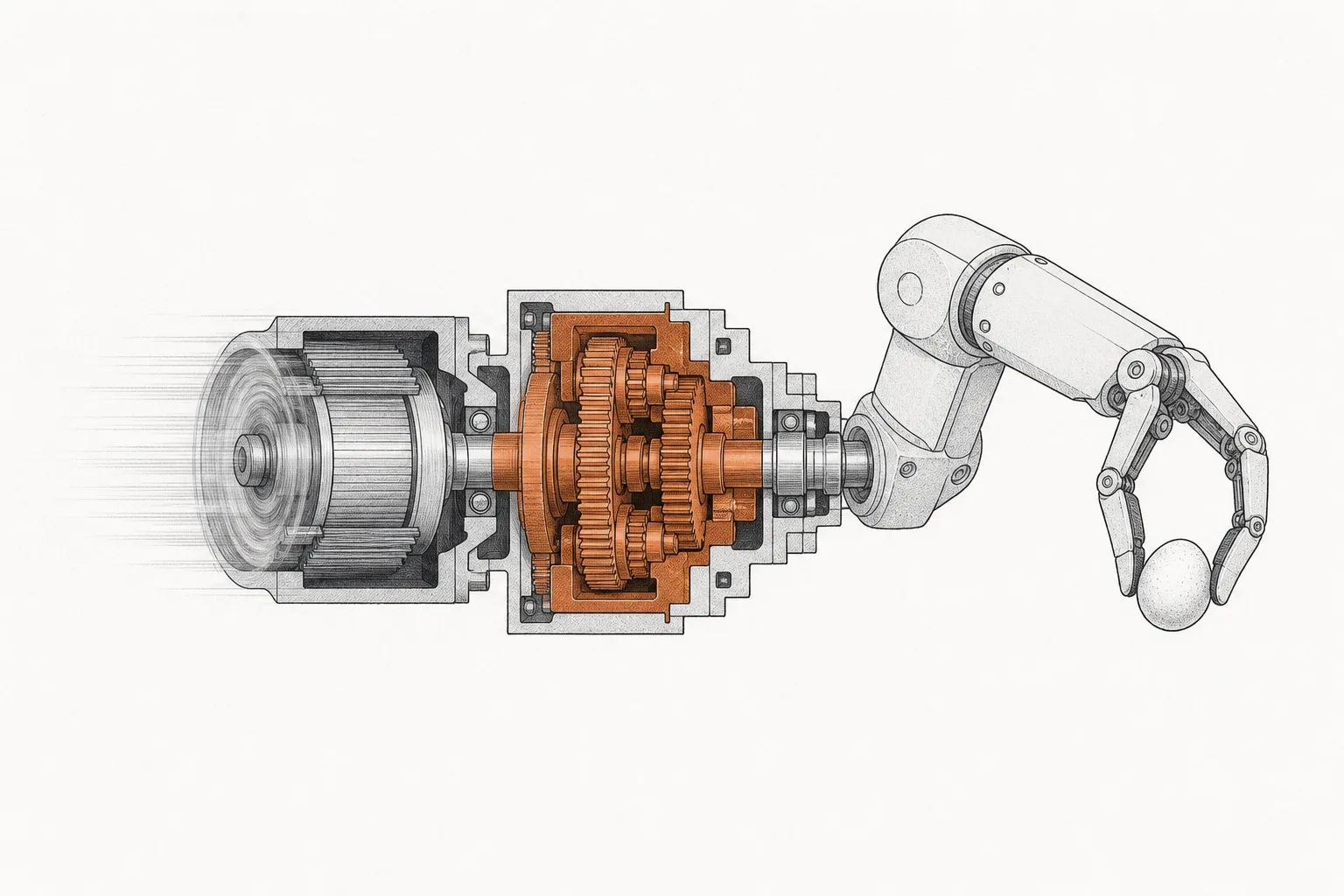
Try a simple thought experiment: connect a small electric motor to a one-meter robot arm, then tell it to "lift a 5 kg weight and hold it dead still at an exact position" — it can't. By nature, an electric motor spins very fast but has very little torque, like a fan that whirs away but you can stop with your hand. An arm bolted straight onto the motor would be floppy and shaky.
What fixes this is the part this lesson is about — the high-precision reducer (a precision reducer or precision drive). It's a gearbox inserted between the motor and the joint, and its job is "reduction": it takes the fast, weak spin from the motor and turns it into rotation that's tens to hundreds of times slower but tens to hundreds of times stronger. And most important of all — it does this with zero "play" (backlash), which is what makes it steady and precise.
On the megatrend map, this node is the deepest branch under Robotics Components & Actuation in the big trend Robotics & Physical AI. It sits in the "upstream layer" — the maker of the parts that robot manufacturers assemble. Its siblings are Servo Motors & Magnets (the motor that feeds in the power) and Machine Vision & Sensing (the eyes and senses). If the motor is the "muscle," the reducer is the "joint" that turns raw force into controlled motion.
Backlash = the tiny gap between gear teeth that creates "free play" when you reverse direction — ordinary gears always have it, but robot gears must have zero, because a sliver of slack at the base of the arm becomes several millimeters of error at the tip · Arc-second = a very fine unit of angle, equal to 1/3,600 of a degree — top-tier gears keep their error down to this level · Reduction ratio = how many turns the motor makes per one turn of the joint, e.g. 1:100 means the motor spins 100 times for the joint to move once — the higher the reduction, the slower but stronger.
02Why it's a bottleneck + the most expensive part
There's a saying in investing: "In a gold rush, the ones who really get rich are the ones selling picks and shovels" — and in the robot gold rush, the high-precision reducer is the most expensive pick and shovel of the bunch. Break down the cost of a robot's parts and the drive system (motor + gear + sensors) eats up roughly 40–60% of the whole machine, and within that, the reducer is the single most expensive and hardest part to make — some estimates put it at ~35% of the cost of the entire robot.
Why are there so few who can do it? Because it's hard in a way that gives you chills. The heart of a harmonic gear is a "thin steel cup" whose teeth must be ground onto a wall just ~0.2 mm thick, with precision that requires holding the machine spindle's "wobble" within 1 micron and keeping room temperature from swinging more than ±0.5°C while grinding. Knowledge and tooling at this level take decades to build up, becoming a wall that newcomers find very hard to climb.
And its importance isn't just the price — it sets the ceiling on the precision of the whole robot. However smart the AI software is, it's meaningless if the joint has backlash that makes the arm overshoot by half a centimeter every time it changes direction. The quality of this gear is what decides whether a robot can "weld metal in a straight line," "assemble electronic parts," or "pick up an egg without cracking it" — it's precision baked into the hardware.
03How it works (a wave of twist in a steel cup)
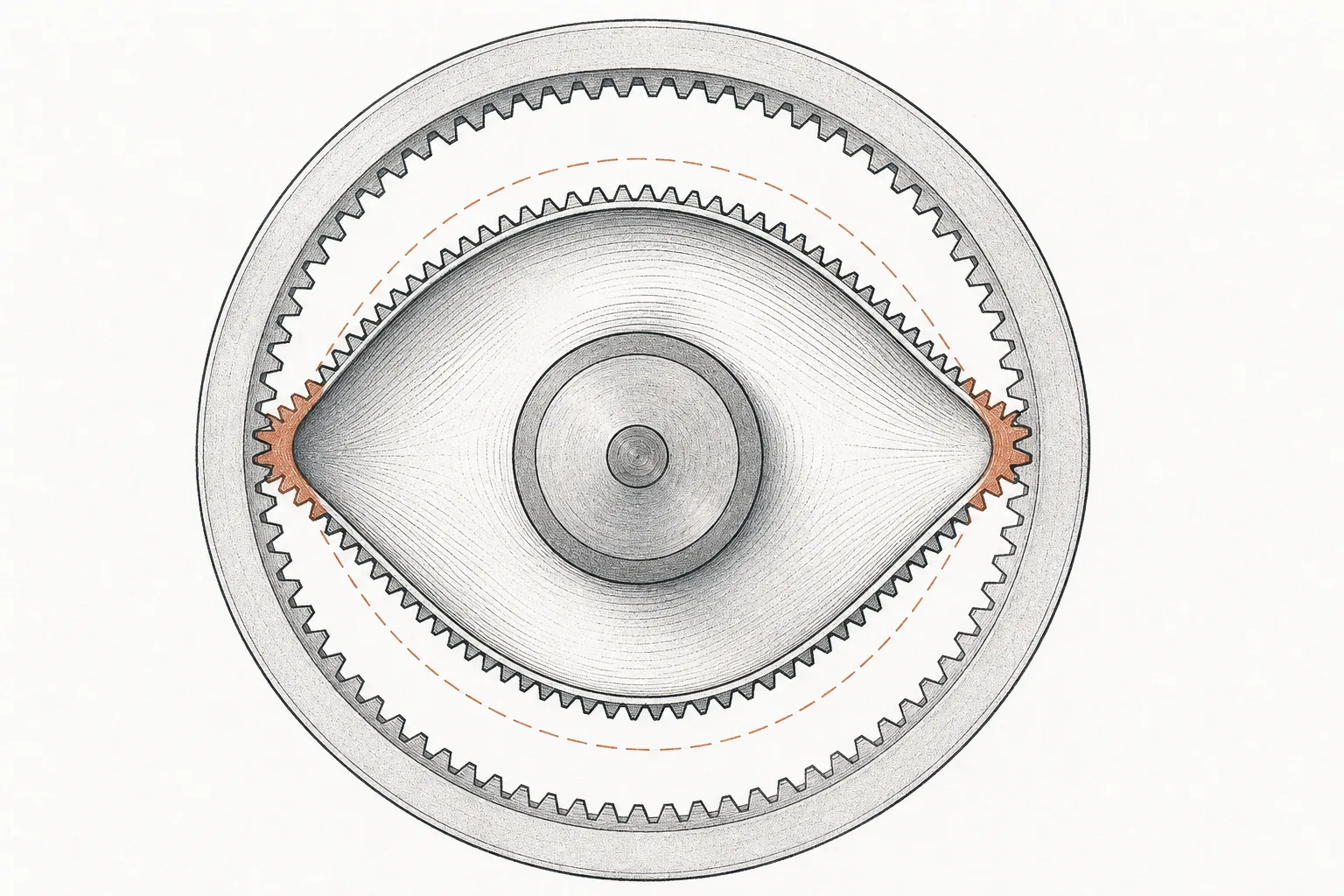
The standout mechanism of this node is the harmonic drive, also called the strain-wave gear — the name sounds futuristic, but it was actually invented back in the 1950s, and its cleverness lies in using the "flexibility of metal" to reduce speed instead of meshing hard gears the usual way. It has just 3 parts:
Here's the deep cleverness: an ordinary gear needs several stacked stages to get a high reduction ratio, making it big, heavy, and full of accumulated gaps that turn into slack. But a harmonic gets a 50:1 to 160:1 reduction in a single stage with just 3 thin, light parts. And because many teeth mesh at once all the time, it has "no play" by nature — perfect for the small joints of robot arms and humanoids that need precision in a tight space.
04harmonic vs cycloidal + what it connects to
High-precision reducers come in two main families, each born for a different kind of work — understanding this difference is understanding why the market splits into two camps.
- Harmonic (strain-wave): what we just saw in the previous chapter — light, compact, zero backlash, but it handles less torque, so it suits the small joints at the arm tip like robot wrists and the joints of humanoids that need to be light and precise
- Cycloidal / RV reducer: uses a "cycloidal disk" pushed by an eccentric shaft to wobble against outer pins — a two-stage system (planetary + cycloidal) that's far tougher. It withstands shocks up to ~5× rated torque and has high torsional stiffness, so it suits the big joints at the base of the arm on industrial robots that have to lift tens of kilos
An easy way to remember it: harmonic = light, precise, for small joints · cycloidal/RV = strong, tough, for big joints. An industrial robot usually uses RV at the base in 3–4 joints and harmonic at the wrist in 2–3 joints, while a humanoid that needs to be light all over leans mainly toward harmonic — which is why the two technologies don't compete head-on but split the field into separate zones.
An RV reducer reduces speed on a different principle from a harmonic: the rotating shaft drives an eccentric cam that pushes a cycloidal disk to orbit in a circle without spinning on its own axis. The disk's teeth mesh with the outer pins several at a time, and because the disk has fewer teeth than the pins, each full orbit nudges the output shaft slowly — the fact that many teeth take the load at once is why the RV is so shock-resistant and stiff.
So how does this tiny gear connect to other trends? It's the "hard floor" that holds up the whole robotics industry:
- Always paired with Servo Motors & Magnets: the servo motor feeds in the spinning power, while the reducer turns that power into something actually usable — the two combine into one "joint" (actuator) and can rarely be sold separately
- Feeds Humanoid Robots and Industrial Automation & Cobots directly: these are the real customers — one industrial robot uses about 4–6 gears, but one humanoid uses 25–40 joints, meaning demand per robot jumps several-fold as the world turns toward humanoids
- Depends on Critical Materials & Supply Chain: a quality gear needs special steel and precise heat treatment, and the motor it pairs with needs rare-earth magnets — making the whole joint sensitive to strain in the raw-materials supply chain
- Awakened by AI: a smarter AI "brain" is what makes a robot actually useful — but AI can only give commands if there's a "joint" precise enough to follow them. The smarter the AI, the more demand for high-precision gears surges
05Where it stands now
The most shocking thing about this market is its concentration. The five big makers of high-precision reducers — Harmonic Drive Systems, Nabtesco, Sumitomo Heavy Industries, Wittenstein, and Nidec-Shimpo — together control about 61% of the global market value in 2025, with a clear split of territory: Japan's Harmonic Drive Systems owns the original strain-wave gear technology and rules the premium harmonic market, while Nabtesco holds ~60% of the RV reducer market for the big joints of medium-to-large industrial robots.
And a fresh wave of demand really is coming. Harmonic Drive Systems returned to growth in fiscal 2025 (ending March 2026) with sales up +7%, and its March-quarter orders hit a 4-year high. Management is targeting another ~14% growth in fiscal 2026 — a sign that the humanoid wave is turning from hype into real orders. The whole harmonic-drive market sits at about $2.8 billion in 2025 and is expected to grow to ~$6.1 billion by 2034 at a CAGR of ~9%.
But the other side shaking the board is China's rise. Because the gear eats up such a big chunk of robot cost, being able to make it in-house is the key to making Chinese robots cheap enough to compete. The leader is Leaderdrive (绿的谐波 / Leader Harmonious Drive), which holds about 25–30% of China's harmonic market (J.P. Morgan puts it as high as 30–40%). In 2025 its revenue grew +47% to ¥570.7 million, net profit doubled to ¥124.4 million, and it shipped over 300,000 strain-wave gears a year — supplying Chinese robots like UBTech and Agibot and getting into the Tesla Optimus supply chain. Behind it are Shuanghuan Driveline and Zhongdali, chasing both RV and harmonic.
06What's ahead — the humanoid wave
The first direction is clearest: humanoids will turn this node from a niche market into a mass market. One industrial robot uses about 4–6 reducers, but one humanoid needs 12–20 or more (some estimates run as high as 25–40 joints). In 2025, global humanoid shipments jumped nearly 480% to ~13,318 units and are expected to reach ~2.6 million by 2035 — and if even a fraction of that comes true, demand for high-precision gears will grow exponentially.
The second direction is a price war that China is starting. Tesla's goal is to cut the cost of Optimus parts from about $43,000 in low-volume production to under $20,000 at scale — and the biggest shortcut is Chinese reducers that run about 30–40% cheaper than Japanese ones. This is enormous pressure on the prices of the incumbent market leaders, and the reason Japanese makers are racing to invest in expanding capacity to keep their per-unit cost competitive.
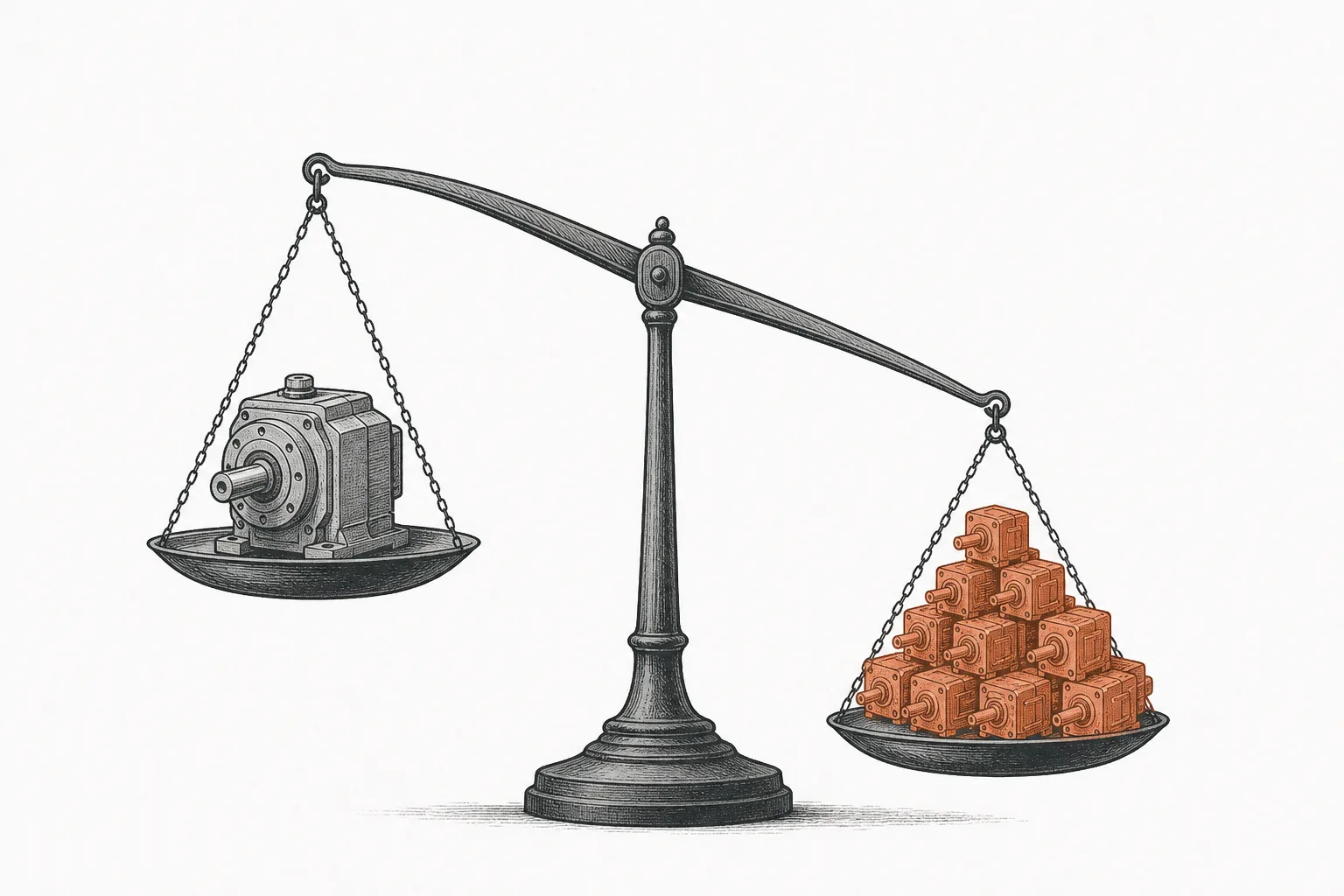
The third direction is closing the quality gap. Chinese gears used to be cheap but less precise, but Chinese makers are climbing steadily — some have started making harmonic gears that hold error down to ~10 arc-seconds and are earning more international certifications (JIS, AGMA). If China can really make gears of Japanese-equal quality at a lower price, the pricing power the incumbent leaders have held for decades will be challenged for the first time.
07Challenges & risks
A "bottleneck" node sounds like a safe investment. But it carries its own particular risks you need to understand.
The first risk is commoditization from China's catch-up. The heart of the value in this node is "a gear so hard to make that few can make it." If Chinese makers can really make gears of good-enough quality at a much lower price, what was once a premium, high-margin product could be pushed down on price step by step — just as happened with other industrial parts that China has come to dominate. The quality gap at the very top still exists, but it narrows every year.
The second risk is cyclicality and being a "bet placed in advance". Demand for gears is tied to factories' capex cycles and the humanoid hype, both of which swing in strong waves. These stocks usually trade on future humanoid expectations — but robot technology is always "slower than the promise." If humanoids arrive later than the market hopes, prices that ran ahead may have to correct hard.
The third risk is dependence on a few large customers. While the humanoid market is still concentrated among a handful of makers (Tesla and a few Chinese startups), the big orders hinge on the decisions of that handful. If any one of them delays its plans or changes its joint architecture (say, switching to "high-power motor + low reduction" instead of harmonic), the gear supplier's demand shakes instantly.
In short: in an era when everyone's excited about a robot's AI brain, what gets overlooked is the tiny gear in the joint that turns a fast, weak spin into motion that's slow, powerful, and steady to a fraction of a degree. To understand this part fully is to understand why a robot's "precision" isn't decided by software, but by a small steel gear that fewer than five companies in the world can make.