Megatrend · Climate Adaptation & Water
As disasters get pricier every year, who “carries the bill” on their own balance sheet?
Catastrophe models can tell you how risky any given house is — but an answer alone isn't enough. Someone has to take real money and say, "if the house burns down, I'll pay." This lesson is about those people: the property & casualty (P&C) insurers that sell you the policy, and the reinsurers standing behind them to absorb the giant losses on top. As weather damage climbs year after year, the whole industry shifts into a "hard market" — raising premiums, tightening coverage limits, and in some states even pulling out entirely. The heart of this business is one phrase: discipline in pricing risk.
01What it is (the people who take on disaster risk)
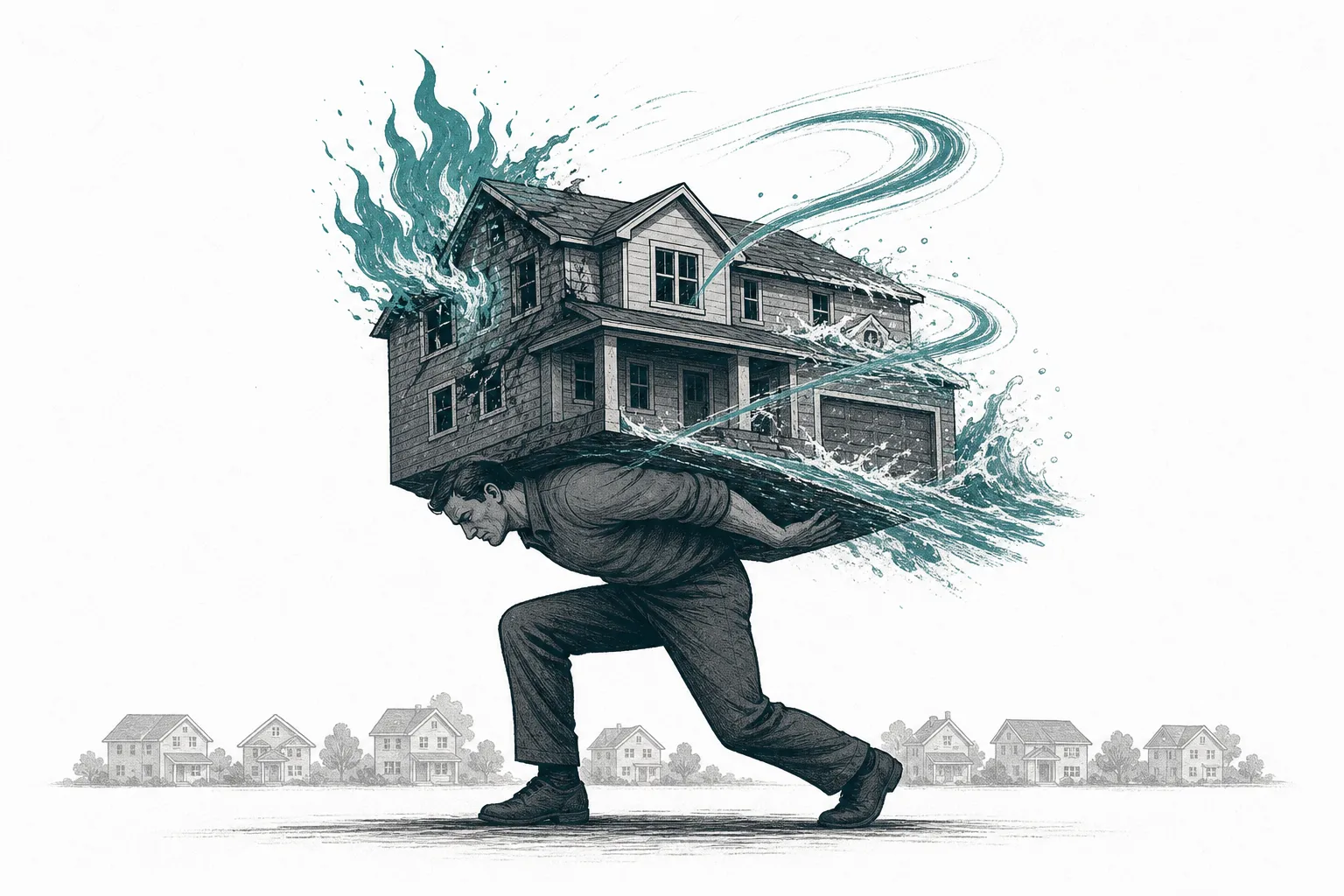
On the morning of January 7, 2025, wildfires began sweeping through the wealthy neighborhoods of Los Angeles — and when the smoke cleared, it had become the costliest wildfire in world history, with insured losses of about $40 billion from a single event. The most important question isn't "how many houses burned" but "so who pays that $40 billion?" The answer is the business this lesson is about — the people who take real money and put disaster risk onto their own balance sheet.
This node is the story of two layers working in sequence. The first layer is the property & casualty insurer (P&C insurer) — the one who sells home, auto, and factory policies directly to you, collects the premiums, and promises to pay for damage if something goes wrong. The second layer is the reinsurer — the "insurer of insurers" standing behind them, absorbing losses too big for any single insurer to bear.
The difference from its neighboring siblings is "who carries the money." The other sub-node next door is Catastrophe & Climate Risk Analytics — the "brain" that builds the models to calculate risk. But those companies don't carry the losses themselves; they only sell the "answer." This node is the "wallet" that takes real money and holds the risk. The brain calculates, the wallet pays — and the wallet always relies on the brain to price.
On the megatrend map, this node is a leaf under Climate Risk Analytics & Insurance, within the big trend Climate Adaptation & Water (adapting to a warming world). Its definition is straightforward: "the insurers, reinsurers, and brokers that price and bear the physical risks from the climate."
P&C (Property & Casualty) = property insurance (homes and factories — fire/flood) and casualty (third-party liability) · Reinsurance = insurance an insurer buys from a reinsurer to spread big chunks of risk · Underwriting = the act of "deciding what to insure" — which risks to take, and what premium to set. This is the heart of the business · Combined ratio = the single most important metric = (claims + expenses) ÷ premiums collected · below 100% = profit from underwriting. The lower, the better.
02Why it matters — disasters get pricier, premiums spike
What makes this business interesting as an "investment in adapting to climate change" comes from one undeniable fact: disasters keep getting more expensive. In 2025, global economic losses from natural disasters ran about $220 billion, of which insurance covered about $107 billion — and this was the sixth year in a row that insured losses topped $100 billion, becoming the industry's "new normal ceiling."
What's startling is that 92% of 2025's losses came from "secondary perils" — wildfires, flash floods, and severe convective storms once dismissed as small stuff. That year, convective storms caused $51 billion in insured losses and wildfires another $40 billion — both all-time records — and the U.S. alone took $89 billion, or 83% of the global total.
When losses get pricier, it creates a clear pricing mechanism: disasters grow more frequent and severe → those who carry the risk have to raise premiums and reinsurance prices to match the higher risk. The industry calls this "upswing" phase a "hard market" — the time when insurer and reinsurer profits look their most beautiful, because they can charge high prices while losses are still contained.
But more important than one year's profit is that this is a mechanism that protects the economy. Every time a house burns or a storm hits a factory, the money flowing back lets families rebuild and businesses reopen — without someone to carry this risk, big losses would become the direct burden of the state and the public. So this node is a "shock absorber" the world economy relies on. The hotter the world, the more important this absorber becomes.
03How it works (the risk-transfer chain)
The heart of this business is the "risk-transfer chain." Risk doesn't stop at a single insurer — it's passed upward in layers until it reaches capital big enough to handle national-scale disasters. Let's trace it step by step. Notice that "premiums" flow down while "claims" (losses) flow up.
The term to grasp in this picture is the "attachment point" (where liability begins). The reinsurer doesn't take every dollar of loss — it takes only the portion above an agreed ceiling. For example, "I'll only take the part above $50 million per event"; the primary insurer carries everything below that. During the 2023–2025 hard market, reinsurers raised this ceiling sharply — meaning they pushed the "smaller secondary perils" like wildfire and flood back onto primary insurers, keeping only true national-scale catastrophes for themselves. This is one reason reinsurers earned so beautifully in recent years.
The last step of the chain is the most interesting — when risk grows too big for the entire insurance industry to bear, it gets passed to the capital markets through retrocession (a reinsurer buying reinsurance of its own) and catastrophe bonds (disaster bonds bought by pension funds worldwide) — so the risk from a Florida hurricane ends up in the investment portfolios of people all over the world.
04How it connects in the ecosystem
This node doesn't work alone. It sits at the junction of several pieces it can't do without:
- Relies constantly on Catastrophe & Climate Risk Analytics (the brain): before it can price a premium or underwrite reinsurance, it has to know how big the risk is — nearly every insurer uses the catastrophe models of Verisk or Moody's RMS as the standard for pricing. "The brain calculates, the wallet pays" is the deepest-rooted relationship in the whole parent node
- Bears the risk for disaster-exposed infrastructure: power plants, water systems, pipelines, and cities investing in climate adaptation — including Water Utilities & Treatment — are all high-value assets in risky zones that someone has to insure. The more the world builds infrastructure in risky areas, the more this node's demand grows
- Fuses with Digital Finance & Tokenization: cat bonds and parametric insurance (which pay out automatically based on data, e.g. wind above X) are turning climate risk into a tradable "financial asset" — the world of insurance and the world of capital markets are becoming one and the same
- Connects to Aging Population: wealth concentrated in the seaside and hillside homes of an aging society further raises the value of assets in risky zones that need coverage
05Where it stands now
The big story right now is that the industry just came out of a "golden run" and is entering a turning point. After three years of hard market (2023–2025), insurers and reinsurers posted record profits — Chubb earned $6.53 billion in P&C underwriting profit in 2025 (up 11.6%) with a record-low combined ratio of 85.7% (lower is better — meaning every $100 of premium yields $14.3 of underwriting profit). Reinsurers as a group posted total net profit of $25.2 billion, with the average combined ratio improving to 83.9%.
But the signal of a turn already showed up at the January 1, 2026 renewal, as capital flowed back into the industry so heavily that competition pushed prices down — the Global Property Cat Rate-on-Line fell 12% (Europe fell hardest at −15%). This is a sign the "hard market" is softening, even though prices are still about 38% above the 2017 trough — investors call this moment "the melting of the hard market."
The most worrying side of "now" is the retreat of insurance from the riskiest zones. When risk gets too expensive to price profitably, insurers choose to leave rather than take a loss. In California, State Farm declined to renew about 70,000 home policies, and after the 2025 LA wildfires the whole industry was hit with a $1 billion assessment into the state's backstop fund (FAIR Plan) — while that fund itself ballooned from 124,000 policies (2019) to 684,000 policies (early 2026). In Florida, home policies in the normal market shrank 78% over a decade, until the state's fund (Citizens) saw its share jump from 6% to 63%.
The players on this field split into three groups — the primary P&C/specialty insurers that sell policies to consumers and businesses, the reinsurers that take on the big chunks of risk on top, and the old-line market Lloyd's of London, the "central marketplace" where underwriters compete to take on special risks.
06What's ahead — cat bonds & climate-conditioned pricing
The first direction is the capital markets taking on more and more risk. As losses grow until the insurance industry's "wallet" can't keep up, capital from pension funds worldwide comes in through catastrophe bonds. In 2025, the cat bond market set records across the board — $25.6 billion in new issuance and total outstanding reaching $61.3 billion (up 24% in a single year), with 15 first-time issuers, a record high. This is a sign that the insurance industry and the capital markets are fusing permanently.
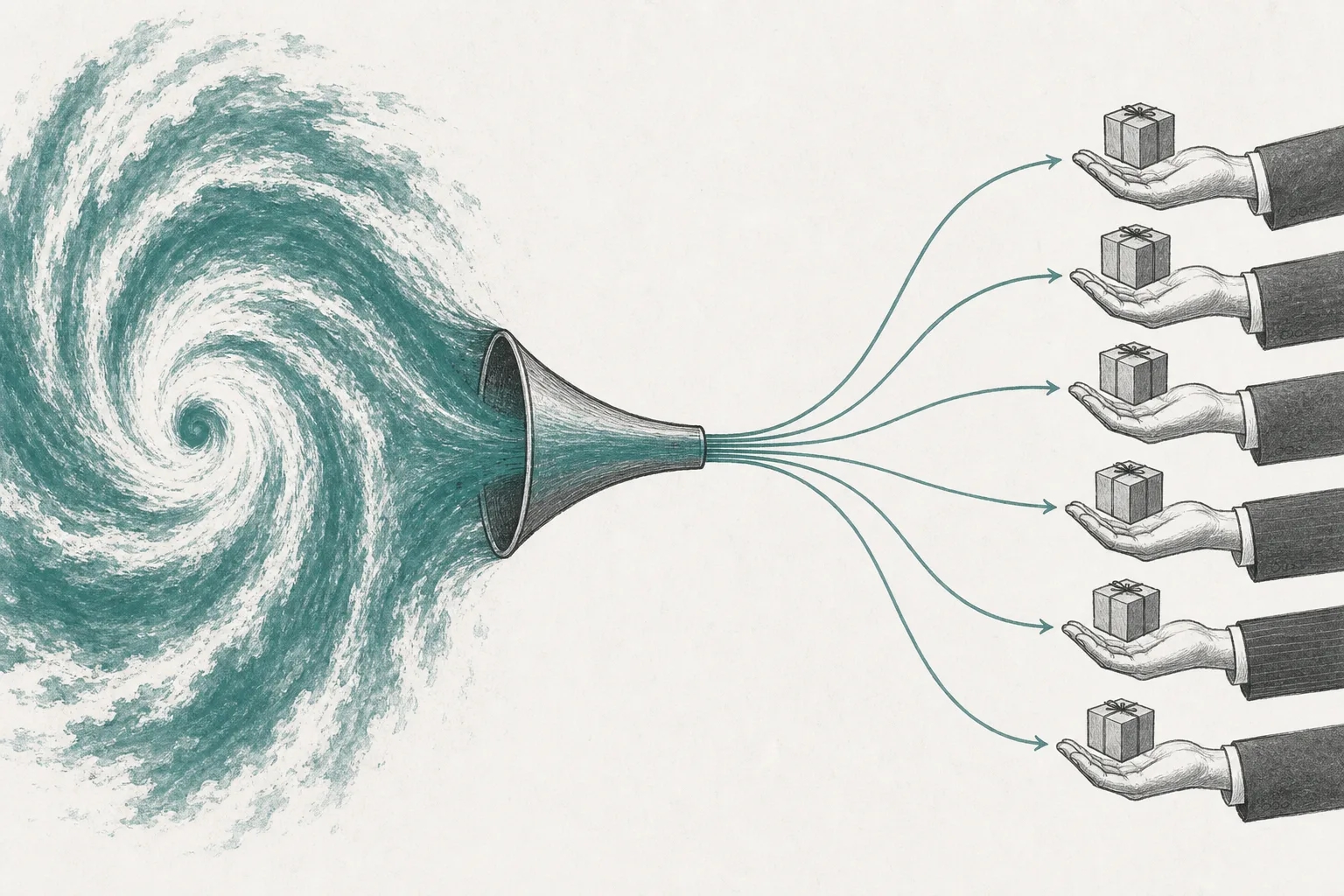
The second direction is pricing that "looks forward," not backward. Premiums were traditionally set from the historical statistics of past disasters. But when the climate changes so fast that the past no longer stands in for the future, the best underwriters will have to price using climate models adjusted for warming scenarios (climate-conditioned). Whoever prices more accurately gains a huge edge — because this business is a "bet against risk" where the most disciplined player with the best data wins.
The third direction is parametric insurance, which pays out automatically when data hits a threshold (e.g. an earthquake above magnitude X, or wind above Y km/h, pays out instantly without sending anyone to assess the damage). This form helps close the "protection gap" in emerging markets that traditional insurance can't reach, and pays out fast in a crisis — opening a vast new market for underwriters bold enough to design new products.
07Challenges & risks
A business that sounds like "the hotter the world, the more it earns" actually has several deeply embedded risks — and that's exactly why it's one of the hardest businesses in the world to price.
The first risk is the "big year." This business collects small premiums every year but pays out big in the year disaster strikes. If a Category 5 hurricane makes landfall on a major city alongside wildfires and floods in the same year, years of accumulated profit can vanish in a single event — especially for reinsurers that take the biggest "tail" of every disaster. This is why stocks in this group swing with the storm season.
The second risk is "mispricing." The whole business is about guessing future risk accurately. If the model underestimates wildfires or convective storms (and these secondary perils are far harder to predict than hurricanes), it sets premiums too low, takes on too much risk, and loses heavily when disaster actually comes. The 2025 LA wildfires, where losses exceeded expectations, are a fresh, live lesson in this risk.
The third risk is the "soft market" returning. This group's profits are cyclical — when capital floods in and pushes prices down (as we saw with reinsurance prices falling 12% in 2026), the profit peak passes. So investing in insurance and reinsurance requires reading the cycle well — the classic mistake is buying when disaster news is loudest and premiums are highest, which is usually right near the peak.
The fourth risk is politics-and-regulation, and the "point where it can't be insured." When premiums get so high that people suffer, governments often step in to hold down increases that reflect the real risk. The result is that insurers pull out (as in California and Florida), leaving the burden to state funds and taxpayers. At the far end of this line, some areas may become "completely uninsurable" — too risky for any price that's both profitable and affordable to exist. When that happens, property values across the whole area can plunge, and the risk flows back into the wider financial system.
In short: this node is the people who stand and take on disaster losses with real money, so that people everywhere can rebuild their lives after catastrophe — a warming world makes this role more important and more profitable. But it also makes it more dangerous. Because the end of this story isn't just profit. It's the question of who carries the final bill when disasters get too expensive to insure.