Megatrend · Spatial Computing / AR/VR
The chip that has to work insanely hard — without making your face hot
A headset or pair of AR glasses sitting on your face has to render images, track your motion, and do AI thinking — all in real time, all inside a window of under 20 milliseconds, on a power budget of just a few watts, and without getting hot, because it's pressed right against your face. This is the strangest chip problem in the industry, and a field one company has almost completely cornered.

01What it is
Put on a VR headset and turn your head left. The image on the screen has to slide along instantly — so fast that your brain believes the virtual world is "really there." If it lags by even a fraction of a second, you immediately start to feel dizzy. The thing that keeps the image tracking your head like that is a chip we call an XR SoC — and this node is about that chip.
XR Silicon & Processors is a leaf node under the megatrend Spatial Computing / AR/VR. It's the "silicon layer" of the whole system — chips designed specifically for head-worn devices, not phone chips repurposed for the job.
A single chip with everything packed into it — the CPU (central processing), GPU (graphics processing), NPU (AI processing), and the circuitry that handles the sensors — instead of using several separate chips. The reason XR has to merge it all into one block is that every millimeter and every watt matters when the thing has to be small and light enough to sit on your face.
What sets the XR SoC apart from a phone chip is that it's squeezed by three constraints at once: latency (it has to be millisecond-fast, or the wearer gets dizzy), heat (it's against your face, so it can barely shed heat), and power (a small battery that has to last). The fastest chip in the world isn't the answer — the chip that does the most work on the smallest power budget is the winner.
02Why it matters — a chip that has to do a lot but can't get hot
Think of an AI data-center chip running flat-out in a room cooled wall to wall, happily eating hundreds of watts. The XR SoC has to do "work that heavy" in the exact opposite setting: no fan, no big heatsink, able to shed heat only through the thin shell pressed against your forehead.
The numbers tell the story clearly. The Snapdragon XR2 Gen 2 inside the Meta Quest 3 runs in a thermal envelope of just ~4–6 watts normally, peaking at no more than ~10 watts, with all of its cooling done by fanless (passive) cooling — versus a laptop chip that eats 15–45 watts and has a fan to help. All-day AR glasses are even harsher: the power budget is just "a few watts."

So why does this matter to the economy? Because it's the "pick-and-shovel" of the spatial computing era — anyone making a headset or glasses, whether it's Meta, Samsung, Sony, or a startup, has to buy or build this kind of chip first. If AR glasses ever become something people wear all day like a phone, this tiny chip becomes a layer that captures enormous value.
But to be honest, that "if" is still a big question. The XR SoC market specifically is still tiny today — estimated at around $0.6 billion in 2023 and projected to grow to ~$2.5 billion by 2030 (CAGR ~24%). Count AR/VR chips more broadly and the number is bigger, but all of it is tied to one thing: will headset and glasses sales actually grow?
03How it works — the 20-millisecond loop
The heart of the XR SoC is winning a single "deadline" called motion-to-photon latency — the time from when you move your head to when the screen emits the light (photons) of the new image. If that stretch runs past ~20 milliseconds, your brain notices the image "can't keep up with the real world" and starts telling you to feel nauseous. This isn't about comfort — it's the line between "works" and "doesn't work."
Inside that 20 ms, the chip has to do three jobs in sequence — and usually at the same time, on different processing units within one chip. This is the loop that repeats dozens of times a second:
Notice why you'd want several "separate processing units" in one chip instead of one unit doing everything. It's because each job has a completely different character. Rendering images suits a GPU; position tracking (SLAM) is a sensor job that needs a dedicated co-processor with extremely low latency; and on-device AI (recognizing hands, gaze, or nearby objects) suits an NPU. Splitting it into specialized units like this is both faster and lower-power than cramming everything onto one general-purpose processor — which is why a "specialized accelerator" matters more than raw speed in the XR world.
SLAM (Simultaneous Localization and Mapping) = a device "mapping the room while knowing where it is within that room," in real time · Sensor fusion = combining signals from several cameras with a motion sensor (IMU) into one accurate picture of position. This job is what keeps the virtual image "locked" to the real world without drifting — and it can't tolerate any latency at all.
The most tangible example is the Apple Vision Pro, which uses two chips together — the M2 runs the system and apps, while the R1 does just one thing: pure sensor fusion. It combines signals from 12 cameras, 5 sensors, and 6 microphones and sends a new image to the screen within 12 milliseconds — 8 times faster than a blink. Having a separate chip dedicated to this job is Apple's answer to the 20 ms problem.
04Where it sits in the megatrend
If you picture Spatial Computing as a whole car, this node is the "engine" — every other part has to run through it:
- It powers VR/MR headsets and AR/AI glasses: the chip is the first thing every headset and glasses maker has to choose before designing anything else — it decides what the device can do and how long it lasts
- It has to pair with displays and optics: however fast the chip can render images, you need a high-resolution display that can keep up. The two have to grow together
- It's a special case of Semiconductors: here's where we should be honest — a chip is a chip, and the XR SoC is made in the same factories as any other chip (see Foundry). What makes this node its own story rather than "just another kind of chip" is its specific problem — extreme low latency plus a tiny heat budget, conditions phone and server chips never had to face
- It depends more and more on AI: the jobs an XR chip has to do on-device (recognizing hands, gaze, objects, and in newer glasses, an AI assistant) are all AI jobs — which makes the NPU the fastest-growing heart of this chip family
The most interesting thing in the ecosystem is that XR chips and Semiconductors are the same story when it comes to manufacturing, but a different problem when it comes to design. The Semiconductors lesson tells you "who can make chips" — this lesson tells you "why a chip that has to sit on your face is especially hard," seen from the angle of spatial computing's specific problem, not the whole chip industry.
05Where it stands now
Today's picture sums up in one sentence: the market is still small, but one company has almost completely cornered it. Qualcomm's Snapdragon chips are in nearly every important standalone headset — Meta Quest 3, Quest Pro, Pico 4 Ultra, Samsung Galaxy XR, and Vivo Vision all use the Snapdragon XR2 / XR2+ Gen 2 family. When Meta itself holds about 84% of the headset market in some quarters, and Meta uses Snapdragon, that makes Qualcomm the "engine seller" to nearly the whole industry.
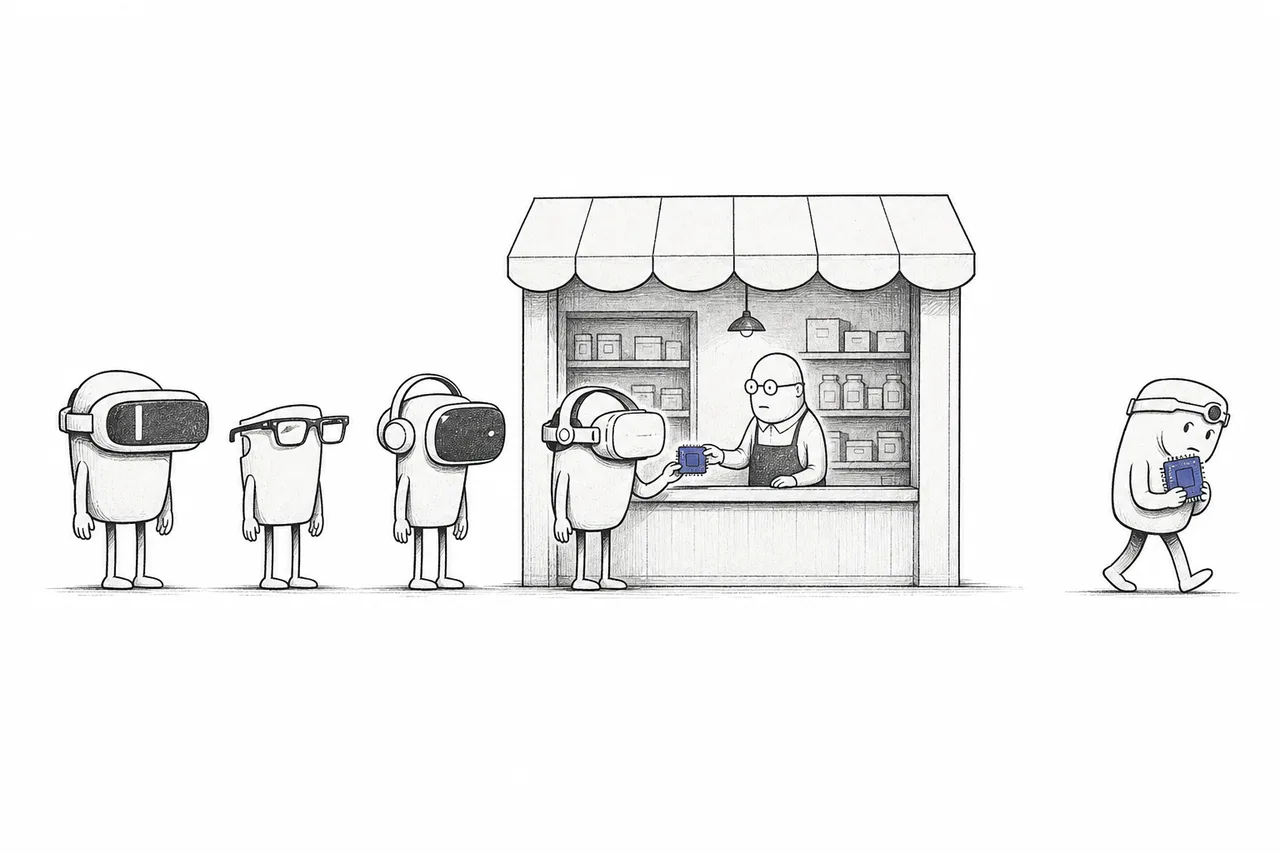
But a big fork in the road is taking shape: players big enough are starting to build their own chips to escape their dependence on Qualcomm — Apple designs the R1 and M-series in the Vision Pro itself (and is reportedly developing an R2), while Sony teamed up with MediaTek to make a custom chip for the PlayStation VR2. This fork is the strategic question for the whole node: in the long run, will XR chips be a "standard product you buy from a central shop," or "something each brand has to build itself"?
Another hot field is all-day glasses. Here Qualcomm split off a dedicated product line, the AR1 family — the Snapdragon AR1+ Gen 1 (launched in 2025) is 28% smaller and efficient enough to run an AI model like Llama 3.2 on the glasses themselves. This is the chip inside the Ray-Ban Meta glasses, and it's a bet that an "AI assistant you can wear all day" will be the next wave — which, unlike a VR headset, has an even harsher power budget.
06The road ahead
The first direction is "everything shrinking down into the glasses." Today's VR headsets are still thick and heavy, but the whole industry's goal is thin, light glasses you can wear all day. That means the chip has to do the same work (or more, because it now needs an AI assistant) on a power budget that's several times smaller again — making the efficiency problem the main battleground, and the reason Qualcomm split off the AR1 line.
The second direction is the flow of AI work into the chip. As glasses need to understand what you're looking at, hear what you say, and answer in real time without sending it to the cloud (for speed and privacy), the on-device NPU becomes the most important part — the XR SoC is shifting from "a chip that renders images" to "a wearable AI chip."
The third direction is the question of when the market really grows. The numbers offer hope — IDC estimates the overall XR market grew +44% in 2025, led by smart glasses, with a projected CAGR of ~26% over 2026–2030. If AI glasses truly become a mainstream device, demand for XR chips will surge along with them. But if glasses sales keep growing slower than hoped, this chip market will stay small for years to come — this is a node whose fate is inseparable from "the end device."
07Challenges & risks
The appeal of XR Silicon comes with risks you have to look at squarely.
The first and biggest risk is an end market that's still small and slow-growing. Unlike phone chips or AI chips, which already have enormous demand, XR chips only sell as much as headsets and glasses sell — and global headset sales are still in the tens of millions of units a year, nowhere near the billions of units for phones. So the XR SoC market specifically is still tiny today (~$0.6 billion in 2023). Investing in this theme is a bet on "the future," not "the present."
The second risk is concentration in a single vendor. With Qualcomm owning almost all of the headset chips, this node's growth is nearly the same as one company's growth. Conversely, if big players like Apple, Sony, or even Meta lean harder into making their own chips, the merchant market Qualcomm relies on could shrink — this few-seller market structure is fragile both ways.
The third risk is the cost of building a specialized chip. Designing an XR SoC that has to balance latency, heat, and power all at once is expensive, time-consuming engineering — done on top of a market whose volumes are still low. So the cost per chip is high, and only a few deep-pocketed players can afford to invest. This is both a moat (small players struggle to compete) and a risk (if the market doesn't grow fast enough to justify the investment).
In short: XR Silicon is the story of a chip squeezed by constraints almost no other kind of chip faces all at once — it has to do a supercomputer's work, in a tiny package pressed against your face, without being slow and without getting hot. It's the quietest but most indispensable silicon layer of the spatial computing era. And understanding why "a 20-millisecond loop on a few watts" is an especially hard problem is understanding why this small node is the key that will unlock — or hold back — the future of the whole trend.