Megatrend · Critical Materials
The world fights over the “mine” — but the real power sits at the “smelter”
The copper in an EV charging cable, in an AI server, in every wire in your house has to be 99.99% pure — but it starts as rock that's only about 0.5% copper. The step that turns “dirty rock” into “pure metal” is smelting and refining. And even though China mines less than 10% of the world's copper ore, it controls more than half of the smelting. This is the quietest chokepoint in the copper chain — and the most powerful.
01What smelting and refining are
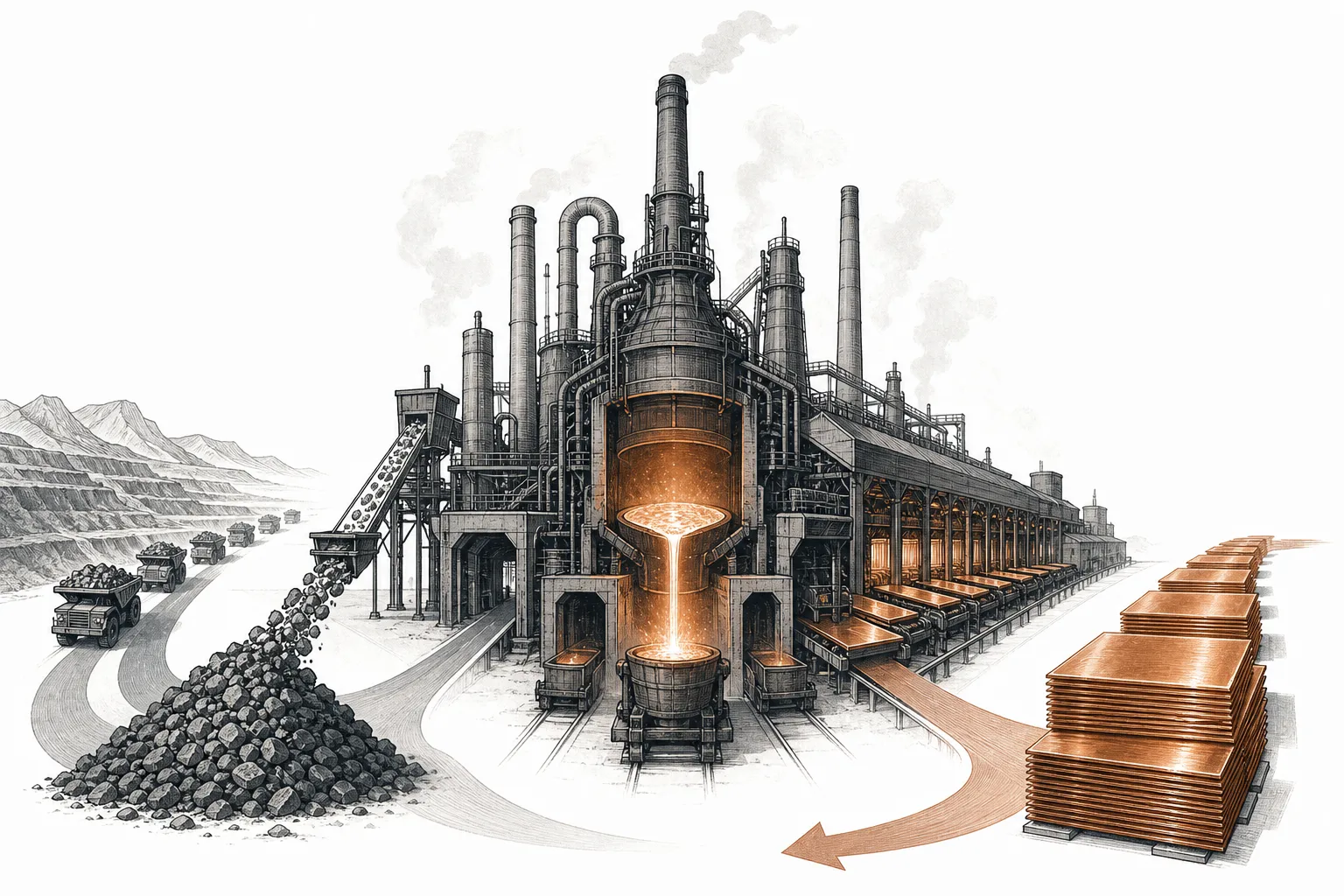
When we say “copper,” we usually picture the giant open-pit mines in Chile or Peru. But what comes out of those mines isn't usable at all — it's a wet rock powder called “concentrate” that's only about 25–30% copper. The rest is sulfur, iron, and other rock. You can't make wire or circuit boards out of any of it.
The players who turn that rock powder into “real copper” are the smelters and refineries — the midstream businesses that buy concentrate from mines around the world, melt it at high heat to drive off impurities, then refine it until they get a 99.99% pure copper cathode, the standard raw material factories everywhere roll into wire, tube, and sheet.
Concentrate = ore powder from the mine, ~25–30% copper · Smelting = melting it with heat to drive off sulfur/iron, giving rough copper at ~98% · Refining = purifying it further with electricity (electrorefining) · Cathode = the 99.99% pure copper sheet, the final product the world trades.
On our megatrend map, this step is a sub-branch of Copper, under the Critical Materials & Supply Chain megatrend — it's the “second gate” the material passes through, after leaving the mine (Copper Mining & Concentrate) and before becoming components (Copper Fabrication & Products).
02Why the real chokepoint is the smelter, not the mine
Here's what most people miss: copper mines are spread all over the world — Chile, Peru, Congo, Indonesia, Australia — no one can monopolize them. But smelting is concentrated in a single country to a shocking degree: China.
The number that tells the story best: China mines only about 8% of the world's copper ore (concentrate) — it barely has big mines of its own — yet it smelts and refines roughly 53–57% of the world's copper. Put simply, China “imports rock from the whole world to smelt at home,” then controls the tap the metal flows out of.
This didn't happen overnight. Since 2005, China has accounted for more than 90% of all the growth in the world's copper smelting capacity, pushing its share from around 15% to half the world today. And now four of the five largest smelters on Earth are in China.
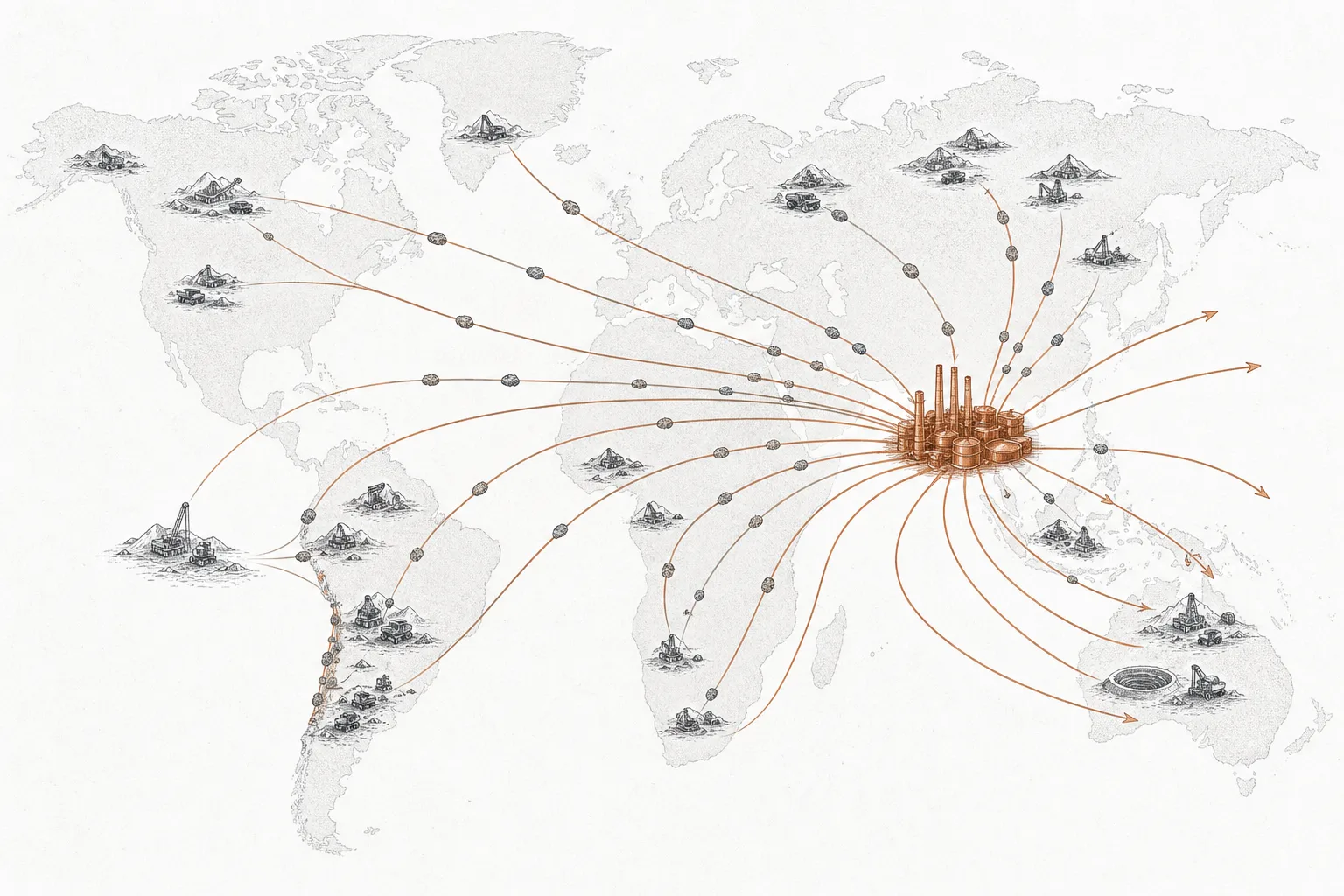
Why does this matter? Because copper is the “metal of the transition” — an EV uses about 3–4 times more copper than a gas car. AI data centers, power lines, wind turbines: they all need enormous amounts of pure copper, and demand keeps climbing. But if you want usable copper, almost every path runs through a smelter — and most smelters are in China.
03How it works (from 0.5% rock to 99.99% metal)
The heart of this business is the “purity ladder” — driving out impurities one step at a time until you're left with almost-perfect copper. Let's follow a single rock on its journey.
The first two steps (heat smelting, or pyrometallurgy) drive off sulfur and iron, leaving “rough copper” (blister) that's already ~98% pure. But the remaining 2% often hides valuables — gold, silver, and platinum. The final step is electrorefining: you hang the rough copper as an anode in a chemical bath and run current through it, so pure copper plates onto the cathode while the gold and silver settle to the bottom (called anode slime), ready to collect and sell.
Here's the secret to a smelter's profit: the smelting fee alone usually isn't enough to survive on. The real money comes from the “extras” — sulfuric acid sold to the fertilizer industry, and the refined gold and silver. The more gold in the ore, the bigger the smelter's edge.
04What it connects to
The smelter is the “middle” of the copper chain, so it touches every stage around it. Upstream is Copper Mining & Concentrate, which feeds it ore; downstream is Copper Fabrication & Products, which takes the cathode and rolls it into wire and tube. And there's a “shortcut” running in parallel — Copper Recycling & Secondary Metal — because copper recycles 100%, and smelting scrap uses far less energy than smelting from ore, so many modern smelters eat both ore and scrap.
More important still are the “mouths waiting to be fed” downstream. Copper cathode is the lifeblood of the era's megatrends: it goes into Energy Transition & Power Demand (power lines, wind turbines, solar panels), into Electrification & Mobility (the motors and batteries of EVs), and into Artificial Intelligence (tons of copper in the wiring and cooling of every data center). Put simply: if the furnace stalls, these megatrends stall with it.
05Where it stands now
2025 was another year copper smelters faced the strangest situation in their history. To understand it, you need to know one number called TC/RC (Treatment & Refining Charges) — the fee mines pay to smelters to process their ore. Normally, the more ore floods the market, the more mines have to pay to jump the smelting queue.
But in 2025, something never seen before happened: China built so many smelters that they started fighting each other for ore, while several big mines around the world hit production snags. So smelting fees dove into negative territory — the spot price fell to −$60 per ton in November 2025, meaning smelters had to pay the mines just to get ore to process! And the 2026 annual benchmark was settled at $0 per ton, down from as high as $88 back in 2023.
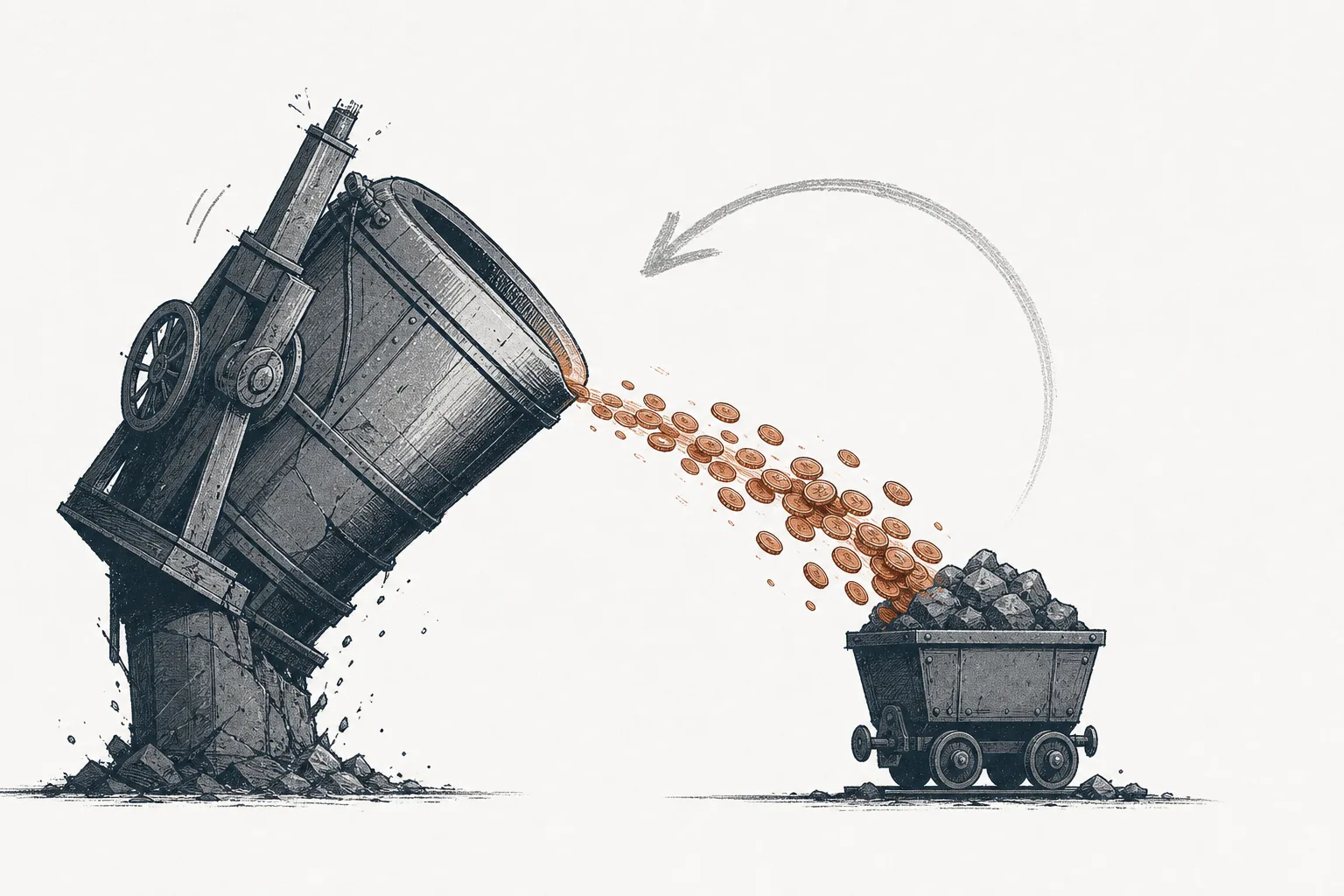
The result: China's own government hit the brakes. The country's major smelters agreed to cut output by more than 10% in 2026 to fight the negative fees, and the government suspended more than 2 million tons a year of new smelter projects planned for 2025–2027 — while ruling that anyone building a new smelter must first own a mine to feed it. The one place smelters still eke out a profit is the “extras” — the sulfuric acid and refined gold/silver. And with gold prices hitting records in 2025, that's what's kept smelters afloat.
In this arena, the real players split into two clear camps: the Chinese smelting giants that control volume, and the Western smelters that lean on full integration and recycling to survive.
06The road ahead
Three forces will shape this business. First — ore will stay tight for a long time. Big new copper mines are getting harder to find and take a decade to build, while demand from EVs and AI keeps surging. That means smelting fees will likely stay pressed down, and whoever owns their own mine to feed ore will have a massive edge.
Second — the West is trying to reclaim the midstream. Realizing they lean too hard on China for smelting, the US and Europe are starting to invest in building and protecting their own smelters — like Aurubis, which is opening a new smelter in the US state of Georgia with government policy behind it. But catching up on a share China has spent 20 years building isn't something you do in a few years.
Third — recycling will keep growing in importance. Millions of tons of copper in old wiring and equipment are reaching end of life. Smelting from scrap (secondary) uses far less energy and doesn't compete for concentrate, so smelters strong in recycling — like Aurubis and Glencore — have better immunity to an ore crunch.
07Challenges & risks
Razor-thin margins. Negative smelting fees leave many smelters losing money on their core smelting work, forced to lean on byproducts and government subsidies. Plants without their own mine and without good “extras” risk being squeezed shut.
Environmental and energy costs. Smelting emits SO₂ gas and uses enormous energy. Tighter environmental rules (especially in the West) make new smelters hard and expensive to build — which, ironically, only reinforces China's existing edge.
Geopolitical risk. When half the world depends on China to smelt its copper, smelting becomes a strategic “card” — just as rare earths once were. Trade tensions, or China restricting exports, could shake the entire global copper chain. And that's why this “boring” midstream step has become a strategic battleground of the energy-transition era.