Megatrend · Critical Materials
Copper sheets all look the same — until the “last gate” that turns them into the real thing
The world argues over mines and smelters, but copper still can't plug into an EV or thread into an AI server as long as it's just a plain, square “cathode” sheet that looks identical to every other. The step that turns those sheets into wire, cable, tube, foil, and busbar is fabrication — the downstream stage closest to “real demand” in the copper chain, and, once again, one where China quietly controls about half the world's capacity.
01What copper fabrication is
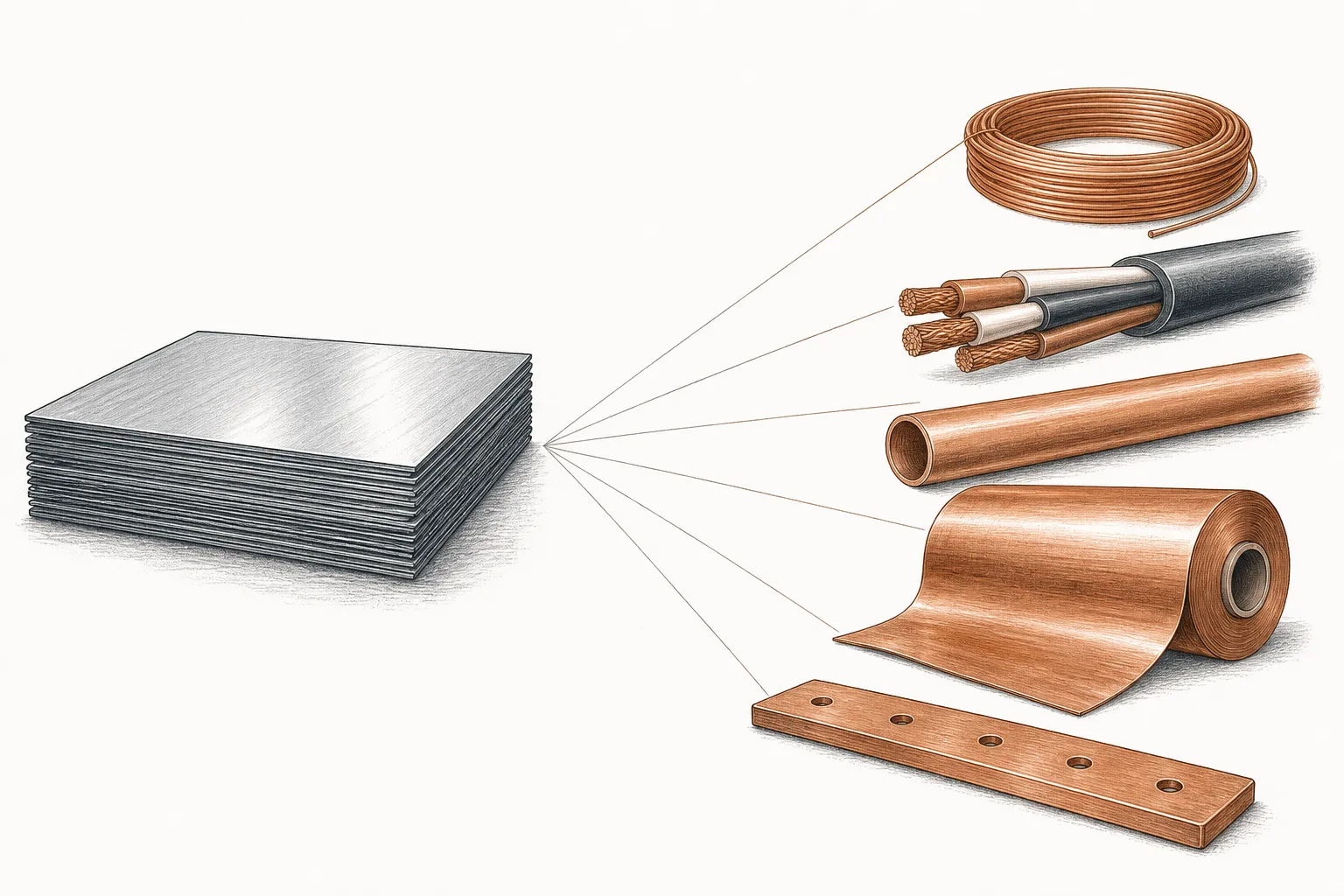
Picture a 99.99% pure copper sheet coming out of the smelter — that's a cathode, a square plate weighing around 50–100 kg, every one identical, traded as a commodity on the London Metal Exchange (LME). But the truth is nobody can use a “cathode sheet” for anything directly. You can't plug a square plate into a socket, wind it into a motor, or run it as wiring through a building.
The people who turn this plain metal sheet into “something you can actually use” are the copper fabrication business — “semi-fabrication,” as the industry calls it — factories that remelt cathode and then roll, draw, extrude, and coil it into the shapes that end industries assemble into products. This is the last gate before the user in the copper chain.
Wire rod = a round copper bar ~8 mm across, the starting material for every kind of wire · Magnet wire = thin insulation-coated wire wound into coils in motors and transformers · Tube = copper tubing in air conditioners, refrigerators, and plumbing · Strip/Foil = thin-rolled copper for connectors, circuit boards, and battery electrodes · Busbar = high-current copper bars in switchgear and data centers
One of these products eats far more copper than the rest: wire rod — because in the end the world mostly uses copper to “conduct electricity.” About half of all fabricated copper is drawn into wire for power lines and cables; the rest spreads across sheet/strip/foil, tube, and bar.
On our megatrend map, this step is a sub-branch of Copper, under the Critical Materials & Supply Chain megatrend — it's the “last gate” the material flows through, after leaving the mine (Copper Mining & Concentrate) and passing the smelter (Copper Smelting & Refining), before it becomes parts inside real products.
02Why this step is the “closest to the money”
Mines and smelters are an “upstream” story — they sell copper as a commodity blob whose price rises and falls with the LME. But fabrication sits at the very end, right up against the world's real demand. When people say “EVs and AI will cause a copper shortage,” the place that demand slams into first is the fabricator scrambling to roll enough wire and foil to fill orders.
The number that tells this best is copper in cars. A gas car uses about 24 kg of copper, but a full EV uses around 80–83 kg — roughly 3–4 times more, because an EV needs motor windings, a high-voltage harness, an inverter, and charging cables. All of that is pure “fabrication work,” not raw cathode.
On the other side is AI. Modern data centers, designed in blocks of 50–150 megawatts, use around 27–33 tons of copper per megawatt inside the building alone — and once you add the high-voltage transmission lines and substations built to feed them, the figure jumps to 100–150 tons per megawatt. Every one of those kilos passes through a fabricator first, whether as busbars in switchgear, cable between racks, or windings in a transformer.
03How it works (from cathode sheet to wire thinner than a hair)
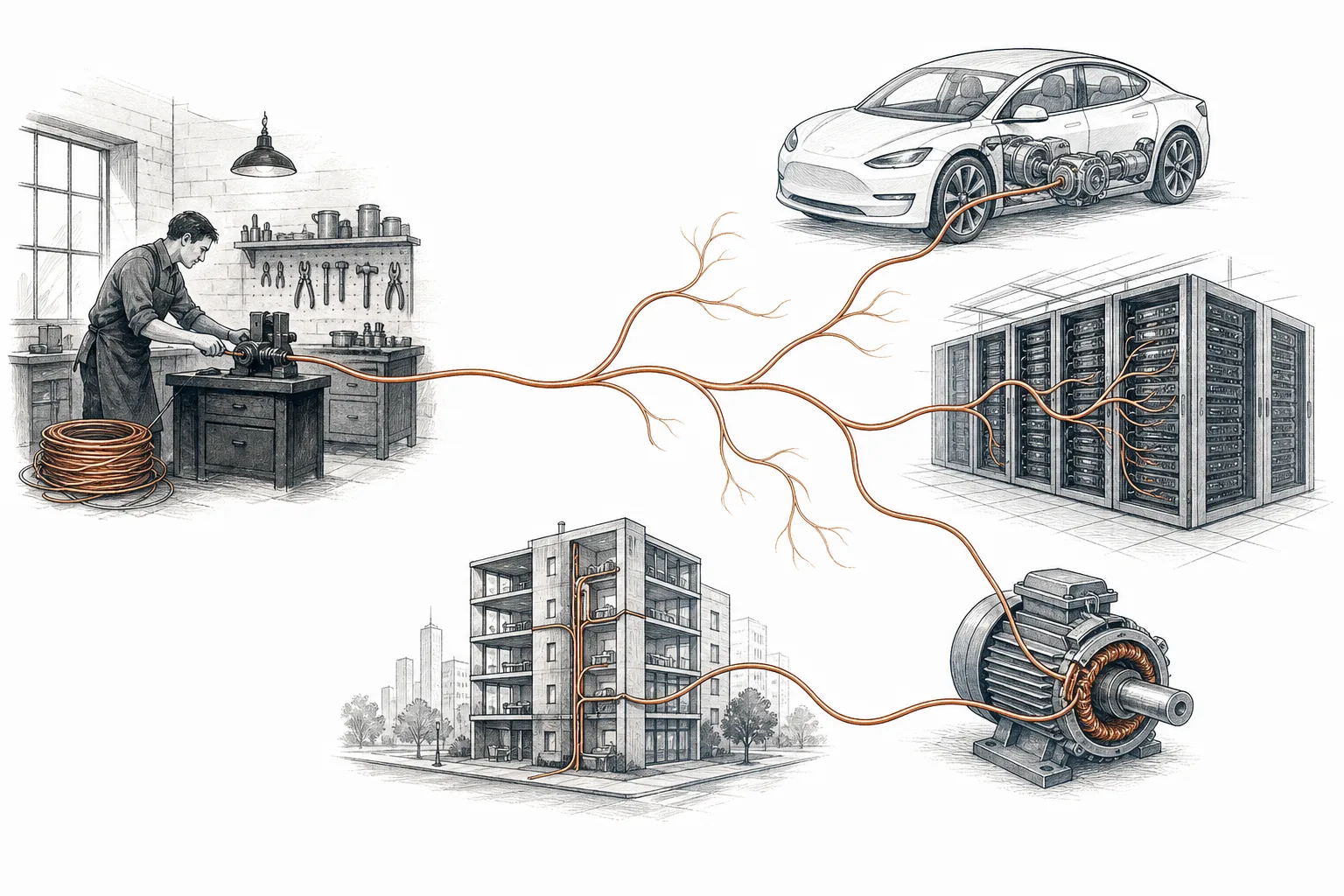
The heart of fabrication is “rolling and drawing” — taking a big piece of copper and making it longer and thinner until it's the shape you need. Let's follow a single cathode sheet on its journey to becoming the wiring in your home.
The first step is melting and continuous casting — cathode is melted into liquid copper and rolled out as “wire rod,” a round strand about 8 mm thick and kilometers long, coiled up for storage. This is the standard raw material for all the world's wire. Next is wire drawing: pulling the rod through progressively smaller “die” holes, so the copper stretches longer and thinner, from 8 mm down to as fine as 0.02 mm — thinner than a human hair, for motor and transformer windings.
Not everything becomes wire. Some copper is rolled into thin sheet to make strip and foil for connectors and batteries; some is extruded into tube for air conditioners and plumbing. So a fabricator's skill isn't in “having copper” but in how thin, how uniform, and how well it can alloy in other metals for special properties — that's where the profit comes from.
04What it connects to
Fabrication is the “end gate” of the copper chain. Its input is cathode sheet from Copper Smelting & Refining (and, further back, Copper Mining & Concentrate). There's an important shortcut too — Copper Recycling & Secondary Metal — because good-quality copper scrap can be remelted and rolled again with no trip through a mine, so many fabricators eat cathode and scrap interchangeably depending on price.
But what matters more are the “mouths waiting downstream.” Because fabrication sits right against demand, it feeds directly into nearly every megatrend of the era: wire and cable go to Energy Transition & Power Demand (power lines, wind turbines, solar); motor windings and harnesses go to Electrification & Mobility (EVs); busbars and foil go to Artificial Intelligence and Cloud & Digital Infrastructure (data centers); and specialty wire goes to Robotics & Physical AI and Defense & Geopolitical Fragmentation.
05Where it stands now
The big picture in 2025–2026 has two things to know. First, China again controls about half the world's fabrication, just as it controls smelting — China's “first use” of copper is around 17 million tons, half of world demand, and it holds about half the world's fabrication capacity, with roughly two-thirds of Chinese plants making wire rod. Since 2019, China has added nearly 11 million tons of copper fabrication capacity — about 80% of all the capacity the world added.
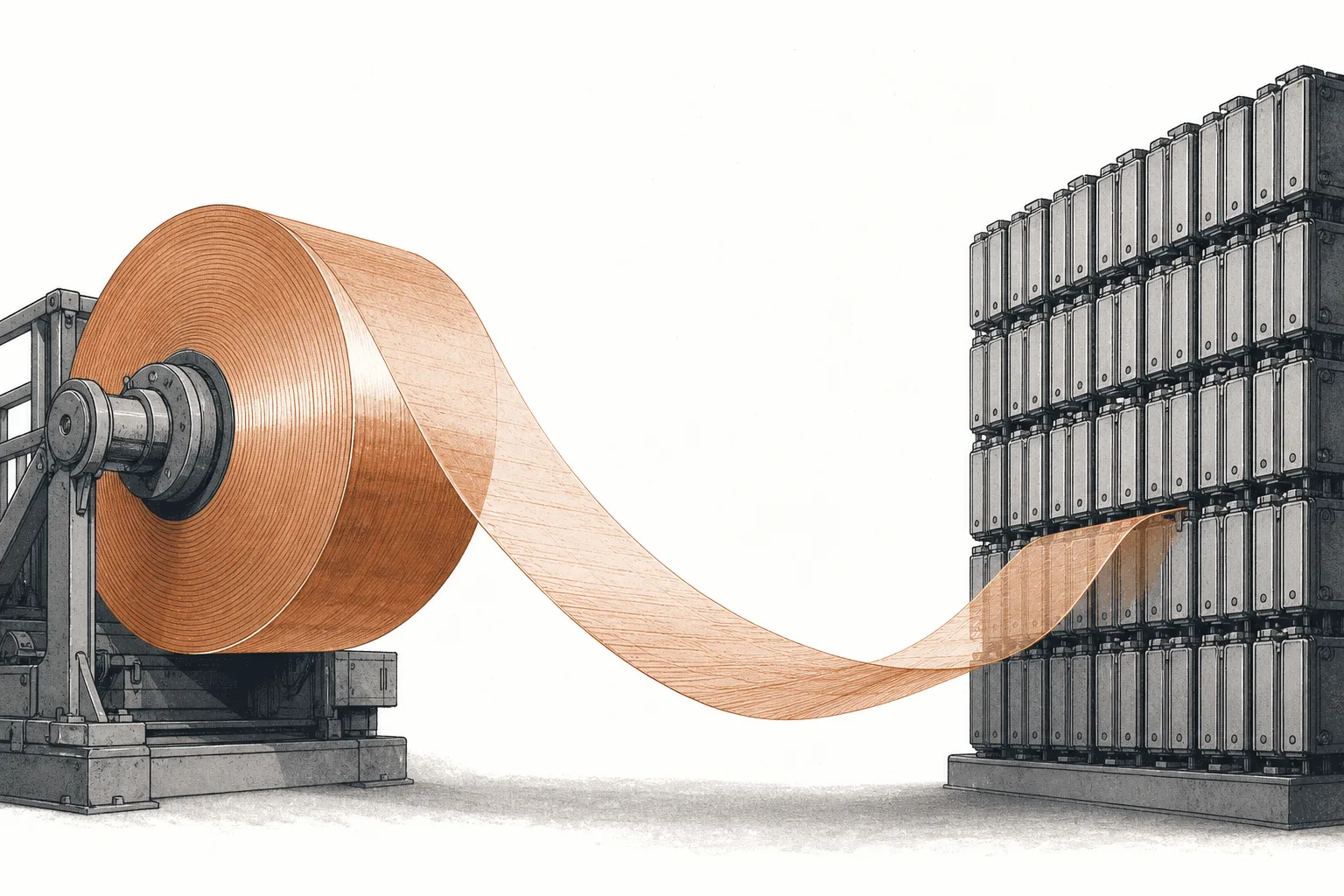
Second, “copper foil” has become the hottest new frontier. Every lithium battery needs an ultra-thin copper foil (around 6 microns, ten times thinner than paper) acting as the negative electrode and current collector. Demand from EVs and energy storage has made battery foil the fastest-growing, most fiercely contested fabricated product — and China dominates it almost completely.
The real players here fall into three groups: Chinese fabrication giants that control tube, wire, and foil alike; Western cable leaders that sit close to construction and grid customers; and specialty-alloy experts that sell properties, not volume.
06The road ahead
Three forces will set this business's direction. First — demand will tilt more and more toward “electrical copper.” The IEA estimates world copper use could double by 2040, with about 70% of the growth tied to clean energy and electrification. That means plants strong in wire rod, magnet wire, and battery foil will sit in the mainstream of demand, while traditional plumbing/AC tube work grows more slowly.
Second — the West wants to reclaim strategic fabrication. Realizing that battery foil and specialty wire are concentrated in China, the US, Europe, and Korea are starting to back foil and cable plants at home. A big deal like Prysmian buying Encore Wire in the US for more than $4 billion in 2024 reflects the move to base capacity close to America's EV and construction demand.
Third — “thinner and more uniform” is the technology battleground. Battery foil makers are racing to go from 6 microns down to 4.5 microns to pack more energy into a battery, and the same goes for specialty wire and alloys for EVs and servers. Whoever can make it thinner and more consistent earns a higher margin — work that used to be a “commodity” is steadily becoming a technology game.
07Challenges & risks
Margins as thin as foil. Basic fabrication like wire rod is a volume game with razor-thin profit per kilo, and conversion fees are constantly squeezed by overcapacity, especially in China. Plants that only make commodity products with no special properties get hurt easily when demand softens — and China's own battery-foil arena hit oversupply and a price war in 2024–2025.
Raw-material costs swing hard. Copper is the main cost, and its LME-driven price swings squeeze the cash flow of fabricators that must hold large raw-material stocks. A botched hedge can swallow a whole year's profit in a single quarter.
Geopolitical and concentration risk. When battery foil, specialty wire, and half the world's fabrication capacity all sit in China, fabrication becomes a strategic “card,” just like rare earths. Tariffs, trade barriers, or the EV/AI chains needing to source foil outside China are all both risks and opportunities — and the reason this ordinary-looking “downstream” step has become yet another battleground of the energy-transition era.