Megatrend · Critical Materials
The biggest “copper mine” of the future isn't underground — it's right in our homes
The world is heading for a serious copper shortage in about 10 years — new mines can't keep up with demand from EVs, AI, and power lines. But there's a huge amount of copper you don't have to dig for at all: it's buried in old wiring, EV motors, and circuit boards, millions of tons of it reaching end of life. Copper recycles 100% with no loss of quality, and remelting scrap uses about 85% less energy than smelting from ore. This is the story of the “urban mine” — the business that turns metal waste back into pure copper, and is becoming the second pillar of the world's copper supply.
01What secondary copper is
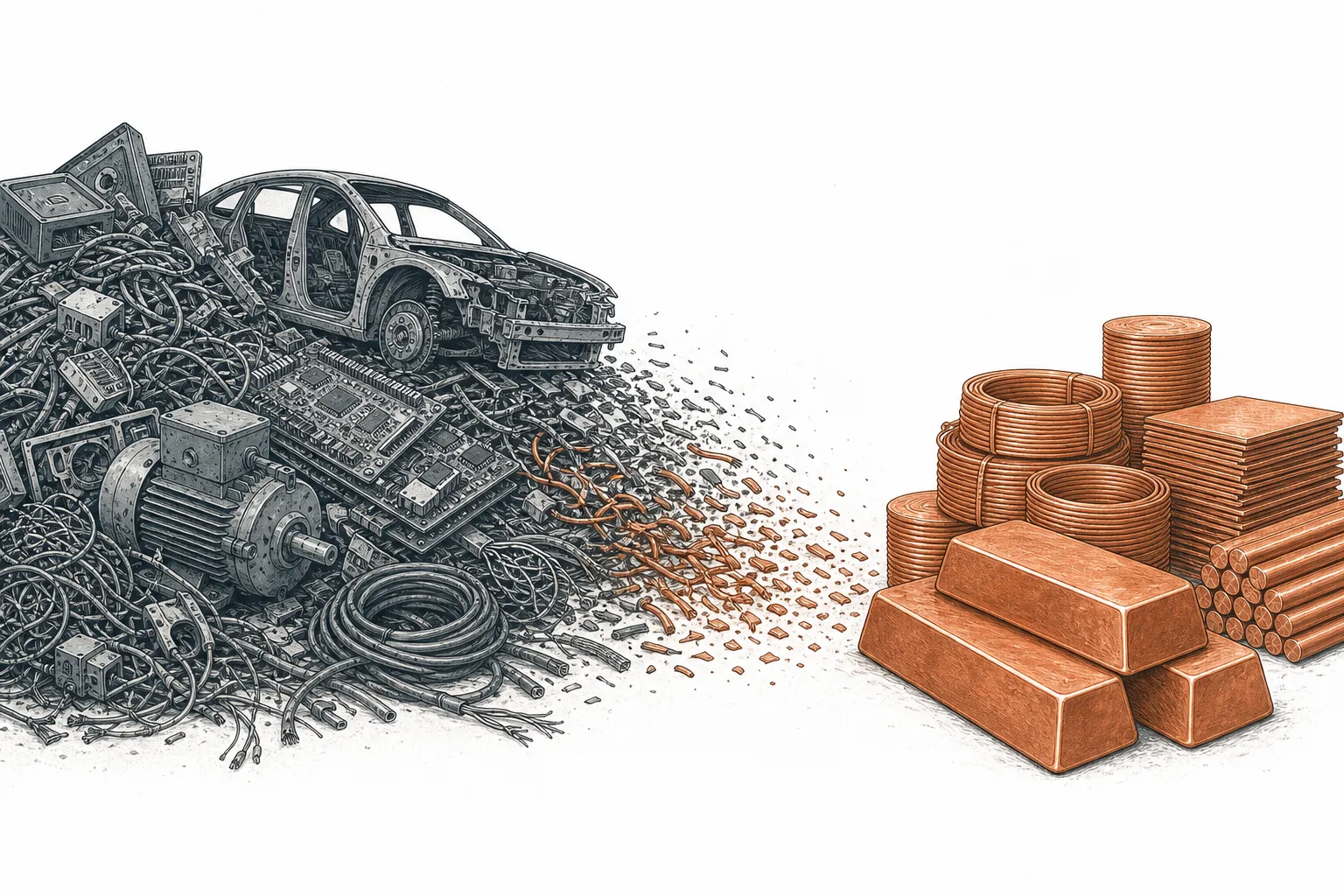
Think of an old charging cable, a dead fan motor, a retired transformer, or the circuit board in that old phone in your drawer. All of them have copper inside — and here's the magic of copper: it recycles 100% with no loss of quality. Remelted copper is just as good as copper freshly dug from a mine — unlike paper or plastic, which degrade the more you recycle them.
The business we're talking about here is “secondary copper” — companies that make money by collecting, sorting, and processing copper scrap back into usable metal. It's not digging ore out of the ground (that's Copper Mining & Concentrate); it's “mining” from things humans have already made. The industry calls these piles of metal waste the “urban mine”.
New scrap = factory offcuts that have never been used, like trimmed wire ends — clean and easy to recycle · Old scrap = copper from things that have actually reached end of life, like wiring ripped out of a house or EV motors — mixed, dirty, harder to sort · Secondary refined = pure copper cathode made from scrap, not ore · Urban mine = the “mine” of copper buried in things still in use, waiting for the day they retire
On our megatrend map, this step is a sub-branch of Copper, under the Critical Materials & Supply Chain megatrend — but it doesn't sit “upstream” or “midstream” like its siblings. It's a “shortcut” that runs parallel to the whole chain, because copper scrap can enter the loop at many points and cycle back into fresh raw material over and over, endlessly.
02Why it matters (the gap mines can't close)
To see why secondary copper is about to matter so much, start with the bigger problem: the world is heading for a copper shortage. Copper demand is expected to grow about 50% by 2035, reaching around 49 million tons a year — driven by EVs (which use 3–4 times more copper than gas cars), AI data centers, power lines, and renewables. But all the announced new mine projects put together cover only about 70% of 2035 demand.
New mines can't fix this fast enough. Good-grade copper deposits are getting rarer, and a single mine takes a decade to build before it produces. This is where secondary copper comes in: it's a “second supply” that can scale faster and doesn't wait for a mine. Today, recycled copper accounts for about a third of the copper the world uses each year (~32%) — not a bit player, but already the second pillar.
And there's another reason recycling looks far more attractive in a carbon-conscious world: remelting copper scrap uses about 85% less energy than smelting from ore. Because the copper in scrap is “already pure,” there's no sulfur and rock to drive off like there is with raw concentrate — so it saves energy, emits less carbon, and is often cheaper too.
03How it works (from scrap back to 99.99% metal)
The heart of this business is the “closed loop” — a single piece of copper can travel from “old” back to “new” endlessly. Let's follow one old wire on its journey back to pure copper.
The hardest step isn't the melting — it's step 2, collecting and sorting. New scrap from factories is clean and easy, but “old scrap” from things that have truly reached end of life is usually contaminated — wiring wrapped in plastic, motors mixed with steel and magnets, circuit boards where copper is blended with gold, silver, tin, and lead. Pulling out copper pure enough to melt takes shredders, magnetic separators, and chemical processes.
And here's the profit secret of this business, just like at a smelter: the real revenue often comes from the “extras” — especially from electronic circuit boards (e-scrap), which contain copper, gold, silver, and palladium all mixed together. The better a company is at refining precious metals out of electronic waste, the bigger its edge — because the gold in a single phone can be worth more than the copper in it.
04What it connects to
Secondary copper is a “shortcut” that runs parallel to the main copper chain. It doesn't compete with Copper Mining & Concentrate head-on; it tops up supply where mines fall short. And it ties tightly to Copper Smelting & Refining — many modern smelters eat both concentrate and scrap (companies like Aurubis and Glencore are smelter and recycler in one). The cathode that comes out then flows to Copper Fabrication & Products to be rolled into wire and tube, blended with mine copper until you can't tell them apart.
What matters more is the demand “waiting to be fed” — whether copper comes from a mine or from scrap, it feeds the same megatrends of the era: Energy Transition & Power Demand (power lines, wind turbines, solar), Electrification & Mobility (EV motors and charging cables), and Artificial Intelligence (tons of copper in the wiring and cooling of data centers). Put simply: every ton you can recycle is a ton you don't have to wait for a new mine to deliver.
05Where it stands now
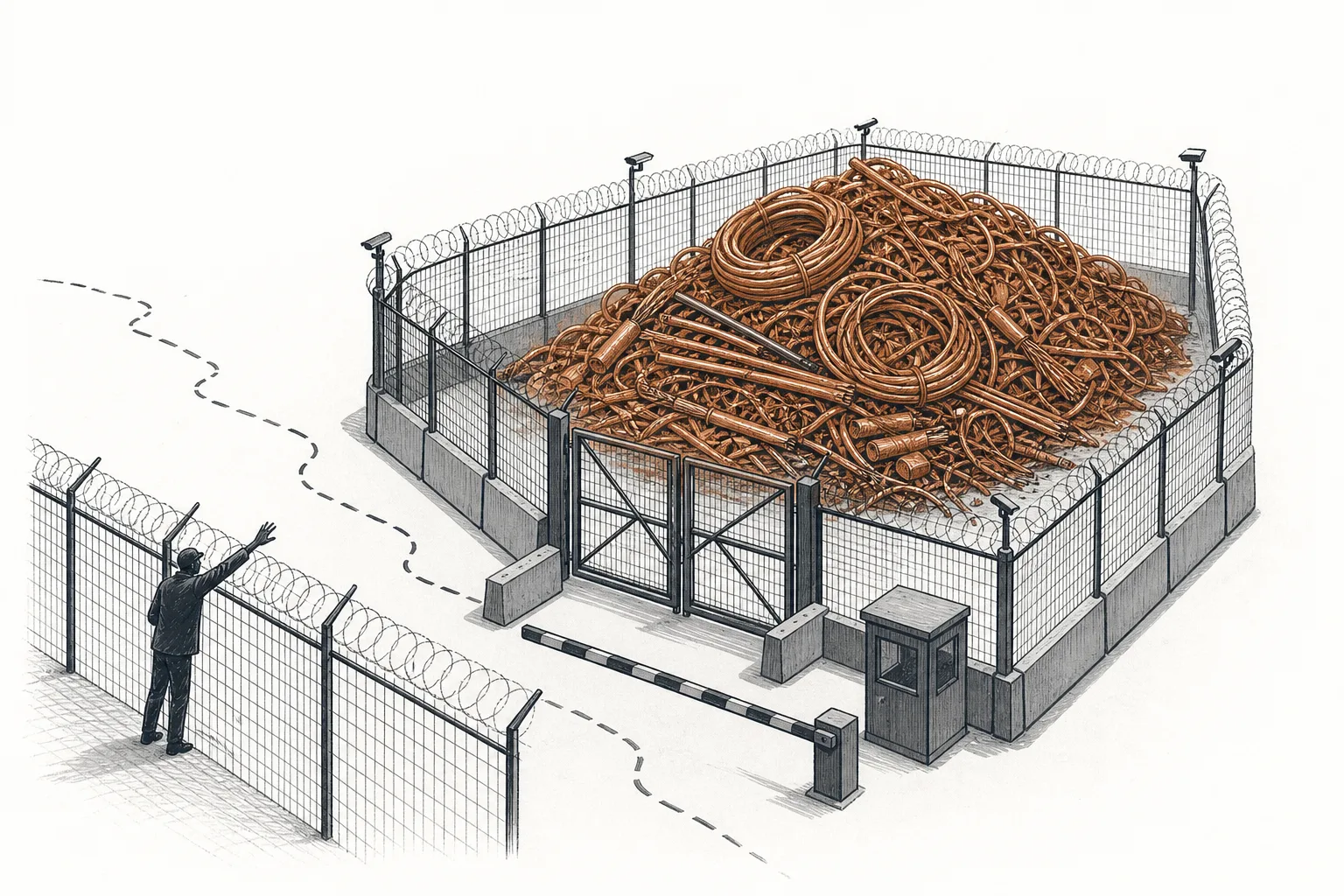
In 2025, copper scrap became something everyone wanted. When smelting fees from ore dove into negative territory (see the Copper Smelting & Refining chapter), smelters around the world fought harder for scrap, because melting scrap still turned a profit. The result was scrap going tight and pricey worldwide.
Then politics piled on. In 2025 the US brought in measures under Section 232 aimed directly at copper — requiring that at least 25% of high-grade copper scrap be sold domestically (rather than exported), and planning a stepped import tariff on refined copper of 15% in 2027 and 30% in 2028. The effect was immediate: US copper-scrap exports to China fell more than 53% from January to May 2025. Copper scrap has become a “strategic resource” that each country wants to keep for itself.
Riding this wave, the West is investing hard. The clearest example is Aurubis, which opened the first multimetal recycling plant in the US, in Georgia (Aurubis Richmond), worth about $800 million, hitting its First Melt in September 2025 — designed to take complex recycled feed like circuit boards and cable at up to 180,000 tons a year. In Canada, meanwhile, the government is stepping in to prop up Glencore's Horne smelter, which recycles over 100,000 tons of electronic waste a year, to keep it from closing — because it's a rare piece of copper-recycling capacity in North America.
The players here are spread around the world and come in many forms — from integrated Western giants to pure-play recyclers in China and Asia who are skilled at pulling precious metals out of electronic waste.
06The road ahead
The biggest story in this business hasn't even arrived yet — it's the “end-of-life wave.” Copper lasts a long time: house wiring, transformers, and motors last 20–40 years. That means the enormous amount of copper installed during China's growth boom and urban expansion worldwide is about to start “retiring” over the coming decade. And a new wave is forming: the EVs, batteries, and AI servers being sold today will become recyclable scrap from around 2035 onward.
Multiple studies point to around 2035 as the moment end-of-life scrap overtakes factory scrap to become the largest source of scrap. That's why companies like Aurubis and Glencore are investing in recycling capacity ahead of time — they're laying the pipes to catch a wave that hasn't hit yet.
But there's a truth worth saying plainly: recycling alone can't close the whole gap. Even if you collect nearly every scrap, the amount of copper retiring each year still can't keep up with demand growing this fast. The world needs both new mines and recycling together. Recycling isn't a “replacement” for mining but an indispensable “ally” — and a cleaner, faster ally that carries less geopolitical risk.
07Challenges & risks
Scrap collection is scattered. Unlike centralized mines, copper scrap is everywhere — every house, every factory, every car. Collecting and sorting it into enough volume and quality is hard work that leans on a large network of small scrap dealers. Inconsistent scrap quality and contamination are chronic problems for the whole industry.
Scrap prices swing with copper prices. When copper falls, people don't bother tearing out old material to sell, so scrap volumes shrink, and recyclers' profits inevitably swing with the global metal price. There's also a macro paradox: if recycled supply rises enough to push copper prices down, low prices can make new mines uneconomic to open — ultimately widening the supply gap in the long run.
Environmental and geopolitical costs. Even though it's cleaner than smelting from ore, melting scrap — especially electronic waste — still emits pollution that must be tightly controlled. Glencore threatening to close its Horne plant over the cost of environmental upgrades is a clear example. And once scrap becomes a “strategic resource” whose exports each nation controls (as the US did in 2025), cross-border scrap flows get more politically entangled — what used to be mere “waste” has become a new battleground of the energy-transition era.