Megatrend · Critical Materials
Moving a hundred tons of rock for a single ton of copper
EVs, AI servers, power lines, wind turbines — they all start from the same thing: copper. But copper doesn't come out of the ground as a bar. It hides in rock that's only about 0.5–0.6% copper, and that number keeps “thinning” every year while the world wants more and more of it. This is the story of the “upstream” of the copper chain — the work of moving a whole mountain for a handful of metal, and the quietest chokepoint of the energy-transition era.
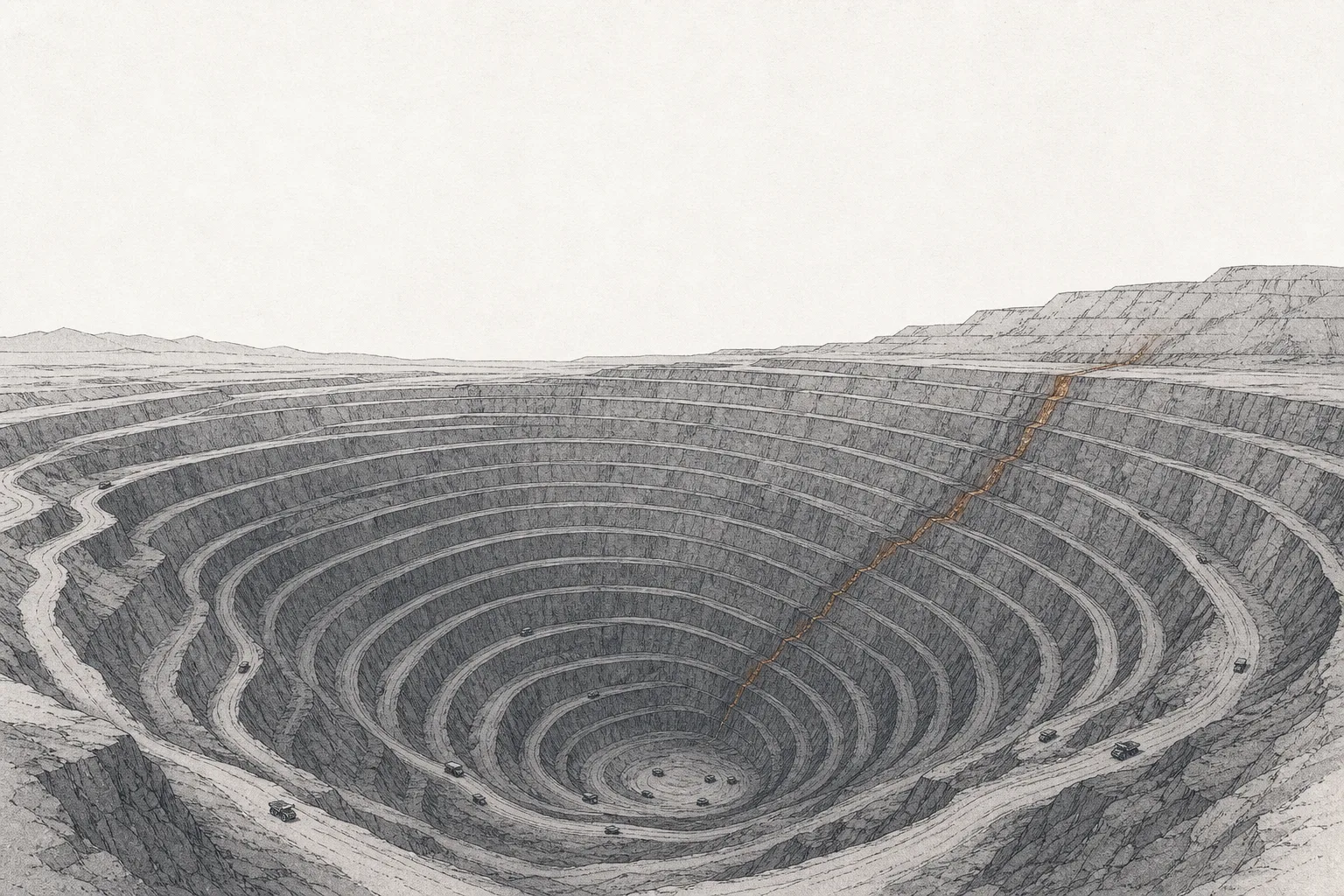
01What a copper mine is
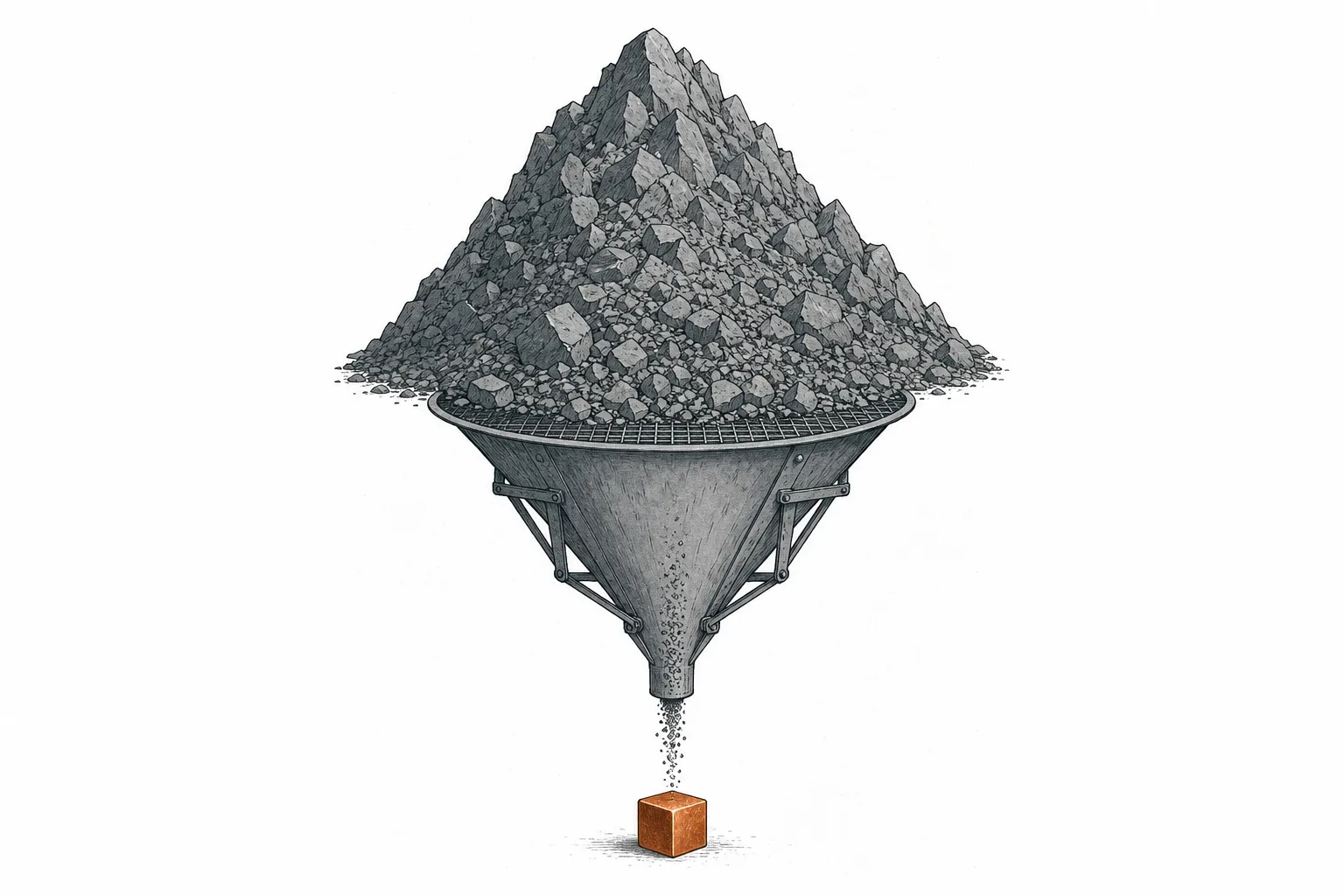
Picture a giant pit in the middle of Chile's desert — miles wide, spiraling down in terraces almost a kilometer deep. Trucks as tall as a three-story building haul up hundreds of thousands of tons of rock a day. All of it for one thing: copper — but each ton of rock they dig out holds only about 5–6 kilograms of it. The rest is waste rock to be thrown away.
This is the “upstream” of the copper chain — companies whose value comes from “copper still in the ground.” Their work runs from exploring for deposits, to digging open-pit or underground mines, to crushing the rock and separating out the copper until it's concentrated enough to sell. What leaves the mine isn't a shiny copper bar but a wet, grayish-brown rock powder called “concentrate”, which is only about 25–30% copper.
Ore = rock with enough copper to be worth mining · Grade = how much copper is in the rock, measured in %; the world average today is around 0.5–0.6% · Concentrate = the mine's product, ore powder spun up to ~25–30% copper before it's sent to the smelter
On our megatrend map, this step is a sub-branch of Copper, under the Critical Materials & Supply Chain megatrend — it's the “first gate” where everything begins, before concentrate flows into Smelting & Refining to be refined into pure metal, then on to Fabrication into components. If the upstream mine stalls, the whole chain stalls with it.
02Why it's the bottleneck of the electric age
The reason is simple: copper is one of the best conductors of electricity among the metals you can actually afford. Every time the world “turns energy into electricity,” it needs more copper — and right now the world is electrifying everything at once.
The clearest number is cars. One EV uses about 83 kilograms of copper, while a gas car uses just 23 kilograms — nearly 4 times more, because an EV's motor, battery, and wiring run much longer. And it's not just cars: a single 1-gigawatt AI data center can swallow around 50,000 tons of copper — about as much as it takes to build half a million EVs.
Add it all up — the power grid expanding to take on clean energy, solar panels, wind turbines, and data centers — and copper demand in each of these will grow hard over the next decade. The IEA estimates grid copper demand alone will rise about 49% by 2035.
Here's the catch: copper isn't like chips or software, where you can add capacity in a few months. It has to be “dug out of the ground,” and the ground gives up copper more and more slowly. Demand runs at the speed of AI, but supply runs at the speed of geology — and that gap is the real bottleneck.
03From 0.6% rock to 30% concentrate (how it works)
So if the rock is only 0.6% copper, how does a mine pull the copper out? The answer is a technique more than a century old that's still used every day: “froth flotation” — and its heart is a simple trick: copper particles like to cling to air bubbles, and waste rock doesn't.
First, the rock is crushed and ground to a powder as fine as flour, to “free” the tiny copper grains (mostly chalcopyrite) from the surrounding rock. Then it's mixed with water into a slurry and dosed with a chemical called a collector, which coats the copper grains and makes them “afraid of water” (hydrophobic). When air bubbles are blown up from the bottom of the tank, the copper grains rush to cling to them and float up as a thick froth on top, while the waste rock sinks. Workers just skim off that froth — and that's the concentrate, where copper jumps from 0.6% to ~30%.
This is why “ore grade” matters so much. High grade means the mine digs less rock per ton of copper, uses less energy and water, and earns more. Low grade makes everything more expensive — and that's the single biggest problem facing this industry today, which we'll dig into in the next chapters.
04What it connects to
The mine is the “top of the upstream” in the copper chain — everything starts here and flows down. Concentrate from the mine goes to Copper Smelting & Refining to be smelted and refined into 99.99% pure copper sheet, then on to Copper Fabrication & Products that rolls it into wire and tube. Running alongside is a parallel track — Copper Recycling & Secondary Metal — which feeds copper from old scrap back into the system and eases the load on mines.
What's interesting is the “mutual dependence” between mines and the megatrends downstream. Copper from the mine supplies nearly every trend of the era — it goes to Artificial Intelligence (the wiring and cooling of data centers), to Energy Transition & Power Demand (power lines, wind turbines, solar), to Electrification & Mobility (the motors and wiring of EVs), and to Defense & Geopolitical Fragmentation. In return, these trends are the force that drives demand and pushes mines to dig faster.
05Where it stands now
The problem that decides this industry's fate has a name: “declining ore grades.” Put simply, the high-grade copper deposits were nearly all dug out over the past century, leaving ore that's more and more “diluted.” The world average grade has fallen from around 1.2% in 1990 to about 0.6% today.
0.6% doesn't sound much different from 1.2%, but the impact is enormous. When grade halves, a mine has to dig and crush twice as much rock for the same copper. At ~0.6% grade, you have to dig and process about 167 tons of rock for just 1 ton of copper — and energy, water, and costs all climb with it.
The tight ore shows up clearly in the price. In 2025 copper hit a record above $12,000 per ton in London, up about 41% in a single year — its best year since 2009. Such a high price is a sign the world is starting to seriously fear a “shortage.” It hands miners fat profits in the short run, but it also sends everyone scrambling to find new deposits.
The real players here range from integrated giants that mine many metals, to “pure-play” companies that bet the whole firm on copper alone, plus a new challenger holding a trump card: “high-grade deposits.”
06The road ahead
The big picture of the future fits in one line: “demand climbing, supply falling.” The IEA estimates refined-copper demand will rise from about 27 million tons in 2024 to around 33 million tons in 2035, while supply from existing and announced mines will peak in the late 2020s and then slide below 19 million tons by 2035 as old mines run out and grades thin — leaving a gap of about 30% that no mine has yet filled.
So how will the world fill the gap? Three paths are running in parallel. First — open new high-grade mines. The best example is Ivanhoe's Kamoa-Kakula in Congo, at a grade as high as ~2.8% (nearly 5 times the world average) — but deposits like this are very rare and sit in politically risky places. Second — recycling: millions of tons of copper in old wiring and equipment are nearing end of life, and smelting from scrap uses less energy and no digging. Third — use copper more efficiently and substitute other metals (like aluminum) in some jobs.
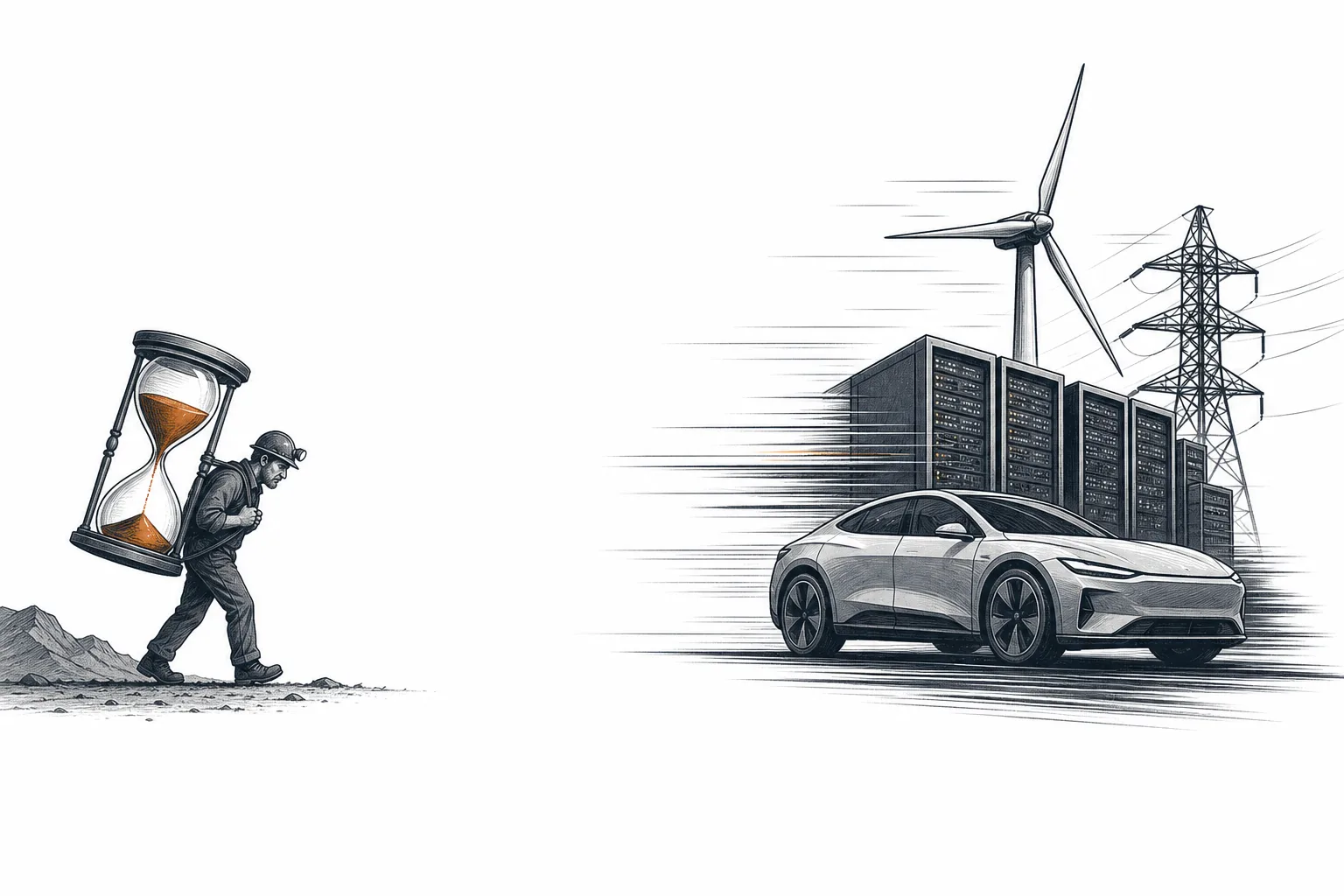
But even all three together aren't enough to keep up with demand in the short run. What almost every analyst agrees on is that the coming decade will be a “golden age of copper,” with prices likely to stay high — and whoever holds good-grade mines will have enormous bargaining power.
07Challenges & risks
Geology isn't on our side. Thinning grades are an irreversible pressure — every year mines have to dig more rock and use more energy and water per ton of copper. In arid places like Chile, “water” has become a real constraint, forcing many mines to invest in desalination plants just to keep the water flowing.
New mines are hard and slow. With an average of nearly 18 years from discovery to production, plus community opposition and tightening environmental rules, new supply follows very slowly even when copper prices spike. Many projects cost $7–10 billion per mine — a huge bet that takes a decade to pay off.
Political risk and resource nationalism. Copper deposits are concentrated in a few countries — Chile and Peru together control more than a third of the world, and Congo is rising. A fresh lesson is First Quantum's Cobre Panama mine, which once produced around 350,000 tons of copper a year (about 1.5% of the world) but was ordered shut by Panama's government in late 2023 after a court ruled its concession contract unconstitutional — a $10-billion mine halted in an instant. It shows that having ore in the ground doesn't always mean you can dig it up and sell it.
Wild price swings. Copper is a commodity — its price rises and falls with the global economy and speculation. Mines cost enormous sums and take years, yet their revenue is tied to a price that can swing hard. When the economy slows, copper often falls first — the “Dr. Copper” that forecasts the economy is a double-edged sword for the people who dig it up, too.