Megatrend · Space Economy
Turn satellites into "cell towers in space," and dead zones vanish across the whole planet
Right now your phone talks to a cell tower a few kilometers away. Step out of its range and you instantly see "No Service" — out at sea, up a mountain, deep in a forest, or in a village with no tower. Direct-to-Device is an idea that sounds simple but is staggeringly hard: take the same phone in your pocket, with no modifications at all, and connect it directly to a satellite flying 500 kilometers up — as if you lifted a cell tower and hung it in the sky. This lesson covers how it works, who's racing to build it, and why it's a bet that's both huge and just as risky.
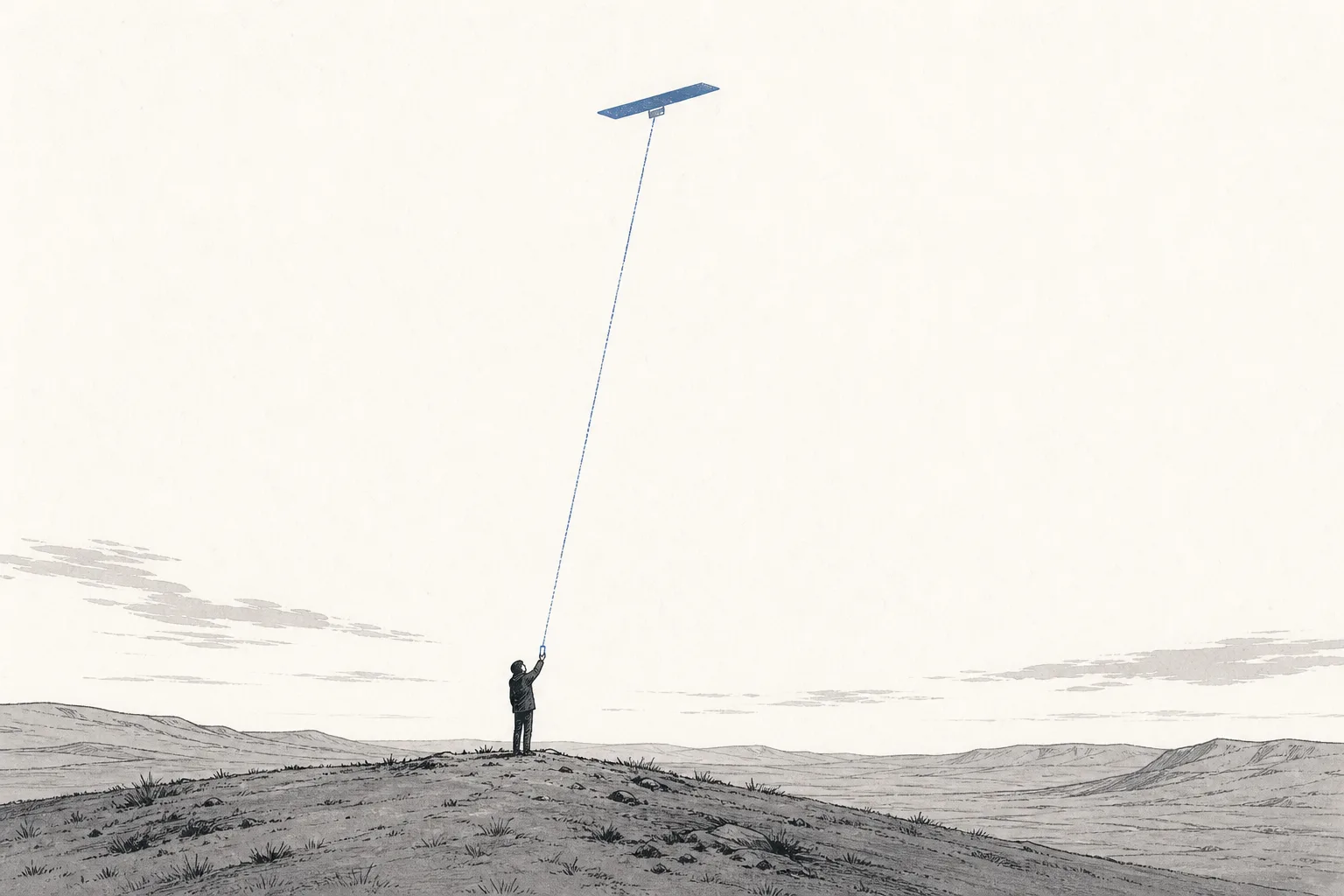
01What it is — a cell tower in space
Picture a cell tower you see by the roadside. It works simply: it broadcasts standard mobile signal a few kilometers in every direction, and your device within that radius picks it up. Direct-to-Device (D2D) means lifting that tower up onto a satellite — putting the tower more than 500 kilometers up and having it broadcast the exact same kind of mobile signal down. So the phone you're using right now connects to it without swapping devices, attaching an antenna, or installing any special app.
The heart of what makes this special is the phrase "an unmodified, ordinary phone". Old satellite phones (like Iridium's) are special-purpose devices — bulky, with a fat antenna, expensive, and they have to point at open sky. But D2D lets the iPhone or Android in your pocket talk to a satellite directly. All the difficulty has been moved "up to the sky" — to building a satellite good enough to "hear" the tiny signal from a small phone hundreds of kilometers away.
On the megatrend map, this node is the deepest branch under Satellite Connectivity & Direct-to-Device, inside the big trend Space Economy. It has one sibling branch — Satellite Broadband, MSS & Ground Equipment — which is the "internet from the sky beamed down to a dish," Starlink at home, that needs a dish and equipment. The key difference: that sibling beams down to a dish, while this node beams straight to an ordinary phone. That dividing line is why D2D's market is so much bigger: its customer isn't someone willing to install a dish, it's every phone on Earth.
LEO (Low Earth Orbit) = a low orbit of roughly 500–600 km. D2D satellites sit here because it's "close enough" for a phone's faint signal to reach · NTN (Non-Terrestrial Networks) = an extension of the mobile standard (set by 3GPP, the same body behind 4G/5G) that lets phones, satellites, and networks "speak the same language" with no modification to the device · SCS (Supplemental Coverage from Space) = the U.S. rulebook that lets satellites borrow terrestrial mobile spectrum to "plug" dead zones — the key that makes D2D legal
02Why it matters — the dead zones of billions
Look at this number: even though 96% of the world's population lives where "there's mobile signal to use," there are still about 300 million people entirely out of coverage, and within that, around 170 million live where there's no mobile infrastructure of any kind — because running cable or building towers in such remote places "doesn't pay" economically. And if you look at the Earth's surface instead of at people, it's even clearer: more than 90% of the surface — oceans, deserts, mountains, forests — has no cell tower at all.
This is the "market" D2D is aiming at, and it's not just about the underprivileged in remote places — it's everyone who has ever driven through a no-signal stretch, gone hiking, taken a boat out, or been caught in a disaster that knocked towers down. So D2D's pitch isn't to "replace" the existing mobile network, but to "plug the holes" — adding signal exactly where terrestrial towers can't reach, making the words "No Service" slowly disappear.
In money terms, today's D2D market is still small, but the growth curve is very steep. Research firm MarketsandMarkets estimates the market will grow from ~$0.57 billion in 2025 to ~$2.64 billion in 2030 — about 36% a year on average. Meanwhile consumer-side users are expected to jump from ~0.6 million in 2025 to ~23.5 million in 2030 — because the moment this feature becomes "thrown in with your mobile plan," it spreads to the masses fast.
03How it works (phone → satellite → carrier)
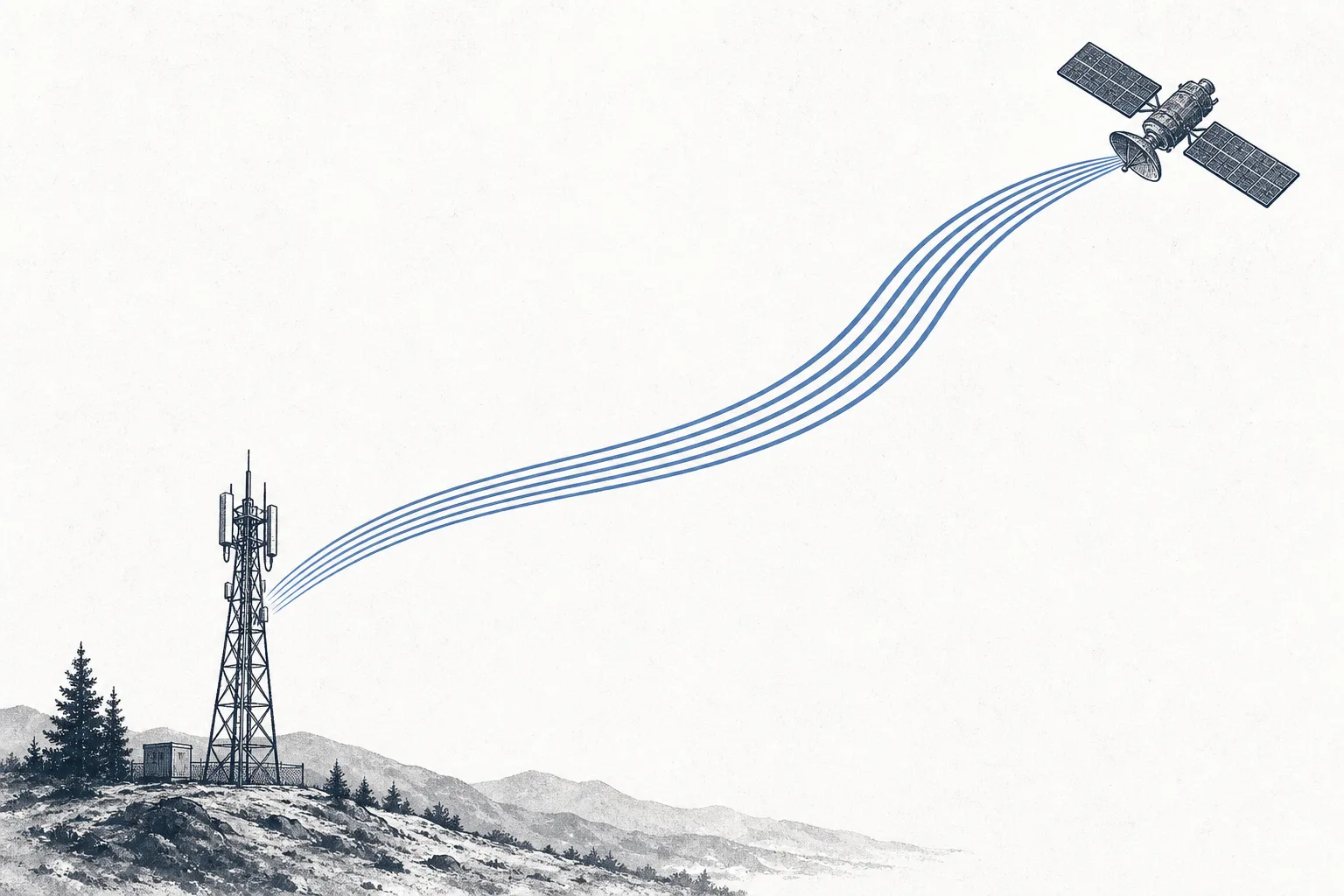
Trace the journey of a single message you send from the middle of a forest with no tower, and see how it travels to reach your friend. The most "magical" part is the first step: your phone thinks it's talking to a normal cell tower, when that "tower" is actually floating more than 500 kilometers up.
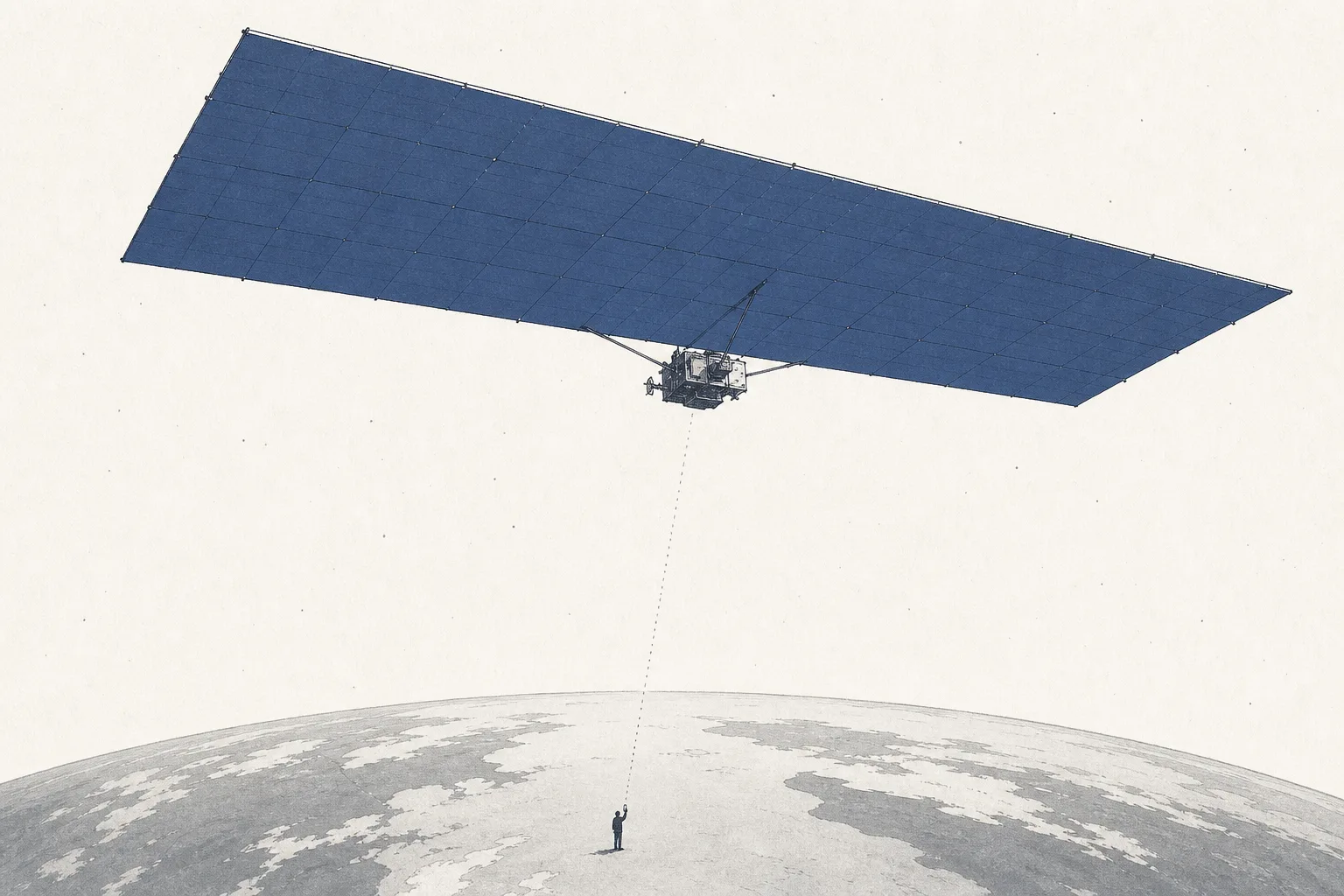
Why is it staggeringly hard? Because phones are designed to talk to towers a few kilometers away, not to satellites hundreds of kilometers up flying thousands of kilometers an hour. So a phone's signal is "very faint" by the time it reaches space. The fix is to build satellites with a giant antenna to "hear" that whisper — AST SpaceMobile's BlueBird 6 satellite, launched in late 2025, has the largest antenna array ever sent to low orbit for commercial communications for exactly this reason.
04The ecosystem — why you have to team up with the carriers
Here's what makes D2D utterly different from other satellite businesses: it almost can't go it alone — it has to pair with a mobile carrier. There are two layers of reasons. The first is spectrum — D2D uses standard mobile spectrum (low-band), and that spectrum belongs to the carriers. To beam it down from a satellite, you have to "borrow" the spectrum from the carrier that holds the license. The second is customers — carriers already have hundreds of millions of subscribers. Selling D2D as an "add-on" through the carrier reaches people instantly, with no need to build a customer base from scratch.
That's why every D2D deal today is about "who teams up with which carrier": Starlink with T-Mobile; AST SpaceMobile backed by AT&T, Verizon, Vodafone, and Rakuten (and Vodafone has a long-term contract running to 2034 covering 20+ countries in Europe and Africa); while Globalstar is paired directly with Apple.
- Different from the sibling Satellite Broadband & Ground Equipment: that branch beams internet down to dishes and terminals (Starlink at home/on a boat), sold straight to users willing to install equipment, while this node beams straight to an ordinary phone through carriers — a completely different business model, even though both use satellites
- Demand from Defense & Geopolitical Fragmentation: communications that are "hard to knock down" and reach everywhere are a strategic asset. Governments and militaries are customers ready to pay, and they push this market from the start
- Relies on Semiconductors and advanced materials: satellites and signal-processing chips that work up in the sky need specialized chips and materials, tying this node directly to the semiconductor supply chain
- A "lifeline" for AI and Smart City / Autonomous Infrastructure: connectivity anywhere, anytime is a prerequisite for self-driving cars, IoT sensors, and AI services that have to stay online
05Where it stands now
The 2026 picture is "three big camps, each running its own lane." Let's go through them one by one.
1) Starlink Direct-to-Cell + T-Mobile — first to move, already selling SpaceX used its edge in cheap rocket launches to rush direct-to-cell satellites up, more than 650 of them already (as of early 2026). The "T-Satellite" service went commercial with T-Mobile in July 2025 — starting with messaging, then location sharing and apps like WhatsApp and Google Maps, at $10 a month as an add-on (open to customers of rival carriers like Verizon and AT&T too). Full voice calling is still in development, and in December 2025 the FCC granted SpaceX and T-Mobile a historic SCS license.
2) AST SpaceMobile — betting the whole company on a giant antenna AST chose a different path: build big satellites with a giant antenna to beam straight to ordinary phones at high speed. In 2025 the company demonstrated a two-way video call over an ordinary phone with AT&T, Verizon, and Vodafone, and set a record of 98.9 Mbps from a satellite straight to an unmodified phone — fast enough to stream video. The company aims to have 45–60 satellites in orbit by the end of 2026 to start service covering the U.S., Europe, and Japan, with about 50 carriers that together have nearly 3 billion subscribers waiting.
3) Globalstar + Apple — quiet, but in the most hands The iPhone's Emergency SOS via satellite feature (since iPhone 14) runs on Globalstar's network, with Apple having invested about $1.5 billion (possibly up to $1.75 billion), holding about 20% of the stock and reserving 85% of the network's capacity. This is the D2D that has actually "reached" the most users today, through hundreds of millions of iPhones — and it's also a target that Amazon is reported to be interested in acquiring, in a deal talked about at around $9 billion.
06The future — from messages, to voice, to data
The clearest direction is climbing the capability ladder. Today most D2D can still only do messages and SOS, because messages use little bandwidth and tolerate weak signal well. The next rung is messaging apps and maps, then voice calls, and finally high-speed data that can stream video. Every rung needs more satellites, bigger antennas, and more spectrum — which is why these companies still have to keep raising money and launching satellites for years to come.
The second direction is D2D becoming a standard phone feature. As the 3GPP NTN standard spreads to new phones, "connecting to a satellite yourself" becomes as ordinary as cross-border roaming — the device switches to the satellite automatically when it leaves tower range, with you barely noticing. Carriers will sell it as an add-on for a few dollars a month.
The third direction is spectrum becoming a battlefield. Because D2D needs terrestrial mobile spectrum, whoever holds more spectrum has more bargaining power. So enormous spectrum deals are starting to happen — like EchoStar selling about 65 MHz of spectrum to SpaceX and another 50 MHz to AT&T, for over $40 billion combined in late 2025 — reflecting that "who holds the spectrum" is becoming as central to the game as "who holds the satellites."
07Challenges & risks
D2D's appeal comes with risks just as heavy.
The first risk is that it burns enormous money and has to keep diluting its stock. The clearest example is AST SpaceMobile: in 2025 the company made revenue of about $70.9 million (up from ~$4.4 million in 2024) but posted a net loss of ~$341.9 million from the cost of building and launching giant satellites. The company has to keep raising big rounds — at the end of 2025 it held about $2.8 billion in cash, and its share count rose about 18% in a single year. Owning a stock like this is like "a bet on the future" that has to endure dilution and wait for real revenue.
The second risk is the shadow of Starlink. Many analysts point out that a challenger like AST faces an "uphill battle" against SpaceX, which has the edge of the cheapest rocket launches, the most satellites in orbit, and a direct-to-cell service already selling. Every weakness of Starlink tends to be a "heavier" weakness for a challenger that doesn't have a single retail user yet — chasing the leader in a game this capital-hungry is no easy thing.
The third risk is spectrum and regulation. D2D needs permission to beam mobile spectrum down from satellites in each country, and it must not interfere with terrestrial networks — a slow process that varies from country to country. Even though the U.S. now has the SCS framework, many markets still don't, and the cost of acquiring spectrum (look at the EchoStar deals worth tens of billions) is sky-high. Add to that the problem of "space junk" and the congestion of low orbit, where tens of thousands of satellites are starting to risk colliding.
In short: this node is about lifting a cell tower up into the sky to erase the words "No Service" from the world. The idea is grand and the market is vast, but it's a game that eats capital heavily, concentrates winners into a few, and requires satellites, spectrum, and carriers all at once — whoever assembles the full set first gets to control the connection in the places where the world once fell silent.