Megatrend · Space Economy
The space internet that actually makes money today — and the little dish that makes it work
Before the buzz about satellites talking directly to your phone, there was another kind of "internet from space" that has been making real money for a long time — beaming the internet down to a receiving dish on ships, on planes, in rural homes, and at disaster camps. Add to that the "satphone" that explorers and soldiers carry up the mountain. And behind all of it is the ground equipment — dishes, gateways, modems — that turns a signal from space into the internet in your hand. This is the original business of satellite connectivity, and Starlink is now shaking it harder than ever in its history.
01What it is
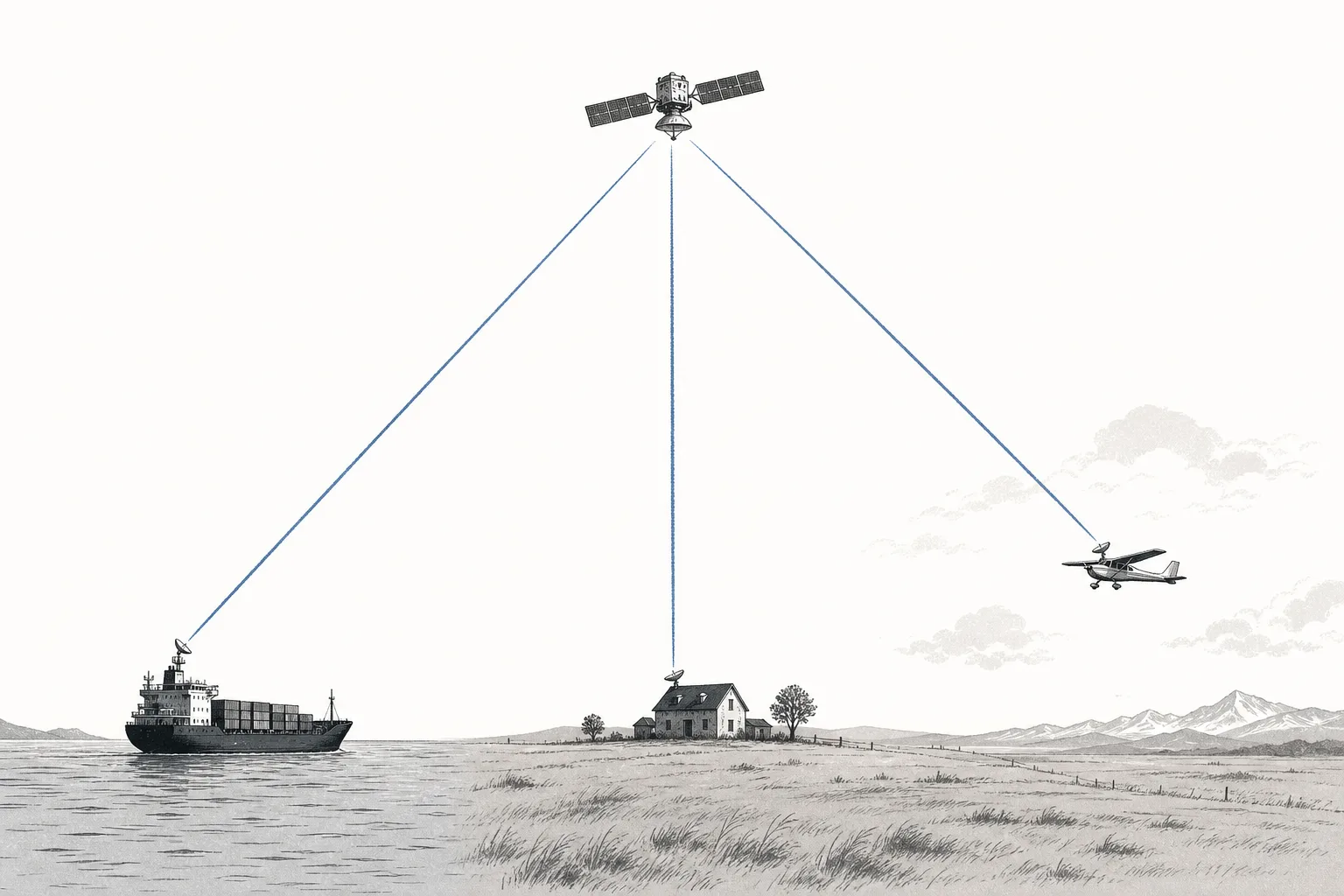
Picture a cargo ship in the middle of the ocean, thousands of kilometers from shore, or a rescue team heading into an area where a storm just knocked down every cell tower — where do they get their internet? The answer isn't a phone tower and it isn't fiber, it's a dish pointed at the sky, catching the internet beamed straight down from a satellite. That's the heart of this node.
The node "Satellite Broadband, MSS & Ground Equipment" is a leaf under Satellite Connectivity & Direct-to-Device, within the giant megatrend Space Economy. It's the "traditional satellite-connectivity business" that has made real money for a long time, built from three legs that work together:
- 1) Satellite Broadband: beams high-speed internet down to a receiving dish at home, on a ship, on a plane, or at a temporary camp — Starlink is the most familiar name, but Viasat, HughesNet, and Eutelsat are also in this ring
- 2) MSS — Mobile Satellite Services: voice/data services through dedicated devices like satphones (satellite phones) and IoT terminals carried by explorers, soldiers, fishing boats, and sensors in remote places — the market leader is Iridium
- 3) Ground Equipment: dishes, antennas, gateways, modems, and ground stations (teleports) that turn a signal from space into internet you can actually use — without this gear, a satellite is just a box floating in the sky
A distinction to draw clearly from the start: this node is the side that always needs "dedicated gear" — a dish or a satphone. Its sibling, Direct-to-Device (D2D), is the new frontier where a satellite can talk to an ordinary, unmodified phone directly, with no dish at all. This lesson stays with "internet into a dish + satphone + ground equipment"; for "internet straight into a phone," read the D2D chapter.
MSS (Mobile Satellite Services) = voice/data services through specialized mobile devices like satphones and IoT terminals, often using the rugged L-band · VSAT (Very Small Aperture Terminal) = a small send-and-receive dish mounted on a home, ship, or branch office to receive broadband from a satellite · Ground Segment = the whole "ground side" of the system — the user's dish + the large gateways/teleports that link the satellite to the real internet
02Why it matters — connecting where nothing else can reach
The value of this node fits in one sentence: it brings internet to places where running a wire "never pays off". Oceans cover over 70% of the planet's surface, and ships, planes, oil rigs, mines in the middle of the desert, mountain villages — none of these will ever get a cell tower or fiber, because there are too few customers to justify the infrastructure. A satellite solves this, because a single one covers a vast area — without caring whether there's a road or a power pole below.
And this is a market where customers are already "ready to pay" — no new demand to create. Shipping lines pay a premium so crews can reach home and paperwork can move, airlines sell in-flight internet, oil and mining companies need to connect remote sites, and governments/militaries want communications that are hard to take down. The overall satellite-broadband market is growing from ~$14.6 billion in 2025 to ~$33.4 billion in 2030 (~18% a year).
But the part many people overlook is "ground equipment", which is actually the bigger slice of cake. The whole Ground Equipment market (dishes, antennas, gateways, modems) was worth about $58.8 billion in 2025 and is expected to grow to ~$104 billion in 2030 — because every time another thousand satellites go up, you need more dishes, gateways, and ground users to follow like a shadow.
And there's another layer that makes this node strategically important: security. The war in Ukraine showed the world that hard-to-take-down satellite communications are a strategic asset. So government/military revenue is a pillar for many players — at Iridium, the U.S. government makes up a large share of revenue, and an equipment company like Gilat grows mainly off defense deals.
03How it works — from satellite to the dish on your house
Many people think satellite internet is just "the satellite beams straight into our dish" and that's it — but really there are four points that all have to be in place for it to work, and the one people overlook is the "ground gateway". Let's trace the path of a single chunk of data.
The most important thing is that the "user's dish" and the "ground gateway" are the ground-equipment business, sold separately from the internet service itself — a company like Gilat makes VSAT modems, antennas, and gateway systems and sells them to every satellite operator. It's like the "seller of picks and shovels" in the gold rush: whichever camp wins, every camp still has to buy ground equipment.
MSS is different — it needs no dish, because it's designed so a portable device like a satphone can receive the signal directly. The trade-off is far less bandwidth (it can send messages/calls/IoT data, but not full-speed broadband). That's why Iridium uses the rugged L-band, which is rarely blocked by rain or obstacles — better suited to work that "has to connect, no matter what" than work that "has to be fast."
04Ecosystem: LEO vs GEO, and how it differs from D2D
This node's entire story over the past few years comes down to moving the orbit from high down to low, which changed everything.
GEO (Geostationary Orbit) = the old-style satellite, hovering still at ~36,000 km, where one covers a very wide area but the signal travels far round-trip, so latency is high (~600 milliseconds) — fine for TV/broadcast, but sluggish for the modern internet · LEO (Low Earth Orbit) = a low orbit at ~550 km, 65× closer, with fast signals and low latency (~20–30 milliseconds) good for gaming and video calls, but one satellite sees only a small patch of ground, so you need thousands of them
This difference is why Starlink left the old-generation GEO players behind. In early-2025 measurements, Starlink's average upload speed was 14.84 Mbps versus HughesNet's 4.44 Mbps — more than a threefold gap, and the latency gap is far wider still. That's why home customers are flowing from GEO to LEO so fast.
This node doesn't sit alone. It connects to other branches of the space economy and to neighboring megatrends:
- Feeds demand to Defense & Geopolitical Fragmentation: hard-to-take-down communications are a strategic asset. Militaries and governments are the biggest, best-paying customers — pushing both the MSS side (Iridium) and the equipment side (Gilat)
- Both competes with and complements Cloud & Digital Infrastructure: it competes with rural ground-based home internet, but it's also the "backup pipe / edge pipe" connecting remote users into the cloud and AI — connectivity everywhere is the fuel for AI
- Depends on Critical Materials & Supply Chain: dishes, antennas, and satellites need chips, special materials, and radio spectrum — resources that keep getting tighter
05Where it stands now
The 2026 picture is one phrase: Starlink squeezes everyone. When LEO is faster, cheaper, and can launch its own rockets at the lowest cost, the old-generation GEO players take a hard hit — in the U.S. home-broadband market, Starlink holds about 72% of the share (mid-2025), and the user numbers of the old rivals are clearly falling.
The incumbents are fighting back three ways. (1) Consolidating for scale: in July 2025, SES bought Intelsat ($3.1 billion), pooling about 120 satellites (~90 GEO + ~30 MEO) to fight with scale and enterprise/government customers · (2) Turning assets into cash: EchoStar, carrying about $27 billion in debt, sold "spectrum" to AT&T and SpaceX for over $40 billion combined (FCC-approved) — showing that an incumbent's most precious asset may not be its satellites, but its spectrum · (3) Building their own LEO: Eutelsat, which merged with OneWeb, has ordered 440 new-generation satellites and is a backbone of Europe's sovereignty project IRIS² (290+ satellites)
Meanwhile MSS stands on firmer ground, because it plays a different game. Iridium doesn't compete on speed with Starlink; it sells "guaranteed connection, anywhere on Earth." In 2025 it made $871.7 million in revenue (+5%), with 2.54 million users — more than half of them IoT (sensors/tracking devices in remote places) — and the U.S. government as its main customer. On the ground-equipment side, Gilat is growing fast off defense and in-flight internet, with 2025 revenue expected at about $445–455 million (+~47%).

06The future — LEO dominance and flat-panel dishes
The first direction is clear: LEO becomes the standard for satellite broadband, and old-generation GEO retreats into specialized roles (broadcast, enterprise customers who need wide coverage from a single satellite). This pressure forces incumbents to choose between "build your own LEO" (like Eutelsat), "merge to get big" (like SES+Intelsat), or "sell the assets and back out" (like EchoStar).
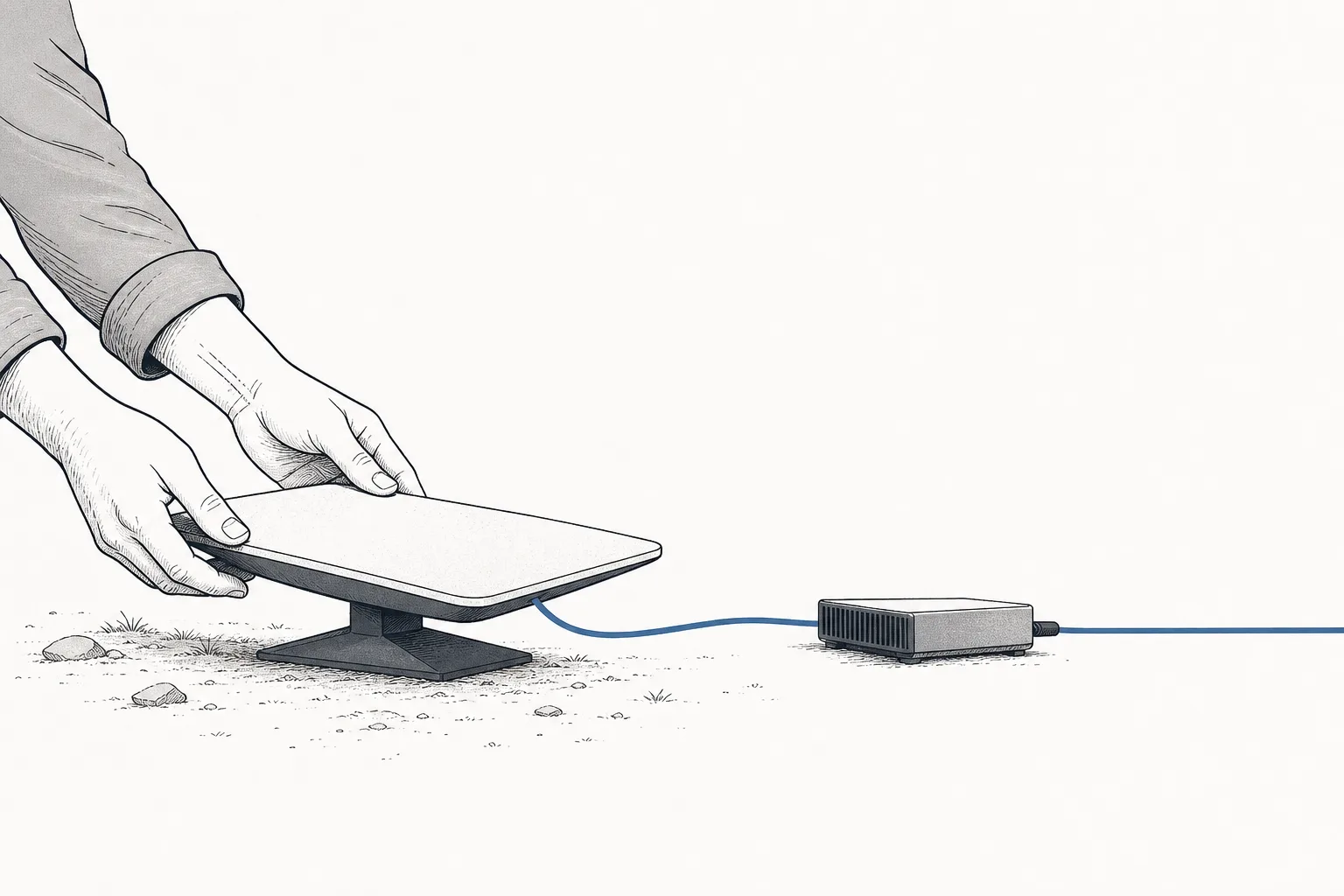
The second direction is the flat-panel antenna replacing the old parabolic dish. The new-generation antenna has no mechanically rotating parts; instead it "steers the beam electronically" (electronically steered), so it can mount on a moving car roof, plane, or ship and lock onto fast-passing LEO satellites in time — this is the key that unlocks the "internet on the move" market. The flat-panel antenna market is expected to grow from ~$7.3 billion (2023) to ~$33 billion (2034), ~15% a year.
The third direction is "connectivity sovereignty". Many nations don't want to depend on "one company's sky." Europe is investing in IRIS², and China is racing to build its own constellation — opening fresh demand on both the satellite side and the ground-equipment side. MSS, meanwhile, keeps growing quietly on the IoT wave: sensors and tracking devices in remote places that want "a signal that reaches everywhere" more than "the fastest signal."
07Challenges & risks
The first and heaviest risk is Starlink (and Kuiper coming behind it) crushing the incumbents. When LEO is faster, cheaper, and the market leader can launch its own rockets at the lowest cost, the old-generation GEO players lose home customers fast — Viasat's retail users have shrunk over 68% and HughesNet's about 29% compared with before Starlink arrived. This isn't a temporary cycle, it's a swap of the underlying technology.
The second risk is GEO obsolescence and the burden of old satellites. Many incumbents hold enormously valuable GEO satellites that haven't reached end-of-life yet, but whose value is steadily eroding as the world turns to LEO — like holding a factory that still runs but makes something people are starting not to buy. And the transition to LEO itself eats enormous capital and is slow.
The third risk is incumbent debt. This business has always invested heavily, so many are carrying big debt loads just as consumer-side revenue is shrinking — EchoStar once held about $27 billion in debt and had to sell off big chunks of spectrum to stay afloat, and Viasat carries net debt of about $5.6 billion. When revenue grows slowly but the interest still has to be paid, financial risk runs high.
The fourth risk is endless capex. Satellites have a limited life (LEO ~5 years) and need new ones launched to replace them constantly. Having a competitive constellation means burning money without stop — only deep-pocketed players or those with state backing can play the full LEO broadband game. Smaller players have to find a specific niche (MSS that Starlink hasn't touched, or ground equipment that sells to every camp).
In short: this node is about getting internet and signal to places wires can't reach — ships, planes, the countryside, disasters, and the battlefield. It has made real money for a long time, well before the D2D buzz, but Starlink is now shaking it harder than ever. The survivors are the players who play the game they're good at — not the ones trying to take an old dish out to race on speed against a swarm of satellites that fly lower and number more.