Megatrend · Critical Materials
The next lithium mine might be the pile of old batteries we're about to throw away
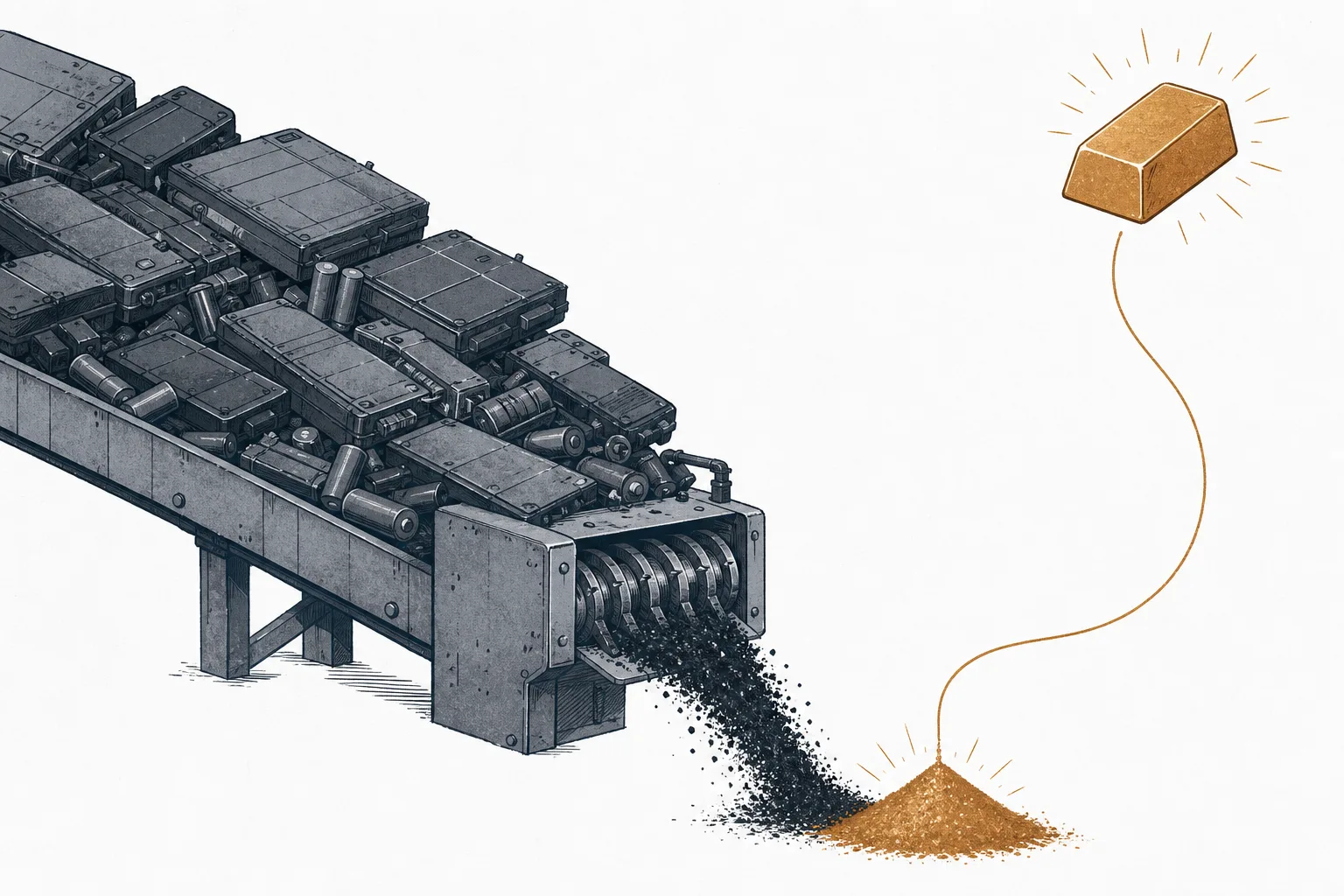
The world's first waves of EVs are reaching end of life, and within a few years millions of lithium batteries will “die” all at once. Inside each one is lithium, nickel, and cobalt that's still perfectly good — ore you don't have to mine, don't have to wait a decade for, and don't have to source from a Chinese refinery. The way to get it back is to shred the batteries into a black powder called “black mass,” then extract the metals to make new batteries. This is the story of a business that turns battery waste back into an “urban mine” — still an infant industry waiting for its big wave, but fast becoming a strategic battleground of the clean-energy era.
01What lithium battery recycling is
Think of the battery in an old laptop, a swollen power bank, or the pack in an EV that's run ten years and worn out. Inside all of these are lithium, nickel, cobalt, and manganese — the same expensive metals the world is fighting to dig out of mines. And here's what most people miss: the metals in an old battery don't “wear out” along with the battery. The cell may no longer hold a charge, but the lithium and nickel inside are as good as freshly mined from the ground.
The business we're talking about here is lithium-ion battery recycling — companies that make money by collecting, shredding, and extracting metals from end-of-life batteries (and from the offcuts left over on battery production lines), then sending those metals back to make new batteries. It's not digging ore out of the ground (that's Lithium Mining & Brine Extraction) — it's “mining” from what humans have already made. Those piles of old batteries and devices have a name: the “urban mine.”
Black mass = the black powder you get after shredding a battery and sorting out the metal casings, blending lithium, nickel, cobalt, and manganese together — the “concentrate” of the recycling world · New scrap = offcuts from battery factories that have never been used, clean and easy to recycle · Old scrap = batteries from things that have truly reached end of life, like EVs, mixed and dirtier · Urban mine = the “mine” of metals locked inside devices still in use, waiting for the day they retire
On our megatrend map, this step is a sub-branch of Lithium, under the Critical Materials & Supply Chain megatrend — but it doesn't sit “upstream” like the mine, or “midstream” like the refinery. It's a “closed loop” running in parallel with the whole chain, because every gram of lithium you recover is a gram the world doesn't have to mine anew.
02Why it matters (ore you don't have to mine)
The first reason is about power. In the Lithium lesson we saw that China refines about 65–70% of the world's battery-grade lithium, leaving the West deeply exposed. Recycling opens a back door: if you can recover lithium and nickel from old batteries inside your own country, you cut your dependence on both foreign mines and Chinese refineries at the same time. That's why the US and European governments pour subsidies into recycling plants as if it were a matter of security.
The second reason is about the environment and cost. Recovering metals from old batteries uses vastly less energy than mining and smelting new ore. A Stanford University study (2025) found recycling uses about 77–89% less energy than mining new ore, emits 58–81% less greenhouse gas, and uses 72–88% less water — because the metals in a battery have “already been refined once,” so you don't start from raw rock.
And the third reason is the size of the opportunity. As EV and energy-storage sales surge, the pile of batteries that will reach end of life keeps growing. The global lithium-battery recycling market is projected to grow from a few billion dollars in 2024 to around $70–80 billion by 2035 — roughly 20% annual growth. Estimates from different research houses vary widely (because it's still an infant market), but they all agree the curve slopes up sharply.
03How it works (from battery, to black powder, to new metal)
The heart of this business is the “closed loop” — a set of metals traveling from a “dead battery” back into a “new battery.” Let's follow one old EV battery pack on its journey back to pure lithium and nickel.
The most important stage is steps 3–4. Once the battery is shredded, you get a black powder called black mass — a concentrate blending lithium, nickel, cobalt, and manganese. This is the real “ore” of the industry. From there, you extract the metals by one of two methods.
Pyro = burning the battery in a furnace at around 1,500°C to drive off the carbon, leaving a nickel-cobalt-copper metal alloy. This method tolerates dirty feed well, but eats a lot of energy and usually “loses” the lithium into the slag · Hydro = dissolving the black powder in acid, then separating the metals one by one. It uses less energy and recovers the lithium too — which is why the modern industry chooses it, because lithium is the most expensive and most easily lost.
The real difficulty is lithium. Metals like nickel, cobalt, and copper are easy to recover, and you get almost all of them back (95–99%). But lithium is light, dissolves easily, and “slips away” with the waste more readily. Older methods like pyro tend to recover very little lithium. The best players today use hydro to recover about 90% or more — and that's the line between who makes money and who doesn't.
04What it connects to
Battery recycling is a “closed loop” running in parallel with the main lithium chain. It doesn't compete directly with Lithium Mining & Brine Extraction — it adds to supply where mines and refineries can't keep up. And it's tightly linked to Lithium Refining & Chemicals, because lithium extracted from black mass still has to be turned into battery grade, just the same. So many companies do both refining and recycling under one roof, until you can't tell whether the lithium came from a mine or an old battery.
Downstream, the megatrends of the era are “waiting to be fed” these metals — the recovered lithium, nickel, and cobalt flow back into EV batteries (Electrification & Mobility) and the grid storage of the Energy Transition, plus the backup-power systems of power-hungry AI data centers. Put simply: every kilogram you recycle is a kilogram you don't have to wait on a new mine or a Chinese refinery for.
05Where it stands now
The surprising truth of 2025 is that this industry has more plants than material to feed them. China built enormous recycling capacity — able to process around 3.6 million tons of old batteries in 2025 (up from 1.2 million tons in 2022) — but the real wave of end-of-life batteries hasn't arrived. As a result, more than 70–80% of China's black-mass refining capacity sits idle, waiting for feedstock. When material is scarce, everyone fights over it — black mass has become a prized commodity that plants worldwide bid up.
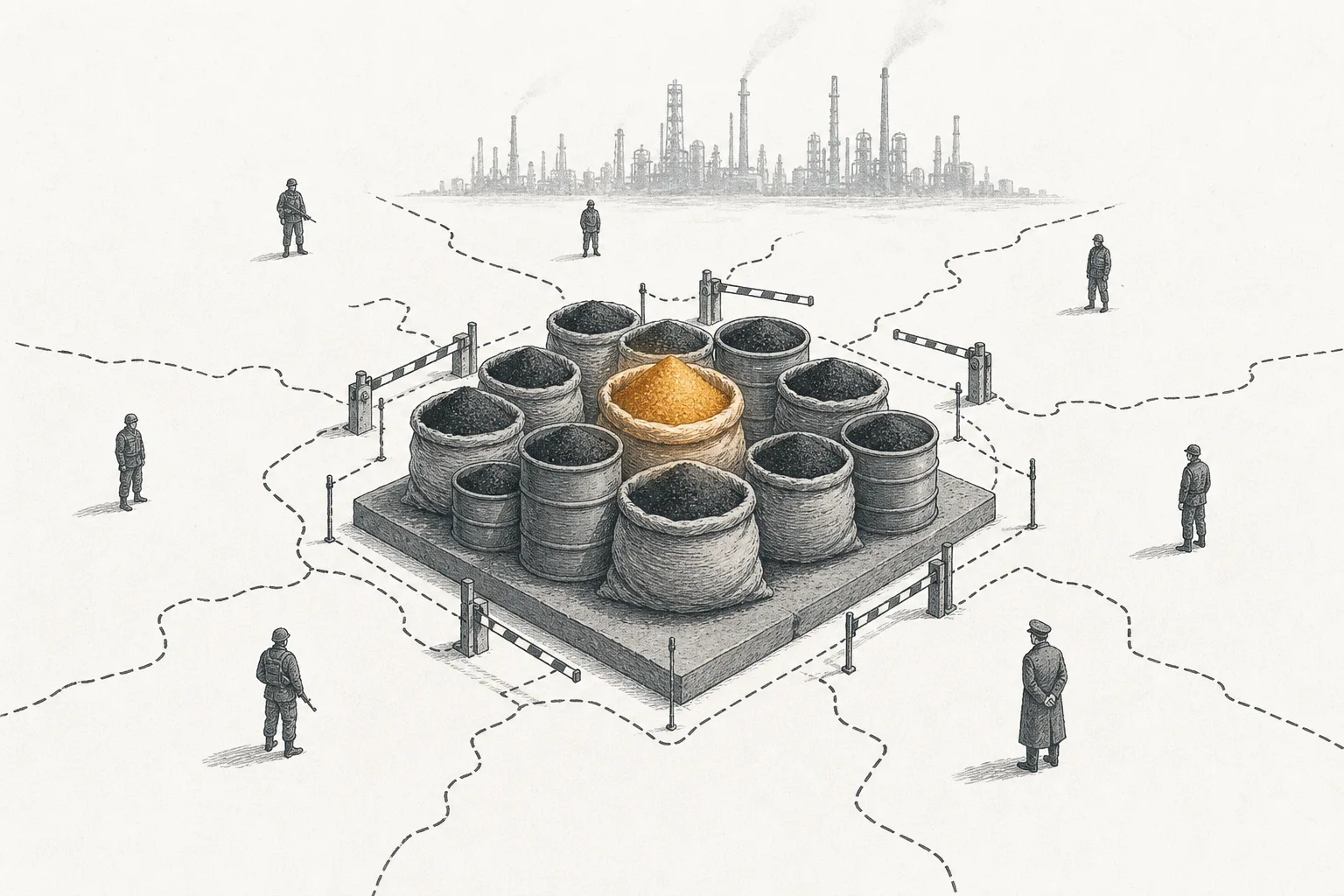
Then politics piled on. China controls about 75–89% of the world's black-mass refining — even higher than its share of refining lithium from ore. And in 2025 it played both sides at once: on one hand, opening the door to pull black mass into the country (from August 2025, classifying qualifying black powder as “not waste” so it can be imported to feed hungry plants); on the other (October 2025), imposing controls on the export of battery technology, cathode/precursor materials, and battery-making machinery — making it harder for the West to build its own recycling chain (these measures were temporarily suspended in late 2025). Europe, meanwhile, classifies black mass as “hazardous waste” with tight export controls, stirring up uncertainty over where the black powder can even flow.
In this current, the West is investing hard. The clearest example is American Battery Technology, which opened a commercial recycling plant in Nevada (20,000 tons/year) and won about $144 million in US Department of Energy funding to build a second. Meanwhile in Europe, the pioneer Umicore has delayed building its big plant to 2032, because there still aren't enough old batteries — reflecting the same truth: the technology is ready, but the “material” hasn't arrived.
The most painful lesson of this round is Li-Cycle, North America's once-watched recycling rising star, which ultimately went bankrupt in 2025 and had its assets picked up by Glencore for just about $40 million. Meanwhile Redwood Materials (private, founded by a Tesla co-founder) has done well — shredding 20 GWh of batteries and earning around $200 million from recycled materials in 2024. That gap tells us the industry is still in its shakeout phase.
The players in this arena are spread worldwide and come in many forms — from Chinese giants that pair recycling with battery-material production, to Western pioneers and Japanese players strong in extraction technology.
06The road ahead
The biggest story of this business is still to come — it's the “end-of-life wave.” Today, most recyclers' feedstock is still “new scrap” from battery factories, not batteries that have truly worn out, because the first waves of EVs are only just starting to retire. But the wave is building: EVs sold in 2015–2020 are reaching end of life, pushing the global volume of end-of-life batteries toward roughly 315 GWh by 2030, and climbing steadily after that.
The number that tells the story best is this one: black mass coming from truly end-of-life batteries (rather than factory scrap) will grow from about 20% in 2024 to around 73% in 2035. That means the industry is shifting from “gathering offcuts beside the production line” to “mining the urban mine” in full. And several studies point to end-of-life material becoming the main feedstock from around 2035 onward. That's why companies like Umicore and Ganfeng are investing in recycling capacity ahead of time — they're laying the pipes to catch a wave that hasn't arrived yet.
But there's a truth worth saying plainly: recycling alone can't close the whole gap. As long as lithium demand keeps growing faster than the pile of batteries retiring each year, the world still needs both new mines and recycling together. Recycling isn't a “replacement” for mining — it's an indispensable “ally,” and one that's cleaner, closer to home, and less exposed to geopolitics.
07Challenges & risks
Not enough material yet (feedstock shortage). This is the strangest risk of an infant industry — the problem isn't selling the product, it's having nothing to process. Plants were built ahead of the wave of used batteries, but the wave hasn't arrived, so many run far below their real capacity, burning cash every day waiting for feedstock. Li-Cycle's 2025 bankruptcy is a warning that if the timing is off, even good technology can't survive.
The economics are tied to metal prices. A recycler's profit comes from the value of the lithium, nickel, and cobalt it recovers. When lithium prices dove more than 80% in the recent cycle, the value of black mass fell with them, leaving some plants barely worth running. Recycling is a business that needs both enough material and high enough metal prices at the same time — two conditions that still don't line up today.
You have to play the scale game. Recovering lithium profitably takes large plants and complex hydro technology. Smaller players who can only shred batteries into black mass and sell it on tend to earn razor-thin margins, while the real value goes to those who can refine it into pure metal — most of whom are still in China.
The geopolitics of black powder. Now that black mass is a “strategic ore,” its flow across borders is caught up in politics. China pulls black powder in, Europe restricts exports of it as hazardous waste, and the US wants to keep it to feed domestic plants. As each nation hoards feedstock for itself, some plants may run short while others overflow — what was once just “battery waste” has become a new battleground of the energy-transition era.