Megatrend · Critical Materials
Anyone can mine lithium — but the ones who turn rock into a battery are in China
Every EV battery in the world needs lithium that's 99.5% pure — but what leaves the mine is a gray rock powder that's only about 1% lithium. The step that turns “dirty rock” into “battery-grade chemicals” is refining. And even though Australia mines more lithium ore than anyone on Earth, China controls roughly 65–70% of the refining. This is the quietest chokepoint in the lithium chain — and the most powerful. In 2025, China drove that power home by locking its refining technology inside its borders.
01What lithium refining is
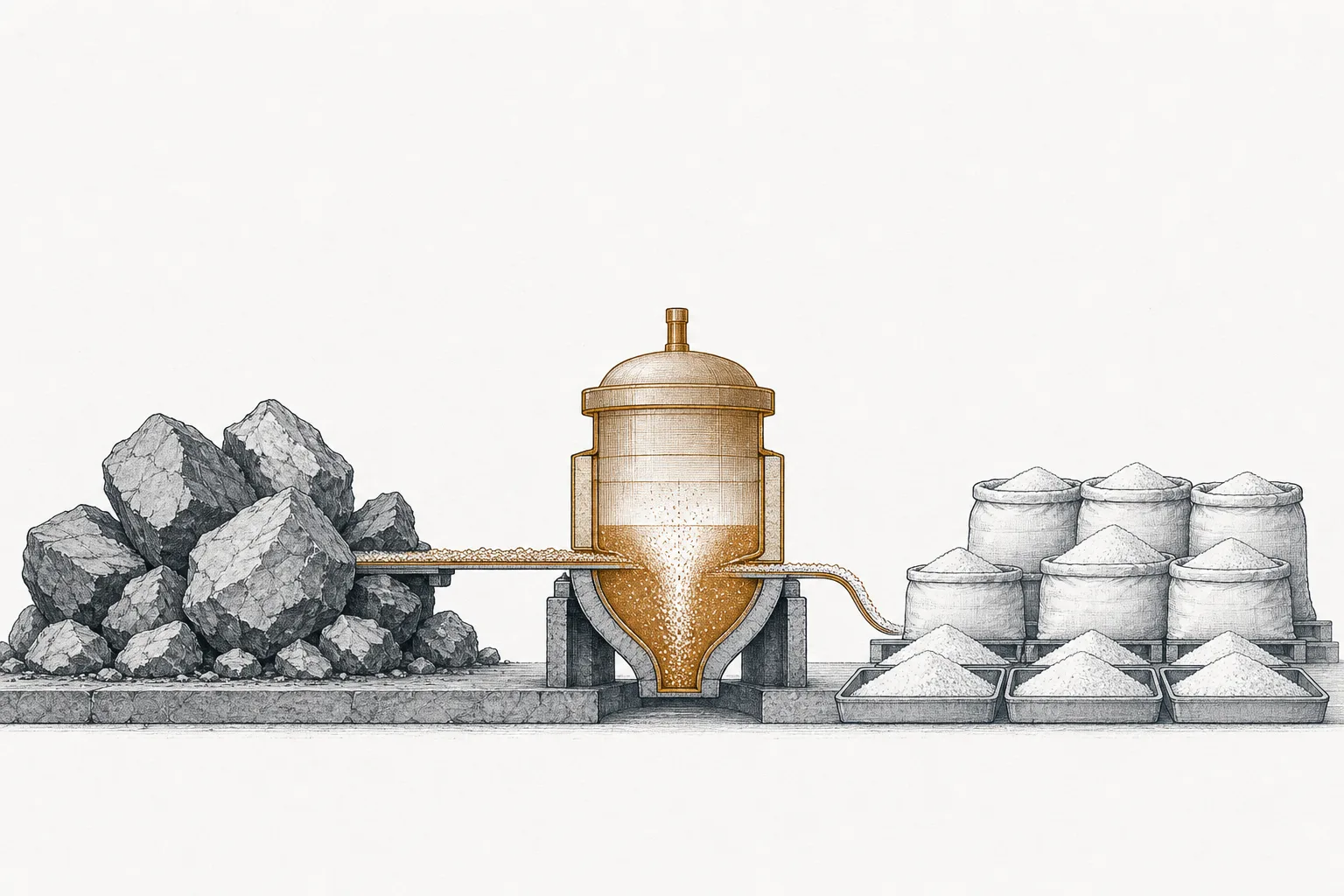
When we say “lithium,” we usually picture the giant rock mines in Australia or the pale brine ponds on the high plains of Chile. But what comes out of those places can't be made into a battery at all — it's a rock powder called “spodumene concentrate” that holds only about 6% lithium oxide (roughly 1% actual lithium). The rest is rock, aluminum, and silica. You can't put any of it into a phone or an EV.
The players who turn that rock powder into “usable lithium” are the refiners and converters — the midstream businesses that buy concentrate (or concentrated brine) from mines around the world, then roast, grind, and run chemical reactions to strip out impurities, refining it until they get battery-grade lithium chemicals about 99.5% pure. That comes as two white powders — lithium carbonate (Li₂CO₃) and lithium hydroxide (LiOH) — the standard raw materials battery factories everywhere buy to make their electrodes.
Concentrate = spodumene ore powder from the mine, ~6% lithium oxide · Refining/Conversion = roasting plus chemical reactions to drive off impurities, then crystallizing into pure lithium salts · Lithium Carbonate = the easier-to-make lithium salt, used in LFP batteries · Lithium Hydroxide = the other salt, harder to refine, used in energy-dense high-nickel batteries
On our megatrend map, this step is a sub-branch of Lithium, under the Critical Materials & Supply Chain megatrend — it's the “second gate” the material passes through, after leaving the mine (Lithium Mining & Brine Extraction) and before becoming a battery cell. And as we'll see all through this lesson, the real power in the lithium chain isn't about “who mines the most,” but “who can refine.”
02Why the real chokepoint is the refinery, not the mine
Here's what most people miss: lithium mines are spread across several continents — Australia, Chile, Argentina, China, Zimbabwe — no one can corner them. Australia is actually the world's #1 miner. But refining is concentrated in a single country to a shocking degree: China.
The number that tells the story best: China mines only about 17% of the world's lithium (around 41,000 tons out of ~240,000 in 2024) — yet it refines and processes roughly 65–70% of the world's battery-grade lithium chemicals. Put simply: Australia mines plenty of rock, then ships it off to “refine in China,” because China is where the refineries are ready and cheapest.
This concentration didn't happen overnight. China spent more than 20 years building refining capacity until it overflowed, subsidizing power and capital for its refineries so their costs run far below everyone else's. The result: even as Western countries try to build refineries of their own, they're still several lengths behind China.
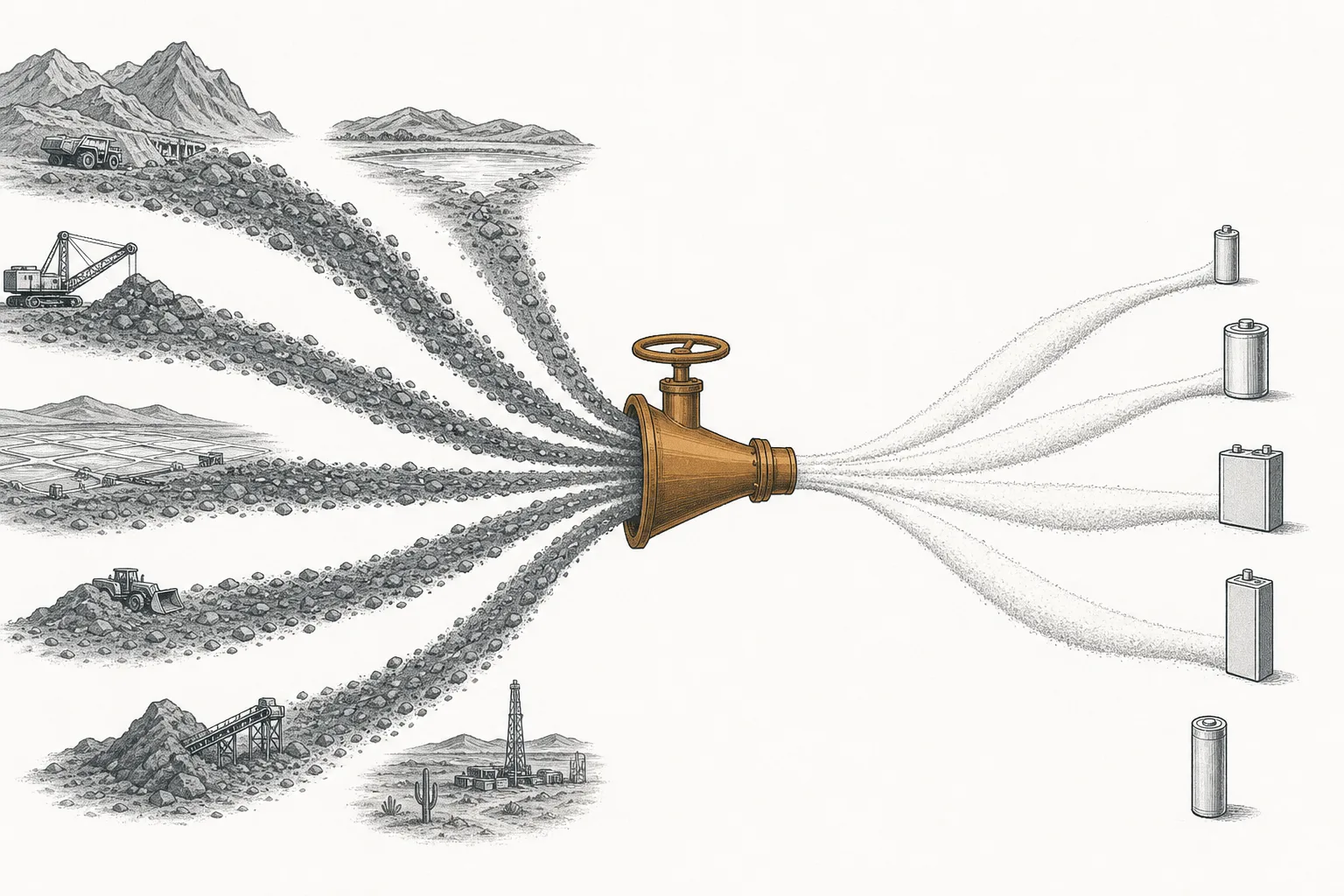
Why does this matter? Because lithium is the “physical chokepoint” of the energy transition. One EV uses about 8–10 kg of lithium (as LCE); grid-scale storage uses even more, and demand keeps climbing. But if you want usable lithium, almost every path runs through a refinery — and most refineries are in China.
03How it works (from 1% rock to 99.5% chemistry)
The heart of this business is “squeezing lithium out of rock” — driving off rock and impurities one step at a time until almost-pure lithium salt is all that's left. Let's follow a single rock on its journey.
The first two steps (roasting, then baking with sulfuric acid) “smash” the rock structure open to release the lithium as water-soluble lithium sulfate. This step eats enormous energy and chemicals, and it takes about 7–8 tons of concentrate to yield just 1 ton of lithium salt. The final step is purifying and crystallizing it into battery-grade lithium salt — the hardest step, and the real “moat,” because batteries demand extreme purity: even a few parts-per-million of impurities can make a battery degrade fast.
Interestingly, brine from the salt lakes of South America can feed into this same refining step — but by a different route. Instead of roasting rock, it's concentrated first, then refined. This matters, because it explains why costs differ so much.
Here's the secret of the refining business: lowest cost wins. Lithium chemicals are a commodity — every plant's output looks the same. A refinery with cheap power, cheap acid, and proximity to both the mines and the battery factories has a huge edge — and that's the structural reason China controls the game.
04Carbonate vs. hydroxide — a fork in the road that has already flipped
Battery-grade lithium comes as two main salts, and which one you use depends on what kind of battery you're building. This is the fork that decides the fate of each refinery.
Lithium hydroxide (LiOH) was once seen as “the future,” because it's needed for high-nickel (NMC/NCA) batteries — the dense, long-range chemistry of premium, long-distance EVs. Hydroxide is harder to refine and has a lower melting point, which suits it better to the high-nickel cathode process, so many people bet that hydroxide demand would overtake carbonate.
Lithium carbonate (Li₂CO₃) is easier to make, cheaper, and the raw material for LFP (lithium iron phosphate) batteries — cheaper, more durable, and safer, even if they run a shorter range. And here's the turn: in 2025, LFP took roughly 63% of the world's cell production, as both China and the global market pivoted to affordable EVs and energy storage (ESS). The result: demand tilted toward carbonate — the opposite of what many had bet on.
This flip produced something strange: prices that used to run the other way around. Hydroxide had always been pricier than carbonate (because it's harder to refine). But once LFP won, hydroxide demand softened, and battery-grade hydroxide crashed from above $80,000/ton in late 2022 to about $8,500/ton by mid-2025 (down more than 90%) — and at times it was even cheaper than carbonate. Refineries that had bet heavily on a hydroxide-only line got hit especially hard.
05What it connects to
The refinery is the “middle” of the lithium chain, so it touches every stage around it. Upstream is Lithium Mining & Brine Extraction, which feeds it concentrate and brine; downstream are the cathode plants and Battery Cells that take lithium salt to make electrodes. And running in parallel is a “shortcut” — Lithium Battery Recycling — because lithium from old batteries can be pulled back and re-refined (an “urban mine”), so many modern refineries now feed on both ore and recycled material.
More important still are the “mouths waiting to be fed” downstream. Lithium chemicals are the lifeblood of the era's megatrends: they go into Electrification & Mobility (EV batteries), into Energy Transition & Power Demand (grid-scale storage), and even Artificial Intelligence is in the mix, because AI data centers need giant backup-power batteries. Put simply: if the refinery stumbles, these megatrends stumble with it.
06Where it stands now (China locks the tech, 2025)
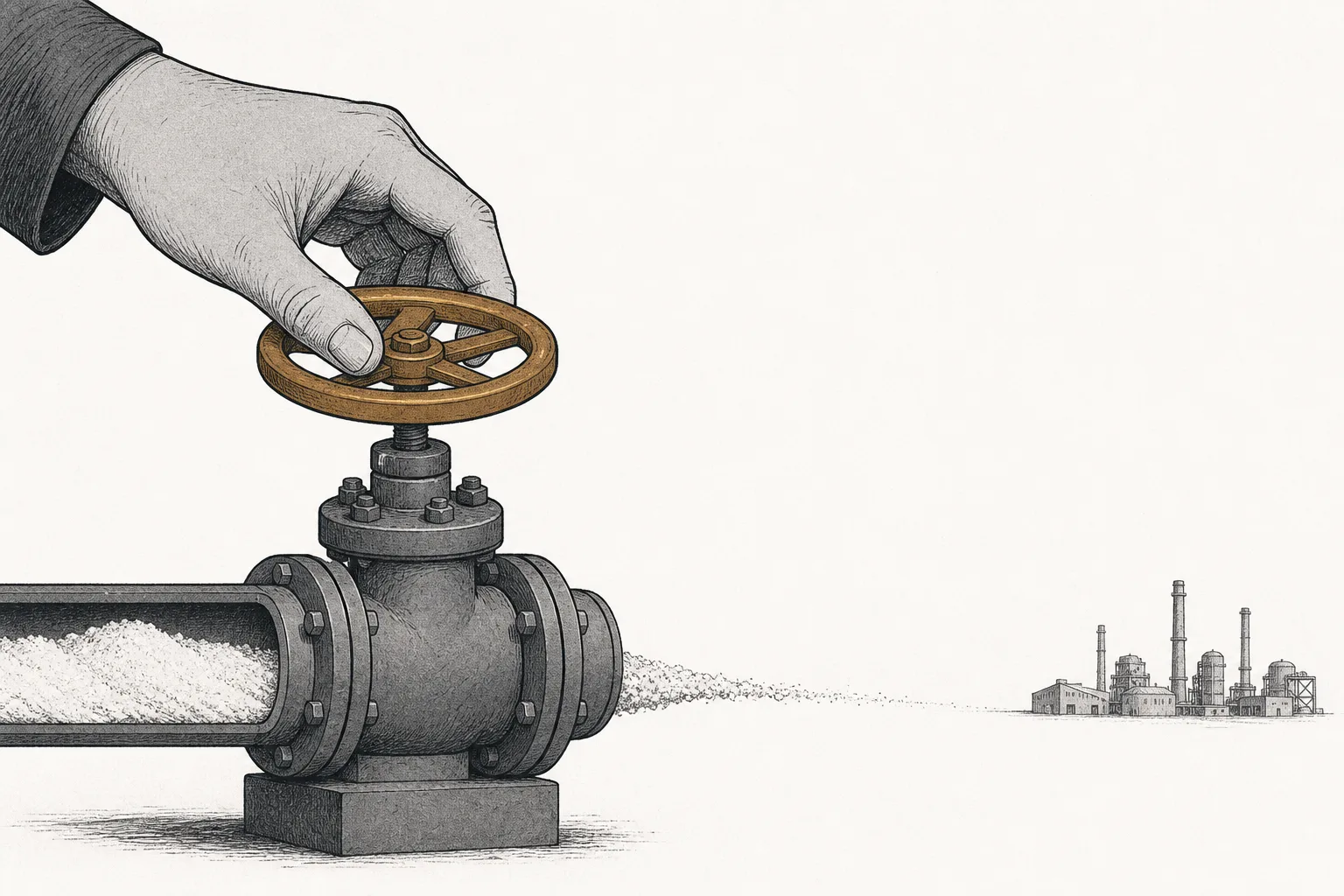
2025 was the year the refining chokepoint was officially turned from an “economic advantage” into a “strategic weapon.” On July 15, 2025, China's Ministry of Commerce (MOFCOM) announced export restrictions on the technology for producing lithium carbonate and hydroxide, along with LFP/LMFP cathode technology — meaning anyone who wants the Chinese “recipe and process” for refining lithium now has to get Beijing's permission first.
That was followed on October 9, 2025 by another round of controls on battery equipment and materials (effective November 8), listing them as “dual-use” goods requiring an export license. This was the one-two punch that made clear: China isn't just controlling the refining — it's locking down its “ability to refine” so it can't flow out and build rivals abroad.
Prices, too, have just climbed off the bottom. After lithium carbonate crashed hard in 2024–2025 (below $10,000/ton), it bounced back above $20,000/ton in early 2026 as producers cut output and demand tightened — giving refineries a breather, though the scars from the price crash are still clear.
In this arena, the real players split into two clear camps: the Chinese refining giants that control both volume and technology, and the Western refiners and their allies trying to build a chain outside China — especially South Korea and Australia, teaming up to stand up their own hydroxide refineries.
07The future and the risks
Looking ahead, three forces will shape this business.
One — the West is trying to reclaim the midstream, but it keeps getting harder. Realizing they lean too hard on China for refining, the US, Europe, and their Asian allies are starting to invest in refineries of their own — like South Korea's POSCO, which opened a 43,000-ton/year hydroxide refinery in Gwangyang, fed by Australian concentrate. But with China locking down its refining technology in 2025, catching up gets even harder and more expensive.
Two — recycling will keep growing in importance. As the first waves of EVs reach end of life, hundreds of thousands of tons of lithium in old batteries are about to re-enter the system. Refining from recycled material doesn't depend on mines and can sit outside China's grip — one way the West hopes to build a chain of its own.
Three — the price cycle is still brutal. Lithium chemicals are a commodity whose supply can ramp faster than demand can absorb. The 2026 rebound may just be one beat of the cycle, and high-cost refineries still risk being squeezed shut when prices fall next.
As for the risks to watch:
Thin margins and a brutal cycle. A refinery with no mine of its own to feed it, locked into the wrong chemistry (like betting on hydroxide just as LFP won), risks heavy losses in a price downturn — as Albemarle saw with a $1.2 billion net loss in 2024, forcing it to slash capex and delay projects.
Geopolitical risk. When half the world depends on China to refine its lithium — and China controls the technology and equipment too — refining becomes a “card” China can hold, just as rare earths once were. Locking down the technology in 2025 is a clear signal that this “boring” midstream step has become one of the hottest strategic battlegrounds of the energy-transition era.