Megatrend · Critical Materials
Digging rock vs. drying in the sun: the two ways the world gets its lithium
Before lithium ends up in an EV battery, it has to be "dug" out of the ground first — and the world does this in two almost opposite ways. One is blasting rock mountains in Australia and roasting them at a thousand degrees. The other is pumping brine from beneath the South American desert and drying it in the sun for a year. The difference in "cost" and "speed" between these two paths is the key to why lithium prices spiked 10x and then crashed 80% in just a few years. Who survives, who goes bust, and why Africa and China have become the new variables everyone has to watch.
01What lithium mining is
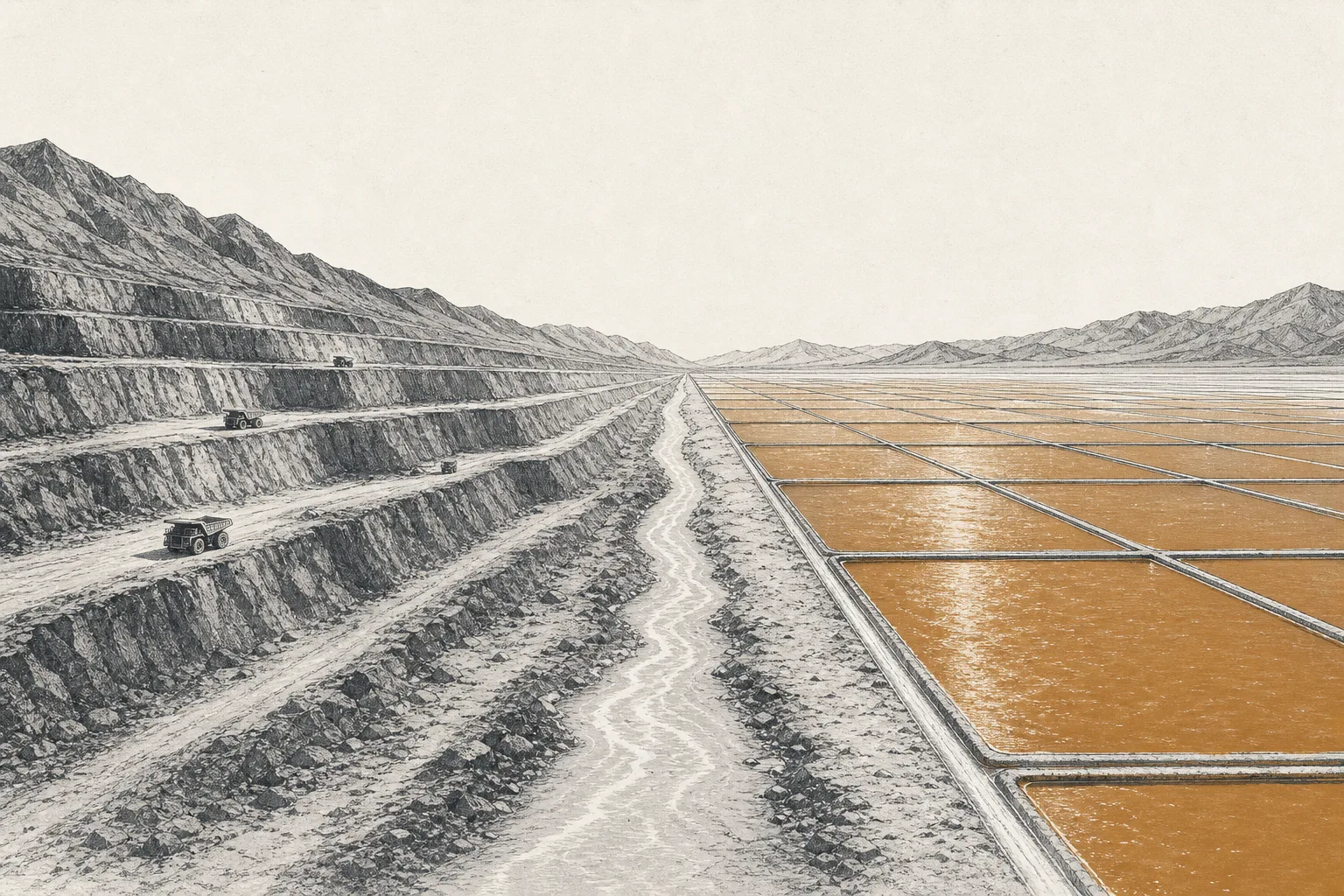
Picture two places at the same time. The first is an open pit in the dry scrubland of Western Australia, where excavators bite into gray rock laced with a mineral called spodumene — blasted, crushed, and sent into a scorching furnace. The second is a world away, on Chile's Atacama desert plateau where it almost never rains, with turquoise ponds stretching as far as the eye can see. The water in those ponds isn't ordinary water but brine with lithium dissolved in it, lying quietly in the sun, waiting a year for the water to evaporate on its own — both of these pictures are the "starting point" of every battery on Earth.
This lesson is specifically about the "raw lithium mining/extraction" (upstream extraction) step — the very first stage of the chain, where companies pull lithium out of nature as spodumene concentrate or concentrated brine, not yet the pure chemical powder you can put in a battery. Let's make this clear from the start, because it's the key to the whole story: "digging it up" and "refining it to purity" are two different businesses — this lesson is about the miners, while the refiners are its sibling, Lithium Refining & Chemicals.
Spodumene = the lithium mineral found in hard rock; mined, then crushed and roasted · Brine = underground water in salt lakes with lithium dissolved in it · Concentrate = the output of a hard-rock mine, ore powder processed to raise the lithium to about 6% (called "6% spodumene" or SC6) before it's sent to the refinery
On our megatrend map, this step is a sub-branch of Lithium, under the Critical Materials & Supply Chain megatrend — it's where the "real stuff" is pulled out of the ground. If upstream mines stop, the whole battery chain shakes, and as we'll see, it's exactly this simultaneous opening and closing of mines that can swing lithium prices worldwide overnight.
02Why "upstream" is a battlefield
The first reason is scale. Today the world mines about 290,000 tons (of lithium metal) in 2025, a new record, up from around 82,000 tons in 2020 — more than tripling in five years, as demand from EV batteries and energy-storage batteries surges nonstop. This is an industry that has exploded into being within a single generation.
The second reason is a startling concentration. In 2024, just three countries — Australia, Chile, and China — together controlled over 85% of the world's mining. Australia led with about 88,000 tons (hard rock), Chile followed with about 57,000 tons (brine), and China about 41,000 tons. When lithium is concentrated in the hands of a few countries like this, one government's or one company's decision can shake prices worldwide.
But the real heart of why upstream is a "battlefield" is cost, because the two mining methods we're about to cover have very different costs. When lithium prices fall, high-cost producers lose money first and have to close mines, while low-cost ones can stay standing — and it's exactly this cost-driven opening and closing of mines that decides whether world supply is in glut or shortage, and sets the price in the next cycle. It's a game of "who can endure low prices longer."
03Two paths: rock vs. brine (how it works)
The world gets lithium two main ways that are opposite in almost every respect. Understand this difference and you understand the whole industry.
Path 1 — the hard-rock mine (hard-rock / spodumene). It starts by blasting and mining a kind of granite laced with spodumene, crushing it fine, then processing it into a concentrate of about 6%. Next comes the energy-hungry step: roasting at around 1,050°C to change the mineral's crystal structure so acid can leach the lithium out. Its strengths are that it's fast to build and quick to ramp up — when prices are good, you can bring more online in a few months. Australia dominates this method and is the world's #1 miner. The downside is high energy use and a per-unit cost usually higher than brine.
Path 2 — brine beneath the salt lakes (brine). Under the arid plateaus of the "Lithium Triangle" (Chile–Argentina–Bolivia) sits brine with lithium dissolved in it. The traditional method is to pump it up into ponds spanning square kilometers, then let the sun evaporate the water over 12–24 months, moving from one pond to the next until the lithium is concentrated enough to collect. Its strength is the lowest per-unit cost, because it uses free sunlight instead of a furnace. But the downsides are that it's very slow, almost impossible to ramp up, and it consumes enormous amounts of land and water in a region that's already water-stressed.
This cost difference is no small thing. On average, producing lithium carbonate from brine costs about $3,000–4,000 per ton LCE, while hard rock runs about $5,000–6,000 per ton, and some low-grade sources reach $8,000–9,000. That's why, when lithium prices fall, the high-cost hard-rock mines are the first to "bleed" and have to pause production.
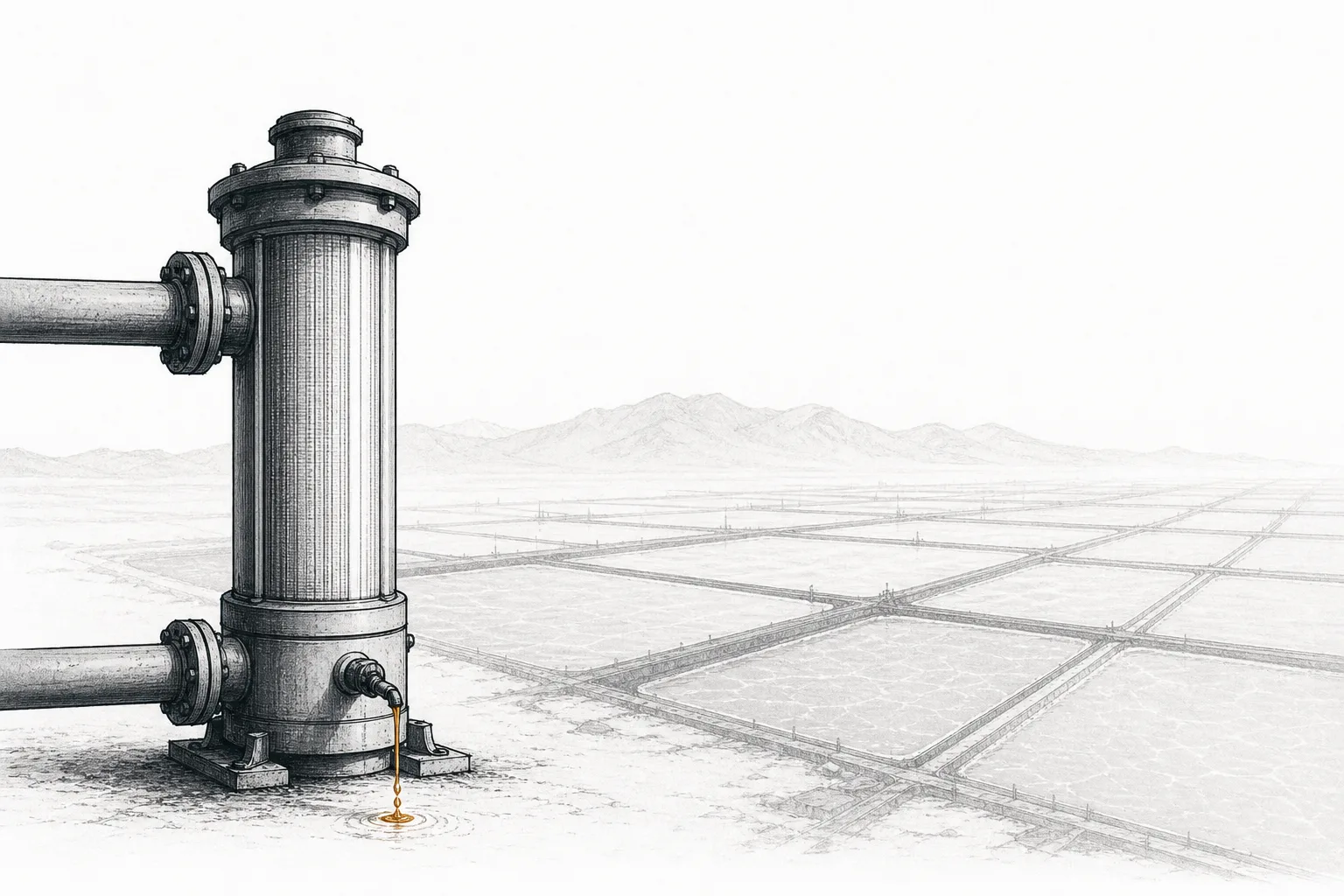
There's a "third way" many are betting will change the game — DLE (Direct Lithium Extraction) pulls lithium out of brine directly using a special sorbent, instead of waiting a year for the sun to evaporate it. It can be done in hours to days, gets more lithium from the same volume of brine, and uses less land. But for now DLE handles only a small share of world supply and hasn't fully proven it's economical at scale — we'll come back to it in the future chapter.
04What it connects to
Mining is the "very top" of the lithium chain; everything starts here and flows down. Concentrate and brine from the mine are passed on to Lithium Refining & Chemicals to be refined into battery-grade lithium carbonate/hydroxide — and this is the step where the real "power" and profit hide (China controls about 65–70% of the world's refining). The other end is Lithium Battery Recycling, which pulls lithium back out of old batteries, an "urban mine" that will one day ease the load on real mines.
Looking beyond the lithium group, this upstream mine supplies raw material to nearly every trend of the era — most directly Electrification & Mobility (EV batteries) and Energy Transition & Power Demand (grid energy-storage batteries), which is becoming a new demand wave growing even faster than EVs. And when Artificial Intelligence forces data centers to hold enormous backup batteries, lithium gets pulled there too. In turn, these trends are the demand driver that decides the mines' fate.
05Where it stands now (from boom to bloodbath)
The story of lithium mining over the past five years is one of the rawest commodity lessons there is. In 2021–2022, everyone feared lithium would run short of feeding the EV wave; the price was whipped up into a frenzy, hitting around $80,000 per ton in late 2022 (nearly 10x the normal level). Sky-high prices lured everyone to open mines, and world capacity jumped 192% between 2020 and 2024. But when all that supply flooded out at once while EV demand grew slower than expected, the price collapsed — plunging more than 80%, dropping below $10,000 per ton in early 2025.
This bottom left miners bleeding across the board, and it revealed who was truly strong. Two big Chinese companies took heavy losses — Tianqi posted a net loss of 7.9 billion yuan in 2024 (its worst year since going public), and Ganfeng lost 2.07 billion yuan (its first loss in company history). Albemarle, the American giant, lost $1.2 billion and had to cut its capital budget by more than half and lay off staff. In Australia, Pilbara Minerals closed its Ngungaju plant and put it into "care and maintenance" from late 2024, cutting about 100,000 tons of capacity to save A$200 million in cash.
The most interesting turning point of this cycle came in August 2025, when CATL, the Chinese battery giant, halted its Jianxiawo mine in Yichun, Jiangxi province, after its license expired — the mine is China's largest source of lepidolite (another lithium mineral), producing about 65,000 tons LCE/year, or roughly 6% of world supply. The news drove lithium prices in the Chinese market up to their +8% daily limit in a single day, and was part of what bounced the price back to around $26,000 per ton in early 2026. Behind it is Beijing's "anti-involution" policy, deliberately tightening supply to prop up prices.
The most era-defining deal was Rio Tinto buying Arcadium Lithium for $6.7 billion (closed March 2025) — the mining giant seized the price slump to scoop up cheap lithium assets, instantly becoming a major producer with both hard-rock mines and brine ponds in one hand. In Chile, SQM teamed up with the state enterprise Codelco to form a joint venture controlling production in the Salar de Atacama out to 2060 — a signal that governments increasingly want strategic ore in their own hands. Right now (mid-2026) the industry is "licking its wounds," with producers tightening their belts together — and it's exactly this simultaneous capacity-cutting that's setting the stage for a tighter market in the next cycle.
In this arena, the real players include the low-cost brine leaders of South America, China's integrated giants, Australia's hard-rock miners, and rising newcomers from Brazil and Africa.
06The future: DLE, Africa, and the new wave
The big picture of the future is long-term demand that will surely keep growing, colliding with an increasingly hard search for new ore. Three forces are about to reshape lithium's "upstream."
One — DLE will unlock brine that couldn't be tapped before. If DLE proves truly economical at scale, it will open new brine sources too low-grade for pond evaporation and cut the time from years to days. Watch ExxonMobil, the oil giant, which is building a DLE plant at the Smackover formation in Arkansas, US, with a deal to sell up to 100,000 tons of lithium to SK On — a sign that old energy capital is jumping into the lithium arena. Albemarle, too, has filed a roughly $3.1 billion project to switch to DLE in Chile.
Two — Africa is rising. Zimbabwe has climbed to about 9% of world lithium production in just a few years, almost all of it from Chinese capital — Sinomine bought the Bikita mine ($180 million) and built a processing plant, while Huayou Cobalt spent big on the Arcadia mine and a processing plant. Crucially, Zimbabwe announced a ban on raw-ore exports from January 2027 to force in-country processing — the same lesson Indonesia used with nickel. The inflowing investment could push Zimbabwe's capacity to 192,000 tons LCE/year by 2027, from just 13,000 tons in 2022.
Three — Argentina and Brazil are the West's rising stars. Argentina nearly doubled its output in 2024 and is more open to foreign investment than Chile, while Brazil has Sigma Lithium, which touts "green lithium" and is about to nearly double its capacity. Both countries are the hope of the Western camp that wants ore sources outside China's influence.
But even all three forces together still can't keep up with long-term demand at certain moments. What almost every research house agrees on is that the coming decade will be a cycle of "shortage–glut–shortage" alternating, and whoever holds low-cost ore in hand will survive every season.
07Challenges & risks
The price cycle is an eternal risk. Lithium is a commodity where supply can ramp faster than demand can absorb it. Every time prices rise, everyone rushes to produce, and then it gluts again. The 2022–2025 cycle that rose 10x then fell 80% won't be the last. Investing in this group means understanding which part of the cycle you're in, not chasing the peak of the best news.
Cost is the line between life and death. When prices fall, high-cost mines (low-grade hard rock, Chinese lepidolite) lose money first and get paused, while low-cost brine leaders stay standing. Anyone investing in this group has to look at a company's "position on the cost curve" first — Ganfeng itself admitted in mid-2025 that many of its projects had costs too high for the lithium price at the time to bear.
Mining it isn't the same as being able to use it. This is the most important mental trap. Raw ore that's mined can't make batteries yet; it has to go through refining first, and China controls about 65–70% of the world's refining. Even if Australia or Africa mines a lot, if the ore still has to be shipped to China to be refined, the real bargaining power isn't in the miners' hands — which is why Zimbabwe banned raw-ore exports, and why the West is racing to build its own refineries.
Geology, water, and politics. Low-cost brine sources sit in deserts that are already water-stressed; pumping brine affects communities and ecosystems, sparking opposition. Ore sources, meanwhile, are concentrated in a few countries. A single rule change — like China not renewing the Jianxiawo mine's license, or Zimbabwe banning raw-ore exports — can swing world supply and prices in an instant. For a lithium miner, then, the biggest risk isn't "is there ore in the ground," but "can I mine and sell it at a worthwhile price."