Megatrend · Energy Transition & Power Demand
The heat beneath our feet — that AI suddenly wants around the clock
Just a few kilometers below the ground sits a giant furnace that never goes out — it doesn't care if it's day or night, sunny or windless. That's why geothermal is clean electricity that runs '24 hours a day,' unlike solar and wind. Its one weakness used to be that it only worked in volcanic regions. But drilling technology borrowed from the oil-and-gas world is about to unlock it 'almost anywhere on Earth' — right as AI data centers are hungrier than ever for clean, around-the-clock power.
01What it is
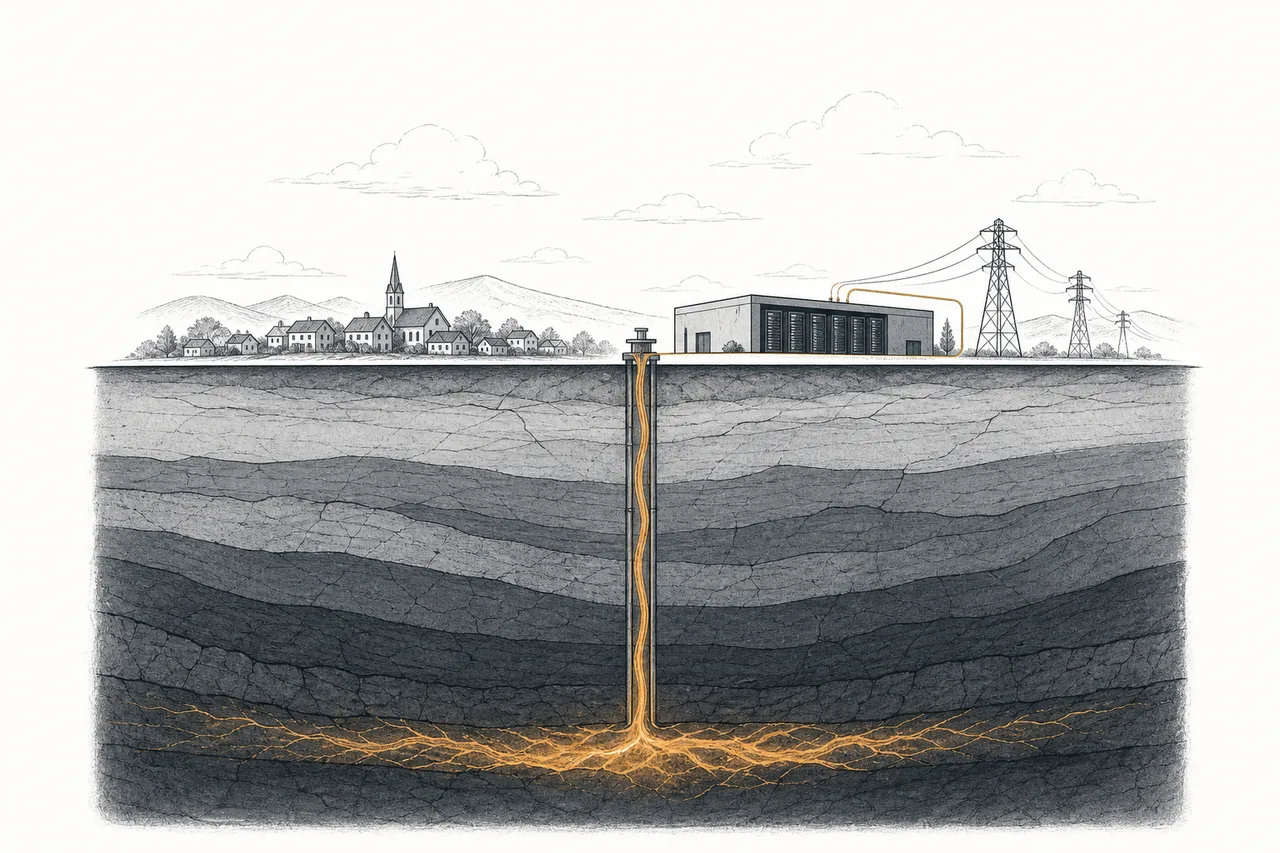
Picture it simply: our planet is like a big boiled egg — the thin shell we live on wraps a core heated to thousands of degrees. That heat keeps seeping out, every second, without rest. Geothermal energy is the act of 'pulling' that heat up to generate electricity.
What makes it special is the word 'firm' (power you can count on to be there). Solar gives power only when the sun is out; wind only when the wind blows. But the heat underground is there 24 hours a day, 365 days a year, no matter the weather. So a geothermal plant can run almost full-time (its capacity factor often tops 90% — nearly double solar or wind) — it's 'clean power that behaves like a coal or gas plant': always dependable, but with no carbon.
Firm power = electricity you can call on whenever you want, independent of the weather · Baseload = the foundational power that runs all the time to cover the system's minimum demand. Geothermal does both — which solar and wind can't, without a battery to help. That's why it's grouped under 'firm renewables,' separate from the 'intermittent' (uneven supply) of solar and wind.
On the megatrend map, this node is a sub-theme under Energy Transition & Power Demand, and a direct sibling of other firm power sources like Nuclear, Hydropower, and Firm Power & Transition Fuels. The thing changing the game and making this chapter exciting is a term called EGS — Enhanced Geothermal Systems, which we'll dig into next.
02Why 'power that never goes out' matters now
For a hundred years geothermal was good clean power but 'stuck under a ceiling' — the whole world had a total capacity of only about 16–17 gigawatts (GW) in 2025, producing roughly 95 billion units (TWh) a year, a tiny sliver of global electricity. That's because it only worked where heat surfaces just right — Iceland, Kenya, Indonesia — the volcanic zones. Everywhere else on Earth, you couldn't drill deep enough, or it wasn't worth it.
So why did this suddenly become hot in 2026? The answer is two trends converging at just the right moment. One is demand — AI data centers are devouring enormous amounts of power, and they need clean, 24-hour power, not solar that goes dark at night. So companies like Google and Meta are hunting for clean firm power in earnest. The other is technology — a new drilling method (EGS) is making geothermal work 'almost anywhere,' not just in volcanic regions.
The number that made the whole energy industry's eyes light up comes from a report by the IEA (International Energy Agency): drill down to 8 kilometers and EGS geothermal holds a technical potential of up to ~600 terawatts (TW) worldwide — roughly 2,000 times the potential of conventional geothermal, and nearly every country on Earth has hot rock deep enough to use. Put simply: the resource was never the problem. The problem is 'can we drill that deep and make it cheap enough.'
With the resource in abundance and demand for clean 24-hour power surging, the only thing standing in the way is drilling cost — and it's falling fast. That's what's turning geothermal from a 'local energy source' into a 'global challenger' in just a few years.
03How it works (drilling down for the heat)
The basic principle is surprisingly simple: drill down to hot rock → bring up heat/steam → spin a turbine → get electricity. In the conventional version, nature does almost all the work — the hot rock, the water, and the fractures for water to flow through are already there, and you just drill in and draw the steam up. But the weakness is that all three have to line up just right, which happens in only a few spots on Earth.
The game-changer is EGS (Enhanced Geothermal Systems) — if nature only gives you 'dry hot rock' with no fractures and no water, you make your own: inject high-pressure water to crack the rock into a fine mesh (just like fracking in oil and gas), then pump cold water down one hole, let it flow through the hot rock and soak up the heat, and draw the hot water back up another hole. In effect you 'build an artificial geothermal reservoir' where nature didn't provide one — and that's why it works 'almost anywhere.'
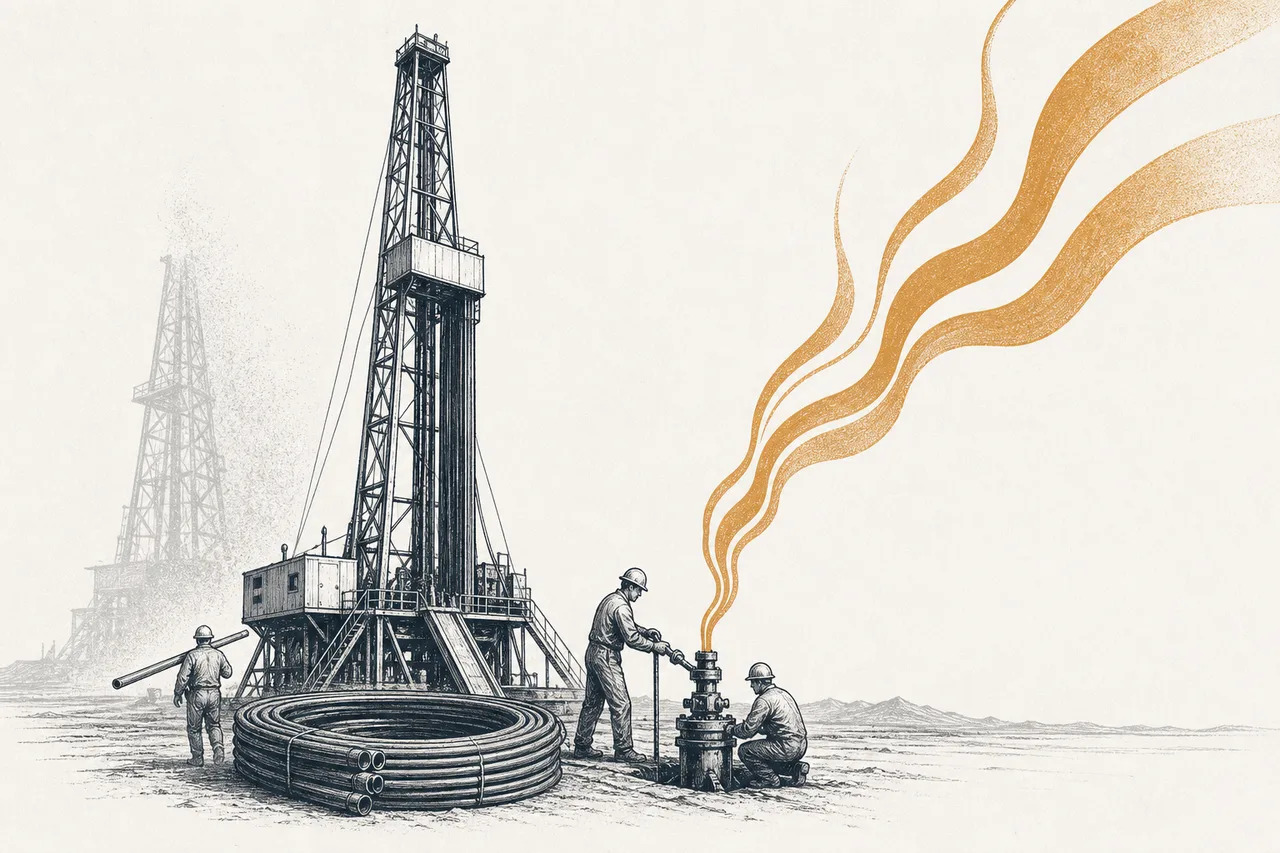
The secret behind why EGS got cheap so fast is that it wasn't invented from scratch — it 'borrowed' technology that the shale oil-and-gas industry spent over a decade refining: both directional drilling and hydraulic fracturing (cracking rock with injected water). The IEA estimates that as much as 80% of investment in next-generation geothermal projects uses the same skills, tools, and supply chain as oil and gas — giving an industry looking for a way to transition a new home to move into.
Geothermal 'enhanced' — when the rock is hot but dry with no fractures, we inject high-pressure water to build our own mesh of fractures, then circulate water through it to draw out the heat. The result: geothermal that works in places the conventional kind couldn't. This is exactly what turns it from a 'local energy source' into 'energy that works almost anywhere.'
Drilling cost is the heart of the whole game — it makes up 60–80% of total project cost. So whoever can drill faster and cheaper is the one who decides whether next-generation geothermal pencils out.
04Where it sits in the world of energy
The best way to understand this node is to look at who it 'connects' to in the energy ecosystem:
- A sibling in the 'firm clean power' family with Nuclear and Firm Power: they all solve the same problem — supplying clean power 24 hours a day, unlike solar/wind. Nuclear is the main option that scales the largest, while geothermal can be built faster, smaller, and with no radioactive waste
- Feeds AI data centers directly: this is the biggest customer of the trend right now — AI needs clean firm power, and signs long-term power purchase agreements to unlock the financing that gets projects built
- Depends on Grid & Transmission: you can generate power, but you need transmission lines to carry it to the load — the grid is the shared bottleneck of every kind of clean power
- Competes with and complements its family: it's a sibling of Solar, Wind, Energy Storage, and Hydropower — solar/wind are cheaper per unit but not firm, and geothermal fills exactly that weakness
The most interesting angle is the link to the oil-and-gas industry, which is looking for new places to invest — their drilling skills are an asset that fits EGS perfectly. So next-generation geothermal isn't the enemy of oil companies; it may be a 'sequel' that uses the same people and the same tools, just pulling up heat instead of hydrocarbons.
05Where it stands now
2026 was the year next-generation geothermal truly 'proved itself.' The clearest signal came in May 2026, when Fervo Energy — the EGS startup backed by Bill Gates — went public on Nasdaq (ticker FRVO), raising about $1.89 billion. Its opening-day price jumped more than 33%, pushing the company's value to around $10 billion. This was the first time capital markets priced 'pure-play EGS' as a business category of its own.
But more important than the share price is the stunning plunge in drilling cost. Between 2022 and 2025, Fervo cut its drilling time by about 75% and its cost per foot by about 70%, halving the cost per well to roughly $4.8 million. This is the same 'learning curve' that once made solar cheap enough to change the world — and now it's happening to hot-rock drilling.
The other leg driving the whole industry is the deals with tech giants that put up the money to make projects real:
- Google × Fervo: a 115-megawatt power purchase agreement (PPA), feeding Google's Nevada data center with 24-hour EGS power — confirmation that EGS can supply firm power at real scale
- Meta × Sage Geosystems: a 150-megawatt contract, starting to supply clean power to Meta's data centers in 2027 (Meta also put about $462 million into backing Fervo)
On the actual construction side, Fervo's flagship project Cape Station in Utah is building its first 500-megawatt phase, expecting first power in late 2026, with permits to expand up to 1.5 gigawatts at the same site. What's notable is that in March 2026, Fervo closed $421 million in project-level financing from a group of top banks (RBC, Barclays, HSBC, J.P. Morgan) without relying on a government guarantee — a sign that financial markets are starting to see EGS as a genuinely 'investable' bet.
06The road ahead
The first direction is cost falling far enough to 'truly compete'. The IEA estimates that if drilling gets cheaper along the current path, the cost of EGS power could drop to around $50 per megawatt-hour — cheaper than nuclear and hydro, and neck-and-neck with solar/wind — but with the advantage that it supplies power 24 hours a day. If it actually reaches that point, the game changes overnight.
The second direction is scaling to global size. The IEA looks far ahead: if cost falls along this path, next-generation geothermal could reach ~800 gigawatts installed by mid-century — about 15% of global electricity generation — and cumulative investment in the trend could hit $1 trillion by 2035 and $2.5 trillion by 2050 — from a base that's still tiny today. That's a very large growth runway if it can run.
The third direction is the transformation of the oil-and-gas industry. When 80% of the skills and supply chain overlap, drilling-service companies like Baker Hughes and SLB have a huge incentive to push this technology — because it's a new market that uses their existing assets. These giants jumping in is exactly what will accelerate cost declines even further.
07Challenges & risks
The bright future comes with several big conditions attached, and to be honest, we have to admit all of this is still just beginning.
The first risk is drilling cost that still has to keep proving itself. Fervo's -70% number is exciting, but it comes from a handful of pilot projects. The question is whether it will keep getting cheaper everywhere around the world, across different geology. Drilling 7–8 km into hard, scorching rock is brutal work and the tools still break easily — and since drilling eats 60–80% of a project, if this doesn't fall as hoped, the whole economics wobble.
The second risk is human-induced seismicity. Because EGS has to inject high-pressure water to crack the rock, the process can trigger small earthquakes. In the past, EGS projects in Europe (such as Basel, Switzerland, and Pohang, South Korea) caused quakes serious enough to shut the projects down. Keeping this risk to a level communities can accept is a non-negotiable condition for scaling up.
The third risk is an industry that's still young and concentrated. Many of the leading players are still private companies that have only just proven their model. Most revenue is tied to a few customers (especially the AI data-center deals with Google/Meta). If AI investment slows, or clean-energy support policy shifts, that fragility shows. And energy projects are heavy investments that take years to pay back.
In short: geothermal is an old clean power source that suddenly got its moment — because technology from the oil industry made it work almost anywhere, right as AI needed clean power 24 hours a day. It's still small, still has to prove itself, and still carries risk. But it's 'de-risking' faster than ever before — and that's why this small, once-quiet node has become one of the most watchable corners of the energy transition.