Megatrend · Aerospace & Aviation
The brain and nervous system of an aircraft — the part you can't see, but can't fly without
These days a pilot barely "pulls a control" wired straight to the wing anymore. They nudge a joystick, and it's the flight computer that decides how to move the wings and tail. This is the world of avionics and aircraft systems — the brain, nerves, and muscles of the whole aircraft. It's the most expensive part per kilogram on the plane, walled off by safety certification that takes years and tens of millions of dollars, and it's making aircraft more "electric" with every new model. This lesson walks through why just a handful of companies control the systems that keep the world's aircraft flying.
01What avionics is
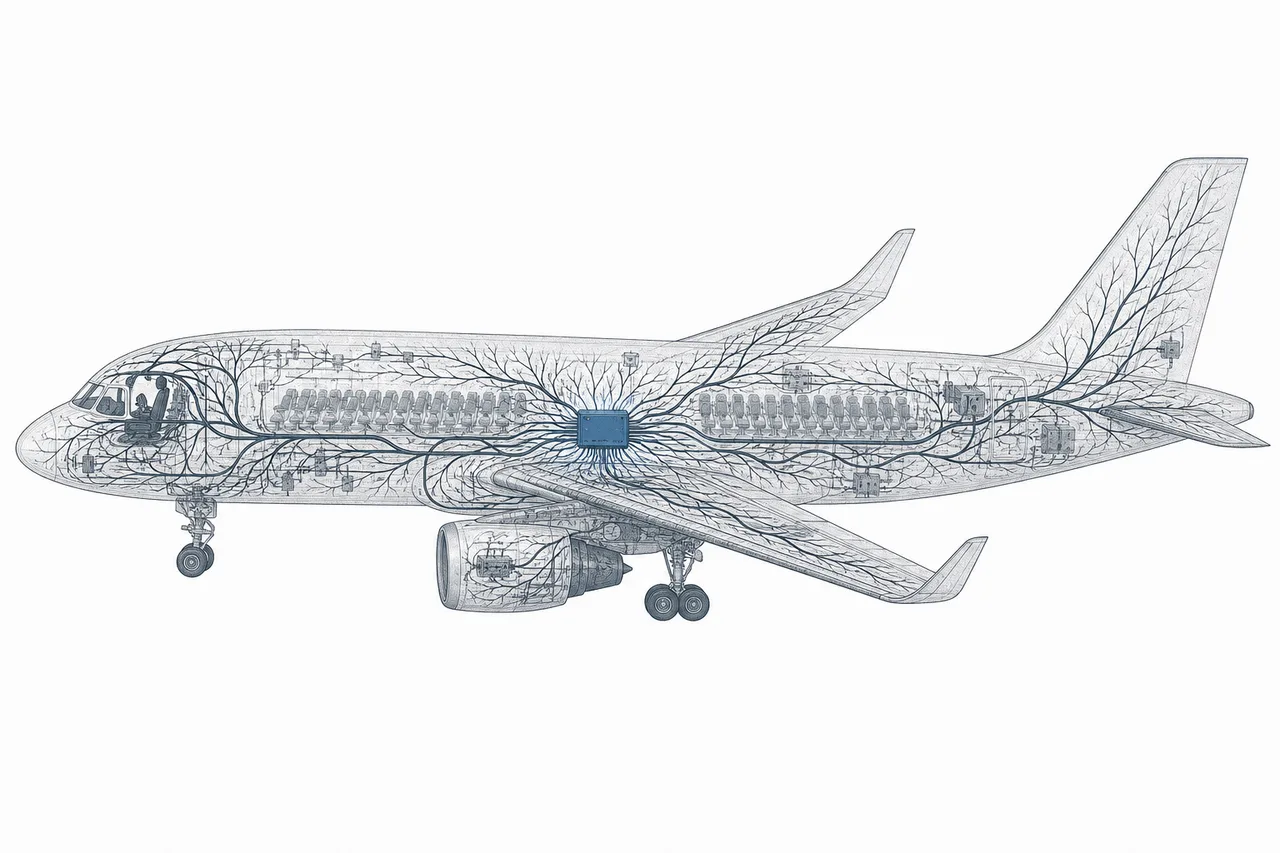
Picture an Airbus A350 pilot pushing the throttle up for takeoff. Here's a fact most people don't know: the control in their hand isn't connected to the wing by a single wire. What they're moving is a small "joystick" beside the seat. An electrical signal runs from the joystick into the flight computer, the computer works out how far to move the control surfaces (wings, tail), and then tells the hydraulic motors on the wing to move accordingly. So the pilot "states their intent," while the computer is the one that actually "flies."
The word avionics comes from "aviation + electronics," so literally it's aviation electronics — but in the broad sense we use in this lesson, it means the "brain, nerves, and muscles" of the whole aircraft: the computers and displays in the cockpit, the navigation and communication systems, the sensors measuring everything, and even systems that aren't purely electronic, like the landing gear, hydraulics, electrical system, and cabin air conditioning. Put simply, it's everything that turns a bare "airframe" and an "engine" into an aircraft that can actually fly, safely.
Avionics = the entire aviation-electronics system (computers, displays, navigation, communication, sensors) · Fly-by-wire (FBW) = flying the aircraft with "electrical signals" through a computer, instead of the old cables and pulleys — it cuts weight, raises safety, and lets the computer keep the pilot from steering past dangerous limits · Actuator = the "muscle" that takes the computer's command and actually moves the control surfaces, landing gear, or brakes
On the megatrend map, Avionics & Aircraft Systems is a sub-theme under Aerospace & Aviation, and it sits in the "supply-chain layer" — it's the one feeding systems up to the airframe assemblers (Airframe OEMs) like Airbus and Boeing to install in each aircraft. Unlike structural parts (fuselage, wings), which are mainly metal and composite, avionics is the "smartest" layer — and the point where aircraft tie ever more tightly into the world of chips and software.
02Why it matters (most expensive per kilogram)
The first reason is value packed into a small part. The engine and airframe are big, heavy pieces, but the avionics system takes the highest share of "value per weight" on the plane. On a modern aircraft, electronics and aircraft systems together make up about 30% of the whole aircraft's cost (and even more on military jets that need radar and complex systems) — even though they add almost no weight to the plane.
The second reason is market size and steady growth. The global avionics market sits at about $57 billion in 2025 and is expected to grow to around $100 billion by 2035 (roughly 7–9% a year). The commercial-aircraft slice alone is about $36 billion in 2025, growing to ~$44 billion by 2030. The drivers: a global fleet about to nearly double, and new aircraft packing in more electronics with every model.
But the most powerful reason is the "safety-certification wall". The software that controls an aircraft has to pass a standard called DO-178C, which is strict to the point that every single line of code must be provably correct and traceable. Certifying the software for one critical system takes 18–36 months and millions of dollars; for a whole complex system, it can run over 5 years and past $25 million — which is why it's so hard for newcomers to compete in this market. The wall isn't just technology, it's the "safety evidence" built up over decades.
DO-178C = the avionics-software certification standard used in the U.S., Europe, and Canada. The more a system touches safety, the more intensely it must be proven (Level A = if it fails, people die, so every condition in the code must be verified) · LRU (Line-Replaceable Unit) = a "box" of equipment that can be swapped out quickly on the ramp, like a navigation-computer box — older aircraft had hundreds of separate LRUs
03How it works (sensor → computer → actuator)
The heart of modern avionics is a "control loop" that runs dozens of times a second. Follow the path of one command: it starts with sensors measuring everything — speed, altitude, pitch angle, heading, even the force the pilot is pressing on the joystick — sending it all into the flight computer. The computer processes it, decides, and then tells the actuator (hydraulic/electric muscle) to move the control surface. Then the sensors measure the result and feed it back in for another round — looping like this the entire time the aircraft is in the air.
The heart of safety is the word "redundancy". The flight computer isn't just one unit — several run at the same time and "vote" among themselves. If one miscalculates, the other two catch it and take over, because this is a system where the cost of a mistake is a human life. The same principle applies to sensors, power supplies, and signal lines — everything must always have a backup.
Another big change is Integrated Modular Avionics (IMA). In the old days, each function (navigation, communication, control) had its own separate "box" of a computer, so older aircraft had hundreds of equipment boxes (LRUs). Today the IMA idea is to bring many functions together onto a powerful, shared central computer. The Boeing 787 uses GE's Common Core System, which collapsed over 100 boxes into a central computer, uses more than 60 remote data concentrators, and cut out over 30 kilometers of wiring — lighter, easier to maintain, and far more flexible.
IMA (Integrated Modular Avionics) = an architecture that runs many functions together on a shared central computer (instead of hundreds of separate boxes), with software "partitions" so one function can't affect another · Redundancy = having multiple backup systems running at once so the aircraft can keep flying even if any one piece fails — the core of what makes flying the safest of all forms of travel
04How it connects in the ecosystem
Avionics is the layer that "connects everything together" in an aircraft — it's both a customer of the chip industry and a supplier to the airframe assemblers:
- Supplies systems for airframe assemblers (Airframe OEMs) to install: Airbus and Boeing design the whole aircraft, but they buy avionics systems from suppliers like Collins, Honeywell, and Thales to install — so when a system runs late or has a quality problem, it directly hits the OEM's production rate
- Depends more on semiconductors with every model: a modern aircraft is a flying computer, and the smarter and more electric the systems get, the more they lean on chips — which makes avionics vulnerable to chip shortages like cars and other electronics (except they have to be specially certified aviation-grade chips)
- Works hand in hand with structural parts and the engine: the actuation system moves the control surfaces on the wings and tail, while FADEC (the engine-control computer) is another avionics layer that talks directly to the engine — so the aircraft's brain and muscles can't be pulled apart
- Feeds work to MRO & Aftermarket over the aircraft's lifetime: avionics systems need upgrading and repair across 25–30 years, and the "replace-with-new" market (retrofit) — like mandated ADS-B installs or new navigation systems — is a rich recurring-revenue stream for this industry
- Is a proving ground for electric air taxis (eVTOL) and defense: new electric aircraft need avionics that are light and "fully electric," while the military side is where avionics is most complex and most profitable (radar, electronic warfare)
05Where it stands now
2025–2026 is a stretch where the whole industry is reaping the full benefit of an aviation supercycle — a growing fleet, plus new aircraft packed with more electronics, and a wave of "upgrading old systems" that shows no sign of stopping. This arena splits into three main stories.
One — the market is concentrated in a few leaders. The two giants that control the cockpit of the world's commercial aircraft are Collins Aerospace (part of RTX) and Honeywell Aerospace, followed by France's Thales. And Garmin all but owns the general-aviation and light-jet side. That there are so few players isn't an accident — it's the result of the safety-certification wall we covered in Chapter 2.
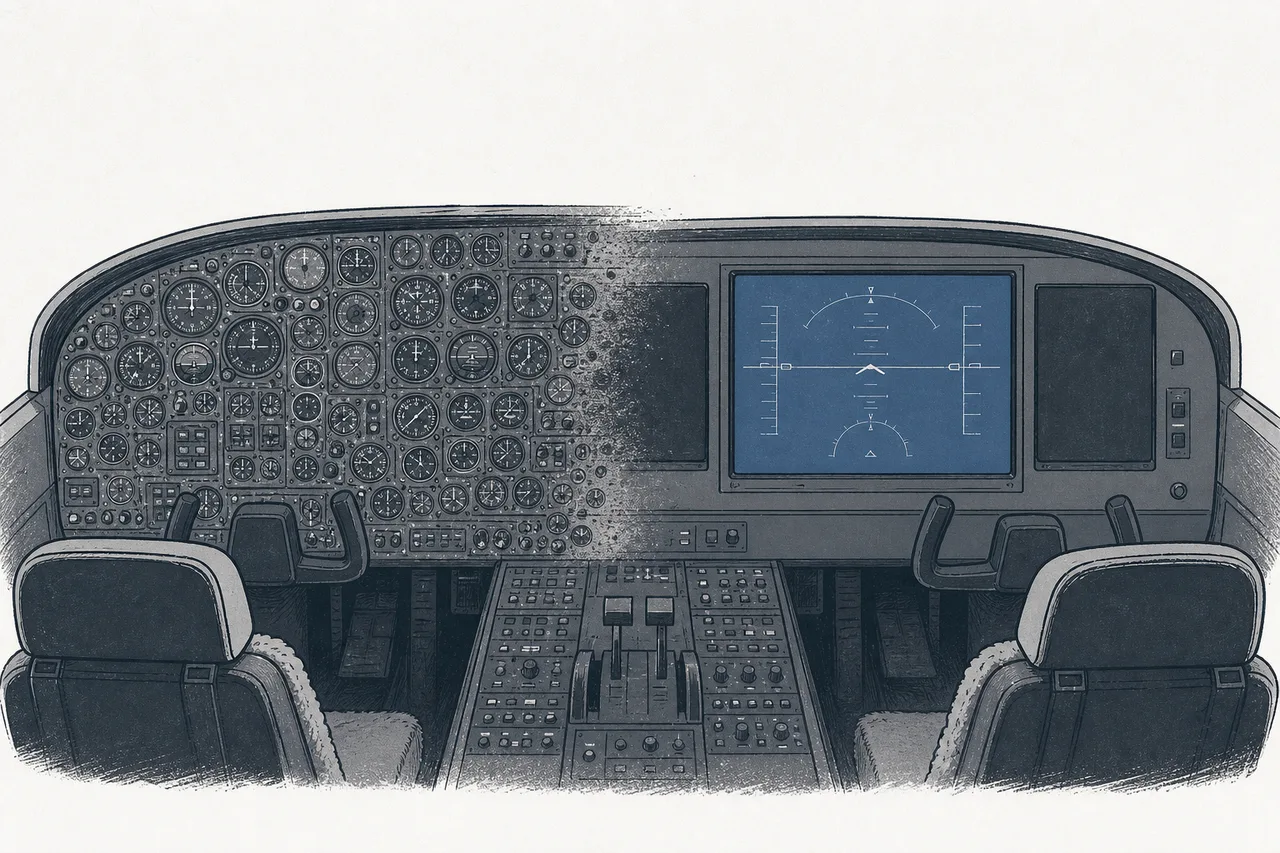
Two — the leaders' numbers reflect the strength. Garmin reported in 2025 that aviation revenue grew 13% to $987 million, growing on both the new-install (OEM) side and the upgrade-old (aftermarket retrofit) side. Thales's Aerospace segment revenue was €5.9 billion (+8%), supported by avionics demand, and it's pushing its new cloud-native cockpit suite, FlytX. Collins, part of RTX (total revenue $88.6 billion in 2025), is still one of the world's largest system suppliers, covering everything from the cockpit to electrical systems and wheels-and-brakes.
Three — the "upgrade the old" (retrofit) wave is getting stronger. Many aircraft have to upgrade their systems to keep up with new rules, like the ADS-B position-tracking system and precision navigation (PBN). Replacing the systems on each aircraft costs from $50,000–150,000 for a narrowbody, and double that for a widebody — a richly profitable market, because customers have almost no choice but to comply with the rules.
06The road ahead
The first and biggest direction is the "more-electric aircraft". For decades, the systems on an aircraft ran on a mix of compressed air bled from the engine, hydraulics, and electricity. The new trend is to gradually turn everything electric — from the brakes and air conditioning to actuators that used to be hydraulic. The Boeing 787 is a major step in this direction. The result: aircraft get lighter, more fuel-efficient, and easier to maintain — but they lean more on electrical systems and electronics too, which is good for system makers' sales.
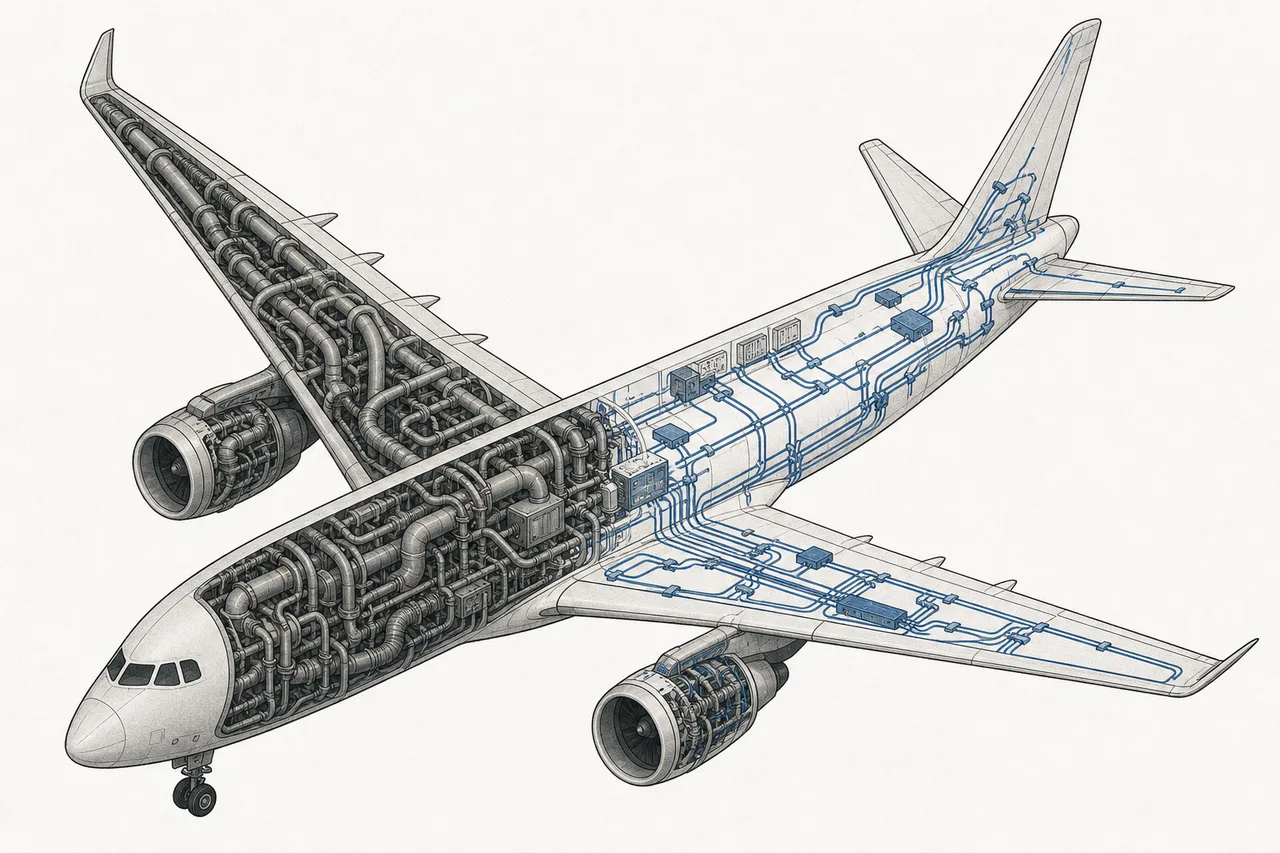
The second direction is consolidation and "software-defined". The IMA architecture will bring functions together even more, so aircraft start to look like smartphones that "update their software" to add capabilities without changing the hardware. New cockpit suites like Thales's FlytX are starting to add AI to cut the pilot's workload — and over the long run, that's the path toward an aircraft with just one pilot (and someday, maybe an uncrewed cargo flight).
The third direction is connectivity. Aircraft are becoming "internet connection points in the sky" — both passenger Wi-Fi via low-earth-orbit satellites, and sending engine/system health data back to the ground in real time to predict repairs before something breaks (predictive maintenance). This opens new markets for system makers and ties avionics ever more tightly to the space economy and communication satellites.
And the last direction is becoming the foundation for the new era of aviation. Electric air taxis (eVTOL) and delivery drones all need avionics that are light, affordable, and fully electric — so the established system makers have to learn to build things that are "lighter and cheaper" without lowering safety standards, a problem that runs against the industry's old DNA of "expensive but reliable."
07Challenges & risks
The appeal of avionics — high walls, juicy margins, recurring revenue across the aircraft's lifetime — comes with its own risks that are just as heavy.
The first risk is safety and cybersecurity. The more an aircraft leans on software and connectivity, the wider the surface exposed to bugs and attacks. A bug in critical-system software, or a vulnerability that gets hacked, costs human lives and the trust of the whole industry. That's why DO-178C certification is strict to the point that every line must be provable — but that strictness is traded for cost and slowness in adopting new technology.
The second risk is a long, expensive development cycle. Designing and certifying a new system takes years and tens of millions of dollars, which makes avionics adapt far slower than the consumer-electronics world. The chips used on aircraft are usually a "proven" generation, not the latest — this slowness is both a wall against competitors and a weakness when outside technology runs faster.
The third risk is dependence on semiconductors and the supply chain. When an aircraft becomes a flying computer, it gets fragile to chip shortages like cars do. But it's worse than cars, because aviation chips have to be specially certified and you can't swap suppliers easily. Dependence on specific materials and components also ties into critical-materials supply chains that are sensitive to geopolitical tension.
And the last risk is being tied to the OEM's production cycle. Because most of a system maker's revenue comes from Airbus and Boeing delivering new aircraft — when an OEM stumbles (like the 737 MAX quality crisis that held production rates down for years), the suppliers feeding it systems hurt right along with it. The aftermarket revenue helps cushion things somewhat, but new installs still depend on the airframe assemblers' rhythm.
In short: avionics is the brain and nervous system that lets the world's aircraft fly the safest of all forms of travel. It's the part you can't see but can't do without, the most expensive per kilogram, walled off by a safety barrier almost no one can compete past — and in an era where aircraft are becoming "flying computers" that use more electricity and connectivity, whoever controls the aircraft's brain only grows more important.