Megatrend · Critical Materials
The pinch of magic powder that keeps the whole world running
A catalyst is a substance you add in tiny amounts to “spark” a huge chemical process — while barely wearing out itself. About 90% of all the world's chemicals depend on one, and the catalytic converter in your car's exhaust is the single biggest user of precious metals like platinum, palladium, and rhodium on Earth. But the clean-energy era is flipping the script: fewer ICE cars means less demand for exhaust catalysts, while a new breed of catalyst for green hydrogen is rising.
01What it is
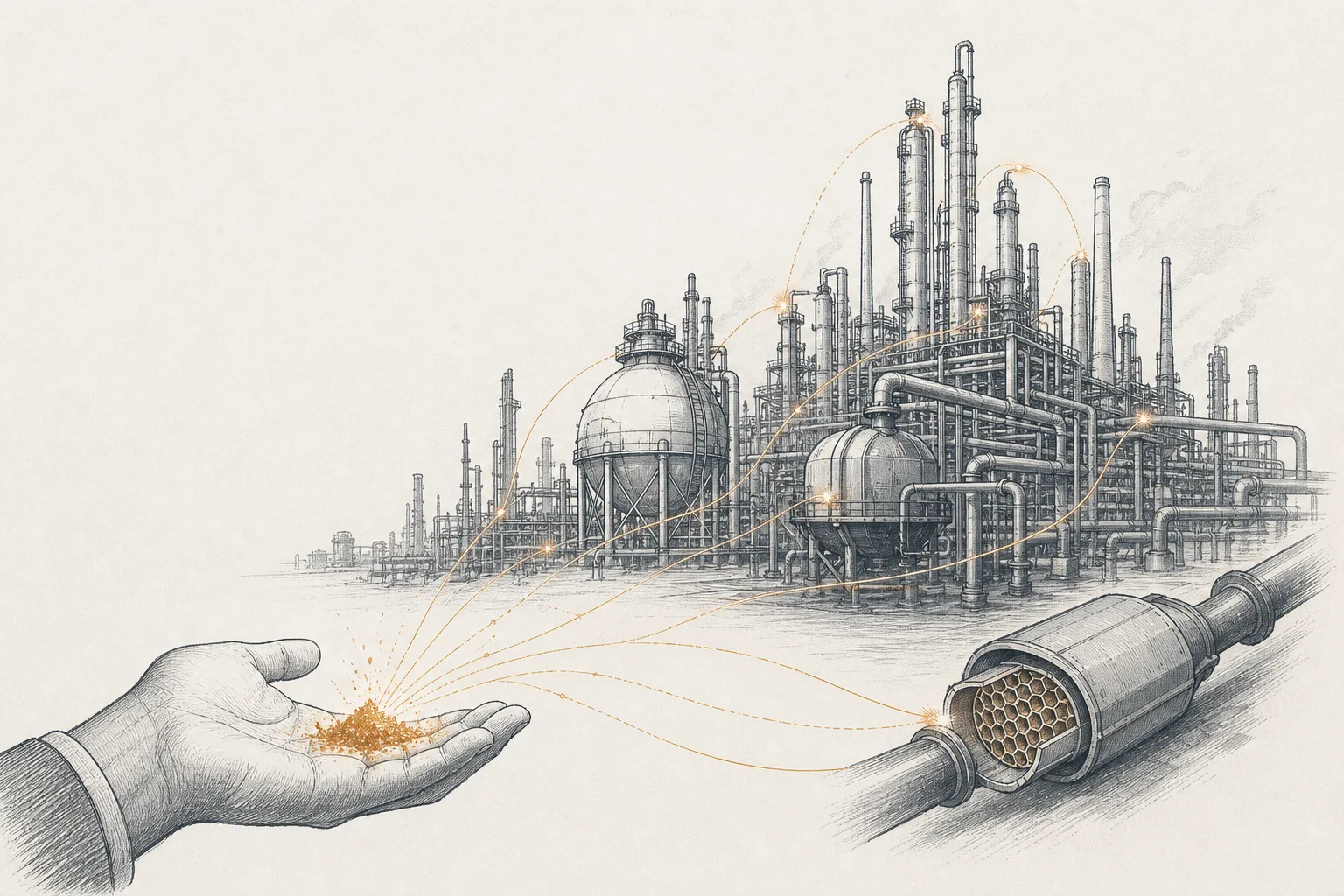
Think of a matchmaker at a wedding. Her job is to help two people “find each other” faster. Once the couple commits, she steps back and moves on to the next pair — without ever getting married herself. That's the heart of a catalyst.
A catalyst makes a chemical reaction happen faster and more easily without being used up in the process. Add a pinch, and it speeds the conversion of raw materials into products over and over again. This node covers three groups of substances that sell on “what they do,” not how much they weigh:
- Process catalysts: used in oil refineries and petrochemical plants — turning crude oil into gasoline, and gas into fertilizer and plastics
- Emission-control catalysts: the star here is the “autocatalyst” in your car's exhaust, which turns toxic gases into safer ones
- Performance additives: substances added in tiny amounts to “upgrade” a material — like UV stabilizers that keep plastic from going brittle in the sun, engine-oil performance boosters, and battery additives
On the megatrend map, this node is a sub-branch of Specialty Chemicals & Industrial Gases, under the Critical Materials & Supply Chain megatrend — it's a kind of “specialty chemical” that sells at a premium because it does a specific job better than anyone, not because it comes in bulk.
Reactant = the stuff that gets “used up,” becoming the product · Catalyst = the stuff that “helps it happen” but comes out unchanged, so it works for a long time. That's why a plant can afford an expensive catalyst even in tiny amounts — it isn't burned away with the product.
02Why a pinch of powder matters so much
This is one of the world's most “invisible but indispensable” industries. The striking number: about 90% of all commercially produced chemicals pass through a catalytic process, and catalysis is estimated to touch ~80% of manufactured goods — together worth more than 35% of global GDP.
The magic is in that huge “leverage ratio.” The catalyst market itself is worth about $38 billion in 2024 and is expected to grow to roughly $49 billion by 2030 (CAGR ~4.5%) — which sounds modest, but this “small” few-tens-of-billions market is what keeps the multi-trillion-dollar oil, fertilizer, and plastics industries running.
The biggest money sits in refinery catalysts, which took about 44% of catalyst use in 2025, led by processes like FCC (cracking heavy oil molecules into gasoline) and hydroprocessing (removing sulfur), followed by catalysts for chemical synthesis, polymers, and environmental control.
03How a catalyst works
Every chemical reaction has an “energy hill” it must climb over, called activation energy. Picture pushing a boulder over a mountain: if the mountain is very high, the reaction happens slowly or barely at all. What a catalyst does is “dig a tunnel through the mountain” — opening a new, lower-energy path so the boulder rolls over to the product side much faster, while the start and end points stay exactly the same.
Because it isn't used up, a single batch of catalyst can work for months or years inside a reactor before it “degrades” (as impurities coat it or its structure breaks down), at which point it must be replaced or recycled to recover the precious metals. This is exactly what gives the catalyst business steady, “repeat-sale” revenue — and ties it inseparably to metal recycling.
04Exhaust catalysts & precious metals (PGM)
To really understand this node, you first have to meet its “champion”: the autocatalyst — a porous, honeycomb-like ceramic block hidden in every car's exhaust. Its honeycomb surface is coated with a wafer-thin layer of precious metals, and as hot exhaust flows through, those metals “catalyze” three toxic gases (carbon monoxide, unburned hydrocarbons, and nitrogen oxides) into safer ones — which is why it's called a “three-way converter.”
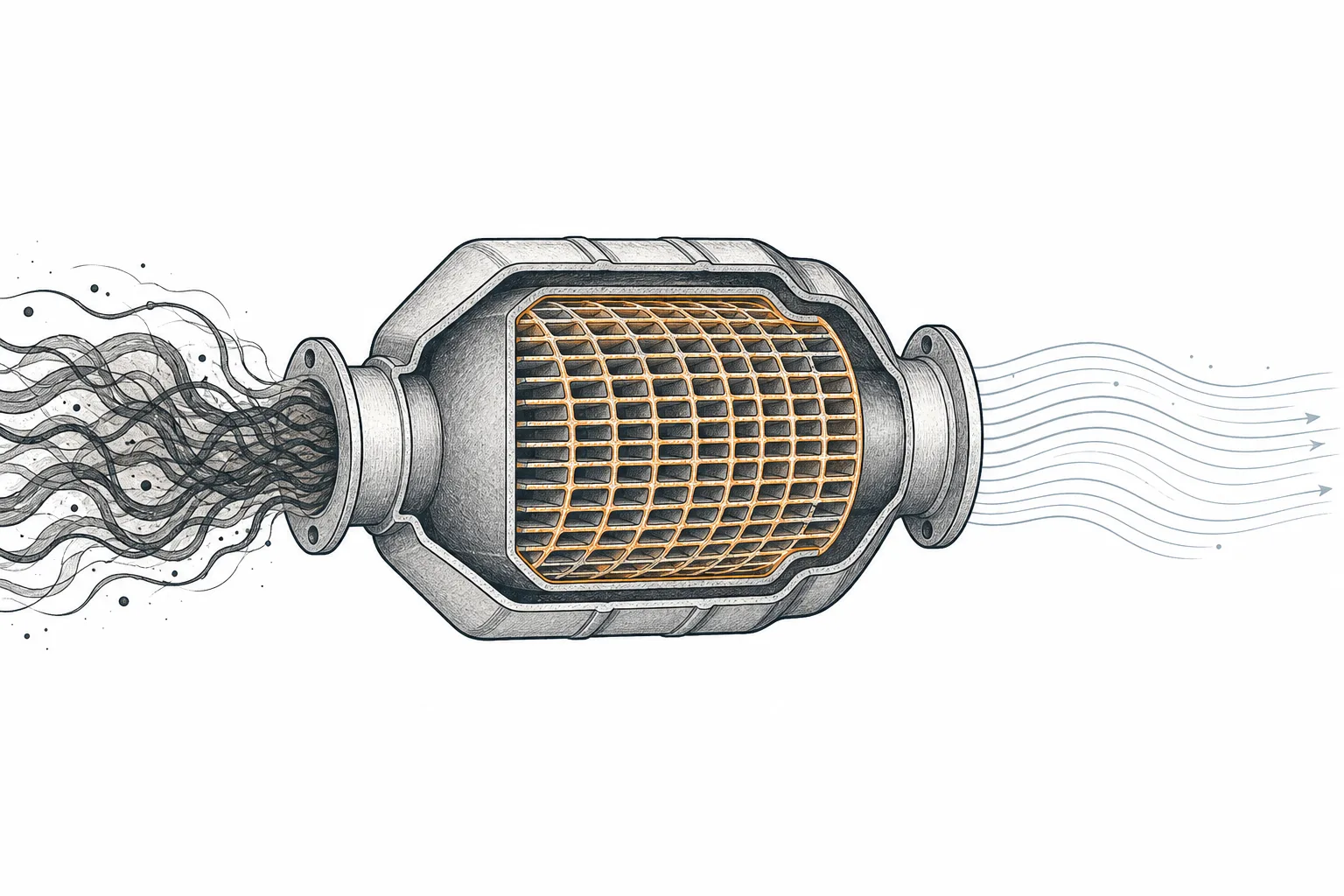
The three metals that do this work are known together as PGM (platinum-group metals): platinum (Pt), palladium (Pd), and rhodium (Rh). And here's a fact most people don't know: autocatalysts are the world's single biggest user of PGM. The auto sector eats more than 80% of global palladium and rhodium demand combined — more than jewelry, more than investment, more than every other use put together.
This is why the autocatalyst market specifically is so valuable — about $87.5 billion in 2023, projected to reach ~$155 billion by 2034. That's several times the size of the entire process-catalyst market, because most of the value is the “precious-metal cost” of the coating. So autocatalyst prices track global PGM prices very closely.
This high, volatile price pushes makers to constantly “use less metal per car” and “swap in cheaper metals.” When palladium ran far more expensive than platinum, for instance, makers switched to platinum in gasoline engines — and since 2025 some have started switching back. It's this metal-swapping game that turns expertise in “coating formulas” into a treasure for the leading catalyst companies.
05What it connects to
This node is a hidden “supplier” behind many other megatrends — because almost every basic manufacturing process needs a catalyst:
- Feeds Energy Transition & Power Demand: catalysts are at the heart of making hydrogen, ammonia, and clean fuels — the clean-energy era is creating demand for a whole new class of catalysts
- Tied to Electrification & Mobility two ways: ICE cars need exhaust catalysts (good for this node), but EVs don't (eroding the old demand) — a double-edged sword that will decide this node's fate
- In the same family as its siblings: Industrial Gases (the hydrogen/oxygen that feed reactions), Electronic & Semiconductor Materials, and Coatings, Adhesives & Sealants — all “specialty chemicals that sell on function”
- Indirectly supports AI: specialty chemicals and catalysts are upstream inputs in the production lines for chips and advanced materials
The key thing to grasp is that this node is the “arms dealer” of industry — no matter who wins the energy or mobility game, as long as molecules have to be transformed, someone has to buy catalysts. That diversifies its risk well, but it also means it grows with the overall industrial economy rather than exploding like a tech trend.
06Where it stands now
2025–2026 is a period of “major reshuffling” in the catalyst world, because every company faces the same question: how do you handle a world with fewer ICE cars?
The biggest deal: Johnson Matthey, the 200-year-old British catalyst company, announced it was selling its Catalyst Technologies business (process catalysts for ammonia, methanol, hydrogen) to Honeywell for £1.8 billion (~$2.4 billion) in May 2025, to focus instead on Clean Air (exhaust catalysts) and PGM metal services — the divested business ran about $930 million in annual sales.
For its part, BASF — the German chemical giant and the world's largest catalyst maker — spun its exhaust-catalyst and precious-metal-services business into a new company called ECMS (Environmental Catalyst and Metal Solutions) back in mid-2023, so it could run separately and raise capital or find partners more nimbly. Meanwhile Belgium's Umicore leans on its strength in integrating “catalyst production + PGM recycling” end to end.
The big picture: this market is concentrated in a few hands — Johnson Matthey, BASF, and Umicore dominate the global autocatalyst market, while process catalysts and additives are spread across specialist players in Europe, the US, and a fast-rising Asia.
07The future: the clean-energy turning point
The future of this node is a story of “one door closing as another opens,” at the same time.
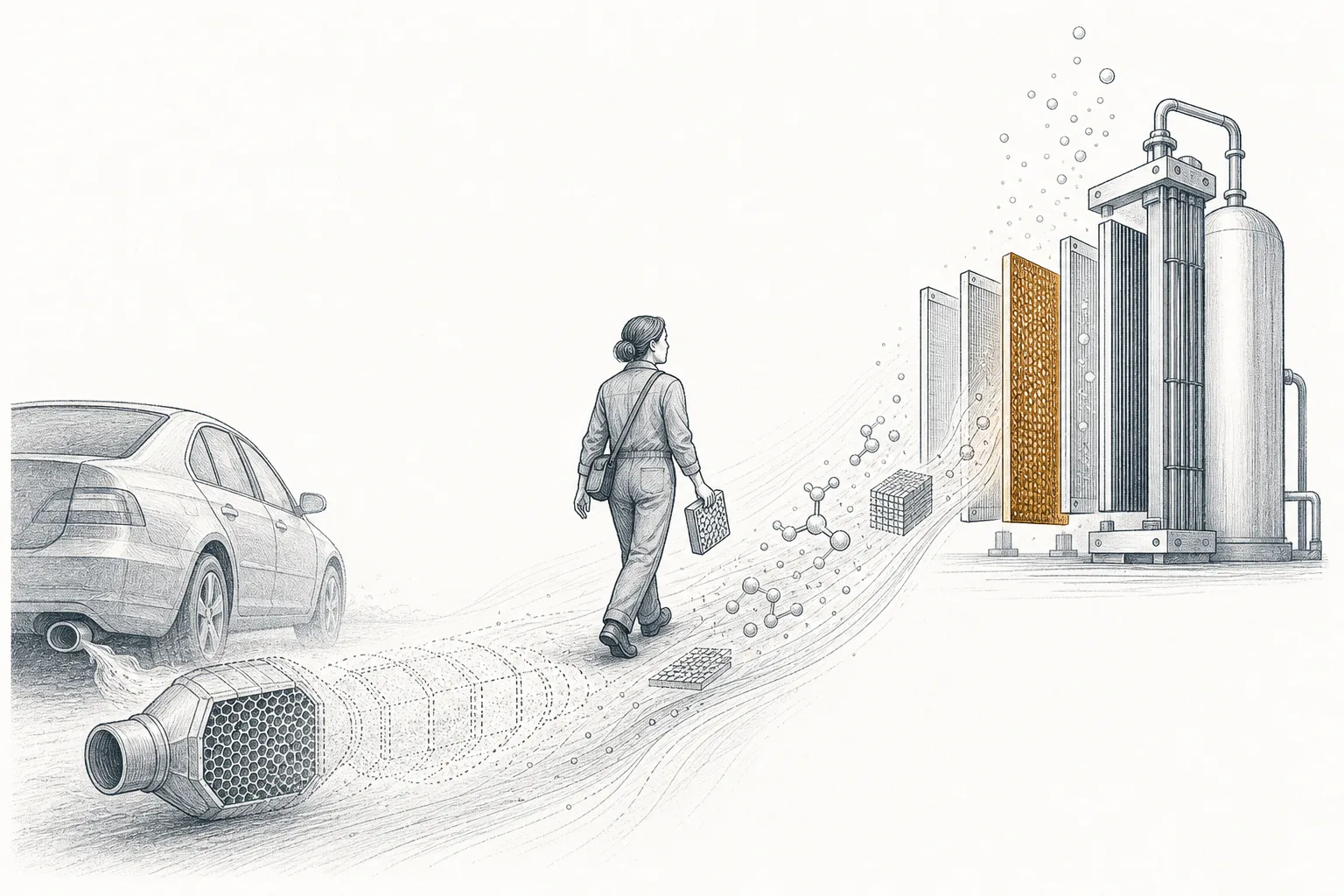
The door that's closing: as EVs steadily replace combustion cars, demand for exhaust catalysts (a big, high-margin revenue stream) will slowly shrink over the long run. That's why Johnson Matthey and BASF are restructuring now.
The door that's opening: clean energy is creating demand for a new breed of catalyst. At its heart is the PEM electrolyzer that makes green hydrogen — it needs platinum to coat the cathode and iridium to coat the anode. Platinum demand from hydrogen and fuel cells is estimated to reach around 900,000 ounces a year by 2030, becoming a meaningful new source of demand — one that partly offsets the platinum lost on the automotive side.
But the real bottleneck is iridium, which is extraordinarily rare — the world produces only about 7 tons a year, and ~80% comes from South Africa alone. So scaling PEM capacity to the gigawatt level depends heavily on “cutting iridium per cell,” or there simply won't be enough metal.
So the industry's long-term challenge is clear: whoever can carry their expertise in “coating precious metals to do more with less” from the exhaust-pipe era into the hydrogen era first will own the new market as it forms.
08Challenges & risks
The appeal of this node is how “indispensable” it is — but it also carries several risks of its own.
The first risk is the transition to EVs. Exhaust catalysts are the group's single largest profit pool, so the rise of electric cars eats directly into the old revenue core. The question isn't “will it shrink” but “how fast” — and “will the new business (hydrogen) grow fast enough to make up for it?”
The second risk is violently volatile precious-metal prices. Because most of an autocatalyst's value is the metal, company profits swing with the wild moves in platinum, palladium, and rhodium — plus there's concentration risk in supply (most PGM comes from South Africa and Russia), which is sensitive to geopolitics.
The third risk is a raw-material bottleneck in the new business. Scarce iridium could cap how fast hydrogen demand can really grow; if metal-per-unit can't be cut on schedule, the transition may stall.
The fourth risk is competition from China. Chinese chemical and additive makers are climbing in many segments (especially additives and commodity-grade process catalysts), pressuring the prices and market share of incumbents.
In short: catalysts and additives are the “magic powder” the whole world can't do without — small in market value, but huge in what they unlock. It's the story of an old industry walking through a turning point, from car exhaust pipes to hydrogen generators — and whoever holds their “precious-metal know-how” tightest has the best shot at crossing the bridge into the clean-energy world first.