Megatrend · Critical Materials
The business that pulls apart the air and sells it — then rules the world with just a few pipes
The air you're breathing right now is the free raw material for one of the deepest-moated businesses on Earth. Gas companies capture air, chill it into a liquid at –196°C, then "distill" it into oxygen, nitrogen, and argon — the gases hidden inside every ton of steel, every chip, and every patient's breath. The remarkable part: the whole world is run by just 3–5 players, through pipes and plants that, once built, almost no one can ever steal the customer away from.
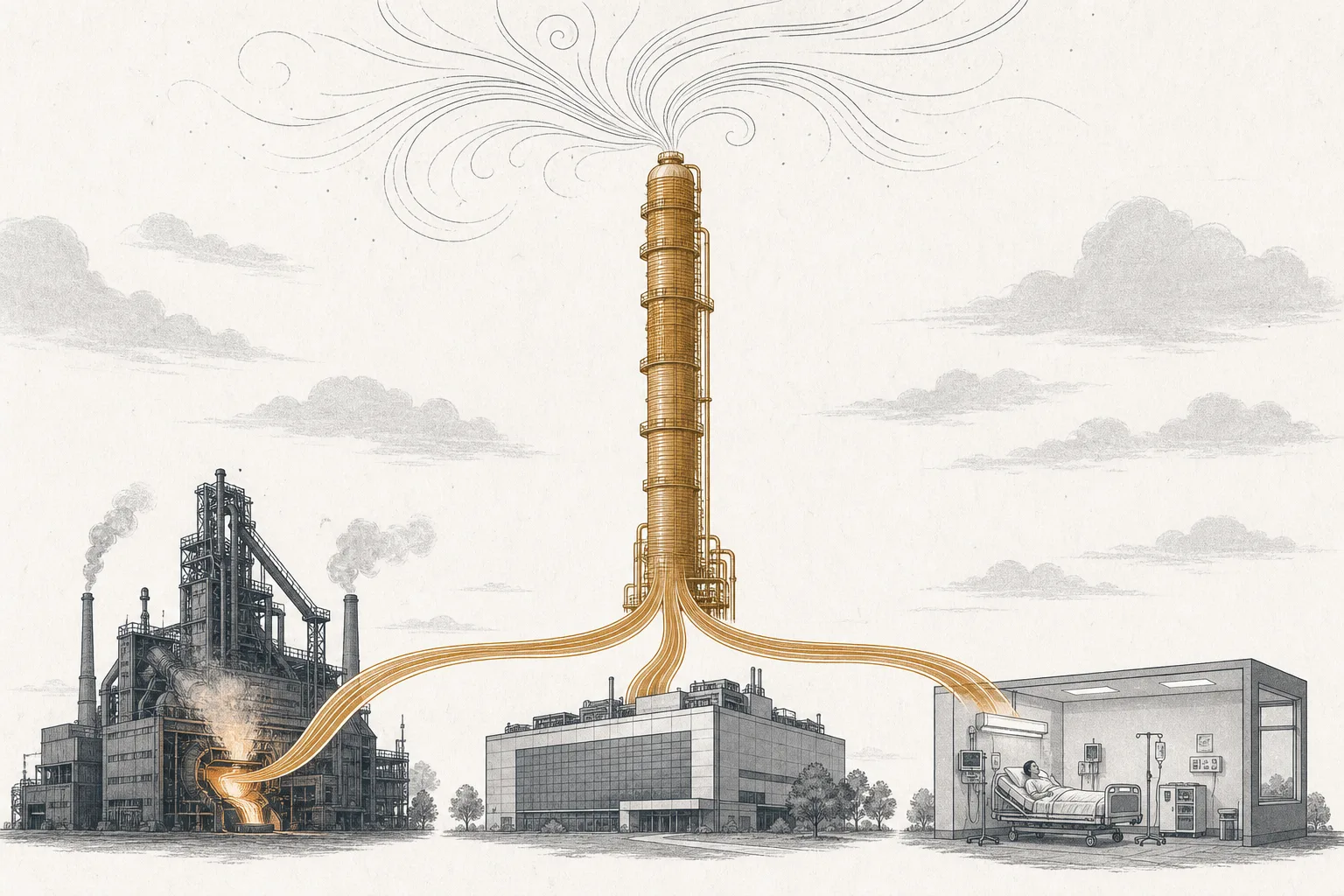
01What it is (three families of gases)
Take a deep breath. The air that just hit your lungs is a mix of ~78% nitrogen, ~21% oxygen, and ~0.9% argon, plus a little of everything else. That's the "ore body" of the industrial-gas business — they don't dig or drill, they just suck in air and split it into pieces, and out comes a product worth hundreds of billions of dollars a year.
Industrial gases split into three big families, by where they come from and how they're made:
- Atmospheric gases: oxygen (O₂), nitrogen (N₂), argon (Ar) — made by "separating air," which is the heart of this lesson. It's the biggest chunk of the market; oxygen alone is about 38% of all gas demand.
- Process gases: hydrogen (H₂), carbon dioxide (CO₂), carbon monoxide — these come from chemical reactions or are pulled out of natural gas, not from the air. Hydrogen is the rising star here, because it's both a chemical feedstock and a clean-energy hope.
- Electronic specialty gases: gases purified to 99.999% and beyond, used to "etch" and "clean" inside chip fabs. Small in volume, but the value per unit is sky-high.
Nitrogen and argon are "inert" gases — they barely react with anything, which makes them hugely valuable as a "blanket" over anything you don't want reacting with oxygen. You flush the air out of a potato-chip bag (to stop it going rancid), shield a welding job (to stop it burning), or create a clean atmosphere in a chip fab. The opposite is oxygen, which is valuable precisely because it's "reactive" — it drives combustion and reactions hard.
On the megatrend map, this node is a segment under Specialty Chemicals & Industrial Gases, which in turn sits under Critical Materials & Supply Chain — the "deepest upstream" layer of the economy, where the most basic raw materials are born before being passed along to become real products in other trends.
02Why something you can't even see is impossible to do without
Start with size. The global industrial-gas market is worth around $99 billion in 2025 and is expected to grow to about $127 billion by 2030 (roughly ~5% a year) — slow but steady, because it doesn't lean on any single industry.
But the market-size number doesn't tell the most important part. The real story is that these gases are "embedded" in almost every industry — pull them out, and factories around the world stop dead. Here's where they hide:
- Steel and metals: blast furnaces blow in pure oxygen to speed the reaction and strip out carbon — a ton of steel needs about 50 cubic meters of oxygen. You can't make steel without gas.
- Healthcare: medical oxygen is a lifeline for patients everywhere — healthcare is one of the largest end markets, around 27% of the total.
- Chips: fabs use vast amounts of pure nitrogen to flush air out of every step, plus specialty gases for etching and cleaning.
- Food and drink: CO₂ carbonates your soda and preserves food; liquid nitrogen flash-freezes it — gas is in your fridge and your fizzy-drink bottle too.
This is why the business is so unusually "durable." It's the "picks-and-shovels seller" — whichever part of the economy is booming, gas still sells. And the fastest-growing new demand right now comes from three forces: AI chips, clean hydrogen, and healthcare.
03How it works — distilling air at –196°C
A question that sounds easy but is hard to answer: how do you "separate" oxygen from nitrogen in air, when they're blended into one thing and look identical to the eye? The answer is a technique called cryogenic air separation — one of the most beautiful engineering processes ordinary people have never heard of.
The trick is that each gas "boils" at a slightly different temperature. If you chill air until it turns liquid (you have to get to about –190°C!) and then slowly warm it back up bit by bit, the gas with the lowest boiling point evaporates off first — like distilling liquor, where the alcohol boils off before the water — except done at nearly two hundred degrees below zero.
The machine that does this is called an Air Separation Unit (ASU). It draws air in, compresses it to about 6 bar, then uses rapid expansion to keep cooling it until the air turns liquid. That feeds into a two-stage "distillation column" that gradually separates each gas by its boiling point. The result: oxygen at 99.5%+, nitrogen as pure as 99.999% (for chip work), and argon at 99.9%+.
Argon's boiling point (–186°C) sits right "in the middle" between oxygen and nitrogen, so it refuses to separate out easily — you need an extra column just to pull it from the middle of the tower. On top of that, air holds only ~0.9% argon, which makes argon (used in welding and chipmaking) far pricier than oxygen or nitrogen, even though it all comes from the same batch of air.
04The moat: pipes, tanks, and local monopolies
This is the part that turns "selling air" into one of the business models investors adore. The key isn't the gas itself (anyone can build an ASU) — it's how you deliver it. Gas gets delivered three ways, depending on how much the customer needs — and each one builds a different layer of moat.
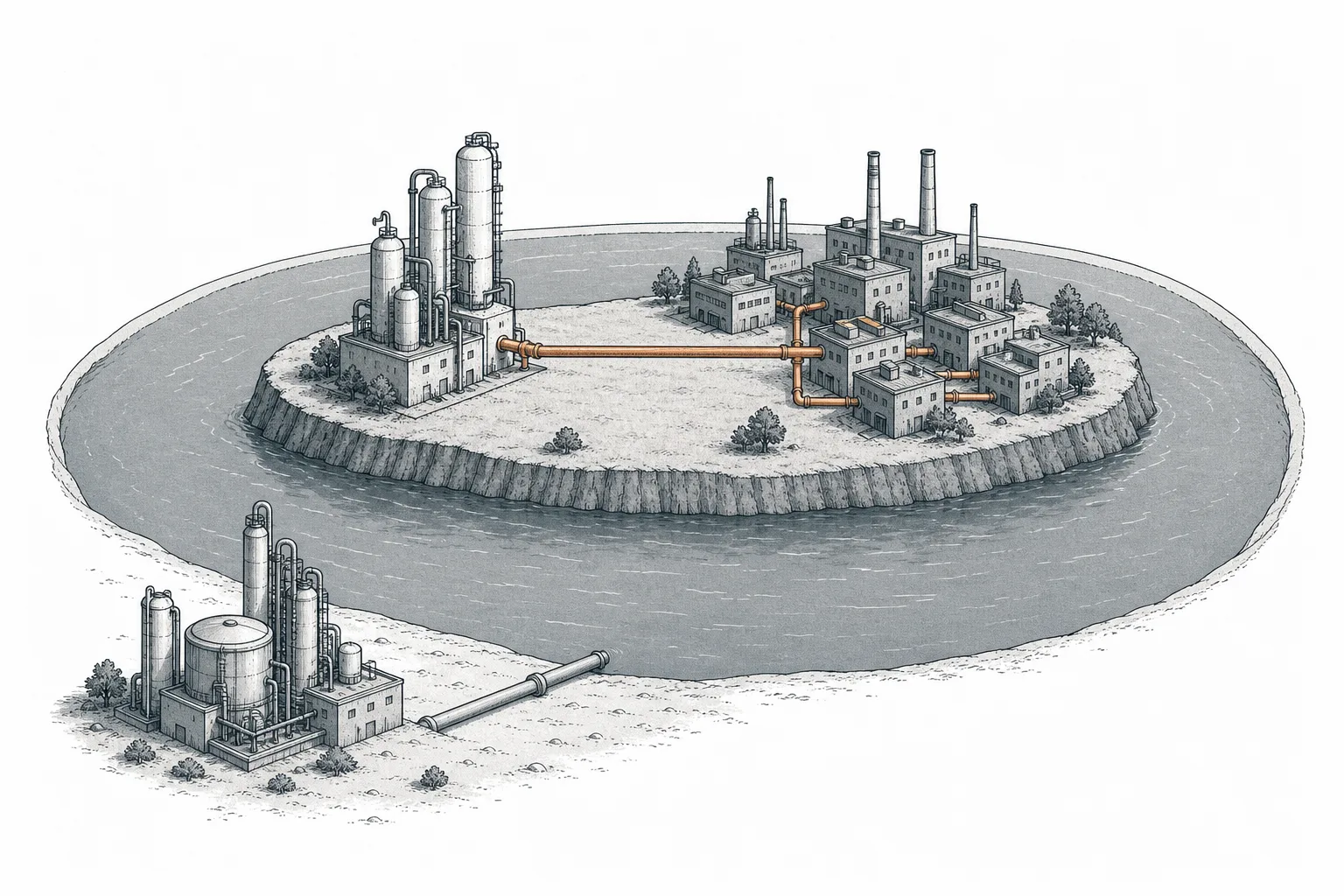
Method one is the strongest moat. For big customers like steel smelters or chip fabs, the gas company will build an ASU right against the customer's fence and pipe gas straight in, under a 15–20 year take-or-pay contract (the customer pays a monthly minimum even if they use less than agreed). Once the plant is built and embedded with that customer, no rival finds it worth building a duplicate to steal one account — this is a "local monopoly."
The second layer of moat is pipeline density. In big industrial clusters like the US Gulf Coast, gas companies lay pipes linking dozens of plants together — Air Liquide has the world's longest pipeline network, over 9,000 kilometers. Once the pipe is there, adding a new customer in the same cluster costs almost nothing extra, while a rival with no pipe in that area simply can't compete on price. The denser it gets, the bigger the edge — a cycle where the leader keeps leading.
05How it connects in the ecosystem
This node has three sibling segments under the same Specialty Chemicals & Industrial Gases umbrella — electronic and semiconductor materials, coatings and adhesives, and catalysts and additives — and where industrial gases overlap most with those siblings is the "electronic gases" that feed the same chip fabs.
But its true role is being the "upstream that feeds almost every other trend." Look at the most important connections:
- Feeds semiconductors and AI: every chip fab is a giant gas customer — the more fabs get built to feed AI, the more nitrogen and specialty-gas demand surges. Gas is the "behind-the-scenes" winner of the AI boom without having to bet on who wins the chip war.
- A core part of Energy Transition: hydrogen is one of the industrial gases, so the gas giants are already among the world's largest hydrogen producers and infrastructure builders. Clean energy is a direct new growth engine for them.
- Feeds rare inputs to Space Economy and Quantum Computing: rockets use liquid oxygen and hydrogen as fuel, while quantum computers need liquid helium to chill things to nearly the cold of space — so some gases are strategic materials with no substitute.
- Leans heavily on energy: distilling air eats enormous power, so gas companies are both suppliers of clean energy and major power users who bear that energy cost themselves — a tightly two-way relationship.
What's fascinating is that this node is the "picks-and-shovels seller" of almost every modern megatrend — whoever wins in AI, hydrogen, or space, the gas company sells to all sides anyway. That makes it a way to invest in hot trends with a built-in "doesn't matter who wins" kind of risk.
06Where things stand now + the players
The current picture of industrial gases is a near-perfect oligopoly — the whole world is run by a handful of players. The big three (Linde, Air Liquide, Air Products) together control about 55% of all market revenue, and the top five (add Messer and Nippon Sanso) together hold over 80%. Decades of consolidation have left fewer and fewer players — fewer players means more pricing discipline, which means fatter margins.
The big three are clearly different in size. In 2025, Linde, the world's largest, did around $34 billion in sales; France's Air Liquide did about €26.9 billion (~$30 billion); and America's Air Products, smaller, is the most heavily bet on hydrogen.
In 2025 the whole group kept moving well. Linde is holding a project backlog of nearly $10 billion not yet delivered — a reflection of future revenue already locked in — while Chinese players are rising fast in both atmospheric and electronic gases, backed by Beijing's chip self-sufficiency push.
07The road ahead
The first direction is clean hydrogen. This is the industry's biggest bet. Linde is pouring a backlog of roughly $8–10 billion into low-carbon hydrogen projects, from a $2 billion clean-hydrogen plant in Canada to an $1.8 billion complex in Texas to feed clean ammonia. Gas companies already have the know-how, the pipes, and the plants they need. If a hydrogen economy really takes off, they're among the first to benefit.
The second direction is the wave of chip-fab construction. Every new fab (US, Europe, Japan, China) needs high-purity gas fed in, usually under long on-site contracts. The electronic specialty-gas market is around $5.1 billion in 2025 and expected to keep growing, with Asia-Pacific taking ~69% of all consumption — a sign that the center of chipmaking has moved to this side of the world.
The third direction is China's rise. Chinese gas makers are catching up fast, both in atmospheric gases (led by groups like Hangzhou Hangyang, which makes both ASUs and the gas itself) and in electronic gases for chips (which Beijing is pushing hard to produce domestically to cut foreign reliance). This will shift the balance of a market long dominated by Western and Japanese giants.
08Challenges & risks
This business's stability comes with its own specific risks worth understanding.
The first risk is energy cost. Distilling air down to –190°C eats enormous power — air-separation units are among the biggest industrial electricity users, and power can be half the cost of making atmospheric gas. Most take-or-pay contracts pass energy costs through to the customer, but on the portion that can't be passed on, a spike in power prices bites straight into margins.
The second risk is the industrial cycle. Even though the long-contract revenue base is stable, "merchant" sales (liquid gas and cylinders sold to mid-size and small customers) are tied directly to the health of manufacturing, steel, and construction. When the economy slows, volumes drop — the business is cycle-resistant, but not fully immune.
The third risk is the big hydrogen bet. Clean-hydrogen megaprojects cost billions and often depend on government subsidies. If policy shifts or demand doesn't show up as expected, that big money can earn poor returns (Air Products, the heaviest bettor, has already faced investor pressure on this) — and the push from Chinese makers could pressure prices in both electronic and general gases over the long run.
In short: this node is the story of a business that captures "free air," splits it into products you can't do without, then defends it with a moat made of pipes and contracts. To understand industrial gases is to understand why the "most basic thing of all" — what you just breathed in — can build one of the deepest moats in modern capitalism.