Megatrend · Critical Materials
The invisible thin film that holds the whole world together
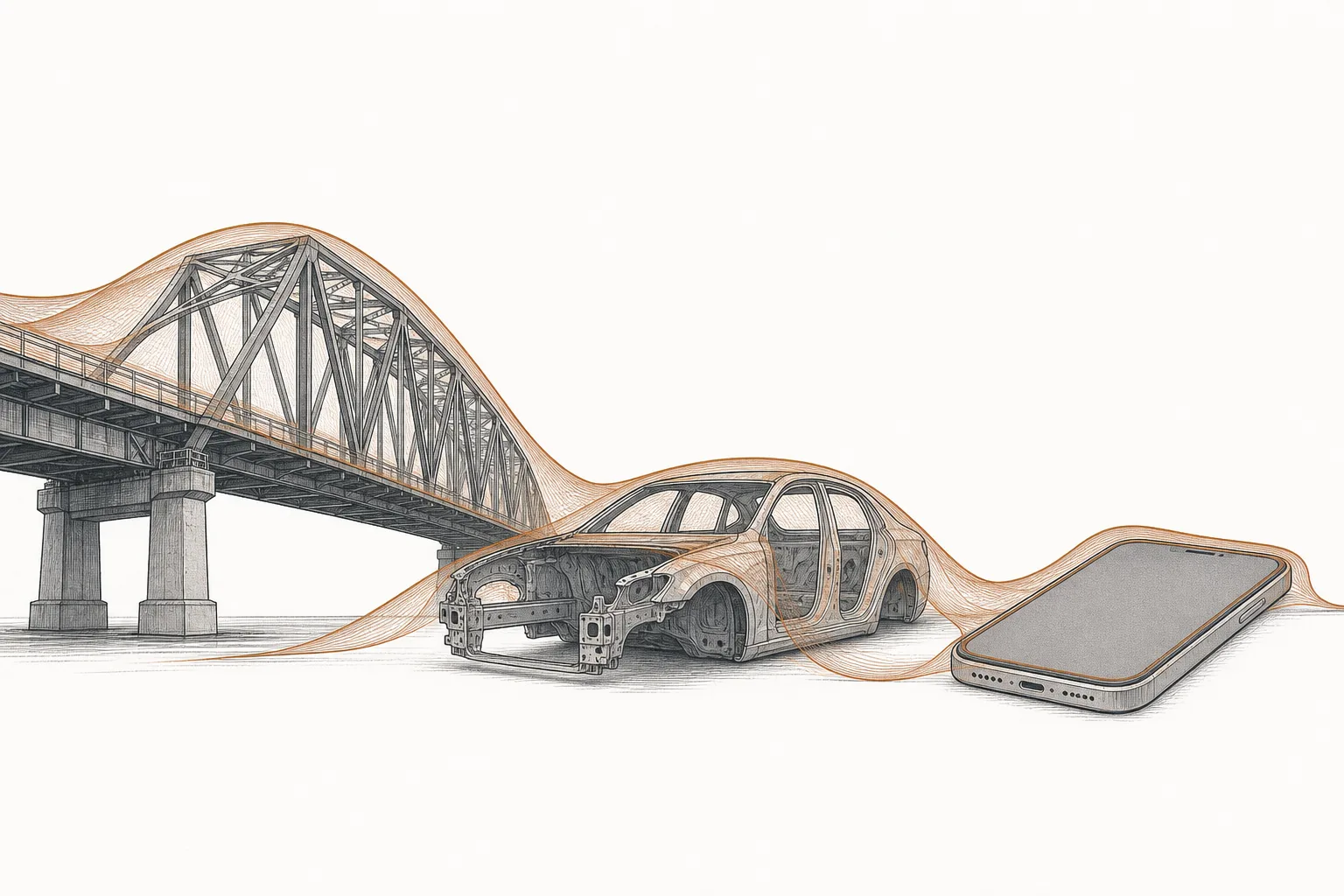
Paint, adhesives, and sealants are the "skin" of everything around you — coating a bridge so it won't rot, keeping a car from rusting, holding an entire EV together without welding steel. We barely notice them, but without them, our buildings, cars, ships, and phones would fall apart many times faster than you'd think. This is a ~$300 billion business that turns "cheap stuff in a drum" into an "expensive brand in a can" — and the EV and construction waves are quietly pushing it to grow.
01What it is (paint, adhesives, sealants)
Look around you right now — the wall, the car body, the phone shell, the soda can, the water pipe, the bridge pillar. Every one of these is "coated" or "bonded" with something you can't see, a thin layer. This node is about those substances — the companies that "formulate" paints, coatings, adhesives, and sealants to sell.
In reality, this node bundles three families that work differently but are related:
- Paints & Coatings: a thin film coating a surface for two main reasons — protection (rust, water, UV) and decoration (color, gloss). It splits into architectural/decorative paint, industrial/protective coatings, auto paint (OEM & refinish), and powder coating.
- Adhesives: substances that "bond" two pieces together — from the glue on a cardboard box to structural adhesives strong enough to hold a car body instead of welding and rivets.
- Sealants: substances that "seal" gaps to keep out water, air, and sound — like window caulk, the seal around a car's glass, or joint seals in an aircraft.
The heart of this business isn't the "raw material" — it's the formula and the know-how to mix it so it gets the properties you want: paint that lasts 10 years in tropical sun without fading, glue that hardens in 90 seconds on a car assembly line, a seal that stays flexible at -40°C. The starting ingredients may be the same, but the different "formula" is what customers pay for — and why this stuff sells for many times more than commodity chemicals.
On the megatrend map, this node is a sub-branch under Specialty Chemicals & Industrial Gases, which sits under the big Critical Materials & Supply Chain umbrella — put simply, it's the "upstream" that mixes a key ingredient before it goes off to coat and bind the real products in the other trends that consume it.
02Why a "thin film" matters so enormously
Start with size. The global paints-and-coatings market is around $205–220 billion in 2025 and expected to grow to about $250 billion by 2030 (midpoint, ~4% a year; some houses see as high as ~$300 billion). The adhesives-and-sealants market is another chunk, around $79 billion in 2024, heading toward ~$106 billion by 2030. Put the two together and this node is a roughly $300 billion business hidden in nearly every product around you.
But the size figure doesn't tell the most important part. The real story is that "it protects enormous value at a fraction of the cost." Here's what it does:
- Protects infrastructure from rust: corrosion eats the world economy at roughly 3–4% of global GDP a year. Protective coatings are the first line of defense that extends the life of bridges, pipes, ships, and rigs by decades — you pay tens of thousands in paint to prevent millions in damage.
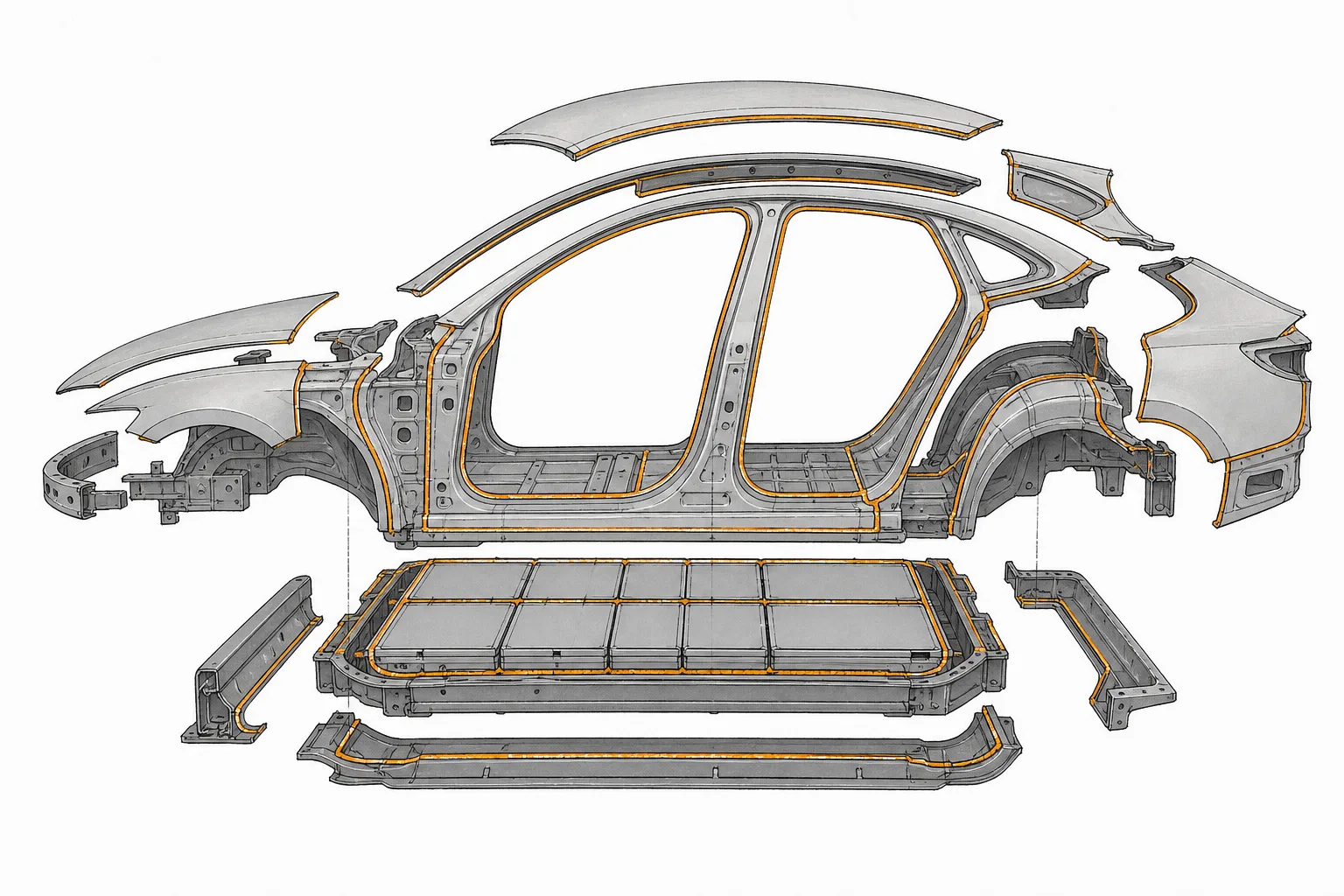
- Enables EVs and modern assembly: EVs use multi-material bodies (steel + aluminum + carbon fiber) that can't be joined by heat, so they need structural adhesive to hold together — and it's what secures the battery, manages heat, and cuts the car's weight all at once.
- Makes things beautiful and sellable: car paint, appliance paint, food-can coating — the "first surface" a customer sees and touches. Half of a brand's value lives in this thin film.
03How it works (what the coating layers do)
Paint that looks like "one layer" is usually a multi-layer system, where each layer does a different job — like human skin, with several layers working together. Take auto paint, one of the most complex and highest-value systems.
The heart of each layer comes from four main ingredients: resin/binder, the "glue" that sticks the film to the surface; pigment, which gives color and opacity (the star is white TiO2); solvent, which makes it spreadable then evaporates off; and additives, small amounts that tune the properties (anti-fungal, anti-UV, adjusting viscosity). Getting the balance of these four right is the "formula" each company guards more than anything.
Adhesives and sealants work on a similar principle — using resin as the binder, but instead of coating a film, they slip into the gap between two surfaces and "cure" into a bridge that spreads force across the whole joint. Unlike a rivet or a weld point that bears load at a single spot — that's why structural adhesives are often stronger and more fatigue-resistant than welding in multi-material work.
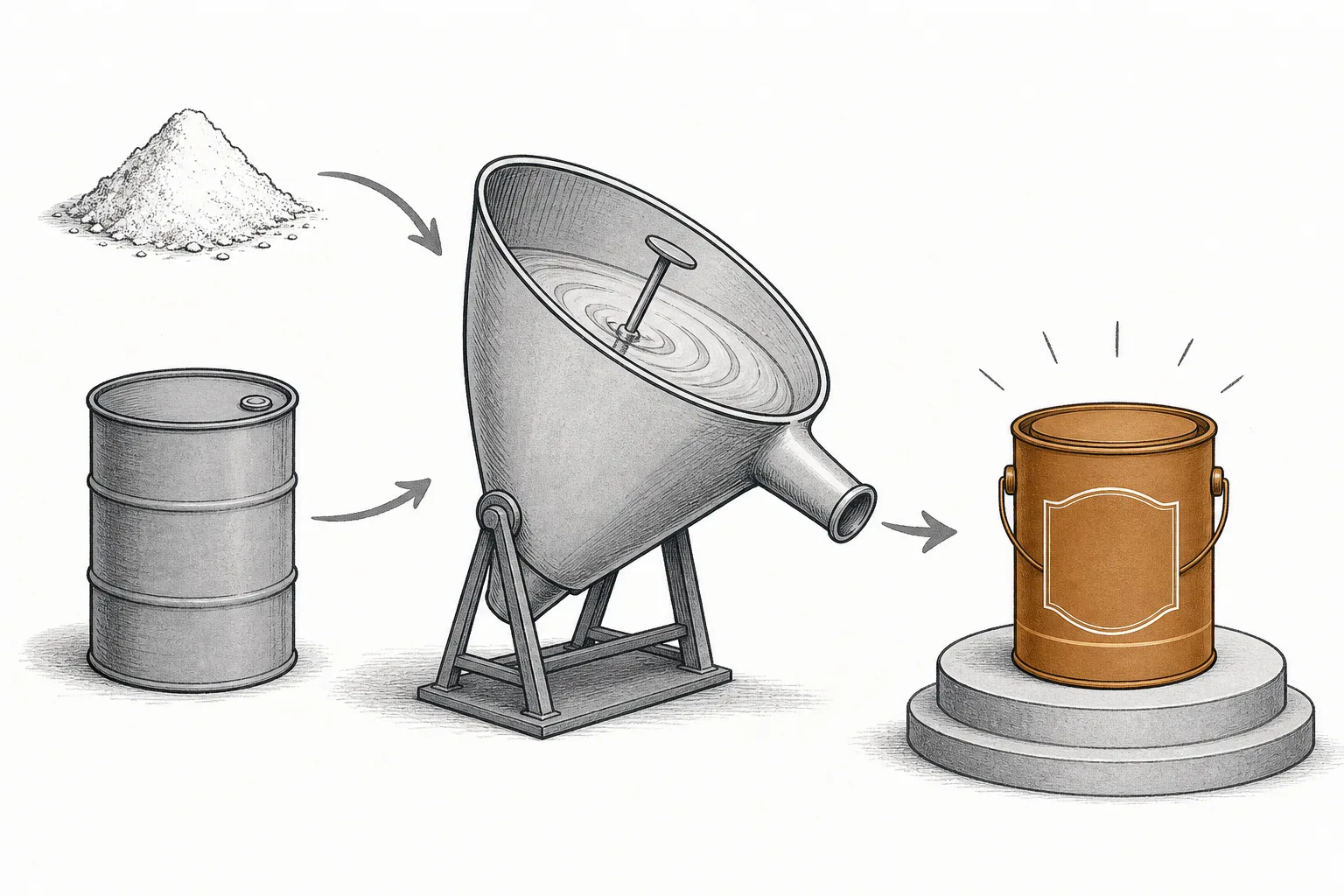
04Cheap stuff in a drum → an expensive brand in a can
This is the business heart of the node, and the reason paint companies make good money even though they "just mix cheap stuff." The key is that they sell "function and brand," not "tons."
The starting materials (resin, TiO2, solvent) are fairly standard chemicals anyone can buy at market price. But once they're "formulated" with a specific recipe, tested and qualified, then branded and given a distribution channel — the value jumps many times over. Take Sherwin-Williams, the world's #1 paint company, with sales topping $23.6 billion, most of it from its own network of over 5,000 stores across the US that painters walk into to buy — the moat isn't just the "paint formula," it's also "a store near the job site."
But the coin has two sides, because raw materials are a big share of cost (around 70% of the cost of making paint), and TiO2 alone eats up ~30% of the material bill. On top of that, about 30% of raw materials come from petroleum (resin, solvents), so when oil or TiO2 prices spike, paint-company margins get squeezed instantly. In the 2021–2022 cost crisis, solvent prices once jumped over +78% and resin +39% in just a few months.
A white powder that makes paint "opaque and able to cover" — the whitest, most reflective pigment in commercial use. It's in nearly every can of house paint (and in toothpaste and sunscreen too), because there's no substitute as good. Its price is a "cost variable" paint makers worldwide watch more than anything — so major TiO2 producers like Chemours are both a supplier and a cycle indicator for the whole industry.
05How it connects in the ecosystem
This node is the "picks-and-shovels seller" to almost every other megatrend — whatever anyone builds, they have to coat and bond it. Look at the most important connections:
- A relative of its siblings under the Specialty Chemicals umbrella: this node differs from Industrial Gases (sells gas), Electronic & Semiconductor Materials (chip-only materials), and Catalysts & Performance Chemicals (catalysts) — the dividing line is that this node focuses on "films that coat surfaces and glues that bind parts," used broadly across every industry.
- Feeds an ever-more-intense Electrification & Mobility: EVs are the hottest new demand — structural adhesive holds the multi-material body + secures and cools the battery + paints the whole car — so per vehicle it uses more glue and coating than a gas car.
- Feeds Aerospace and Defense: aircraft and military gear use special coatings (heat-resistant, radar-absorbing, corrosion-proof) and lightweight structural adhesives — high-margin work where switching suppliers is hard because of strict qualification.
- Tied to construction and Energy Transition: architectural paint is the biggest group (~47% of the paint market), so it's tied to the construction cycle, while clean energy needs weather-resistant coatings for wind turbines, solar panels, and pipes.
What's interesting is that because it sells to "everyone," whoever wins the EV war or dominates construction, paint and adhesive companies sell to all sides anyway — a way to invest in several trends at once without having to guess "who wins."
06Where things stand now + the players
The current picture of the paint market is steadily rising concentration from decades of consolidation. The five giants (Sherwin-Williams, PPG, AkzoNobel, Nippon Paint, Kansai) together hold a big share of the global market, especially after Sherwin-Williams bought Valspar and Nippon Paint went on an acquisition spree across Asia. Fewer players means more pricing discipline and steadier profits.
By use, architectural/decorative paint is still the biggest group at around 47% of the market, with the rest spread across industrial work, protective coatings, auto paint, and powder — and powder coating, which is more eco-friendly, is the fastest-growing group (~6% a year).
On the adhesives side, Germany's Henkel (owner of the Loctite brand) is the world leader in adhesives and sealants. Its Adhesive Technologies unit does around €11 billion a year, with a key growth engine in the "Mobility & Electronics" group — put simply, EVs and electronics.
Large paint makers reported 2024–2025 results in a "steady" tone — AkzoNobel had sales of about $11.6 billion, with net profit up even as sales held flat, while Nippon Paint hit record sales and profit (about $10.4 billion, up 13.6%) from pushing into Asian markets — a sign that this business grows slowly but consistently, and its center of growth is shifting to Asia.
07The road ahead
The first and hottest direction is structural adhesive in the EV and lightweighting era. As cars have to get lighter to extend battery range, and bodies are made of multiple materials that can't be joined by heat, structural adhesive steps in to replace welding and rivets — multi-material bonding is estimated to cut a car's weight by ~25%. The niche structural-adhesive market is growing from around $13.3 billion in 2025 to ~$20.6 billion by 2035 (~5.8% a year). This is glue turning from an add-on into an indispensable "structural part."
The second direction is sustainability and regulation. The world is pushing paint to drop the solvents that release fumes (VOCs) in favor of water-borne paint (already ~50% of the market) and powder coating that produces almost no waste, plus pressure to drop PFAS and certain heavy metals — companies that can reformulate "green" first gain an edge, because qualifying a new formula takes a long time.
The third direction is the center of growth moving to Asia. Paint use per person in China, India, and ASEAN is still far below the West. As cities expand and the middle class grows, demand for architectural and auto paint grows with them — which is why Nippon Paint and Kansai are aggressively buying up businesses in Asia, and it's the real growth battleground of this decade.
08Challenges & risks
This business's stability comes with its own specific risks worth understanding.
The first and most prominent risk is raw-material cost, because raw materials are ~70% of cost and tightly tied to TiO2 and petroleum. When oil or TiO2 prices spike, margins get squeezed instantly. Companies with a strong brand and pricing power (like Sherwin-Williams) pass costs through to customers faster, while small makers competing on price hurt more during a cost upswing.
The second risk is the construction and auto cycle, because demand is tied directly to those two industries. When high interest rates slow the housing and car markets, paint sales slow too, especially the big architectural and auto-paint groups — the business is durable, but not immune to the economy.
The third risk is regulation and competition from China. Tightening environmental rules (VOC, PFAS, heavy metals) force constant investment in reformulating and retooling, while Chinese makers climb up in the low end with cheaper prices, pressuring margins on general-grade products — even though specialty work (aerospace, structural adhesive) still has a high moat from qualification.
In short: this node is the story of the "invisible thin film" that protects and binds the whole world together. The remarkable part is that it turns cheap standard raw materials into a branded product with pricing power, through "formula and trust" — and today it's taking on a bigger new role, from "surface coating" to a "structural part" that actually holds the electric-vehicle era together.