Megatrend · Artificial Intelligence
The AI accelerator “anyone can buy” — and why the richest people in the gold rush sold shovels
In the AI race where every company is scrambling to build models, there's one thing everyone has to buy before they can even start playing — the accelerator. And it's sold the way a store sells to whoever walks in, not as a secret chip the tech giants build only for themselves. This lesson walks through why training AI takes thousands or tens of thousands of GPUs running in parallel, why a single company can take nearly 90% of this market with a “moat” made of software, and how far the challengers — AMD and Intel — can break in.
01What it is — the AI accelerator “anyone can buy”
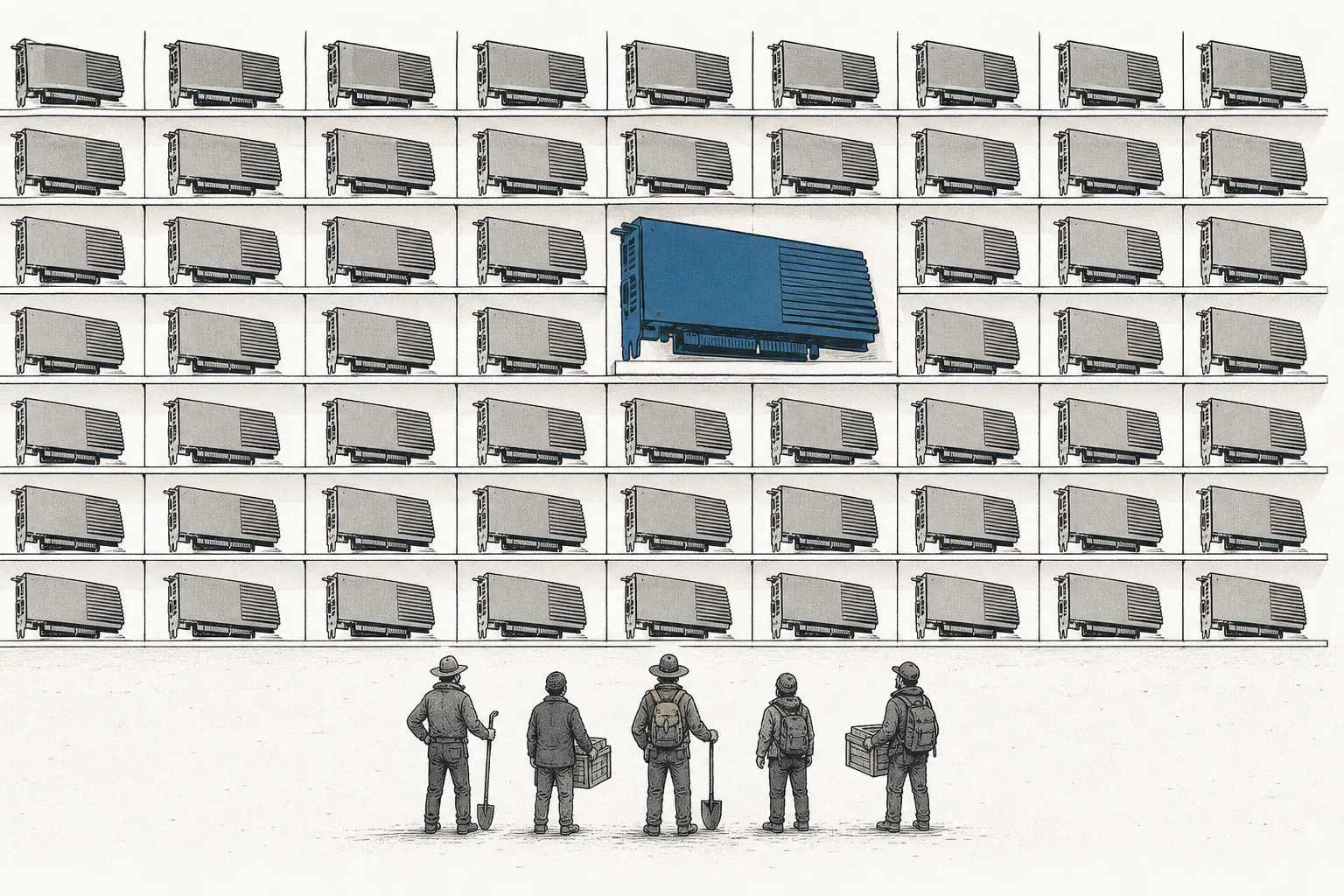
Picture a tool shop that anyone can walk into and buy from — from giant corporations down to a one-room startup. Everyone buys the same model off the same shelf. That's the heart of the word “merchant” (sold commercially) — an AI accelerator built as a standard product and sold to everyone, not a secret chip designed for one company's own use.
This node is about the “buy-it-and-plug-it-in” accelerator — mostly data-center GPUs like NVIDIA's Blackwell family, AMD's Instinct, or Intel's cards, all of which anyone can order the same way. The word “accelerator” matters, because it doesn't replace the CPU that's the machine's main brain — it joins as a “special helper” that's hundreds of times better at one job: the giant matrix multiplications that are the heart of every AI (we dig into this in Chapter 3).
On the megatrend map, this node is a sub-branch under AI Compute & Accelerator Silicon within the big trend Artificial Intelligence. What sets it apart from its siblings is exactly that word, “merchant” — it's not Custom Silicon / ASIC (the made-to-order chips Google and Amazon design for their own use alone), and it's not Inference-Optimized Silicon (chips trimmed down to focus on “running” models). It's a general-purpose card that can both train and run, sold as a standard product in the open market.
Merchant GPU = a card built to a standard and sold to everyone (NVIDIA, AMD, Intel) — flexible, able to both train and run, switchable between jobs · Custom ASIC = a “made-to-order” chip a tech giant designs for its own use alone (Google's TPU, Amazon's Trainium) — cheaper for a specific job, but can't do anything else and outsiders can't buy it · The dividing line is “sell to everyone” vs “build for yourself” — this node is the first side.
02Why it matters — the shovels and picks of the AI era
There's a classic line that fits this industry better than anything: in a gold rush, the people who get rich for sure aren't the miners — they're the ones selling shovels and picks. Whether the AI race ends at OpenAI, Google, or some brand-new startup — everyone has to buy these accelerators before they can start training a model. This node is the store that sells shovels to everyone on the field, and the best-selling store collects an enormous toll.
The scale of the money tells the story plainly. In fiscal 2026, NVIDIA's revenue hit $215.9B, up 65%, and in the final quarter alone its data-center revenue set a record of $62.3B in a single quarter, up 75% from the year before — this isn't ordinary company growth, it's a single company pulling the whole world's AI investment into one main current.
But what makes this node more powerful than just its market size is the profit it keeps. In the latest quarter, NVIDIA's gross margin was about 73% — meaning for every $100 of cards sold, $73 is left as gross profit. A number like that is unnatural for a business selling “hardware,” and it's a sign there's some moat that keeps customers paying a premium without leaving (we'll dig into what that moat is in Chapter 4).
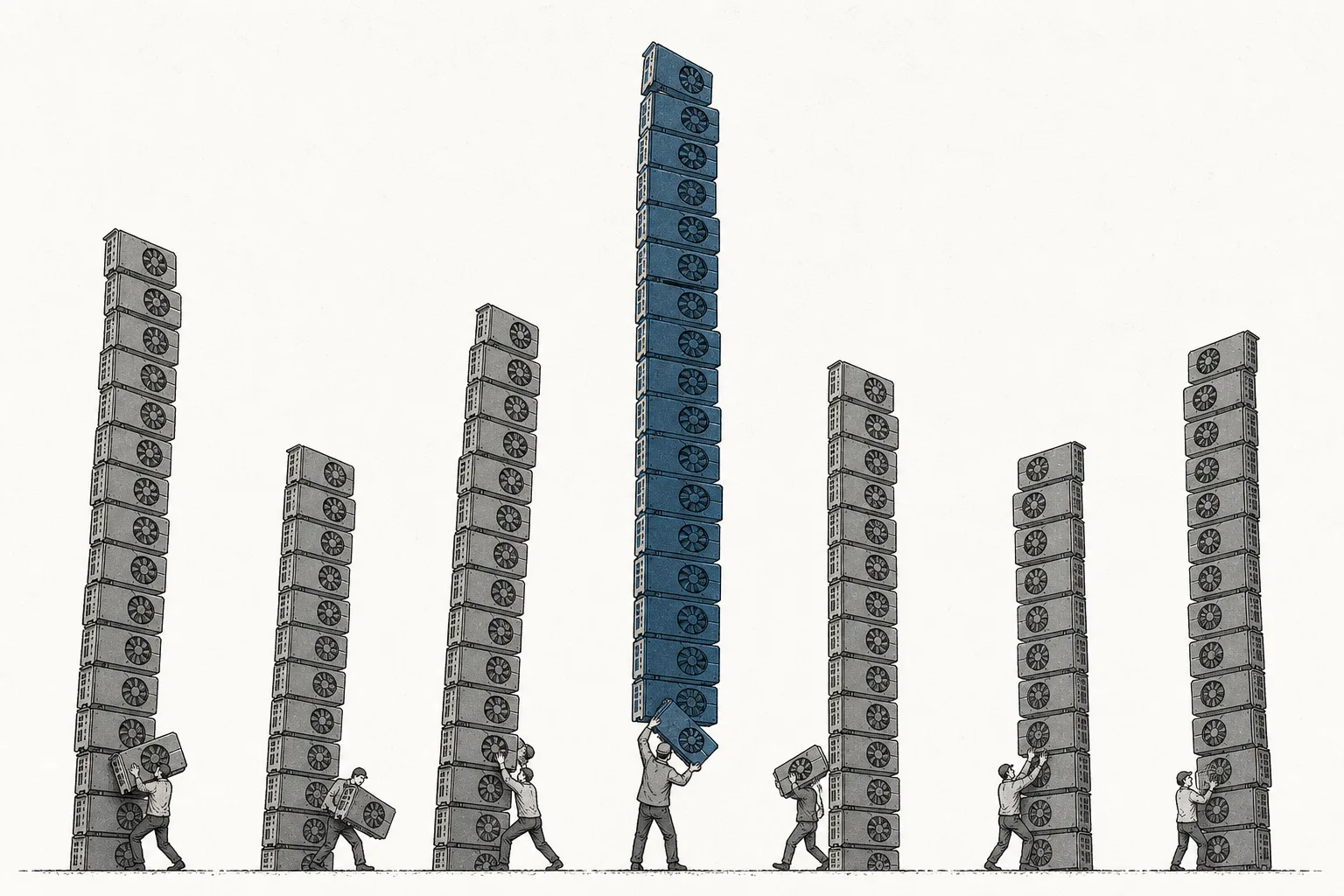
Why does everyone have to buy “right now,” all at once? Because this is a compute arms race — the company with more accelerators can train bigger, smarter models first, so competitors don't dare wait. The result: tech giants poured a combined ~$410B of capex in 2025 and have budgeted roughly $600–725B for 2026, with over 75% going to AI infrastructure — and the first place that money always lands is this accelerator layer.
03How it works — from one model to thousands of GPUs charging in at once
To understand why AI “eats” accelerators without limit, you have to grasp one truth: almost everything behind AI is matrix multiplication — taking two enormous tables of numbers and multiplying them, repeated billions of times. The magic is that this job “breaks into small pieces that can be computed at the same time”. Each cell in the result can be computed separately, without waiting on the others. That's why a GPU, with thousands to tens of thousands of small cores, does this job hundreds of times faster than a CPU that handles one thing at a time.
But today's models are far too big for a single GPU to handle. One large language model has trillions of parameters — so big you have to slice the model up and spread it across thousands of GPUs wired together as one cluster. Let's walk step by step through how this job runs.
The real numbers make it vivid: GPT-4 was trained on about 25,000 cards (A100 generation), running continuously for months. By 2024–2025, frontier-model training clusters climbed to 100,000 cards (like xAI's cluster in Memphis), with plans for clusters of 300,000 cards and up to follow — this is why demand for accelerators looks like it has no ceiling, because every time you want a smarter model, the most direct way is to “add more cards.” And the network that wires thousands of cards together to talk fast matters as much as the cards themselves — NVIDIA's networking revenue grew 142% in a single quarter for exactly this reason.
04The ecosystem — CUDA, custom chips, and the chip industry
The question every investor asks is this: since AMD makes cards that are just as fast, why is the market still almost entirely concentrated on NVIDIA? The answer isn't the card itself — it's the software called CUDA — and this is what sets this node apart from an ordinary hardware business.
CUDA is NVIDIA's software suite that lets developers put GPUs to work. The scary part is that almost every AI library and framework in the world is built to run on CUDA, and more than 4 million developers and over 40,000 organizations have grown fluent in it. Moving to another brand's chip means rewriting code, re-tuning, and risking that it runs slower — expensive and time-consuming enough that many teams won't take the gamble. This is the “moat” that makes it hard for a competitor with an equally good card to win customers away.
To understand where this node stands, you have to look at it next to its siblings in the same family — and this difference is the key to the whole lesson:
- Different from custom chips — Custom Silicon / ASIC: Google (TPU), Amazon (Trainium), Meta (MTIA) design chips for their own use alone to dodge NVIDIA's 73% cut; outsiders can't buy them. This node's merchant cards sell to everyone — the line is “build for yourself” vs “sell to everyone”
- Different from inference-focused chips — Inference-Optimized Silicon: merchant cards can both “train” and “run” (inference), while specialized inference chips are trimmed to do the repetitive job of running models more cheaply and with less power — a field the challengers are trying to break into
- They're the “logic” chips of the chip industry — Logic / Compute (Semiconductors): technically, these accelerators are logic-processing chips made with the most advanced technology. This node's lens is “why AI needs them”; making logic chips in general lives in the Semiconductors trend
- Paired with HBM memory and manufacturing: no matter how fast an accelerator is, it's worthless if it can't be fed data fast enough, so every card depends on special HBM memory and advanced manufacturing/packaging (Foundry & Contract Fabrication, which TSMC handles almost entirely) — the HBM and CoWoS bottlenecks are the bottleneck of the whole industry
- Feeding power to AI Cloud & Platforms and drawing power from Energy Transition & Power: these cards are the machines inside AI data centers that eat so much power they've become a driver of global electricity demand
05Where it stands now
The picture today is “one giant + an army of challengers.” NVIDIA still holds about 80–90% of the AI accelerator market by revenue (it touched ~92% in high-end data-center cards during 2025), but analysts expect its share to drift down to about 75% by the end of 2026 — not because NVIDIA is growing slower, but because the whole cake is growing faster than any one player can eat.
NVIDIA's engine right now is the Blackwell family of chips it's racing to ship — the GB300 just overtook the GB200 to make up about two-thirds of Blackwell revenue. The scary part is that NVIDIA runs on a cadence of a new architecture every year (Hopper 2022 → Blackwell 2024–25 → Rubin late 2026), leaving competitors barely able to keep up — because by the time they catch one generation, NVIDIA has already launched the next.
On the challenger side, real weight is starting to show. AMD is the clearest number-two merchant rival — its Instinct MI350 card comes with 288GB of HBM3E memory (more than NVIDIA's), and the MI400 is coming in 2026. AMD's data-center revenue hit $5.8B in the latest quarter, up 57%, and its biggest deal is Meta announcing it will deploy AMD cards at the 6-gigawatt level. The weakness AMD still has to chase down is its ROCm software, several steps behind CUDA — but it's getting better, bit by bit.
Meanwhile Intel is a lesson in how hard this field is — the Gaudi line was wound down, the flagship Falcon Shores card was canceled before launch, and Intel pivoted to a narrower game with the Crescent Island card focused on inference (entering customer testing in the second half of 2026), placing its big bet on the Jaguar Shores generation in 2027. It shows that even a veteran chip giant gets bruised when it takes NVIDIA on head-to-head.
Another field heating up is China. Under U.S. export controls that cut NVIDIA's high-end cards out of the Chinese market, NVIDIA's share in China fell from once ~95% to around 55%, opening the door for domestic players to grow fast — China-made AI cards took about 41% of the country's 2025 shipments (roughly 1.65 million of 4 million cards), led by Huawei (the Ascend line), followed by listed players like Hygon, MetaX, and Biren — with MetaX having just gone public on the Shanghai exchange in late 2025, surging nearly 700% on its first day.
06The road ahead — Rubin, price wars, and power
The first direction is the annual cadence squeezing competitors even harder. In late 2026, NVIDIA will launch the Rubin architecture (using new HBM4 memory), followed by Rubin Ultra in 2027 and Feynman in 2028. Every generation comes with a CPU, network switches, and a full system — the strategy is to sell “the whole system,” not just the card, which makes customers even harder to peel away and puts competitors selling bare chips at an even bigger disadvantage.
The second direction is the war shifting to “running” (inference). As AI spreads, the weight shifts from the big “training” runs to “running” models that answer millions of queries a day. This is where the CUDA moat is weaker, and where AMD/Intel's merchant cards — plus custom chips (ASIC) and specialized inference chips (Inference-Optimized Silicon) — get room to break in and compete on cost, because the repetitive job of running doesn't need as much flexibility as training.
The third direction is the bottleneck is moving. Today the bottleneck is HBM and packaging (CoWoS), but tomorrow it may be power and cooling — the new Blackwell cards draw over 1,000 watts each, and 100,000-card clusters are starting to hit the ceiling of the power grid. Whoever solves the next power bottleneck first gains the edge, and that's why this node is tying ever more tightly to the energy trend.
The fourth direction is a faster-growing cake means “losing share but still growing”. Even as NVIDIA's share falls, the whole market is growing so fast that everyone's revenue can keep rising at the same time — the one to watch is custom chips (ASIC), whose shipment count is expected to grow faster than merchant cards for the first time in 2026 (~45% vs ~16%), a sign that the tech giants' move to “dodge the cut” is starting to become real.
07Challenges & risks
The first risk is extreme concentration. Enormous value is tied to almost a single company, NVIDIA, and behind it sits another layer of just a few suppliers — TSMC makes almost all of the most advanced cards, and HBM has only three makers. If any one point stumbles (disaster, geopolitics, or a technical issue), the whole chain shakes. And because the most advanced manufacturing is concentrated in Taiwan, geopolitical risk is anything but far-off.
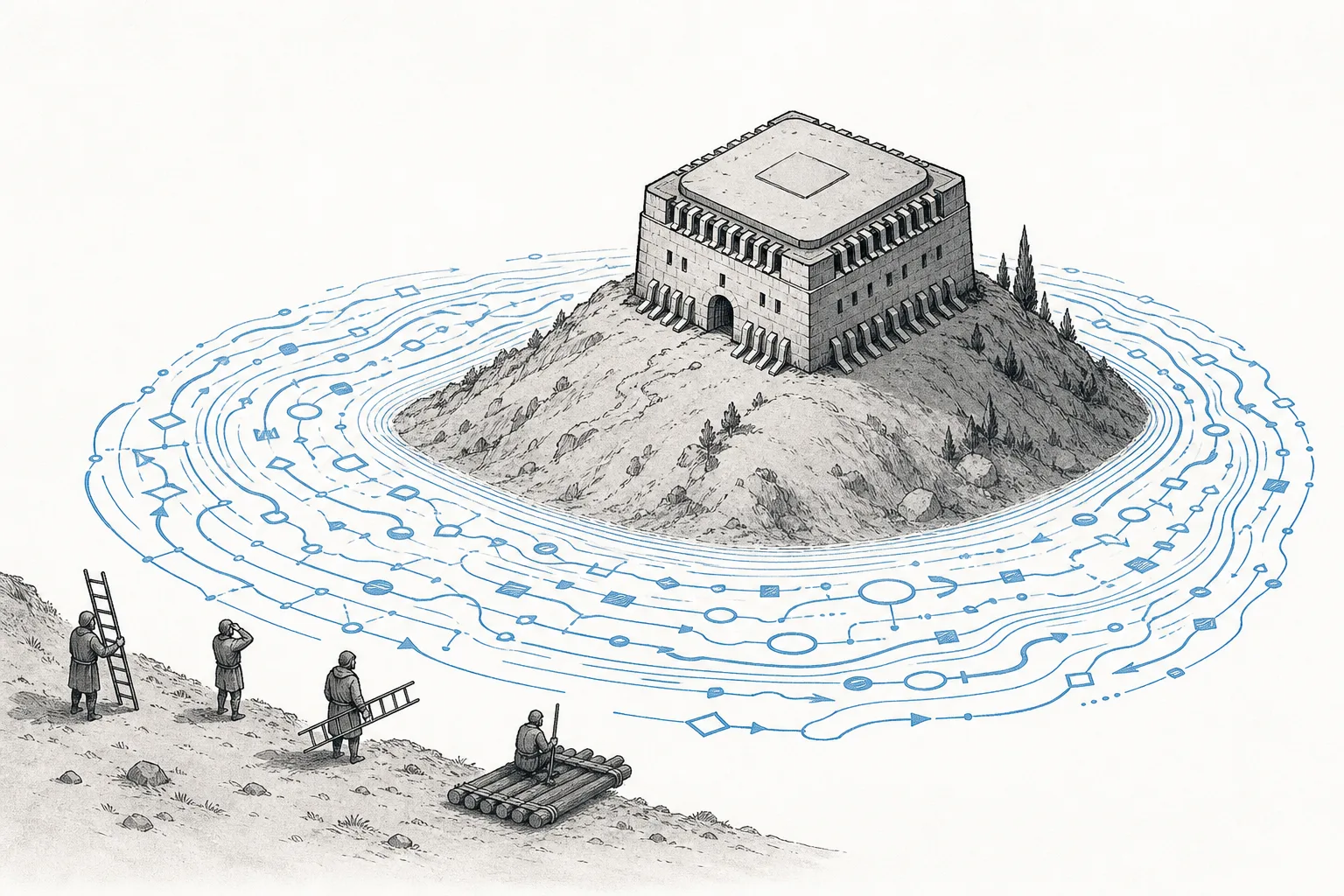
The second risk is the biggest customers are turning into competitors. Google, Amazon, Microsoft, and Meta are the customers who buy the most cards, but they're also building their own custom chips to dodge the 73% cut. The economic logic is stark: if your own chip does about 70% of the flagship card's work but costs 40–65% less in total for inference, it's hugely worth moving internal work off merchant cards — this is long-term pressure on both share and margins.
The third risk is the question of cycles and bubbles. Demand for cards is very strong right now because the tech giants are pouring in enormous capex all at once — but the numbers give pause: actual revenue from AI is still small next to the money poured in (for example, OpenAI's ARR is around $20B against hundreds of billions in tech-giant capex). If returns come slower than expected, or investment slows down all at once, the demand that looks endless could shrink fast — because most of it comes from the same few deep-pocketed customers.
The fourth risk is the geopolitical wall is a double-edged sword. Export controls cut the once-huge China market off from American makers — and being unable to sell there is the same as speeding up Chinese players (Huawei, Hygon, MetaX, Biren) building their own cards. In the end, the market leader risks both losing today's sales and losing long-term share in China.
In short: this node is the shovel shop everyone has to stop at before stepping onto the AI field. Today a single company holds the shop more through software than the cards. But the field is changing — as the world shifts from “training” to “using,” the biggest customers are starting to forge their own shovels, and China is building its own shop in parallel. Understand this layer, and you understand why a few small kinds of cards became both the heart and the bottleneck of the entire AI economy.