Megatrend · Artificial Intelligence
A model is "trained" once, but "run" a billion times — and this is the chip built for those billion runs
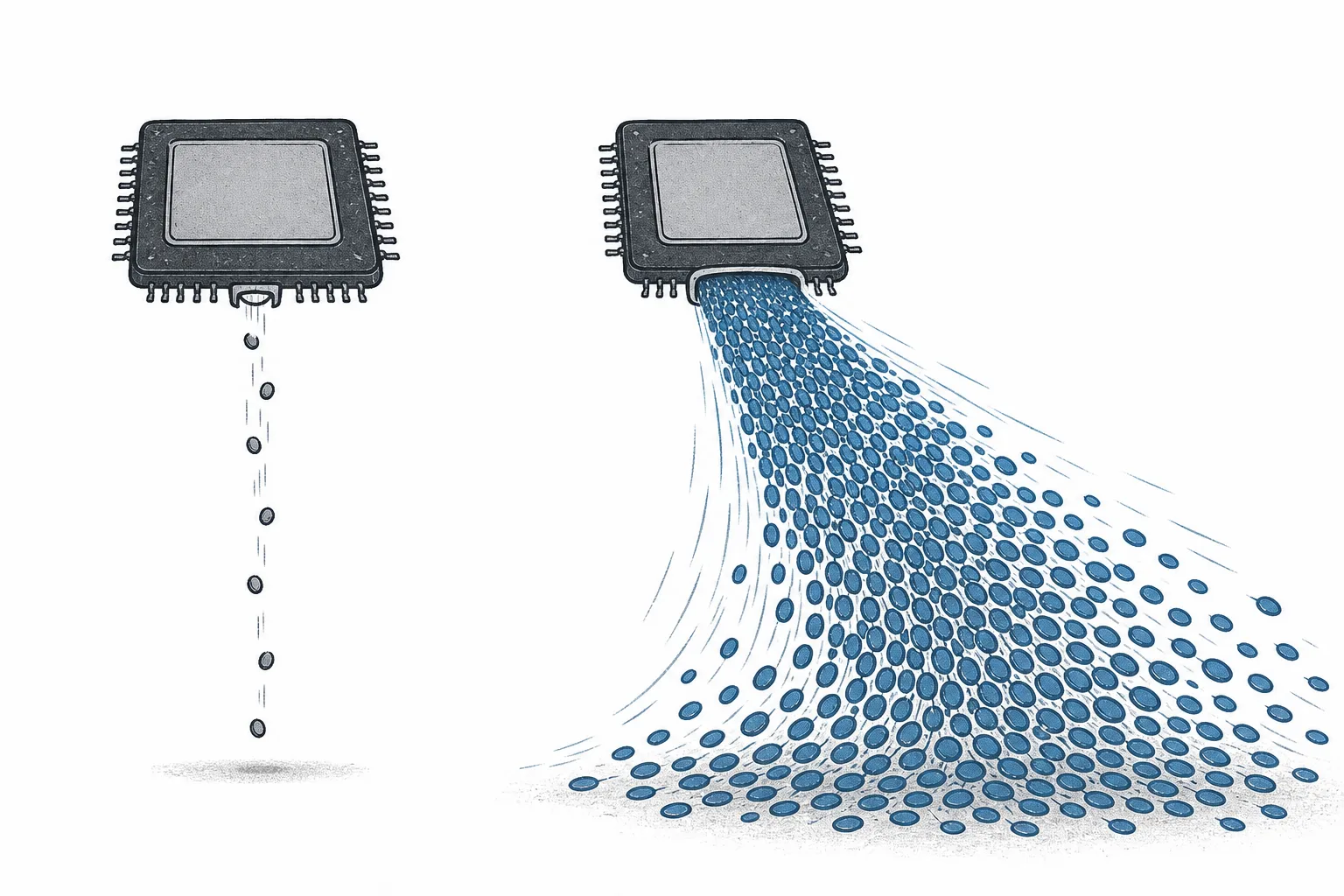
The AI chip the world knows (NVIDIA's GPU) is built to be great at "training" a model. But training happens only a few times. Running the model to actually answer real questions (inference) happens every second, millions and billions of times. Once the volume of running dwarfs training, the cost per answer (cost per token) and the speed (tokens per second) become the new battleground — and that opens the door to a new breed of chip that does "only the running," faster and cheaper than a general GPU. This lesson introduces Groq, Cerebras, d-Matrix, and the reason most of the real players are still private companies.

01What it is — a chip made to "run," not to "train"
Picture building a dictionary. Writing and editing the dictionary takes years and a huge team — but you do it only once. After that, what happens every day is people looking up words, millions of times. The world of AI is exactly the same. "Training" a model is writing the dictionary; "running" it (inference) is looking up a word — and this node is about the chips designed specifically for "looking up words," not for writing.
On the megatrend map, this node is a leaf under AI Compute & Accelerator Silicon, inside the larger trend Artificial Intelligence. Its definition is straightforward: "an architecture designed for low-latency, high-throughput model execution." In plain language — a chip that makes AI answer fast and answer well at the lowest possible cost per answer.
Why does this job need its own chip? Because "running" and "training" are two different jobs. Training has to compute backward and adjust trillions of weights — it needs flexibility and enormous raw power. Running is a one-way forward computation, repeating the same thing, predictable — and a job where you "know in advance what you'll do" can be handled by a purpose-built chip far faster and more power-efficiently than a general-purpose one. That's why new breeds of chip like Groq's LPU or Cerebras's wafer-scale machines came to be.
Training = teaching a model with massive data; happens once / rarely · Inference (running) = taking the trained model and answering real questions; happens all the time · Token = the small unit of text (roughly a word or word-piece) the model produces one piece at a time; one paragraph of an answer can be hundreds of tokens · Latency = the wait before you get an answer — the lower it is, the more "instant" it feels
02Why it matters — when "running" gets bigger than "training"
What changes everything is that the share of compute is flipping. In 2023, training a model ate about two-thirds of compute and running took just one-third. But once AI left the lab and reached real use by millions, everything inverted — by 2025 running rose to about half, and by 2026 it's expected to reach two-thirds of all AI compute. Many shops see running eating 70–80% by 2028–2030.
Once running becomes the big chunk, the market for chips that do this work balloons too. Different shops size the inference-chip market differently depending on what they count, but the direction agrees: Deloitte sees chips designed for inference alone breaking $50 billion in 2026, while the broad inference-chip market runs around $105 billion in 2025, with many shops seeing it grow to $300–570 billion in the early 2030s at roughly 25–28% a year.
More important than the size is that its economics are completely different from training. With training, you pay a lot once to get a good model. But with running, you pay again every time someone asks. So if you can cut the cost per answer even a little, multiplied by a billion times it becomes enormous money — and that's the entire reason this chip group exists: not to be good at everything, but to do one job fastest and cheapest per token.
03How it works — train once, then run without end
The heart of this node is the asymmetry between training and running. Let's trace the life of a single model to see why "running" becomes the big cost that decides everything.
So how do inference chips make it faster? The key is memory. When you run a model, the multiplier isn't the bottleneck — it's moving the model's weights out of memory and into the chip that's slow. A typical GPU keeps the weights in HBM memory that sits "off-chip," sending data at roughly 8 TB/s, while Groq chose to keep the weights right on the chip in SRAM, which runs at 80 TB/s and up — more than ten times faster. The result: the chip doesn't have to wait for data, so it fires out tokens far more rapidly.
HBM = high-bandwidth memory placed beside the chip; holds a lot but is slower to reach (see HBM & AI Memory) · SRAM = memory embedded right on the chip; very fast but holds little — some inference chips trade capacity for speed · Deterministic execution = scheduling every operation in advance, clock cycle by clock cycle, at compile time, so there's no random "stutter" — Groq uses this to squeeze out maximum speed and certainty
04How it differs from GPU and ASIC — and what it connects to
This node has siblings in the same family you need to tell apart, because they can all "run" a model — but their philosophies differ:
- Versus GPU & Merchant Accelerators: a GPU is a general-purpose chip that can both train and run. Its strength is flexibility and the software (CUDA) the world's developers know. But that flexibility carries overhead you don't need when running — a specialized inference chip cuts that overhead away in exchange for better speed/price per token on pure running
- Versus Custom Silicon / ASIC: the line is very thin — a specialized inference chip is itself a kind of ASIC. The difference is "who builds it and for what." Node 10010200 centers on ASICs the tech giants build themselves to use in their own cloud (like Google's TPU), while this node centers on inference chips that independent chip companies build to sell or serve to everyone (Groq, Cerebras, d-Matrix)
- Relies on HBM & AI Memory and Foundry & Contract Fabrication: whether they pick SRAM or HBM, these chips still have to be built with the most advanced process and advanced packaging, just like every other AI chip
Looking beyond the chip family, this node is the "engine" that ignites other trends:
- Powers Agentic AI directly: an AI agent that works in steps calls the model many times per task — each call is a new run. The more agents spread, the more inference demand multiplies. These are the customers hungriest for speed and the lowest cost
- A partner to Semiconductors (Logic): an inference chip is a logic chip designed specifically for AI work — view this node through the "AI-demand lens," while Logic looks through the lens of the whole industry's chip-manufacturing technology. Two views of the same thing
- Draws power from Energy Transition & Power Demand and relies on Cloud & Digital Infrastructure: running that happens every second draws power continuously (unlike training, which finishes in rounds), so efficiency per watt is the main selling point of this chip group. And it "enables" both Robotics and Biotech, which need AI to answer fast
05Where it stands now
This field is hot right now, with two layers of wonder. The first layer is speed numbers that tear up the chart. Specialized chips run an LLM literally orders of magnitude faster than a single GPU — Groq does about 300–750 tokens per second versus a typical GPU's roughly 100, while Cerebras on a wafer-scale machine does over 2,500 tokens per second per user on a large Llama model. And d-Matrix claims its platform runs faster, costs less, and uses several times less power than a GPU system.
The second layer is that most of the real players are still private companies — Groq, SambaNova, and d-Matrix aren't yet listed on the stock market, so retail investors can't buy them directly. d-Matrix just raised $275 million in a Series C at the end of 2025 at a $2 billion valuation, while Cerebras, the wafer-scale pioneer, is among the first in the group to step into the stock market, with 2025 revenue of about $510 million, up 76%, backed by a compute-purchase contract worth over $20 billion from OpenAI.
On the other side, incumbents like NVIDIA and AMD aren't just standing by. Both have shipped chips/versions tuned specifically for inference — NVIDIA unveiled the Rubin CPX, designed for large long-context runs (expected late 2026), while AMD pushes its Instinct family (MI350/MI400) as the cost-per-compute option and landed OpenAI as a strategic partner. So the inference field isn't just "startups vs. giants" — it's a competition along the axes of speed–cost–flexibility that everyone has joined.
06The future — the era of models that "think a lot"
The biggest tailwind for this node is reasoning models. The new generation of models doesn't answer right away — it "thinks to itself" in steps before answering, and that internal thinking is the production of a huge number of tokens the user never sees. The result: a single question can eat 5–10 times the compute in the running stage of a previous-generation model (and heavy jobs can hit 70–100 times in energy terms). So inference demand grows not just with the number of users, but with the surging "tokens per question" too.
What looks contradictory but actually reinforces it is that the price per token is dropping very fast. The cost of running a GPT-3.5-class model fell more than 280-fold from late 2022 to late 2024 — but the cheaper it gets, the more people use it and the more the models think, so total usage grows faster than the price falls. This is the "AI cost paradox" that keeps AI companies' compute bills ballooning even as the unit price drops — and the reason everyone is chasing the chip that runs cheapest.
The second direction is that running will spread out. Not every job has to run in a giant data center — some inference is starting to shift closer to the user (see Edge & On-device AI Silicon) for low latency and privacy, opening room for especially power-efficient architectures to play where the big GPU can't reach.

07Challenges & risks
The first risk is that the incumbents have come down into the running field too. Many people think inference is NVIDIA's "weak spot," but the truth is NVIDIA already holds most of the inference work and ships specially tuned chips (like the Rubin CPX) to defend its turf, while AMD chases with an attractive total cost — so an inference startup has to be fast and cheap enough to be worth "leaving the familiar software ecosystem," a wall that's harder to cross than the speed numbers on a slide.
The second risk is that most of the standout players are still private companies. Groq, SambaNova, and d-Matrix aren't on the stock market, so ordinary investors find it hard to reach them directly. And as young companies still burning cash to build a customer base, their road to profit is still to be proven — some may be acquired, some may not survive. This is a field where "great technology" doesn't guarantee "the business survives."
The third risk is dependence on a handful of customers, and the question of cycles. The big demand for inference chips comes from a few AI companies and cloud giants that pour in capital all at once (like the giant contract between Cerebras and OpenAI). If returns from AI come slower than expected or investment slows, demand that looks bottomless could shrink fast. And because the customers are concentrated, losing a single big deal can shake the whole company.
In short: this node is the chip born for the job AI does most often — "running" a model to answer real questions billions of times. As running keeps getting bigger and models keep thinking more, whoever can run fastest and cheapest per token will hold one of the key keys to the entire AI economy.