Megatrend · Critical Materials
Before there's a single steel bar, a whole ship of dirt has to be dug up
Every building, every bridge, every car, every power line, and every AI data center starts with three things dug out of the ground by the billions of tons a year — iron ore, bauxite, and coking coal. This is the “very first mile” of steel and aluminum: a quiet, heavy, boring business, yet so huge that iron ore is one of the most-shipped commodities on Earth, second only to crude oil — and it's controlled by just a handful of companies selling to essentially one customer: China.
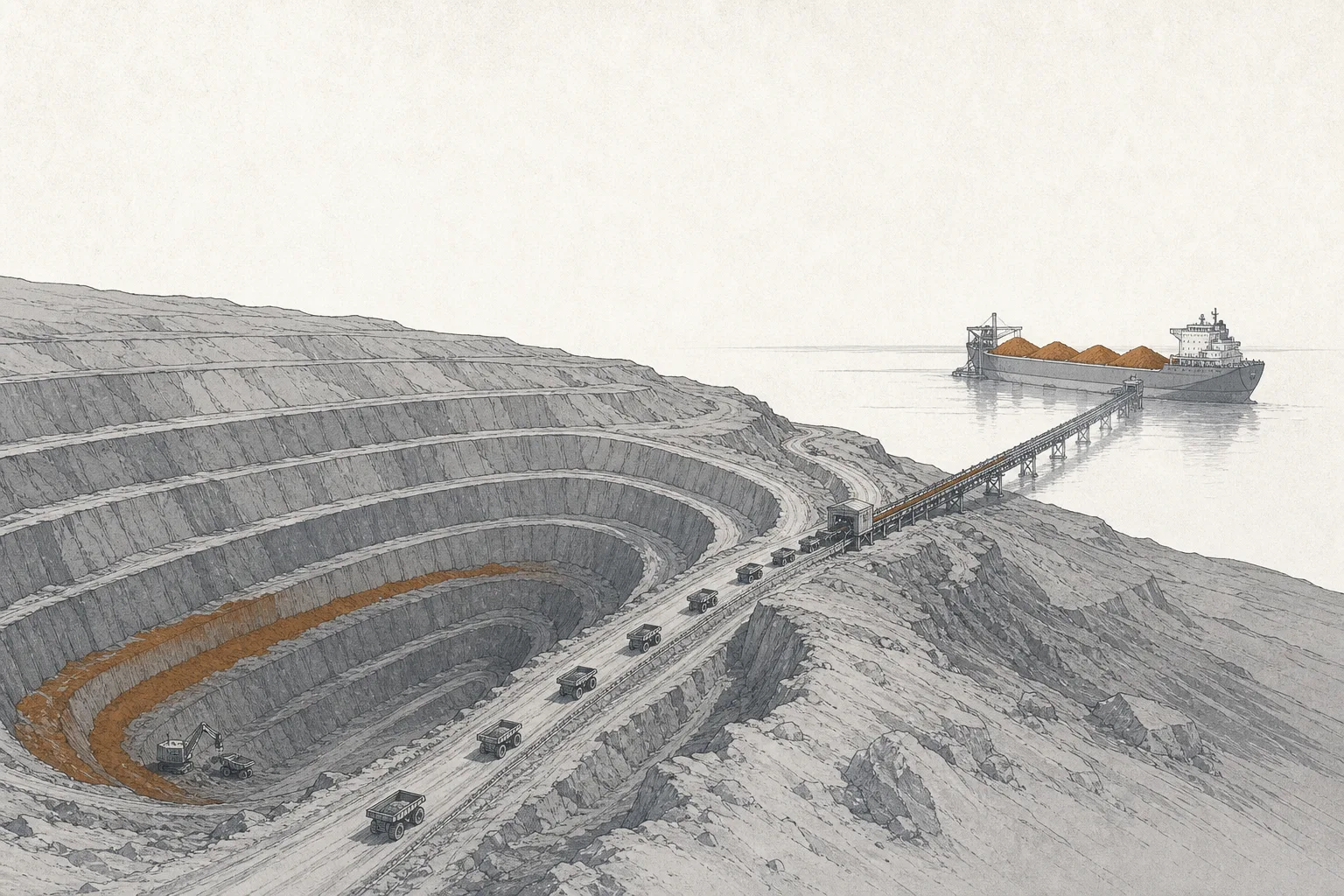
01What it is
Picture a steel bar or an aluminum can. It looks clean, smooth, a finished metal — but trace it all the way back and it starts as ugly-colored dirt and rock dug from a giant pit in the Australian desert or a rainforest in Guinea. This node is the business of the “feedstock” for structural metals — the people who dig the raw stuff out first, before anyone else in the chain.
There are three main raw materials, each feeding a different metal:
Iron ore = rock with a high iron content, the main raw material for “steel” · Bauxite = red earth containing aluminum oxide, which must be refined into a white powder called “alumina” before it can be smelted into aluminum · Coking coal / metallurgical coal = a special grade of coal used as both “fuel and reactant” in ironmaking — a different thing from the coal used to generate electricity
On our megatrend map, this step is the “furthest-upstream” sub-branch of Bulk & Structural Metals, under the Critical Materials & Supply Chain megatrend — it's the first gate before the raw stuff flows into Primary Steel & Aluminum Smelting to become metal, then on to Structural Products & Fabrication. And there's a parallel path — Metal Recycling & Scrap — that feeds electric furnaces without digging new dirt. If this upstream stumbles, the whole chain stumbles with it.
The thing to grasp from the start is that these materials aren't rare in the “rare-earth” sense — the world has plenty of iron ore and bauxite. So their story isn't “will there be enough,” the way it is for copper or lithium. It's about “who can dig it cheapest, ship it closest to the customer, and control the ports and railways” — because the raw material is cheap but heavy and enormous in volume, so the real cost is “moving mountains,” not the ore itself.
02Why something so boring is so enormous
The clearest picture is the sheer scale. In 2025 the world produced about 1,850 million tons of crude steel, with China alone making around 961 million tons (~52% of the world). And nearly every ton of steel starts as iron ore, so the world consumes about 2,200 million tons of iron ore a year — more by weight than almost everything else humans dig up or grow combined, except rock, sand, and oil.
It matters not just because it's “big” but because it's the invisible skeleton of almost every other megatrend. Every time you hear about a new AI data center, a power grid that needs expanding, a factory reshoring, or more EVs rolling off the line — under that news there's always a big order for steel and aluminum, and under that steel and aluminum, iron ore and bauxite that had to be dug up first.
Another thing that makes this business fascinating is its brutally good margins. A company that owns a good-grade deposit near a port can dig iron ore for under $20 a ton but sell it for around $100 — and that enormous spread is why a few iron ore miners earn tens of billions of dollars a year, even selling something that looks like “nothing.”
But there are two sides to the coin. 2025 was a year of softening iron ore prices, as China built less property and its steel demand shrank. The 62% iron ore price averaged around $100 a ton, dragging mining giant BHP's full-year profit down 26% to about $10,160 million — its lowest in five years. This is the nature of a commodity: profits swing with prices, and prices swing with China.
03The secret recipes of steel and aluminum (how it works)
Why dig up three different things? Because steel and aluminum follow different “cooking recipes,” and understanding these recipes explains almost everything about this business — why coking coal matters, why ore grade is valuable, and why aluminum is nicknamed “solidified electricity.”
On the steel side, the traditional recipe takes iron ore (which is really “rust” — iron bound to oxygen) and “pulls the oxygen out” in a giant blast furnace hotter than 1,500°C, using coking coal as both fuel and the oxygen-remover, with limestone added to separate impurities. Roughly, it takes about 1.5 tons of iron ore + about 0.6 tons of coking coal to make 1 ton of crude iron. That's why coking coal is a “feedstock,” not just fuel — without it, you can't smelt iron this way.
The aluminum side is longer and far more power-hungry. You first refine ~4–5 tons of bauxite into ~2 tons of alumina powder, then use a huge amount of electricity to “shock” the aluminum apart from its oxygen, until you get 1 ton of metal — a smelting process so power-hungry that people in the industry call aluminum “solidified electricity,” or electricity that has hardened.
This recipe explains two big things. One — “ore grade” is very valuable: if iron ore has a high iron content (say 65%+), the furnace uses less coking coal and energy, emits less carbon, and earns better margins. Two — coking coal is the carbon weak spot: because it's coal, traditional ironmaking emits enormous CO₂, and it's why the world is looking for ways to “stop using coking coal” — which will reshape iron ore demand forever (we'll dig into that in chapter 6).
04Few sellers, one buyer
If you had to understand this business in one sentence, it's “a market with only a few sellers and essentially one buyer” — a structure you barely see in any other commodity.
On the seller side, seaborne iron ore is dominated by just four giants — Vale (Brazil), Rio Tinto and BHP (Australia), and Fortescue (Australia). In 2025 these four together produced over 1,150 million tons, roughly two-thirds of all the iron ore traded worldwide. They control their own mines, railways, and ports, building a “moat” that new rivals can barely cross — you have to invest billions in infrastructure before you can sell your first ton.
The buyer side is even more concentrated: China absorbs about 75% of all seaborne iron ore — three out of every four tons crossing the ocean head to China, because it makes half the world's steel but doesn't have enough ore of its own, and what it has is low-grade. That relationship is a double-edged sword: the miners are rich because of China, but fragile because of China too. If China's economy stumbles, ore prices worldwide fall with it.
On the bauxite side it's even more extreme: a single country, Guinea in West Africa, has risen to control over 70% of all traded bauxite — and China is again the biggest buyer (importing over 70% of the world's bauxite). So iron ore and bauxite tell the same story: the material is concentrated in a few hands, and it all flows to the same place — China's smelters.
This node differs from its siblings in Bulk & Structural Metals in that it's the “furthest upstream” — while siblings like smelting and fabrication tell a story of tariffs and reshoring, this upstream tells a story of geography and control of shipping routes. Whoever holds good-grade deposits near the sea holds the strongest hand of anyone in the chain.
05Where it stands now + the players
The 2025 picture has three storylines running at once. First — soft prices as China slows. China's steel demand shrank with its property crisis, so in 2025 China imported less iron ore for the first time since 2022, down to about 1,192 million tons. Iron ore prices held around $100 a ton, below prior years, squeezing every miner's profit.
Second — Guinea's bauxite boom overflows. In 2025 Guinea exported a record ~183 million tons of bauxite, up 25% in a single year, until the glut pushed bauxite prices down — and Guinea's government began talking about export controls to prop up prices and force alumina refineries to be built domestically. This is the geopolitical risk hidden in the red dirt.
Third — a giant new mine just opened its eyes. In late 2025 the Simandou project in Guinea — the largest untapped high-grade iron ore deposit in the world — started production and shipped its first cargo. It will gradually ramp to 60 million tons a year over the next two and a half years, adding a huge block of high-grade ore into a market that's tightening on grade — an event that will shake the balance of the whole industry.
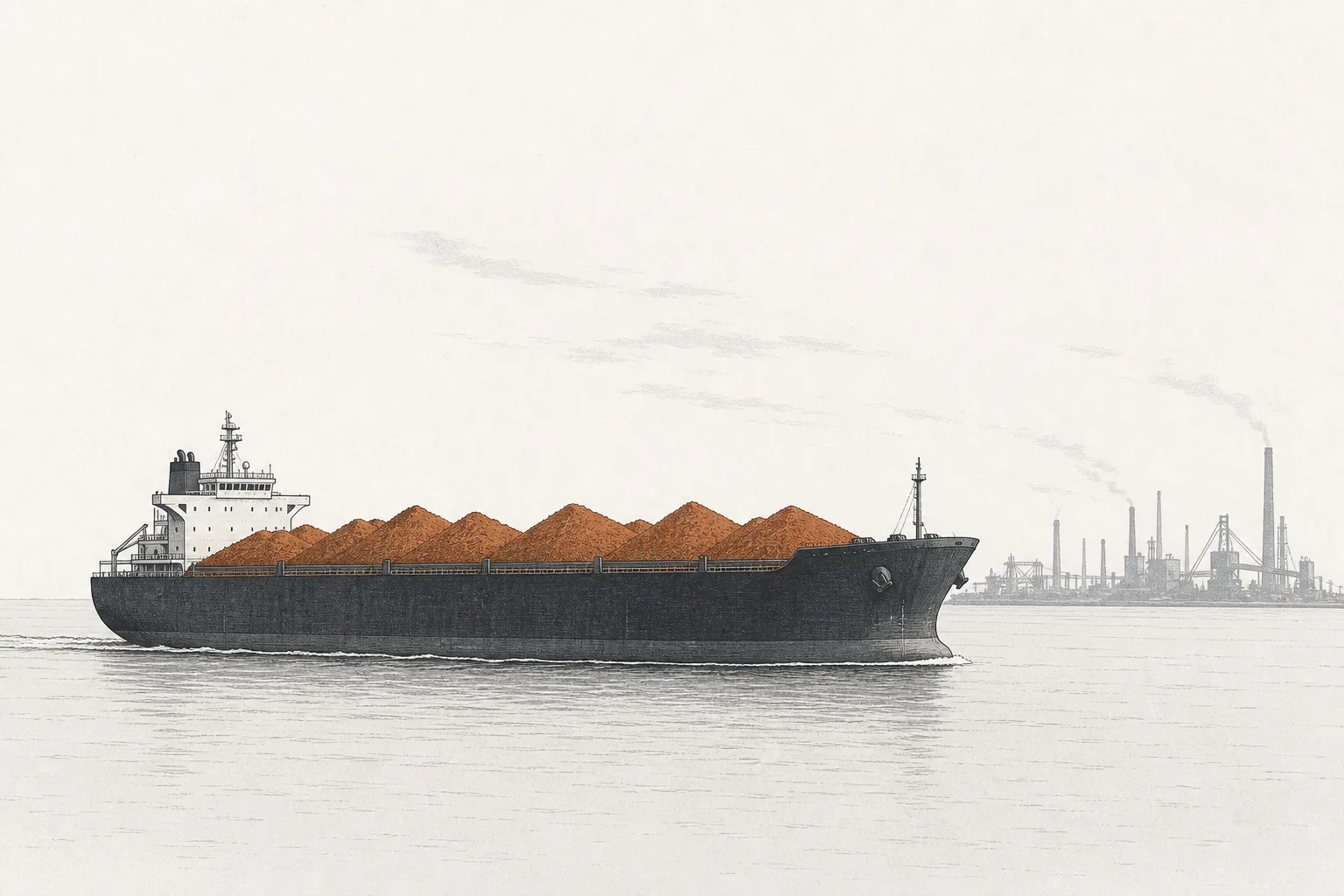
The real players here range from integrated giants that mine many metals, to pure-plays that bet the whole company on iron ore alone, plus the “bauxite–alumina” players that feed the aluminum chain.
06The future: the war over high-grade ore
The future of this business isn't about “digging more,” but about “digging cleaner” — and the word to remember is DRI.
DRI (Direct Reduced Iron) = a new ironmaking method that uses natural gas or green hydrogen to pull oxygen out of iron ore, instead of burning coking coal — so it emits far less carbon. It's the heart of “green steel,” but it has a harsh condition: it only works with extra-high-grade iron ore (usually pellets with 67%+ iron and very low impurities).
This is the turning point. Old-style smelting (the coke furnace) can handle medium-grade ore, but DRI can only eat high-grade ore. The problem is that ore high-grade enough for DRI is very scarce in the world, and most mines produce only medium grade. As the whole world rushes to build green-steel plants, demand for “DRI-grade pellets” is surging so fast it's expected to fall short.
The result: “high-grade ore” is becoming a premium product that sells for more than ordinary ore, and whoever holds high-grade deposits holds the trump card. That's what makes Vale (with its high-grade Carajás ore from Brazil) and Rio Tinto's Simandou project (grade ~65%) especially valuable — they aren't just selling iron ore, they're selling “a ticket into the clean-steel era.”
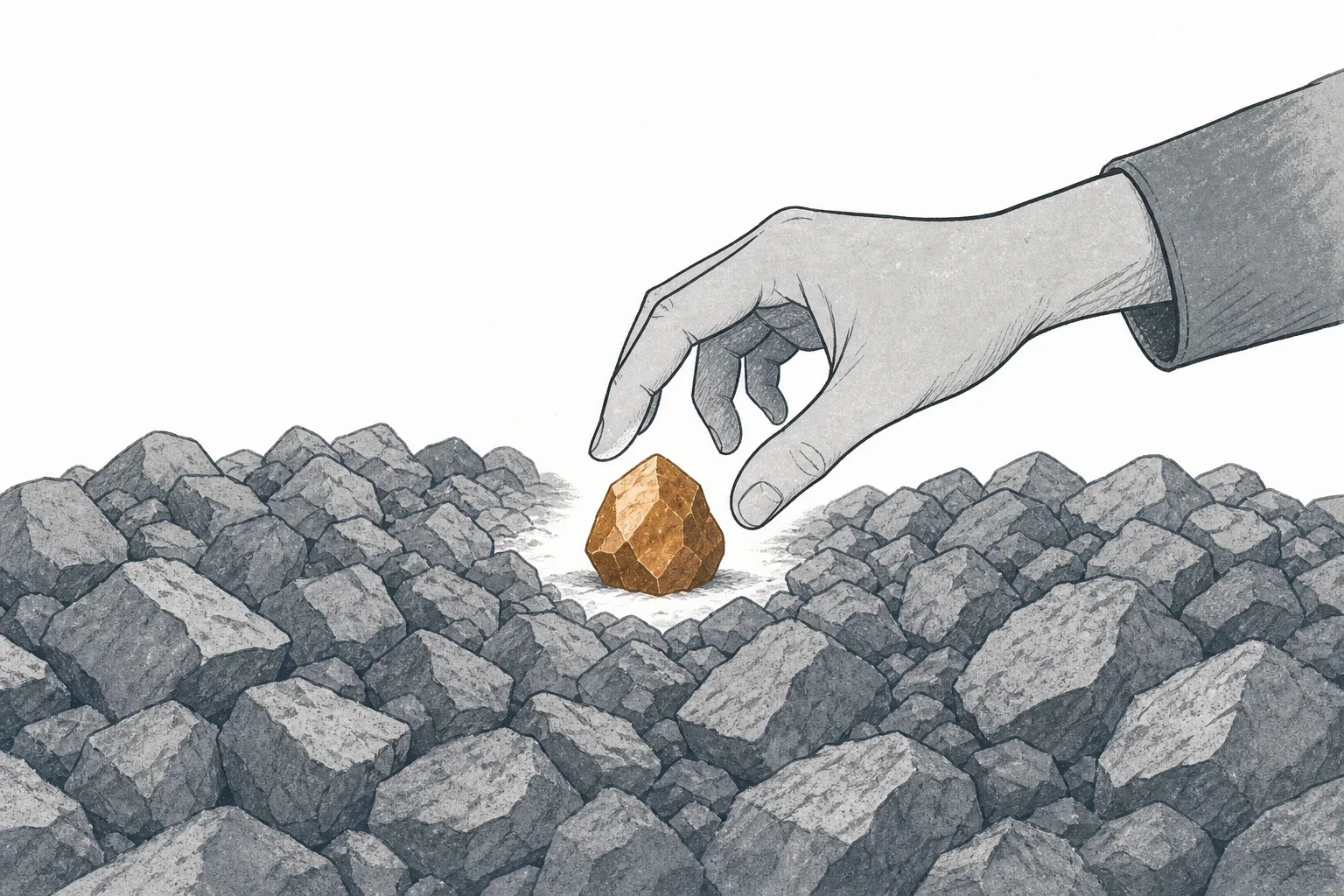
The other side of the future is “peak China.” Many analysts believe China's steel production has already passed its peak and will gradually decline over the next decade as population and construction slow. If true, total world iron ore demand could grow more slowly or plateau — making the “grade war” (who has cleaner ore) matter more and more than the “volume war” (who can dig the most).
07Challenges & risks
Too tightly bound to China's fate. When 75% of the buying is one country, everything hinges on the health of China's economy. China's drawn-out property crisis has pressured steel demand and ore prices for years, and if China's steel production really has peaked, long-term demand may never return to the strong growth of the past two decades — the biggest structural risk facing the whole industry.
Brutally cyclical prices. Iron ore, bauxite, and coking coal are true commodities, with prices that swing hard through economic cycles. 2025 showed it clearly: BHP's profit fell 26% just because iron ore prices dropped about 19%. Mines require huge, long-lived investment, but revenue is tied to a price that can swing every quarter.
Geographic concentration risk. Over 70% of bauxite comes from Guinea alone — a country with high political risk that has just floated export controls — while Australian iron ore faces cyclones that periodically disrupt shipments. When supply is concentrated in a few points, a single event — a coup, a storm, or a concession dispute — can shake prices worldwide.
The decarbonization wave threatens coking coal. Traditional ironmaking emits roughly 7–9% of all global carbon, so the pressure to stop using coking coal keeps building. Over the long run, coking-coal demand is likely to fall as the world shifts to DRI/hydrogen, and medium- to low-grade ore that can't be used in DRI may get harder to sell — “something that used to sell every ton” could become “something where you have to pick the grade.”
In short: iron ore, bauxite, and coking coal are the most boring items on the investment periodic table — but they're the first mile of everything the world builds. As long as humans keep building towers, cars, power grids, and data centers, these three will keep being dug up onto ships by the billions of tons. What's changing isn't “will there be enough,” but “who has the right grade, in an era where the world is starting to pick its ore.”