Megatrend · Critical Materials
A steel billet and an aluminum ingot can't build anything — until they hit the stage that “shapes” them
The world argues about mines and smelters, but the hot steel bar coming out of the furnace still can't build a tower, string a power line, or stand up a data center. It has to pass one more stage first — the one that takes raw metal and rolls, draws, extrudes, and shapes it into beams, rebar, plate, tube, and aluminum profiles, then routes it through “metal service centers” to the actual job site. This is the most demand-facing downstream stage of the heavy-metal chain — where metal meets its real customers: construction, infrastructure, cars, and the twin waves of reshoring and the massive AI data-center buildout.
01What structural-metal fabrication is
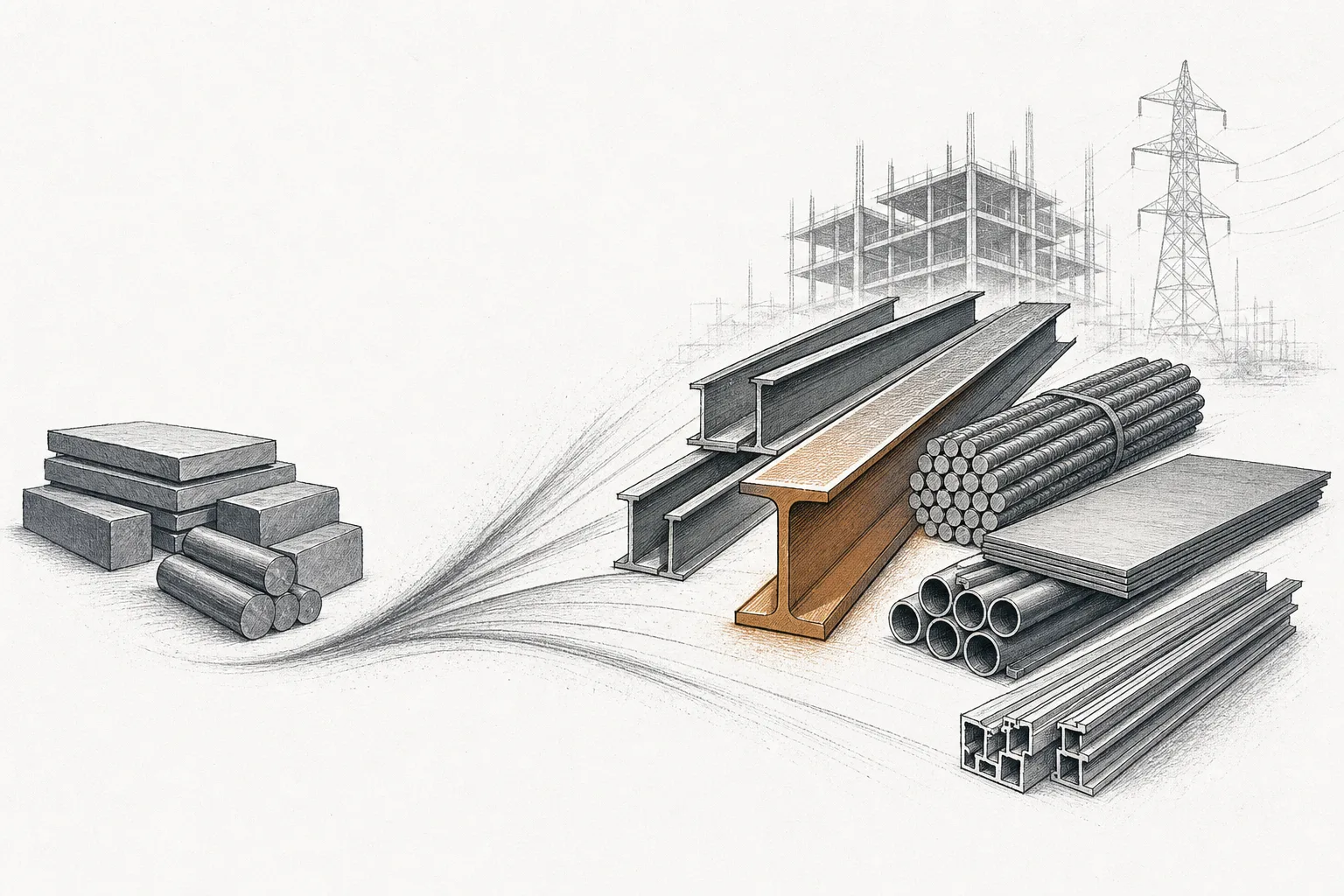
Picture a red-hot steel bar just out of the furnace, or a square aluminum block cast at the smelter — these are semi-finished metals called “slab,” “billet,” or “ingot.” They all look alike and trade as commodities. But here's the thing: nobody builds anything directly out of a raw block of metal. You can't stand a steel billet up as a building column, thread it into a bridge frame, or run it as a water pipe.
The players who turn these plain blocks into “things you can actually build with” are the fabrication and metal-processing businesses — plants that take raw blocks and roll them flat or long, draw them into wire, extrude them into profiles, and cut, bend, and weld them into structural parts. This is the last downstream stage of the heavy-metal chain, right before it becomes the skeleton of everything around us.
Long products = beams, rebar (concrete-reinforcing bar), angles, and rails — mainly the raw material of construction · Flat products = rolled sheet and coil/plate for car bodies, appliances, and machinery · Tube/pipe = steel and stainless pipe for energy, water, and structures · Aluminium extrusion = aluminum pushed through a die into different cross-sections, for window frames, EV bodies, and solar panels.
Of all these, the products that feed “construction” the most are long products — beams and rebar — because in the end the world uses steel mainly to “stand up structures.” So global demand for finished steel splits into roughly half long products, half flat, and about one-tenth tube.
On our megatrend map, this stage is a sub-branch of Bulk & Structural Metals, under the Critical Materials & Supply Chain megatrend — it's the “last gate” metal flows through, after leaving the raw-material sources (Iron Ore, Bauxite & Metallurgical Inputs) and passing through the smelters (Primary Steel & Aluminum Smelting), before becoming parts in real construction.
02Why this stage is the one “closest to the money”
Mines and smelters are an “upstream” story — they sell metal as a commodity block, priced by the global market. But fabrication sits at the very end, right up against the world's real demand. When people say “reshoring and AI will make steel scarce,” the first place that demand slams into is the fabrication plants that have to roll beams and cut plate to fill the orders.
What matters most: almost every end user consumes “processed” products, not raw blocks — and the biggest user is construction, which soaks up roughly half the world's steel (about 38–50%, depending on definition) as beams, rebar, and plate. Every time you see news of “a new chip plant,” “a grid expansion,” or “a giant AI data center,” there's a big order for beams and rebar hidden underneath it.
There's one player people overlook but that matters a lot: the “metal service center” — the middleman that buys metal from the mills in big lots, then cuts, slits, and processes it into the sizes customers need. In North America, these centers together buy around 75 million tons of metal a year, feeding over 300,000 factory and construction customers. They're the “warehouse and cut shop” that connects real demand back to the smelters.
The other side is a structural demand wave taking shape. A major US beam and rebar maker like Nucor has gone as far as calling it a “tsunami of earnings power” from data-center construction. In Q3 2025, steel shipments from Nucor's mills grew 12% to 6.4 million tons, with rebar work hitting a record — and all of it is copper — er, steel — the “processed” kind, not raw slab.
03How it works (from raw block to beam and rebar)
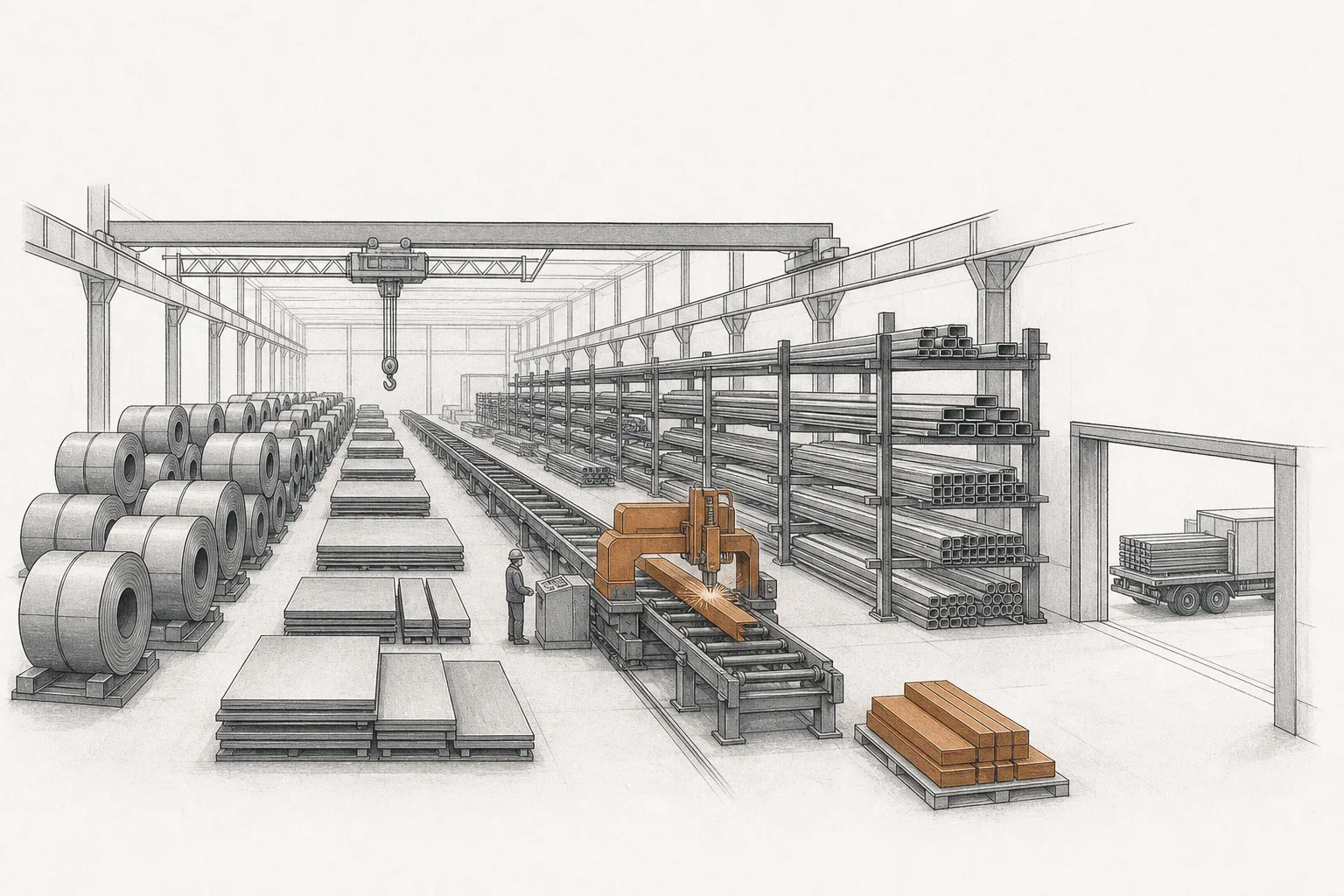
The heart of fabrication is “shaping with force” — taking a big block of metal and making it longer, flatter, or into the cross-section you want. Let's trace how a single slab or billet becomes a beam in a building or rebar in a column.
First comes heating the block, then hot rolling — feeding the slab or billet through pairs of rollers that squeeze it longer and thinner one station at a time, until you get beams, angles, or rebar. Rolling is the heart of all long and flat products. Some of it is then drawn into thinner wire, or extruded — pushing a hot aluminum billet through a “die” cut into a cross-section, like squeezing toothpaste out of a tube, to get I-shapes, T-shapes, or hollow frames on demand.
So a fabrication plant's skill isn't about “having metal” — it's about how precise, how consistent, and how complex a shape it can make. A perfectly straight beam, rebar hardened to spec, or a razor-thin aluminum profile for an EV body — that's where the higher margins over commodity work come from.
04What it connects to
Fabrication is the “final stage” of the heavy-metal chain. Its input is the metal blocks from Primary Steel & Aluminum Smelting (and further back, the ore from Iron Ore, Bauxite & Metallurgical Inputs). There's an important shortcut too — Metal Recycling & Scrap Processing — because good-quality steel and aluminum scrap can be melted straight back down and re-rolled without going through a mine, so many “mini-mill” fabricators run on scrap as their main feed.
But what matters more is the “mouths waiting to be fed” downstream. Because fabrication sits right against demand, it feeds directly into nearly every megatrend of the era: beams and steel frames go to Cloud & Digital Infrastructure and Artificial Intelligence (data-center frames); rebar and plate go to Energy Transition & Power Demand (wind-turbine foundations, transmission towers, substations); aluminum profiles and plate go to Electrification & Mobility (EV bodies and battery boxes); and specialty steel and processed titanium go to Defense & Geopolitical Fragmentation and Robotics & Physical AI.
05Where it stands now
The big picture of this arena in 2025–2026 has two things you need to know. First, North America has built the “mini-mill + service center” model into real strength. Unlike the old giant mills that smelt from ore, the new American producers use electric arc furnaces (EAF) to melt scrap and roll it into beams and rebar in the same plant — nimbler, lower-carbon, and sited close to customers. Today ~67% of US steel is made with EAF, versus a world average of only about 33% — and it's exactly this model that makes Nucor and Steel Dynamics the home-market kings of beams and rebar.
Second, processed aluminum is growing structurally — but China dominates it. The global aluminum-extrusion market is worth around $119 billion in 2025 and is expected to grow to about $167 billion in 2030 (CAGR ~7%), driven by EVs, solar panels, and buildings. But China takes roughly 65% of world extrusion demand — making aluminum processing another arena the West wants to win back.
In this arena, the real players split into three groups: America's mini-mill structural-steel makers, riding reshoring and data centers; service centers and metal distributors, sitting closest to the customer; and specialty aluminum and tube processors, selling properties, not just volume.
06The road ahead
Three forces will shape this business. First — the “construction super-cycle.” If factory reshoring, grid expansion, and the AI data-center boom keep going as planned, demand for beams, rebar, and plate in the West will stay strong for years. So mini-mill producers are racing to add capacity — like Nucor, which opened a new rebar micro-mill with 430,000 tons of capacity to grab this demand ahead of everyone.
Second — the West wants to reclaim strategic fabrication. Realizing that aluminum profiles, specialty tube, and processing capacity are concentrated in China, the US, Europe, and Korea are starting to back home-country fabricators — both with Section 232 tariff walls at 50% and by siting production close to their own EV, grid, and construction demand — because “home-made beams and rebar” has become a matter of security, not just a commodity.
Third — “shape it more precisely, at lower carbon” is the technology battleground. Fabrication is climbing from “commodity” work into high-value work: prefabricated structural steel that ships ready-assembled from the plant, cutting on-site time; low-carbon aluminum profiles for the grid and EVs; and specialty-grade stainless tube for energy. Whoever can shape more precisely and more cleanly earns the higher margin — work that used to be a “commodity” is steadily becoming a technology business.
07Challenges & risks
Margins as thin as rolled plate. Basic fabrication like beams and rebar is a volume game, with razor-thin profit per ton. The conversion margin (fabrication fee) is under constant pressure from overcapacity, so plants that make only commodity work with no special properties get hurt easily when demand softens — in 2025, sales in Steel Dynamics' own steel-fabrication segment fell 20% as prices eased.
The cycle never goes away. This is a business where profits swing hard with the economic cycle: when construction booms, profits pour in; when it slows, they sell near cost. The reshoring story gives demand more of a “floor,” but it doesn't erase the cycle. You can see the warning sign on the aluminum side — from late 2025 into early 2026, Norsk Hydro, the world's largest aluminum extruder, had to idle European plants one by one on weak demand.
Raw-material and energy costs swing hard. Raw metal is the main cost, and volatile prices squeeze the liquidity of plants that carry heavy raw-material inventory. Extrusion and hot rolling also devour electricity, so when power prices spike — which is happening as data centers compete for electricity — fabricators' costs spike too. It becomes a paradox: the very thing creating the demand (AI/data centers) also drives up the producers' own energy costs.
Chinese oversupply and reliance on tariffs. As long as China controls roughly two-thirds of the world's aluminum-processing capacity and exports its surplus to push prices down, Western fabricators have to lean on tariff walls as armor. So most of the fat margins are tied to political decisions, not a permanent structural advantage. Change the government or ease the tariffs, and the profit equation can shift fast — and that's both the appeal and the fragility of this “downstream” stage that looks ordinary but turns out to be another battleground of the transition era.