Megatrend · Critical Materials
The whole world is forged from a handful of furnaces — and those furnaces emit more carbon than anything else on Earth
Buildings, bridges, cars, power grids, data centers — almost everything starts with two things: steel smelted from ore in a furnace, and aluminum “pulled apart with electricity.” Each year the world makes nearly 1,900 million tons of steel and about 72 million tons of aluminum — but this “smelting” step alone emits about 8% of all global carbon and uses more electricity than many countries combined. This lesson walks through how civilization's most basic metals are actually made, why China controls over half the world's smelting, and why “changing the furnace” is becoming the biggest battlefield in heavy industry.
01What primary smelting and refining is
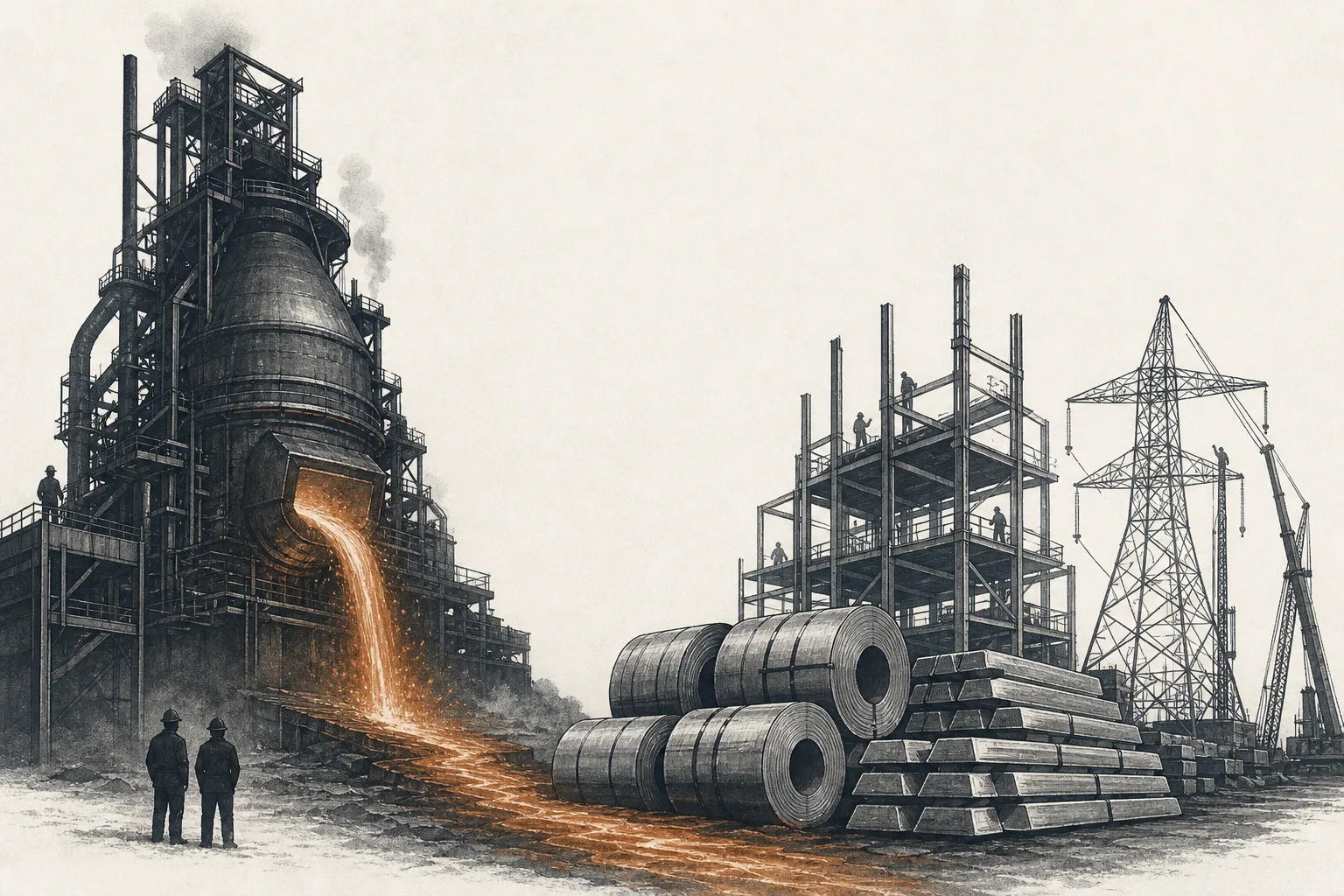
Look around you — buildings, lampposts, car bodies, machine frames, soda cans, airplane wings — almost every piece is made of two metals that are cheap, strong, and produced by the billions of tons: steel and aluminum. But neither springs from the ground as ready-to-use metal — they hide in rock as “oxides” that take enormous energy to strip the oxygen from before you get real metal.
The people who do this are the primary metal producers — the steel mills and aluminum smelters that turn “ore or scrap” into “crude steel” and “primary aluminum” that factories worldwide can actually roll, cut, and shape. This is the upstream-midstream stage that is the heaviest, most capital-intensive, and highest-carbon in the whole structural-metals chain.
Smelting = using heat or electricity to pull oxygen out of ore, leaving pure metal · Crude steel = the steel you get straight from melting, before it's rolled into sheet/bar · Primary = made from fresh ore, extremely energy-intensive · Secondary = melted from recycled scrap, using several times less energy
On our megatrend map, this step is the heart of Bulk & Structural Metals, under the Critical Materials & Supply Chain megatrend — it takes raw material from the upstream gate (Iron Ore, Bauxite & Metallurgical Inputs) and passes crude metal on to the downstream gate (Structural Products & Fabrication) to be shaped into finished pieces.
02Why it's the bedrock of every megatrend
The first number says it all: each year the world makes nearly 1,900 million tons of crude steel and about 72 million tons of primary aluminum. No other human-made material is produced anywhere near these volumes — all the world's plastic combined is less than half the tonnage of steel. A ton of steel costs only a few hundred dollars, but because it's the “skeleton” of everything, the sheer volume makes it a multi-trillion-dollar industry.
But what people miss is how shockingly concentrated production is in China. China has about 18% of the world's population, yet it smelts around 54% of the world's steel and about 58% of its aluminum. Put simply, more than half of the “solid stuff” that holds up modern civilization comes out of furnaces in a single country.
Why does this matter more and more? Because demand is being lit by every megatrend of the era at once — AI and data centers need vast steel frames and power systems, the energy transition needs aluminum towers and cables, EVs use 60–80 kg more aluminum per car than gas cars, and defense needs special steels that can be made at home. Every path runs back to one question: “who smelts the metal for us?”
03How it works (steel furnace vs aluminum electric cell)
These two metals are made with different physics, and that difference decides “who emits how much carbon.” Start with steel. It has two “routes” to choose from, and those two routes are the heart of the entire carbon war.
The old route is the blast furnace + basic oxygen furnace (BF-BOF): you burn iron ore with “coking coal” (baked coal) in a giant blast furnace. The coal pulls the oxygen out of the ore, but it turns into CO₂ and floats away — this route emits about 1,850–2,000 kg per ton of steel. The new route is the electric arc furnace (EAF): you remelt “scrap steel” with pure electricity, no coal to burn, at several times lower carbon. The key point: today the world still makes 73% of its steel via the coal route — the source of that 8% of global CO₂.
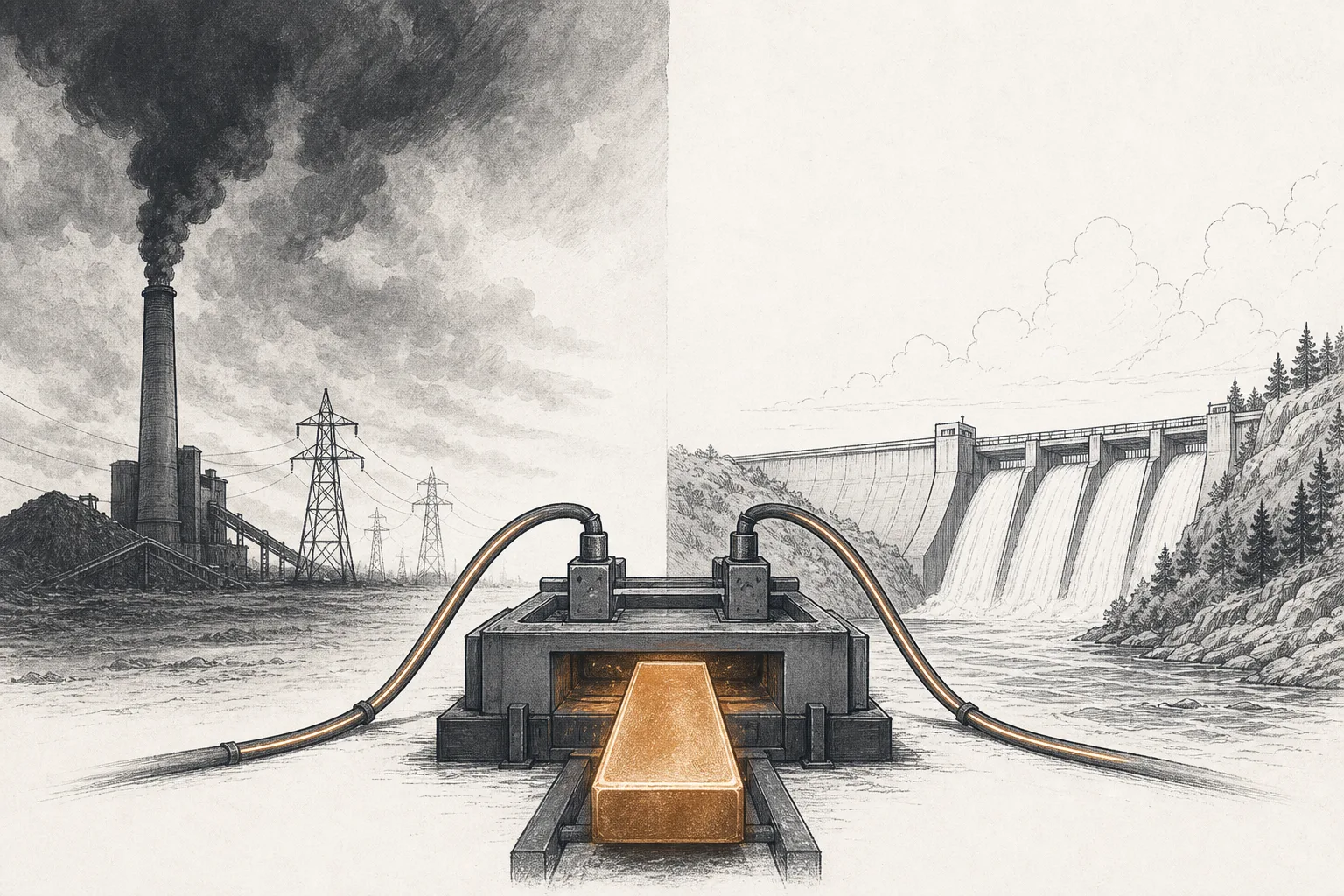
Aluminum plays a different game — it isn't “smelted with heat” but “separated with electricity” through a process called Hall-Héroult. You dissolve alumina powder (Al₂O₃ extracted from bauxite) in a molten salt bath (cryolite) at around 960°C, then run a powerful electric current through it; the current splits pure aluminum out to sink to the bottom of the cell. The catch is that it guzzles power — about 13–14 megawatt-hours per ton of metal. The whole world uses over 900 TWh a year smelting aluminum, more than all of Germany uses in a year — which is why the industry calls aluminum “solidified electricity.”
Here's the secret that follows: because aluminum is solidified electricity, its carbon depends entirely on the “plug.” Aluminum smelted with hydropower emits about 10 tons per ton, but smelted with coal power (as most of China does) it jumps to about 30 tons per ton — the exact same metal, but a carbon footprint 3× different.
04What it connects to
Primary smelting is the “middle” of the structural-metals chain, so it connects to every stage around it. Upstream is Iron Ore, Bauxite & Metallurgical Inputs, which feeds it iron ore, bauxite, and alumina; downstream is Structural Products & Fabrication, which takes the crude metal and rolls it into sheet, bar, tube, and structures.
But what's growing in importance is the “shortcut” running in parallel — Metal Recycling & Scrap Processing — because remelting scrap steel/aluminum uses far less energy than making it from ore (recycled aluminum uses only ~5% of the power of making it from bauxite). Scrap is a “low-carbon feedstock” fed straight into electric arc furnaces, and whoever has plenty of scrap has an edge on both cost and carbon.
More important still are the “mouths waiting to be fed” downstream. These crude metals are the bedrock of almost every megatrend of the era — they go into Energy Transition & Power Demand (towers, wind turbines, substation frames), into Electrification & Mobility (EV bodies and motors), into AI and Cloud & Digital Infrastructure (the steel frames and power systems of data centers), and into Defense & Geopolitical Fragmentation (special steels for armaments). Put simply: if the furnaces stall, these megatrends stall too.
05Where it stands now
The 2025–2026 picture has two clearly opposite sides. The first is a global glut: China's own steel demand shrank in its property crisis, so China pushed record amounts of surplus steel out as exports. The OECD estimates world overcapacity will jump from about 640 million tons in 2025 to 745 million tons by 2028 — cheap steel flooding out and pressing prices down worldwide. On the aluminum side, China hit the capacity ceiling the state set at 45 million tons/year (set back in 2017), producing 45.02 million tons in 2025 — right at the cap.
The second side is tariff walls. In June 2025 the US raised its Section 232 steel and aluminum import tariffs to 50% (except the UK at 25%). Tariffs this high almost shut the door on imports, handing US producers a “home market” where they can price and profit far better. This is the trend's “double-edged sword”: in America, metal is expensive and margins are fat because of the tariff walls, but the same walls push the glut harder into other markets, hammering their prices.
So the real players split into several camps. On the steel side, the biggest is China Baowu (Chinese state), which made about 131 million tons in 2024 — more than all of Japan combined. Next is ArcelorMittal (~69 million tons), followed by Ansteel and Nippon Steel. On the aluminum side China dominates too, led by China Hongqiao (the world's largest aluminum producer, ~6.5 million tons) and Chalco, while the West differentiates on “low carbon” and “made at home.”
06The future: green steel and clean aluminum
Because smelting is ~8% of global carbon, the pressure to “change the furnace” has become the industry's biggest story. The hottest fix on the steel side is “H₂-DRI” — using green hydrogen (made from clean electricity) instead of coal to pull oxygen out of the ore, then melting it in an electric arc furnace. This cuts carbon by 90–95%, to under 400 kg/ton. Pioneering projects in Sweden and Europe are already running, and ArcelorMittal is spearheading several H₂-DRI projects.
“The price gap by which clean material costs more than ordinary material.” Today green steel costs about 40% more than regular steel — sounds like a lot, but because steel is only a small part of a finished product's cost, the green premium makes a single EV only ~1% more expensive. That's why automakers and tech companies will pay for better carbon numbers, giving green steel a real “premium market,” not just a dream.
On the aluminum side, “going clean” is simpler in principle but harder in scale — just switch the power feeding the Hall-Héroult cell from coal to hydro/solar/wind, and carbon drops instantly. The problem is that China, which smelts over half the world's aluminum, still leans heavily on coal power. So China's government has set a target for smelters to use up to 70% renewable electricity (from just ~25% before) and is moving new smelters to hydro-rich provinces like Yunnan — which is exactly where Western producers already on hydropower (like Alcoa and Rusal) get to sell “low-carbon aluminum” as a premium.
The third force is that recycling will be the quiet hero. Billions of tons of metal in old buildings, cars, and equipment are reaching end of life. Smelting from scrap (secondary) uses far less energy, doesn't compete for ore, and emits several times less carbon — so mills strong in scrap and electric arc furnaces, like Nucor, have better immunity to both an ore crunch and carbon rules than old coal-furnace mills.
07Challenges & risks
Deep cyclicality. This is a business whose profits swing violently with the economic cycle: fat profits in a construction boom, selling below cost in a downturn. The reshoring/AI story gives demand more of a “floor,” but it doesn't erase the cycle — investing in this group means learning to read the timing.
China's overcapacity. As long as China has enormous surplus capacity and heavily subsidizes its domestic producers, cheap steel/aluminum will keep flooding into markets without walls, keeping world prices chronically low. Tariff walls protect only the home market — they don't fix the global glut.
Energy cost — aluminum's paradox. Because smelting guzzles power, when electricity prices spike (which is happening as AI data centers compete for power), aluminum producers' costs spike too. It becomes a paradox: the very thing creating metal demand (AI) is also the thing driving up the smelters' own energy costs.
Carbon rules and tariff walls can change. US producers' fat margins are tied to the 50% tariff, which is a political decision — change the government or a trade deal, and margins can shrink fast. Meanwhile carbon rules (like Europe's carbon border adjustment) will gradually tilt the field toward low-carbon smelters — but it takes a decade, and it's a double-edged sword for slow-to-adapt coal-furnace producers.