Megatrend · Critical Materials
The world's biggest mine sits above ground — in scrapped cars and the steel offcuts behind the factory
The world uses nearly 2 billion tons of steel a year, and almost a third of it doesn't come from a mine — it comes from “old stuff”: shredded cars, demolished buildings, worn-out appliances. The business that collects, shreds, and sorts this scrap to feed “electric arc furnaces” (EAF) is the quiet backbone of decarbonizing heavy industry, because steel from scrap emits about 75% less carbon than steel from ore, and aluminum from scrap uses up to 95% less energy. This is the story of the “above-ground mine” — a boring business that suddenly became a strategic resource every country is racing to hoard.
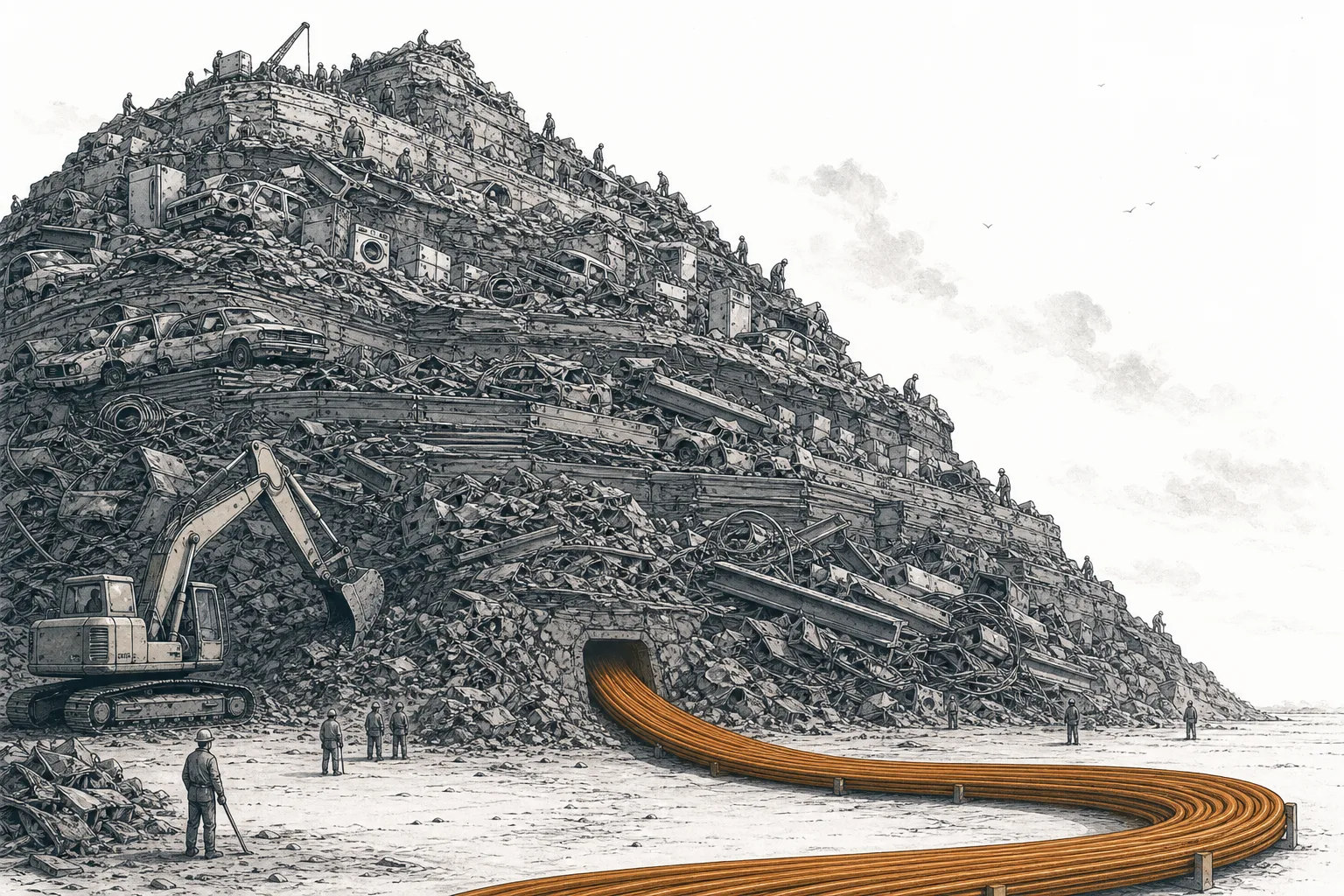
01What scrap metal is
Think of a car sent to the auction lot when it dies, an old building torn down, a fridge dumped on the curb, or steel offcuts left over at a factory. All of it is “trash” to most people — but to the metals industry it's high-grade raw material, because metal has one magical property: it can be melted and reused endlessly without losing quality. Steel melted from good scrap is just as good as steel freshly smelted from ore — unlike paper or plastic, which degrade the more you recycle them.
The business we're talking about here is “metal recycling & scrap processing” — companies that make money by collecting, shredding, and sorting scrap metal back into raw material a furnace can actually use. Scrap splits into two big worlds: ferrous scrap like iron and steel, and nonferrous scrap like aluminum, copper, brass, and zinc — the latter smaller in volume but far higher in value per kilo.
Ferrous (iron scrap) = mostly iron, magnetic · Nonferrous = aluminum, copper, etc., non-magnetic, high value · New scrap = offcuts from factories that were never used, like trimmed steel ends — clean and easy · Old scrap = metal from things that actually reached end of life, like cars, demolished buildings, appliances — contaminated, harder to sort · EAF (electric arc furnace) = a furnace that uses an electric arc to melt “scrap” straight into new steel, unlike a blast furnace that has to burn ore with coal.
On our megatrend map, this stage is a sub-branch of Bulk & Structural Metals, under the Critical Materials & Supply Chain megatrend — but it doesn't sit “upstream” like a mine. It's a “shortcut” that runs parallel to the whole chain, because scrap can loop back into the system over and over, and the huge stock of metal buried in the things around us is called the “above-ground mine” — for copper alone, the world holds over 500 million tons in in-use goods, equal to roughly 20 years of mine output.
02Why it matters (the hidden pillar of decarbonization)
To see why scrap is about to matter so much, start with a fact people overlook: making steel is one of the most carbon-intensive activities on Earth — around 7–9% of the world's total carbon emissions, because the traditional method (a blast furnace with coke) burns coal to reduce iron ore. But there's a much cleaner alternative: melting “scrap” in an electric arc furnace (EAF), which independent research from CRU confirms emits about 75% less carbon than smelting from ore.
And this isn't a small effect by volume, because steel is the most-recycled material in the world by weight — more than paper, glass, aluminum, and plastic combined. In 2025 the world used about 630 million tons of recycled steel, roughly a third (~30%) of all steel produced. Every ton of scrap steel melted back down avoids about 1.5 tons of CO₂ and saves 1.4 tons of iron ore and 740 kg of coal — which is why scrap is the “hidden pillar” of decarbonizing heavy industry.
On the aluminum side it's even sharper: recycling aluminum uses about 95% less energy than smelting it from bauxite ore (8.3 vs 186 gigajoules per ton), so that today over 80% of the aluminum the US produces comes from scrap, not ore. Because smelting aluminum from ore devours electricity, recycling isn't just “good for the planet” — it's cheaper too.
03How it works (from an old car back to rebar)
The heart of this business is the “closed loop” — a single piece of metal can travel from “old” back to “new” endlessly. Let's trace how a single old car makes the journey back to becoming rebar in a new building.
The hardest step isn't the melting — it's step 3, shredding and sorting. New scrap from factories is clean and easy, but “old scrap” from cars or buildings usually comes mixed up — steel with aluminum, copper wire coated in plastic, motors with iron and copper fused together. The heart of this industry is the giant “shredder” that grinds a whole car into fist-sized pieces in seconds, then runs them past magnets to pull out the steel, and air/eddy-current sorters to pull out the aluminum and copper.
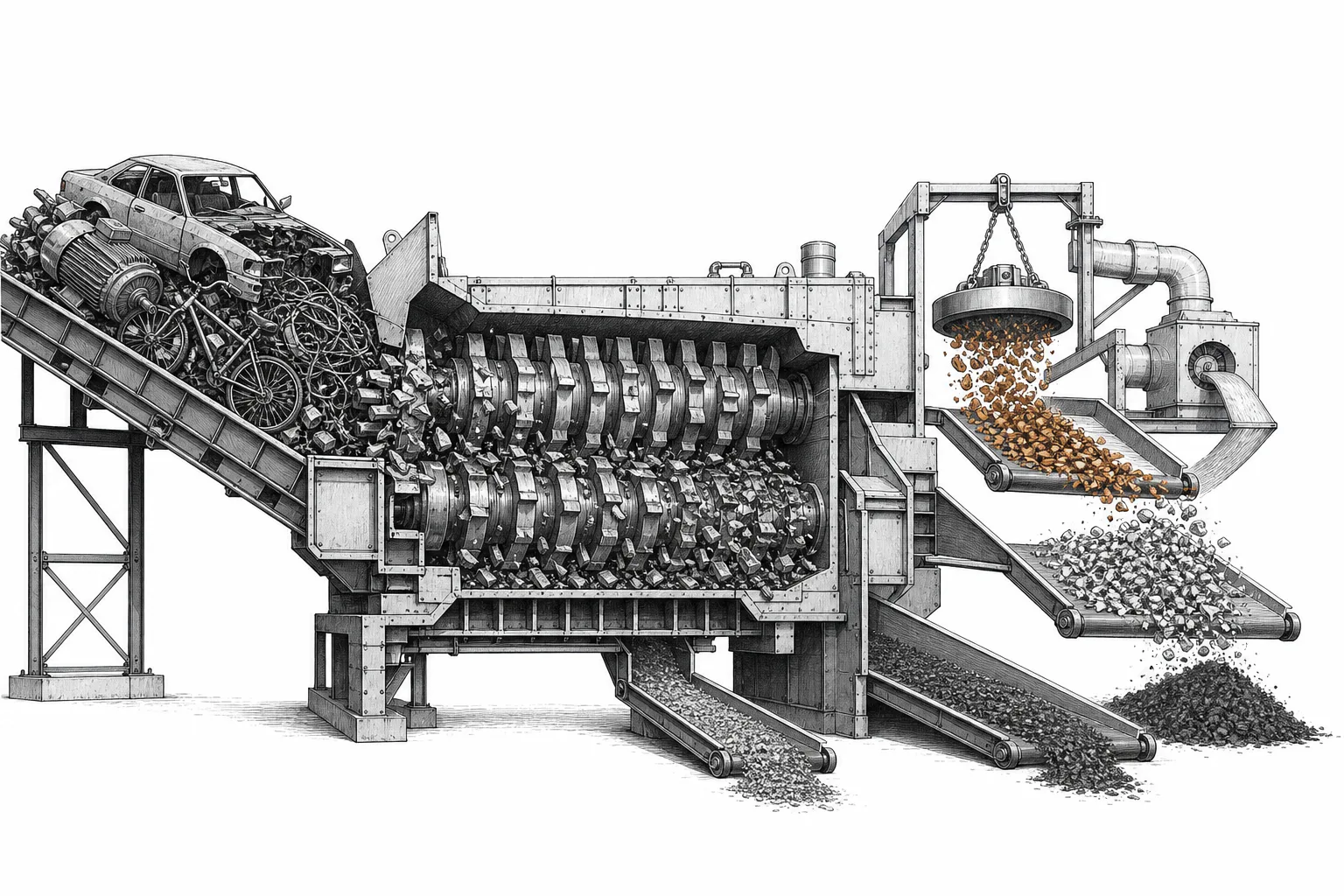
And here's the secret of the industry's structure: it's extremely fragmented. Upstream are tens of thousands of small scrap dealers and little scrapyards all over the world, but the downstream end — with the shredders and big logistics networks — is concentrated in the hands of a few large players. Whoever controls both the “scrap volume” and the “ability to sort it clean” has the edge, because the cleaner and more consistent the scrap, the better the price you get from the mills.
04What it connects to
Scrap is a “shortcut” that runs parallel to the main metals chain. It doesn't compete directly with iron ore and bauxite (upstream); instead it supplements and sometimes replaces them where you need metal fast and low-carbon. And it connects most tightly to steel and aluminum smelting (Primary Steel & Aluminum Smelting) — because the EAFs that run mainly on scrap are this business's biggest customers. The more the world shifts from coke-fired blast furnaces to EAFs, the more scrap demand surges. From there the melted metal flows on to fabrication and structural products, mixed in with ore-based metal until you can't tell them apart.
But what matters more is the demand “waiting to be fed” downstream — all megatrends of the same era: artificial intelligence (AI) and digital infrastructure, where data centers devour structural steel; the energy transition (transmission lines, wind turbines); electric vehicles (aluminum bodies, motors); and defense and geopolitical fragmentation, where countries want their “national materials” made at home. Put simply, every ton you can recycle is a ton you don't have to dig up or wait to import.
05Where it stands now
In 2024–2025, scrap became the thing everyone wanted. In early 2024 the price of pig iron (a substitute feed for scrap) jumped ~45%, squeezing mills' margins. The result: steelmakers moved to buy up scrapyards to lock in their own supply — the clearest example being Nucor, the largest EAF steelmaker in the US, whose scrap subsidiary (David J. Joseph) snapped up more Midwest scrapyards in 2025, pushing the scrap it controls to around 8 million tons. And Steel Dynamics has its own OmniSource division feeding scrap to its furnaces too.
Then politics piled on. In 2025, scrap was elevated to a “strategic resource.” As of March 2025, 48 countries had imposed measures restricting steel-scrap exports (about 38% of them full export bans). In July 2025 the European Union launched a system to monitor scrap-metal imports and exports, and is preparing to ban scrap exports outside the OECD from 2027, because every nation wants to keep scrap to feed its own domestic EAFs — what used to be just “exported trash” has become a card everyone hoards.
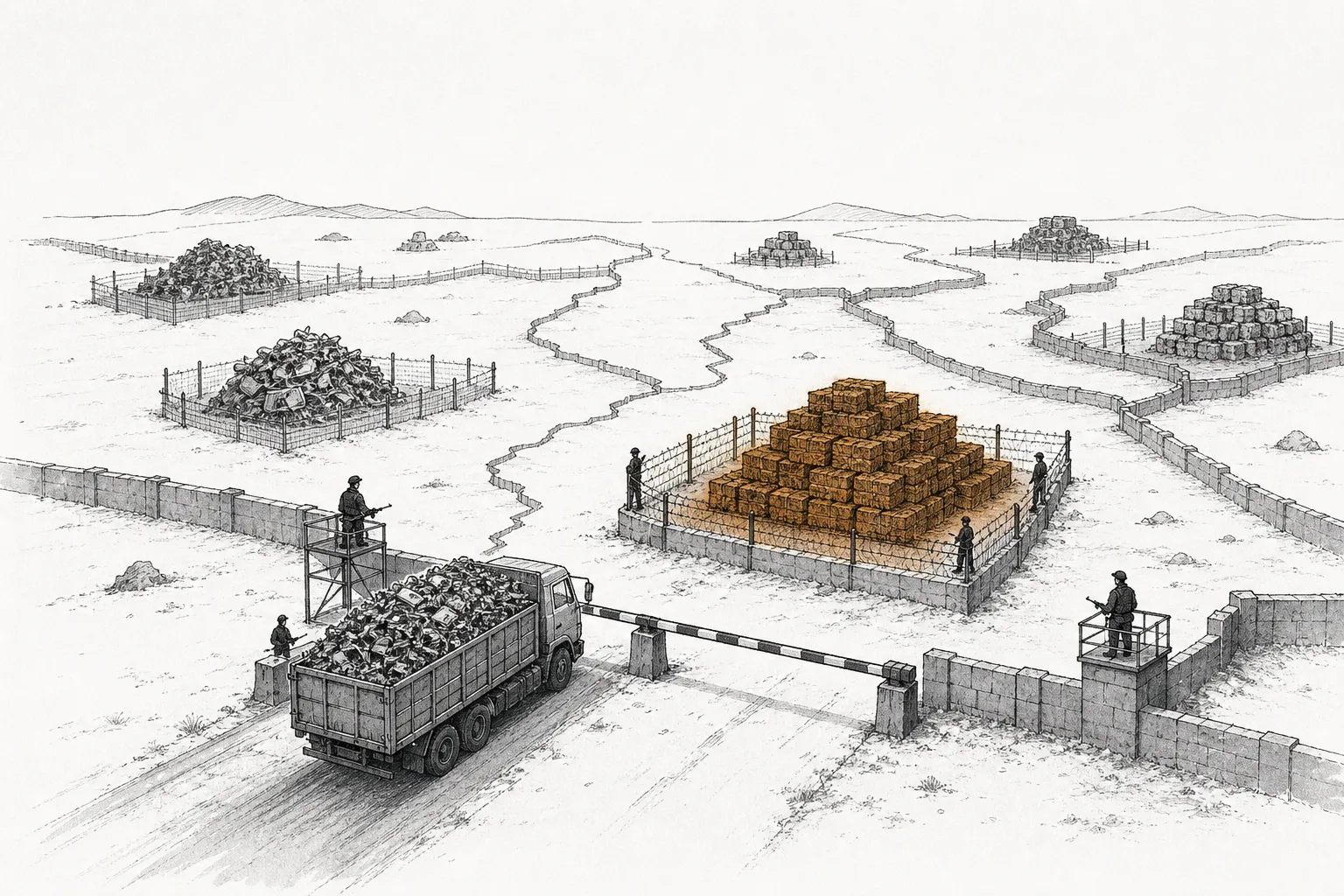
Another big move was consolidation. In mid-2025, Toyota Tsusho (the Toyota-group trading company) acquired Radius Recycling (formerly Schnitzer Steel, founded 1906) for around $1.34 billion — a premium as high as 115% — to seize its network of over 100 scrapyards and its US EAF steel mills, showing that even automakers now see scrap as the heart of their own “circular economy.” So the players in this arena wear many faces, from EAF steelmakers that fold scrap into themselves to global pure-play recyclers.
06The road ahead
The biggest story in this business hasn't arrived yet — it's the “scrap wave.” Metal has a long life; steel in buildings and infrastructure lasts 30–50 years, which means the enormous amount of metal installed during China's growth era and urbanization worldwide is about to “retire” in waves over the coming decade. worldsteel estimates that the volume of end-of-life steel scrap available worldwide will rise from about 400 million tons in 2019 to roughly 600 million tons in 2030, hitting ~900 million tons by 2050.
This wave will meet another trend: the world is shifting from coke-fired blast furnaces to scrap-eating EAFs. Today EAF makes about 30% of the world's steel, and that's expected to reach around 40–42% by 2050. Even China, which today relies on EAF for only ~10%, aims to raise its scrap use from 215 million tons in 2022 to roughly 350 million tons by 2030. When scrap demand grows alongside scrap supply, the business of collecting and sorting scrap carries ever more weight in the economy.
But there's a truth worth stating plainly: scrap alone isn't enough. Even if you collect nearly every piece, the volume of metal retiring each year still can't keep up with fast-growing demand. The world still needs both new mines and recycling side by side. Scrap isn't a “substitute” for ore — it's an indispensable “ally,” and one that's cleaner, faster, and less exposed to geopolitics.
07Challenges & risks
Scrap collection is fragmented. Unlike a centralized mine, scrap sources are everywhere — every home, every factory, every car. Collecting and sorting enough of it, at enough quality, is hard work that depends on a large network of small scrap dealers. This is why the business is hard to centralize, and why steelmakers have to buy up scrapyards to guarantee their raw material.
Scrap quality and “tramp elements.” The chronic problem with steel scrap is copper and tin, which come in with wiring and motors from old cars — these elements are very hard to remove from molten steel and make the steel brittle. The more times you recycle, the more they accumulate, until low-quality scrap can only make construction rebar, not the high-grade sheet steel needed for cars. Sorting it clean is both a cost and a technical barrier.
Scrap prices swing with metal prices. When steel or aluminum prices fall, people don't feel like tearing down old goods to sell, so scrap volume shrinks. Recyclers' profits therefore swing with global metal prices, unavoidably. This is a cyclical commodity business in its bones — the decarbonization story gives long-run demand more of a “floor,” but it doesn't erase the cycle.
The geopolitics of scrap. Now that scrap has become a “strategic resource” whose exports each nation controls (48 countries already), the cross-border flow of scrap is increasingly caught up in politics. Countries that rely on imported scrap to feed their EAFs may face both expensive and scarce supply, while traditional scrap-exporting countries are pressured to keep it for themselves — what used to be just “trash” has become a new battleground of the energy-transition era.