Megatrend · Critical Materials
Chip fabs breathe gas — and some of that gas comes from almost one place on Earth
Every wafer that becomes an AI chip is bathed in gas the whole time — huge volumes of nitrogen and argon to drive out every trace of air and dust, plus a handful of "expensive, extremely pure" specialty gases: neon for the lasers, NF3 to clean out the equipment, and phosphine for doping. These gases are the quietest "utility" in the chip industry — piped in from an air-separation plant out front under contracts that run for decades, supplied by just a few giant gas companies. And in 2022, the world learned the hard way that if one single gas runs out, the whole chip production line stalls.
01What it is
When we think about making chips, we usually picture expensive machines and a cleanroom full of people in head-to-toe dust suits. But there's one character everywhere in that room that we never see — gas. Every modern chip is built in an atmosphere that's constantly controlled by gas, from ordinary gases that drive out air and moisture, to specialty gases that go in and "react" directly with the silicon itself. This node is the story of all that gas.
Gas in a chip fab splits simply into two groups. The first is bulk gases — nitrogen (N₂), oxygen (O₂), argon (Ar), hydrogen (H₂). These are used in enormous volume to create an inert atmosphere, purge air, carry off heat, and flush the pipes. They're pumped through pipes constantly, like tap water. The second is specialty / electronic gases — far smaller in volume but much purer and much more expensive, because they play a role in the actual chemistry of building a transistor.
Bulk gas = the basic gases used in huge amounts (N₂/O₂/Ar/H₂), cheap per unit but heavy on volume · Specialty gas = special-purpose gases used in small amounts but which must be extremely pure (like NF3, WF6, phosphine, neon) · 6N–8N is the purity standard this industry talks about — "6N" = 99.9999% (six nines), "8N" = 99.999999%. Just a few parts per billion of impurity can ruin an entire wafer. This level of purity is exactly the wall that makes this business hard.
On the megatrend map, this node is one of the four sub-groups of Semiconductor Materials, under the big trend Critical Materials & Supply Chain. Its siblings next door are Silicon Wafers & Substrates (the wafers), Process Chemicals & Photoresist (the liquids and chemicals), and Compound-Semi Substrates (compound semiconductors) — if the wafer is the "paper" and the chemicals are the "ink," this node is "the air everything has to breathe" in the production room.
02Why it matters — gas is the fab's breath
The first reason is volume. A single modern chip fab uses so much bulk gas that it needs its own gas plant sitting right against the fence. Nitrogen alone takes the biggest share, because almost every step needs an inert atmosphere with no oxygen or moisture to react with the wafer being built — picture having to purge air out of hundreds of rooms, 24 hours a day, without stopping. That's why gas becomes a big "utility bill" for every fab.
The second reason is that specialty gas is the "bottleneck". Even though it's used in small amounts, the global specialty electronic-gas market was worth about $5.1B in 2025 and is expected to grow to $6.9B by 2032 (~4.4% a year). Count every gas used in the chip industry and the figure climbs to $10B and up. That doesn't look big against a $600B chip market, but the importance isn't in the size — it's that if it runs short, the whole fab can't make chips.
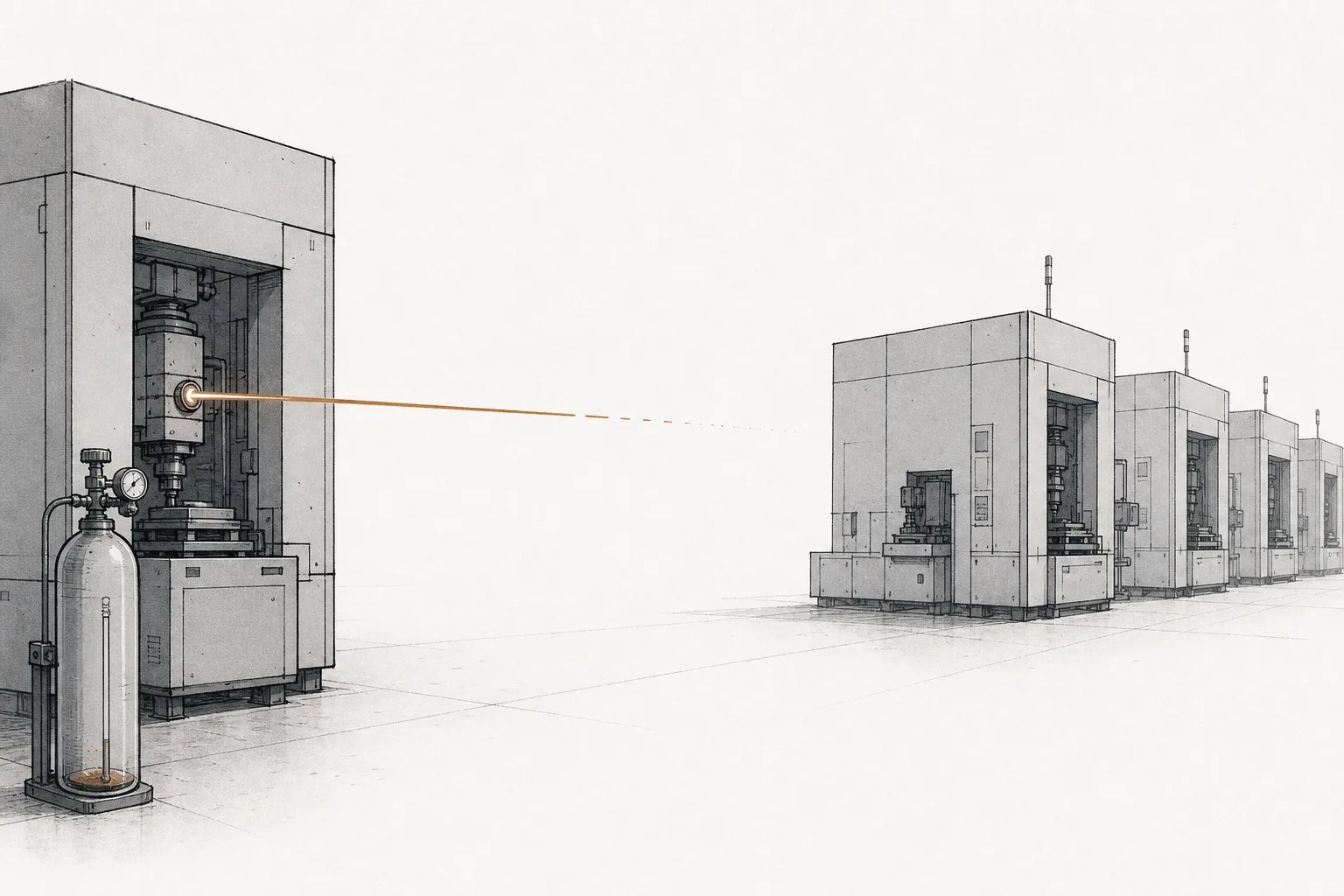
The heart of why it matters is this: some specialty gases come from almost one place on Earth. The most famous example is neon, used in the lasers of the machines that print chip patterns (lithography) — before 2022, Ukraine produced about 50% of the world's semiconductor-grade neon (some estimates put it as high as 70%), through two main companies, Ingas (in Mariupol) and Cryoin (in Odesa). This neon was a by-product of Soviet-era steel mills. When Russia invaded Ukraine in early 2022, both plants stopped, and the price of neon shot up 500% within a few months — in China, the price per cubic meter moved from 400 yuan to 1,600 yuan.
That's why this node is a story about the supply chain, not just chemistry — gas is an invisible utility, but the point where it concentrates is one of the most fragile spots in the chip economy (the geopolitical angle on raw-element bottlenecks is told in full in Semiconductor Materials, the parent node).
03How it works (from air to the pipes in the fab)
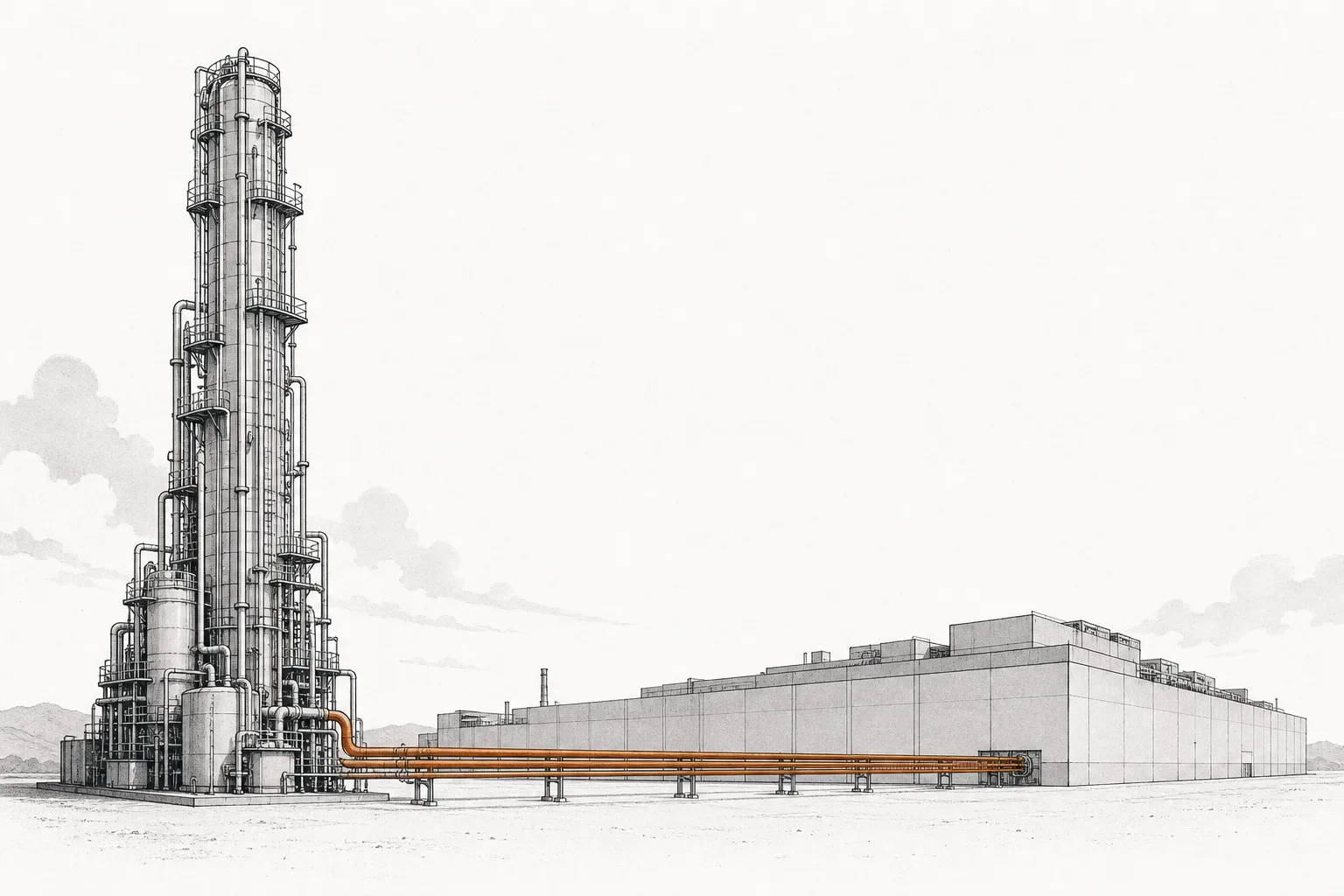
Here's the remarkable part: most of the gas in a chip fab starts from the ordinary air around us. Air is ~78% nitrogen, ~21% oxygen, plus a bit of argon and the rare gases. The way to pull it apart and use it is the air-separation unit, which cools the air until it turns liquid, then slowly distills each gas out by its different boiling point. Some specialty gases have to be synthesized separately from chemical reactions. Let's trace the route from air all the way to the wafer.
Each specialty gas has its own specific job — NF3 (nitrogen trifluoride) is used to "clean the equipment," etching away leftover silicon residue inside the CVD deposition chamber after a run. It's the most-used specialty gas — taking about 37% of the market for specialty electronic gases · WF6 (tungsten hexafluoride) is used to build the tiny tungsten interconnects inside a chip · phosphine (PH₃) and gases in the same family are used for "doping," firing atoms in to change the electrical properties of the silicon · and neon is the inert gas inside the lasers of DUV-style printing machines.
04Where it sits in the world of chip materials
This node is one of the "four pillars" of materials fed into a chip fab, and it works inseparably alongside its neighbors.
- Paired with Process Chemicals & Photoresist: gases and liquid chemicals often act as "partners" in the same step — etch, for instance, uses plasma gas in some versions and liquid chemicals in others. These two are the "reactants" on the consumable-materials side of the fab that have to be topped up constantly
- Feeds Silicon Wafers & Substrates: right from growing the silicon crystal and polishing the wafer, you already need a controlled inert-gas atmosphere — gas is with the wafer before it's even a chip
- A material of Semiconductor Materials & Specialty Chemicals in business terms: if this node looks at gas through the "upstream bottleneck" lens, node 56070000 looks at all chip materials through the "industry and manufacturers" lens — two sides of the same story, read together for the full picture
- A direct feedstock for the machines of Semiconductors: the deposition–etch machines of Deposition, Etch & Process Tools and the printing machines of Lithography are all "worthless" without gas fed in. A DUV machine can't fire its laser without neon, and a deposition chamber can't clean itself without NF3
- The end point is AI and Cloud & Digital Infrastructure: the more AI chips and memory the world builds, the more gas gets used — demand flows all the way down to this deepest layer
05Where it stands now
The big picture of this industry is concentration in the hands of a few gas giants. The global industrial-gas market (about $100B) is controlled by three majors — Linde ~33%, Air Liquide ~29%, and Air Products ~15% — together more than three-quarters of the market. For chip-specific specialty gases, Asian specialists add to the mix, like Nippon Sanso (Japan) and the fluorine-gas specialist Kanto Denka.
Their business model is fascinating — instead of delivering gas in tanks, they build an air-separation plant right against the chip fab's fence and pipe gas straight in, under 15–20 year "take-or-pay" contracts (the customer guarantees a minimum purchase and pays even if they don't buy). This model makes revenue very steady and locks customers in for the long haul. A fresh example: in mid-2024, Air Liquide signed an investment deal worth over $250M to build a high-purity gas plant for Micron's memory fab in Idaho — a reflection of how the wave of building new fabs in the U.S. drags gas demand along with it.
As for neon after the 2022 shock, the industry adapted remarkably — many fabs installed systems to recycle neon in-house (capturing used gas to reuse over 90% of it), and China rushed to build its own neon capacity, so prices eased a lot. But the lesson remains: in 2024, ASML's customers used a combined over 500 tons of neon a year for their EUV/DUV machines — real demand isn't falling, it's rising, so diversifying sources is still a key priority.
06The road ahead
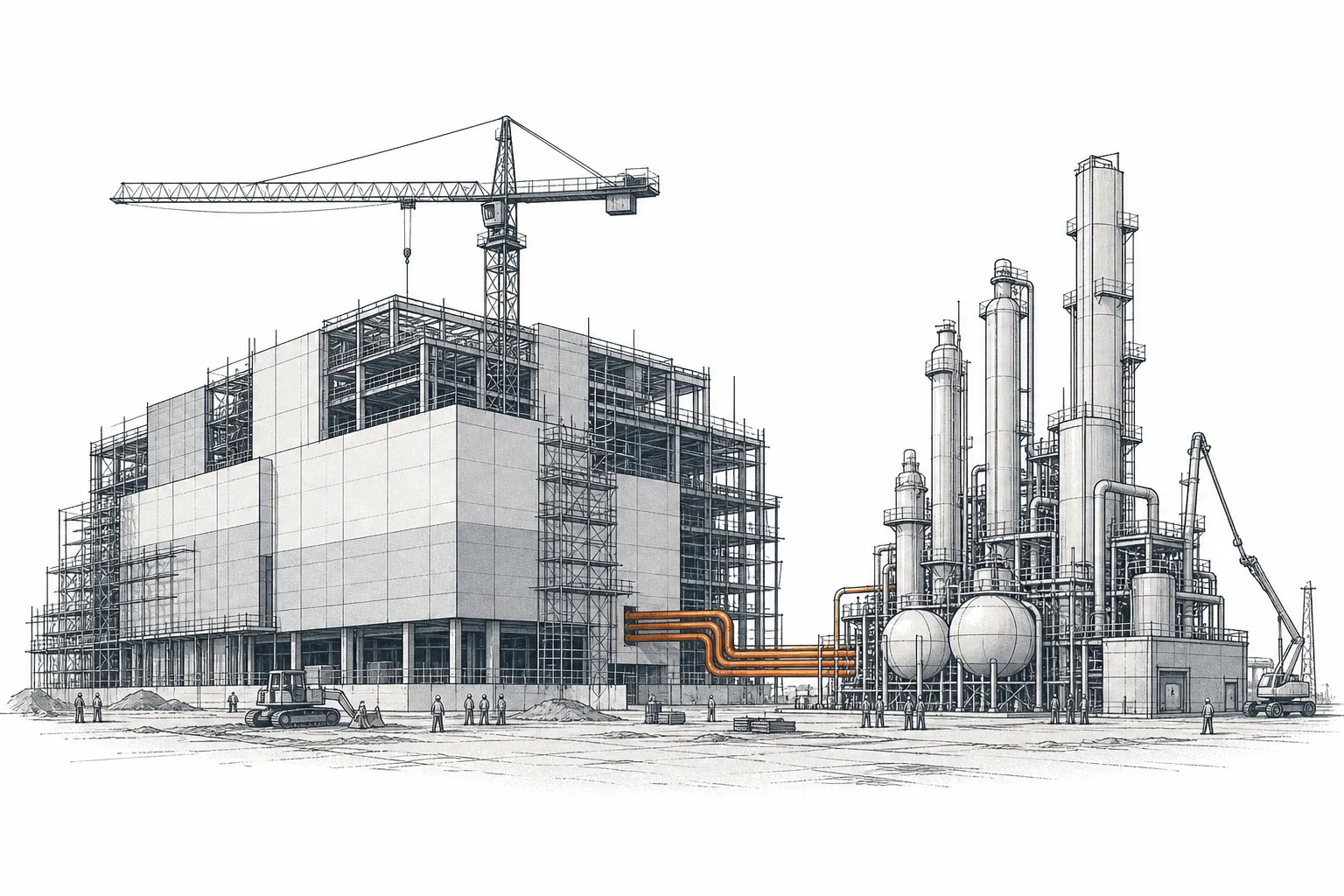
The first direction is more and more on-site gas plants. Every time a new fab is announced — whether in Arizona, Texas, Japan, Germany, or India — it comes with a new long-term gas contract. So the global wave of "reshoring" chip production is a direct tailwind for the gas giants, because every new fab = a new air-separation plant + a new take-or-pay contract.
The second direction is diversifying neon and specialty-gas sources away from the "fragile point". After the Ukraine lesson, the U.S., Europe, Korea, and China are all rushing to build their own neon capacity (from domestic steel mills and large air-separation plants), plus in-house recycling that reduces reliance on imports — the goal is to make sure one gas from one place can never stop the whole industry again.
The third direction is gas getting "cleaner" and more complex. As chips get smaller and more complex, the purity standard moves from 6N up to 7N–8N, and the industry also has to deal with the environment — NF3 and many fluorine gases are powerful greenhouse gases. Cutting leaks and treating waste gas (abatement) has become both a regulation and a new selling point for manufacturers.
07Challenges & risks
The first risk, and the symbol of this node, is the single-source bottleneck. The Ukraine neon lesson of 2022 is the most real example — one crucial gas concentrated in a war zone, then gone overnight, the price up 500%. Even though the industry eventually adapted (recycling + finding new sources), the transition created turmoil and costs can spike at any moment. And there are still several other specialty gases tied to just a few specialized suppliers.
The second risk is concentration of manufacturers. When the world's industrial gas is controlled by three majors, end customers (fabs) have limited bargaining power. In the other direction, the gas makers also lean on just a few big customers — if a big fab pushes back its investment plans, the new take-or-pay contracts slow down with it.
The third risk is cyclicality and geopolitics. Gas demand is tied to fabs' investment cycles, which rise and fall in waves, and some specialty gases (including their feedstocks) are on the list of things that can be used as trade-bargaining tools — just like what happened with other raw elements in the Critical Materials trend. So gas is never free from the shadow of world politics.
In short: this node is the breath of the chip fab — enormous volumes of bulk gas flowing through pipes constantly, plus a handful of extremely pure specialty gases, some of which come from almost one place on Earth. It's a quiet, steady, nicely profitable business, but also a bottleneck the world has just learned can let one "small gas" stop the entire chip economy.