Megatrend · Critical Materials
Even enriched uranium can't light a reactor — not until it clears the “final gate” that shapes it into fuel
The world argues about uranium mines and enrichment plants, but even fully enriched uranium can't just be “plugged into a reactor.” It's still only a gas or a powder that has to be pressed into tiny ceramic pellets, sealed inside metal tubes, and bundled into a “fuel assembly” tailored to fit one specific reactor design exactly. This is fuel fabrication — the quietest final step of the nuclear fuel cycle, where Russia has an almost total grip on Soviet-design reactors, and the real chokepoint of the SMR era.
01What fuel fabrication is
Picture uranium that's already been through enrichment — its share of the fissile isotope U-235 is now high enough to sustain a reaction. Right now it sits as UF₆ gas (uranium hexafluoride) in a steel cylinder. Can you feed that gas straight into a reactor? Absolutely not. A reactor doesn't run on gas. It needs solid, tangible “fuel rods” that can take enormous heat and sit in precisely calculated positions.
The people who turn uranium gas into “something a reactor can actually eat” are the nuclear fuel fabrication businesses — plants that take in UF₆, convert it to a ceramic powder, press it into tiny pellets, bake them hard, load them into metal tubes, and bundle those into a fuel assembly ready to drop into the reactor core. This is the final step of the fuel cycle before the atoms start releasing energy — and a step outsiders have barely heard of, even though without it there's no power.
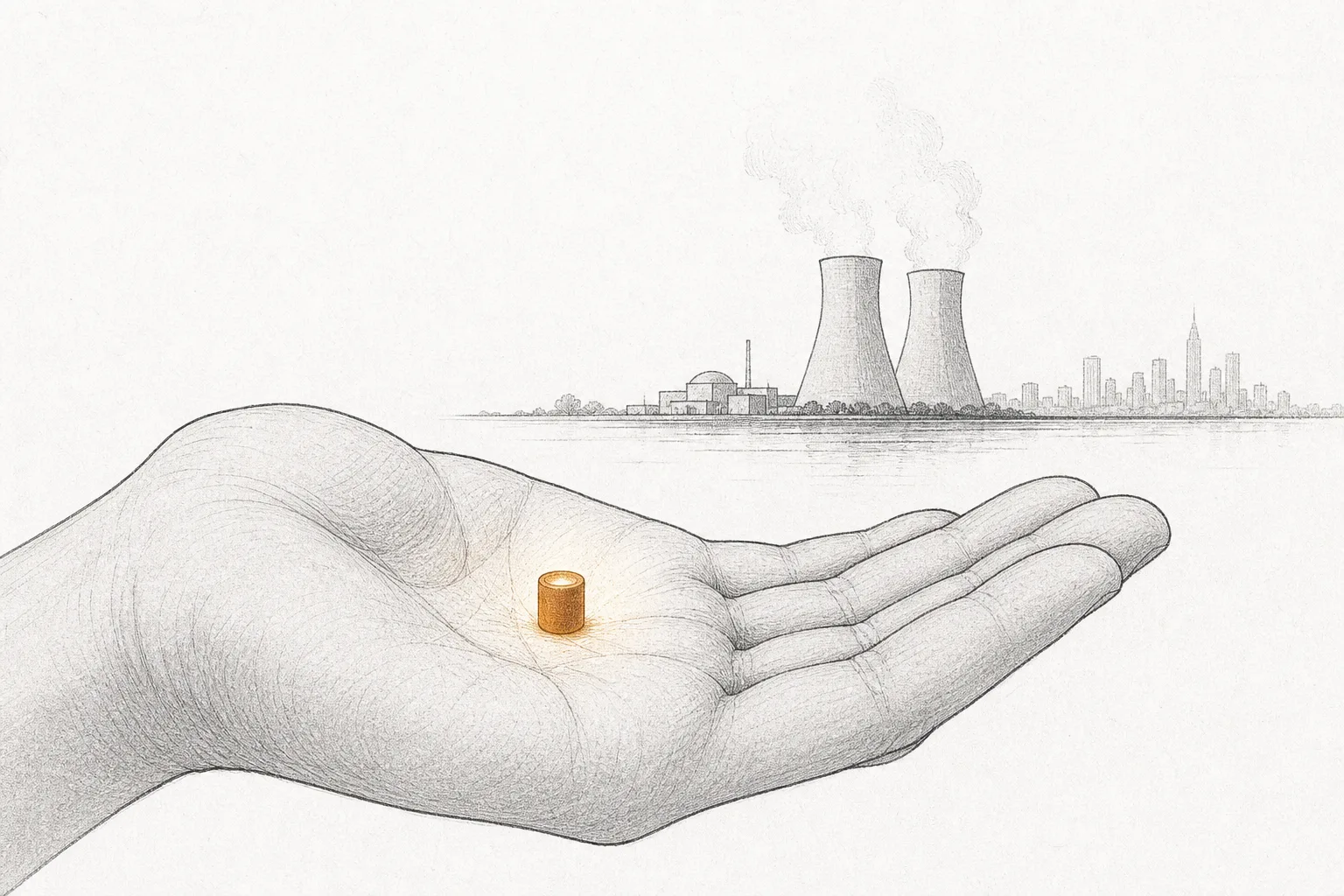
Pellet = a fingertip-sized ceramic pellet of uranium dioxide (UO₂), roughly 1 cm tall and wide · Fuel rod = a metal tube about 4 meters long packed with a stack of pellets · Fuel assembly = hundreds of rods bundled into a grid; one reactor uses hundreds of assemblies · Cladding = the zircaloy (zirconium-alloy) tube that wraps the pellets and keeps radioactivity from leaking into the coolant.
On our megatrend map, this step is a sub-branch of Uranium & Nuclear Fuel Cycle, under the Critical Materials & Supply Chain megatrend — it's the “destination” uranium reaches after leaving the mine (Uranium Mining) and passing through conversion and enrichment (Conversion, Enrichment & Fuel). If enrichment is “concentrating the material,” this step is “giving it a shape” each reactor can actually use.
02Why this step is a “moated gate”
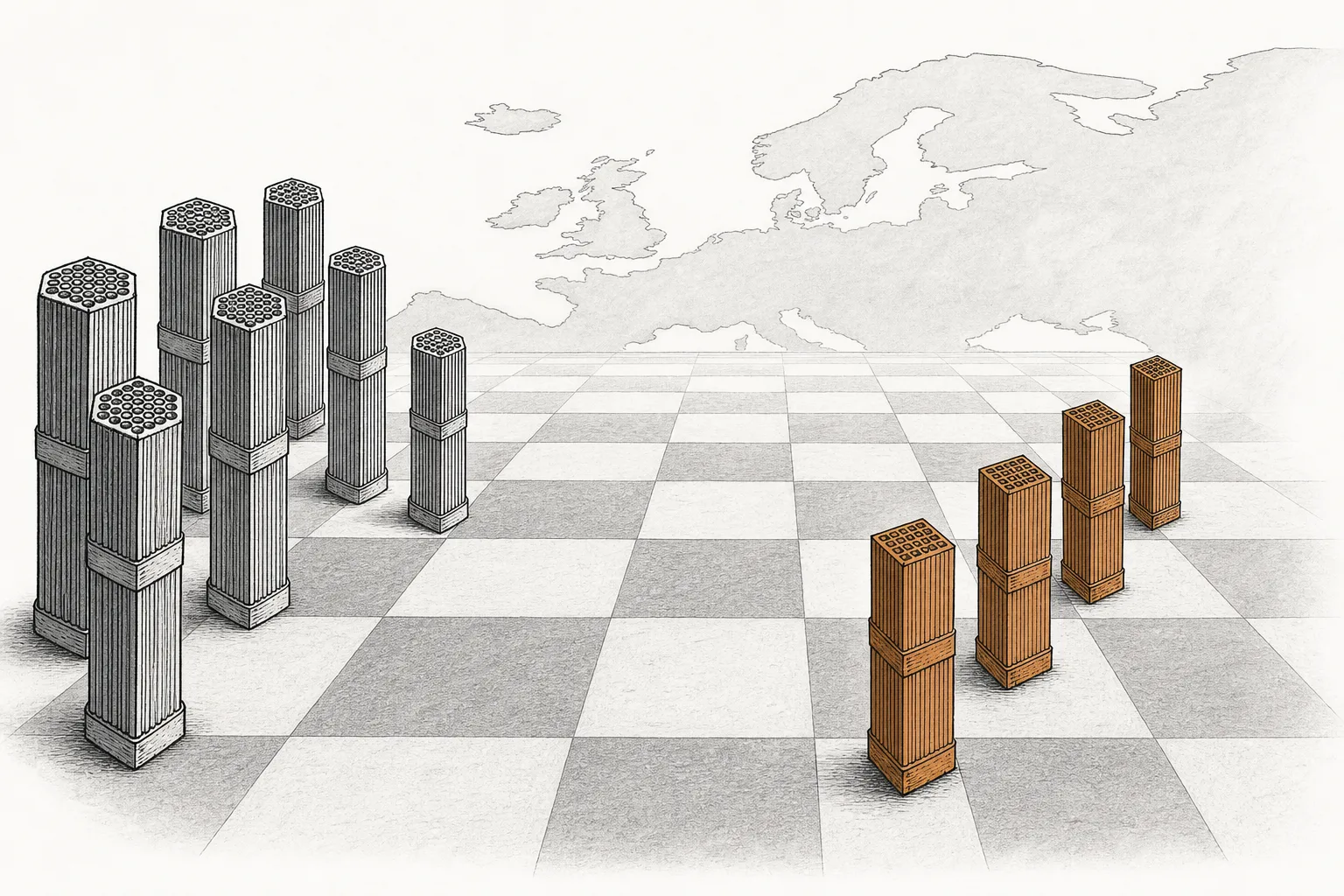
Mines and enrichment plants are a game of “volume and price” — uranium is a commodity where one batch is much like another. Fuel fabrication is completely different, because a fuel assembly isn't a commodity. It's a bespoke piece of engineering. An assembly built for a Westinghouse reactor can't go into a Russian-design reactor (VVER), because the shapes differ — a VVER assembly is hexagonal, while Western ones are square. That alone makes them worlds apart.
That specificity is the business's “moat.” Customers are power plants running reactors with 60–80-year lifespans. Once they pick a fuel supplier, switching to another means years of safety testing and licensing. So this is a tightly bound regional market more than a free global one — and the number of players who can actually make fuel for light-water reactors (LWRs) is just four: Framatome, Global Nuclear Fuel (GNF), Westinghouse, and Russia's TVEL.
The number that best captures “energy density” is the pellet itself. A single fingertip-sized UO₂ pellet holds roughly as much energy as nearly a ton of coal, or about 3 barrels of oil — which is why the world tolerates all the hassle of nuclear: the fuel takes up so little space for the energy you get. And the work of making every single tiny pellet “100% reliable” is the heart of the fabrication business.
03How it works (from uranium gas to a reactor-ready fuel assembly)
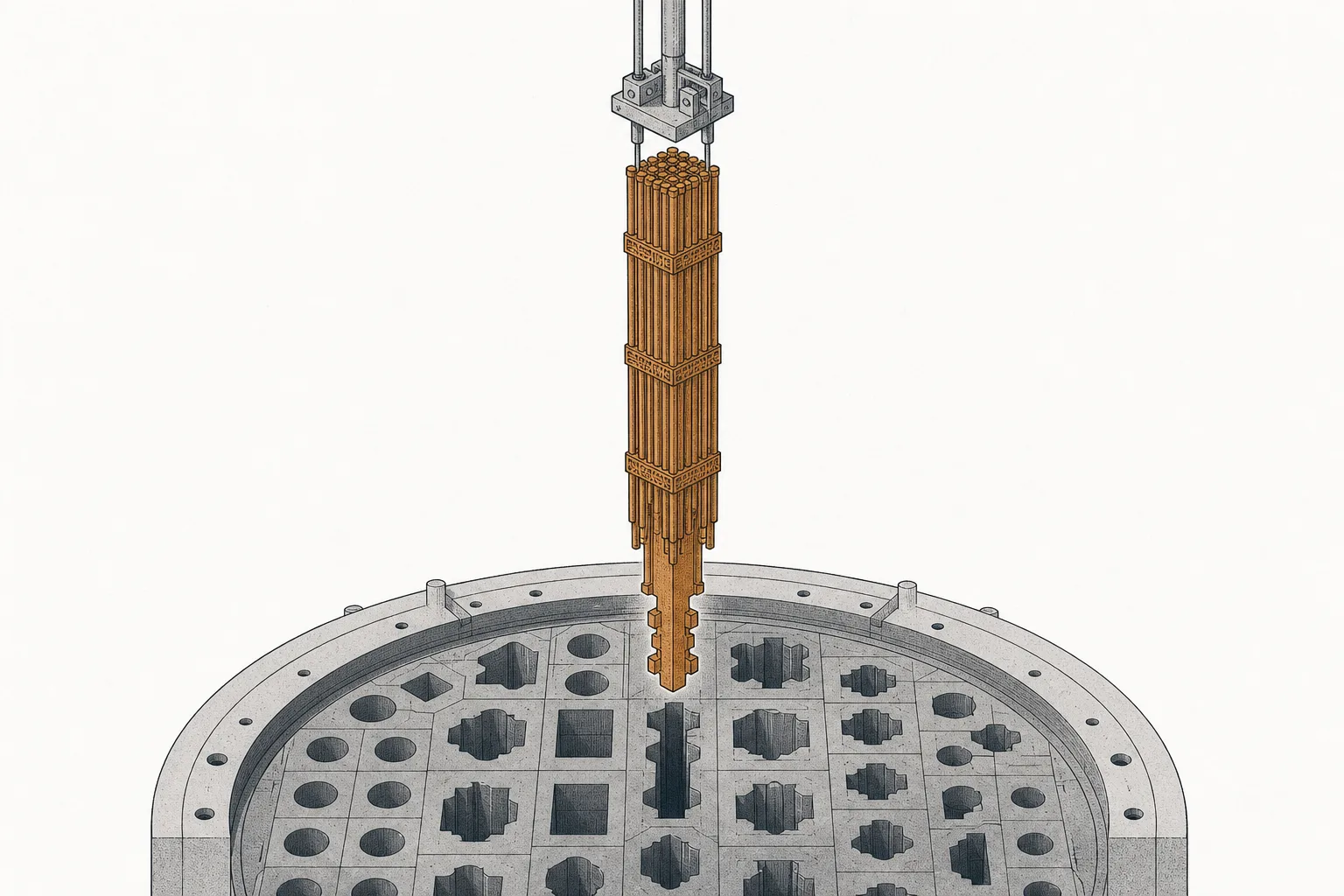
The heart of fabrication is turning “gas” into “solid ceramic” accurate to the micron. Let's follow a single cylinder of UF₆ gas as it becomes a fuel assembly in a reactor.
The first step is converting gas to powder — UF₆ is reacted until it becomes a black ceramic powder, uranium dioxide (UO₂). The powder is then pressed into pellets, small cylinders, and sintered in a furnace at around 1,700°C until they shrink and harden into true ceramic, before being ground to a diameter accurate to the micron — because the gap between the pellet and the cladding directly affects heat transfer.
Next comes loading the rods. Hundreds of pellets are stacked and dropped into a zircaloy (zirconium-alloy) tube — a special metal that's “transparent” to neutrons (it doesn't absorb them enough to quench the reaction) and withstands the heat and corrosion of reactor water. Both ends are welded shut, helium gas is sealed inside to help conduct heat, and you get a fuel rod about 4 meters long. Finally comes bundling: hundreds of rods are arranged in a grid with support frames and channels for coolant to flow through, becoming one fuel assembly. One large reactor uses hundreds of them. A plant's skill isn't in “having uranium” but in making pellets uniform, welding cladding with not a single leak, and controlling tolerances in every batch.
04What it connects to
Fabrication is the “final gate” of the fuel cycle. Upstream is enriched uranium from Conversion, Enrichment & Fuel (and further back, Uranium Mining) — and the key point is that these two chokepoints run back to back. On enrichment, Russia controls nearly half the world's capacity; on fabrication, Russia has an almost total grip on Soviet-design reactor fuel. Anyone who wants to truly avoid Russia has to unlock both gates at once. Having fuel assemblies but no enriched uranium to feed them, and you still can't run.
The destination for a fuel assembly is the “hungriest mouth” in decades. Assemblies feed straight into nuclear power plants and small modular reactors (SMRs) — all of which have been reawakened because Artificial Intelligence and Cloud & Digital Infrastructure need “stable 24-hour” power for data centers. Beyond that, high-assay fuel ties directly to Defense & Geopolitical Fragmentation, because the reactors on nuclear-powered submarines and aircraft carriers also use specially fabricated fuel — and the same technology extends to reactors for the future Space Economy.
05Where it stands now
The big picture in 2025–2026 comes down to two things. First, Russia has an almost total grip on Soviet-design reactor fuel — TVEL, part of Rosatom, supplies fuel to 73 of the world's 440-plus reactors across 13 countries and holds about 16% of the global nuclear fuel market. The sharpest point is Europe: in 2023, 81% of the VVER-reactor fuel assemblies Europe imported (573 of 707 tons) came from Russia. So the EU's 19 Soviet-design VVER reactors remain almost entirely tied to Rosatom.
The second thing is that the West is racing to win this market back. Westinghouse developed working fuel for Soviet-design VVER reactors — and by late 2025, Bulgaria, Finland, and the Czech Republic began loading Westinghouse assemblies into Russian-design reactors. Meanwhile Framatome (part of France's EDF) signed deals to supply VVER-440 fuel to Hungary and Slovakia, and is developing a “100% European” VVER fuel that needs no Russian technology at all — even though for now Framatome still has to make Russian-recipe fuel at its Romans plant in France, because its own recipe won't be ready until around 2030.
Amid this game, a new chokepoint is forming — most next-gen reactors like SMRs and advanced designs don't use conventional-enrichment fuel (~5%). They need HALEU (High-Assay Low-Enriched Uranium), enriched to around 5–20%, which almost the entire world (outside Russia) still makes very little of. In 2024 the US produced only about 900 kilograms of HALEU domestically, while demand is projected to surge past 50 tons a year by 2035. That gap is exactly what could leave next-gen reactors “built but with no fuel to light them.”
In this arena, the real players split into three groups: the four light-water-reactor fuel giants (Framatome, GNF, Westinghouse, TVEL) that control the core market; the next-gen fuel pioneers making HALEU and TRISO for SMRs; and the emerging assembly plants in Central Asia climbing up the chain.
06The future — HALEU and next-gen fuels
Three forces will shape this business. One — a race to build HALEU supply at home. The US government has poured money in through the HALEU Availability Program (around $700 million), and in early 2026 awarded a $900 million contract to Centrus Energy to expand its enrichment plant at Piketon, Ohio for commercial HALEU production. It's an attempt to close the gap from 900 kilos/year to demand measured in tens of tons — a bet that “if we don't start today, next-gen reactors won't have fuel.”
Two — new-breed fuels that “don't melt down.” Many advanced reactors are turning to TRISO fuel, which wraps a uranium core in three layers of carbon and ceramic — so tough the DOE calls it “the most robust fuel on Earth,” because it withstands extreme heat without melting. Companies like BWX Technologies have made TRISO for over 20 years — in late 2025 it delivered a complete fuel core for the Project Pele microreactor, and by mid-2026 BWXT's TRISO fuel took Antares's reactor to its first criticality successfully. Westinghouse, meanwhile, began making its new ADOPT (LEU+) fuel pellets at its Springfields plant in England back in 2024.
Three — breaking Europe free of Russian fuel for good. The EU aims to end its reliance on Russian energy, and the Westinghouse and Framatome VVER fuel lines will come online in stages from 2027 onward. But because nuclear reactors refuel only every 12–18 months, the real transition will take until the end of the decade — slow but sure, and every contract signed is market share permanently shifting out of Russian hands.
07Challenges & risks
The “chicken-and-egg” problem of fuel and reactors. Plants that fabricate new-breed fuel (HALEU/TRISO) will only invest in large capacity once they're sure reactors will buy it — but SMR builders hesitate to move ahead without certainty that fuel will be there. Each side waits on the other, until government money has to break the deadlock. And if next-gen reactors slip behind schedule (which happens often), the fuel plants that invested first are exposed.
An overlooked logistics chokepoint. HALEU isn't just hard to make — moving it is a problem too. A HALEU transport cask holds only 1,271 kilograms, versus 2,277 kilos for a standard uranium cask — about 45% less — because it needs criticality-control systems. So every shipment requires nearly twice the casks, trucks, and security personnel, adding cost all along the chain.
Geopolitical and concentration risk. As long as Russia holds VVER fuel and enrichment capacity in its hands, fuel fabrication can be a strategic “card” just like rare earths — both a risk that supply gets cut, and an enormous opportunity for the Western producers stepping in to replace it. The other side is licensing and time: every new fuel recipe must pass years of safety testing and certification before it's ever loaded into a real reactor, which makes this business slow to change by nature — and that's exactly why the plain-looking “downstream” gate has become another quiet battleground in the nuclear revival.