Megatrend · Semiconductors
The part smaller than a grain of sand that a single phone needs by the thousand — and no one talks about it
When we think about electronics, we picture the big processing chips. But around every chip sit thousands of tiny "basic" parts, so small you can barely see them — capacitors, inductors, resistors. They don't "think," but they keep the power steady, filter out noise, and make those expensive chips actually work. The star of this group is the MLCC — a ceramic capacitor made by the trillions each year, controlled by just a few companies in Japan, Korea, and Taiwan. And the era of AI and electric vehicles is making every device hungrier and hungrier for these parts.
01What it is
Open up your phone and take a look (in your imagination is fine). Besides the few big chips that act as the "brain," the board is covered with thousands of tiny pale-brown square dots — the small ones just 0.25 millimeters long, smaller than a grain of sand and nearly impossible to pick up by hand. These aren't chips, they're passive components, and without them all those expensive chips wouldn't work at all.
They're called "passive" because they don't amplify or process a signal the way a transistor does (those are the "active" ones) — they just do three basic jobs over and over: (1) the capacitor stores and releases charge to steady the voltage and filter out noise · (2) the inductor resists changes in current, used in power circuits and frequency filters · (3) the resistor limits current and sets the voltage. The real star of the group is a type of capacitor called the MLCC.
MLCC (Multilayer Ceramic Capacitor) = a multilayer ceramic capacitor — thin ceramic sheets interleaved with metal sheets (electrodes), stacked hundreds of layers deep and fired into a single block. It's the most widely used capacitor in the world · Capacitor = a device that stores electric charge temporarily, like a "mini battery" that charges and discharges very fast, used to steady the power and filter signals · Passive = a part that doesn't amplify or process a signal, unlike Active parts (transistors/chips) that do.
On the megatrend map, this node is a branch under Interconnect & Passive Components within the big trend Semiconductors. It sits in the "supply-chain layer" — the one that makes the parts around the chip that every board has to have. Its siblings right next door are Printed Circuit Boards (PCB & HDI) (the board these parts attach to) and PCB Laminates & Substrate Materials (CCL) (the board's base material) — if the chip is the lead actor, passives are the crew behind the scenes who actually keep the set running.
02Why it matters — the rice of electronics
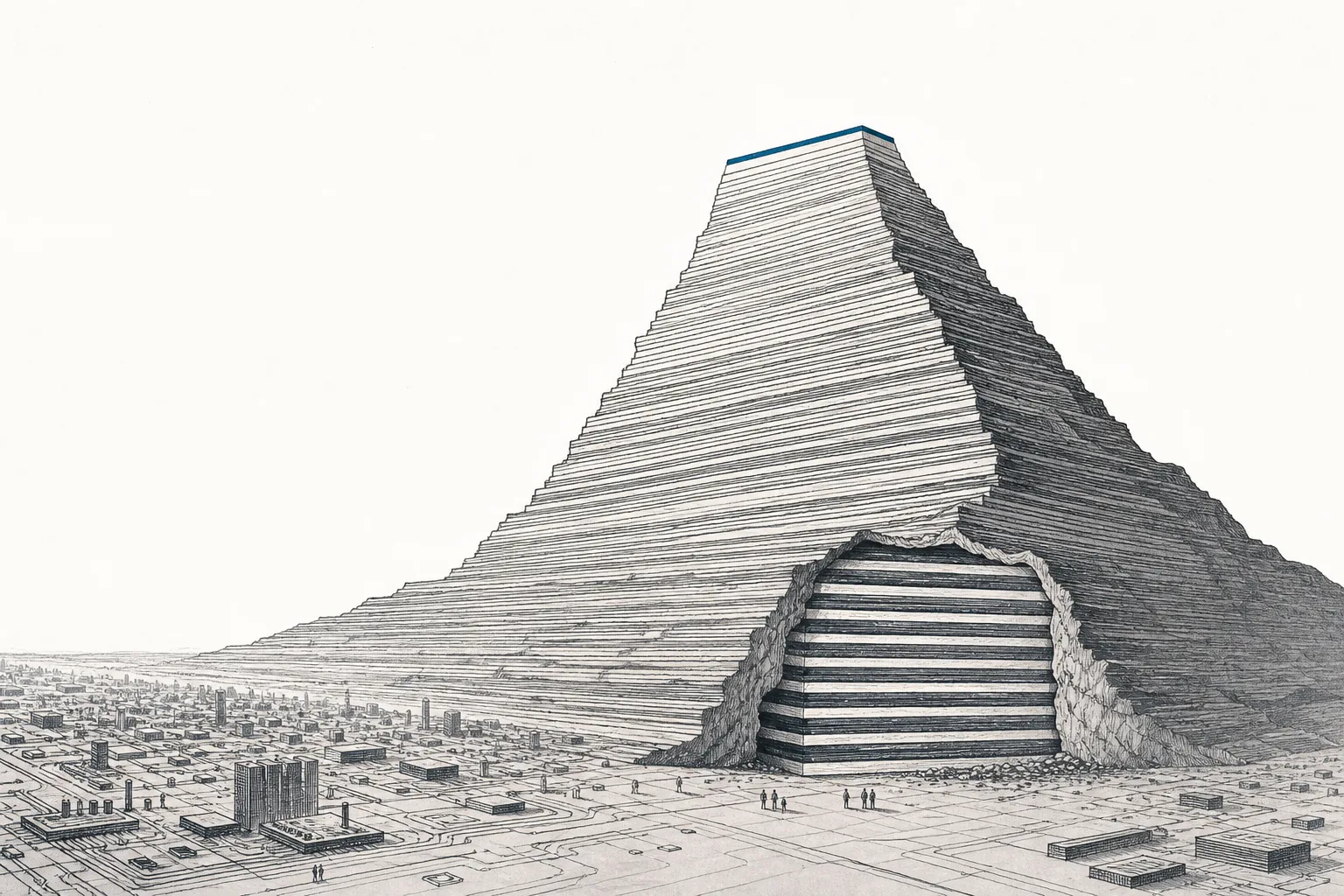
Think of it in these numbers: a flagship smartphone uses about 1,000 MLCCs, while a single electric vehicle uses as many as 10,000 or more, and the world makes around 5 trillion MLCCs a year combined. It's the most-produced electronic component in human history — staggeringly so, with nothing to compare it to, more than the grains of rice the world eats in a year. Calling it the "rice" of electronics isn't wrong.
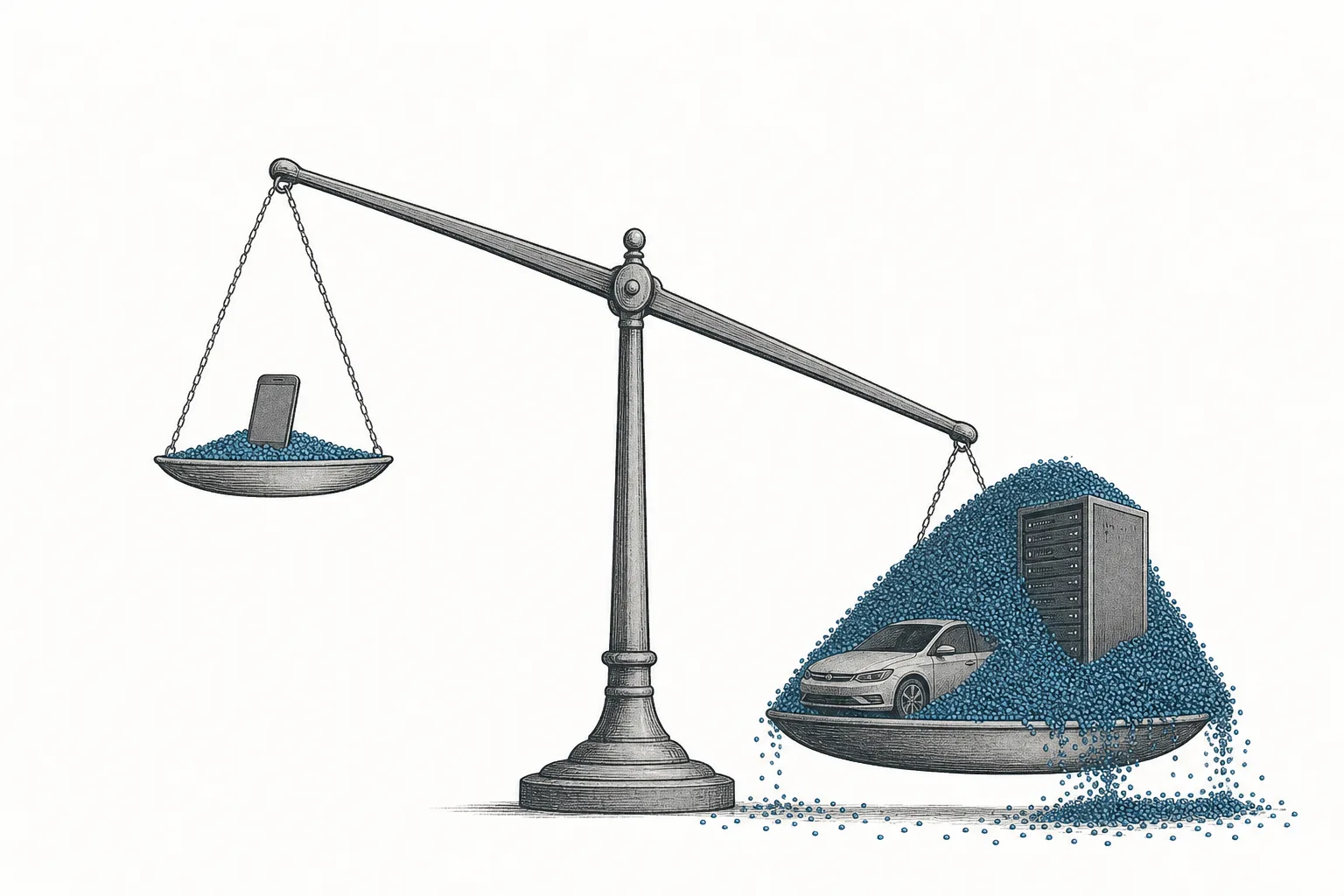
Here's the heart of it: this market doesn't just grow with the "number of devices" but also with the "number of parts per device" rising too. Every time a device gets smarter — phones add cameras, cars add screens and sensors, servers pack in AI chips that draw more power — it needs more capacitors to keep the power steady and filter the signal. So demand grows in two layers stacked on top of each other.
The size of the market reflects this. The MLCC market alone was worth about $15B in 2024, and counting every kind of passive component (adding inductors, resistors, other types of capacitors) it adds up to a market of around $35–40B a year. Much smaller than the processing-chip market, but what matters is that there's no circuit board on Earth without these parts.
03How it works (a tiny thousand-layer cake)
The magic of the MLCC is in "how it packs a lot of capacitance into a tiny block." The basic capacitor principle is this: put two metal plates close together with an insulator between them (called a dielectric). The larger the area of the plates, the closer they sit, and the better the insulator — the more charge it can store. The problem is that a single pair of plates stores very little charge. So how do you pack a lot of capacitance into something tiny?
The answer is to stack layers — take ceramic sheets (the insulator) just a few microns thin, interleave them with metal sheets (electrodes), stack them hundreds of layers deep, and fire them into a single block. It's like making a very thin "thousand-layer cake." The result is hundreds of pairs of storage plates in parallel within the volume of a grain of sand — giving it hundreds of times the capacitance of a single-layer capacitor. That's where the name "Multilayer" comes from.
This is why the competition in this field is a war over "who can make the layers thinner and stack more of them." The thinner the ceramic sheet and the more layers you can stack in the same size, the more charge it stores — or the smaller you can make the part for the same capacitance. Today's top MLCCs stack over 1,000 layers, each thinner than 1 micron — work that demands enormous precision in controlling the ceramic body (the main material is barium titanate), the metal powder, and the firing temperature. This know-how has been built up over decades, and it's a wall newcomers find hard to cross.
MLCCs aren't all the same. The ones that are hard to make and carry good margins are the high-cap ones for AI chips that draw heavy current in bursts, and the automotive-grade ones that have to withstand heat and vibration and never fail for the life of the car (because safety depends on it). These sell for many times the price of an ordinary MLCC, and it's a field where the Japanese/Korean leaders have left rivals far behind.
04Where it sits in the ecosystem
Passive components are "the thing everyone has to use." They don't stand out as the star, but they connect to almost every trend that has electricity flowing through it. Let's trace who they plug into.
- Feed directly into Artificial Intelligence and Cloud & Digital Infrastructure: AI chips like GPUs draw enormous power and pull current in very fast bursts, so they need high-cap MLCCs by the hundreds placed around the chip to keep the power steady every fraction of a second. One AI board uses many times the MLCCs of an ordinary board — AI demand is the single biggest tailwind for this field right now
- Drive Electrification & Mobility: an electric vehicle is a "moving box of electronics" — the powertrain, battery, ADAS driver-assist, displays, and sensors together use tens of thousands of automotive-grade MLCCs per car. It's the fastest-growing and most profitable market
- Form the foundation of Robotics & Physical AI and Quantum Computing: robots and high-precision measurement instruments need steady power and clean signals, which is again the job of capacitors and inductors
- Always sit on a PCB: every passive component has to be soldered onto a circuit board (PCB) made from CCL base material — the three siblings in this same group work as a set, and if any one is missing the board can't be assembled
- Depend on Critical Materials & Supply Chain: MLCCs use specific materials like barium titanate (ceramic), nickel, and copper (electrodes), while tantalum capacitors rely on rare, source-sensitive tantalum ore — tying this field to the global raw-materials chain
05Where it stands now
The clearest fact about this field is its concentration in East Asia. Almost all the world's MLCC leaders are in Japan, Korea, and Taiwan, led by Japan's Murata, which has held the top spot for years with about a 40% share, followed by Korea's Samsung Electro-Mechanics and Japan's Taiyo Yuden, TDK. Taiwan's Yageo has climbed to the top ranks of the world through a string of acquisitions. These five together control most of the world's MLCC market.
The tailwind right now comes directly from AI. In 2025–2026, demand for high-cap MLCCs for AI servers surged so much that top makers have had to rush to expand capacity and pour investment into high-grade production lines. Murata and Samsung Electro-Mechanics report that the server/AI and automotive MLCC segments are their main profit drivers, while demand on the phone/consumer-electronics side has plateaued — the battlefield is shifting more and more toward the "hard, high-margin stuff."
Another move is consolidation. Taiwan's Yageo has kept playing an acquisition game — earlier it bought America's KEMET (gaining tantalum/film capacitor technology), and in 2025 it pushed ahead with a deal for Japan's Shibaura Electronics (sensors/thermistors) — a sign that the big players are stockpiling technology and capacity to ride the wave of AI and automotive demand.
And what's shaking up the board is the rise of Chinese players. Under a policy of self-sufficiency, Chinese makers like Fenghua, Three-Circle (CCTC), Sunlord, Chaozhou Three-Circle are aggressively expanding capacity for mid- and low-grade MLCCs. They're still several steps behind the Japanese/Korean leaders on the high-grade stuff, but they're eating share in the general-grade market faster and faster.
06The road ahead
The first direction is steady growth on AI and EV demand. The MLCC market is expected to grow from about $15B in 2024 to $22–25B around 2030, at a compound growth rate of about 6–8% a year, driven mainly by AI servers (which need more high-cap MLCCs per board) and electric vehicles (which use tens of thousands of automotive-grade MLCCs per car) — the two markets that are both the fastest-growing and the most profitable.
The second direction is that the "hard stuff" becomes more valuable. The war won't be over who can make cheap MLCCs in volume (China is catching up there), but over who can better make high-cap MLCCs for AI and durable, reliable automotive-grade ones. These have to stack more layers, run thinner, and control quality more tightly — and they sell for many times the price. So the Japanese/Korean leaders are retreating up into this segment to escape the price war.
The third direction is the continued spreading of production bases and consolidation. Makers are starting to spread their factories outside Japan/Korea (to the Philippines, Thailand, China) to cut risk and cost, while the big players keep playing the acquisition game to stockpile technology and capacity — so the field is gradually concentrating into the large players who can invest heavily.
07Challenges & risks
The first risk is severe boom-and-bust cycles (cyclicality). Because the MLCC is a basic part in every device, its price and orders swing with the whole electronics cycle. In a shortage (like 2018), MLCC prices once spiked several-fold and stock ran out worldwide, but when demand flips down, inventory piles up and prices dive — a business that's profitable but has to ride waves of volatility in cycles.
The second risk is price competition from Chinese makers in the general grades. Standard-grade MLCCs are becoming a commodity that Chinese makers can produce ever more cheaply. Anyone still leaning mainly on general-grade products will get their margins squeezed. The leaders' way to survive is to retreat up into high-grade products China can't yet match — but if one day China catches up on the hard stuff, the competitive picture changes instantly.
The third risk is dependence on raw materials and geopolitics. MLCCs are tied to specific materials like barium titanate, nickel, and (for tantalum capacitors) rare, source-sensitive tantalum ore. The concentration of capacity in East Asia also means that if a disaster or tension hits the region, the whole global electronics supply chain would shake instantly — because nearly every circuit board on Earth has to pass through parts made there.

In short: this node is the tiny part that quietly holds up the world's electronics. A single phone uses thousands, a single electric vehicle tens of thousands, and the era of AI is making everything hungrier for them — as long as the world keeps putting chips into new things, passive components will remain an indispensable foundation.