Megatrend · Critical Materials
The rare-earth "mine" you don't have to dig — it's parked in scrapyards and sitting in the pile of hard drives you already threw away
The world is afraid China will shut off the rare-earth tap — but there's a huge supply of rare earths that needs nothing from China at all. It's buried in the small magnets inside EV motors, wind turbines, and the millions of tons of hard drives about to reach end of life. Today the world recycles less than 1% of its rare earths — almost all of it gets thrown away — even though the "shortcut" way of recycling magnets uses about 88% less energy than mining and reducing new metal. This is the story of a business trying to turn magnet waste back into new magnets — and becoming the non-China solution that many countries are pouring money into building.
01What rare-earth recycling is
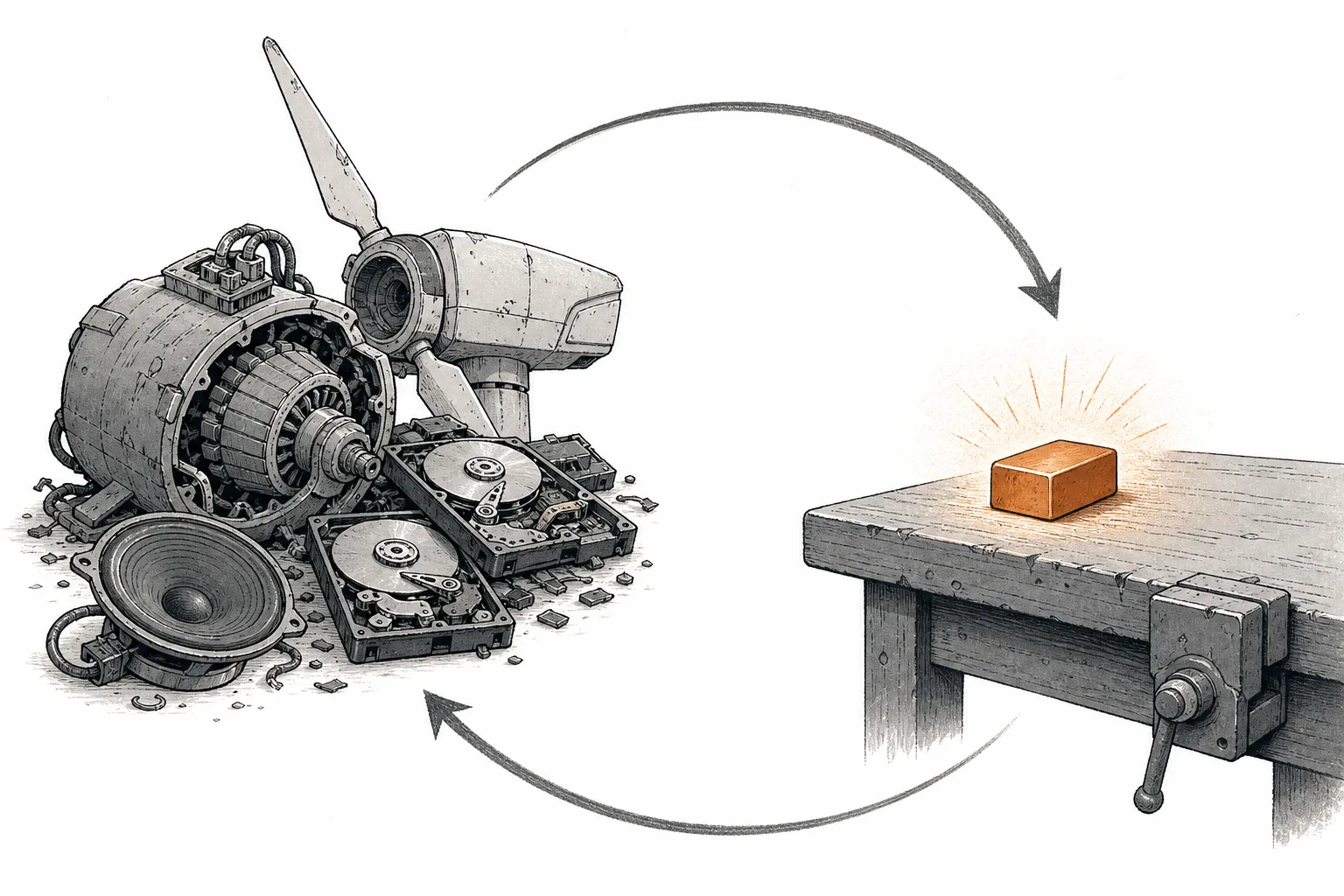
Think about the motor in an old EV, a decommissioned wind turbine, or the hard drive in a computer you stopped using. All of them have a small NdFeB permanent magnet hidden inside, and inside that magnet are rare earths like neodymium (Nd), praseodymium (Pr), dysprosium (Dy), and terbium (Tb) — the very elements the whole world is afraid China will cut off. But instead of digging new ore out of the ground, we can "mine" them back out of things humans already made.
The business we're talking about here is rare-earth recycling and secondary recovery — companies that make money by collecting, removing, and reprocessing end-of-life magnets back into usable rare earths or new magnets. Not mining ore from the ground, but "mining" from the motors, turbines, and hard drives about to become waste. The magnets buried in these products are what people call the "urban mine".
Manufacturing scrap = magnet offcuts left over from grinding/cutting in the factory (up to ~30% of the raw material is lost as scrap); clean and easy to recycle · End-of-life scrap = magnets from products used all the way to end of life, buried in motors and hard drives; much harder to remove · Magnet-to-magnet (direct recycling) = turning old magnets into new magnets without breaking them down into elements — a short, energy-saving path · Long-loop = chemically dissolving the magnet, separating it back into pure single-element oxides, then rebuilding from scratch — more flexible on feedstock
On our megatrend map, this step is a sub-branch of Rare Earths & Permanent Magnets, under the Critical Materials & Supply Chain megatrend. But it doesn't sit "upstream" or "midstream" like its three sibling steps (mining · separation · magnet-making). It's a "shortcut loop" that runs parallel to the whole chain — because a single magnet can cycle back into new feedstock over and over, without ever starting from a mine again.
02Why it matters (the non-China solution)
To see why rare-earth recycling is about to matter so much, start with the bigger problem: China controls the rare-earth chain almost completely. It controls about 90% of separation and about 90% of magnet-making worldwide. In 2025 China played that card for real — restricting magnet exports until car factories around the world stalled (the full story is in the Rare Earths & Permanent Magnets lesson). Recycling is the only way to create "rare earths" at home, without going through a Chinese mine or separation plant at all.
And here's the number that gets people in the field excited: today the world recycles less than 1% of its rare earths — almost every piece gets landfilled or just thrown out. That means a massive gap nobody has touched yet. Unlike copper or aluminum, which have been routinely recycled for ages, rare earths are still an "urban mine" almost no one is digging.
There's another reason recycling looks far more attractive in a carbon-conscious era: the "shortcut" way of recycling magnets (magnet-to-magnet) uses about 88% less energy than the mine-separate-reduce-remake path, and emits about ~95% less carbon — because the rare earths in old magnets are "already blended and formed," so you don't have to start over from the hard, dirty job of separating elements.
Governments see this too. Europe passed the Critical Raw Materials Act, targeting at least 25% of the region's demand for strategic materials (including rare earths) to be met by recycling by 2030. The US has pulled magnet-recycling technology into its Minerals Security Partnership and is subsidizing domestic plants — because every kilogram recycled at home is a kilogram that doesn't have to wait for an export license from Beijing.
03How it works (two paths back to a magnet)
The heart of this business is the "closed loop" — a single magnet travels from "old" back to "new" without touching a mine again. But there's a key fork in the middle: once the magnet is removed, you can take two paths — the short path that converts it straight into a new magnet, or the long path that breaks it back down into pure elements first.
Path A is the star of this era. The most famous technique is called HPMS, developed at the University of Birmingham — you soak old magnets in hydrogen gas, which works its way into the magnet until it "crumbles" into powder and loses its magnetism on its own. Then you press that powder straight into a new magnet, no need to break it down into elements. That's why it saves so much energy — it skips the hardest chemistry step entirely.
A process that uses hydrogen gas to "crumble an NdFeB magnet into powder" and demagnetize it in the process, making it easy to pull the magnet powder out of a motor or hard drive, then press the powder straight into a new magnet · It's the heart of low-energy magnet-to-magnet recycling — its weakness is that it only accepts magnets still in "good enough" condition; if they're too old or degraded, they have to go to Path B instead.
Path B (long-loop) uses chemistry to dissolve the whole magnet and separate it back into pure single-element oxides (Nd, Pr, Dy, Tb), like running the mine's separation process in reverse. Its upside is that it "eats dirty material" — it accepts contaminated, degraded, or mixed-metal magnets far more readily, and yields high-purity oxide you can use for anything. Its downside is that it uses more energy and chemicals. In reality the industry needs both — Path A for clean scrap, Path B for the rest.
04What it connects to
Rare-earth recycling is the "fourth step" that runs parallel to the three main steps of the magnet chain. It doesn't compete directly with mining, but supplements supply at the world's most fragile point. And it does a job similar to separation and magnet-making — but starting from "old products" instead of "concentrate." Put simply, it leapfrogs the upstream steps China controls most tightly.
More important are the downstream "mouths waiting to be fed" — whether the magnets come from a mine or from recycling, they all feed the same megatrends of the era: Electrification & Mobility (EV motors), Energy Transition & Power Demand (wind turbines), Robotics & Physical AI (robot joints and drones), Defense & Geopolitical Fragmentation (guidance systems and fighter jets), and even Artificial Intelligence (motors and hard drives in data centers). Put simply, every kilogram you can recycle is a kilogram that doesn't have to wait for a new mine or a license from China.
05Where it stands now
2025–2026 is when rare-earth recycling "stepped from the lab into real factories." After China restricted magnet exports in April 2025, money and policy poured into this field like never before — across the US, Europe, and Asia.
The magnet-to-magnet side is moving fastest. HyProMag (part of Mkango Resources, listed in London and Canada) fired up its first commercial HPMS recycling vessel in Birmingham, UK, in July 2025, and opened a plant in Pforzheim, Germany, later that year, with plans to expand to the US in 2027. Meanwhile in Texas, Noveon Magnetics is the only sintered NdFeB magnet maker operating in the US, using its own magnet-to-magnet process, and it just closed a $215 million Series C in early 2026.
The long-loop chemical side is just as busy. Ionic Technologies (part of Australia-listed Ionic Rare Earths) runs a demonstration plant in Belfast that it says makes it the only company outside China separating all four magnet oxides (Nd, Pr, Dy, Tb) at plant scale, at over 99.5% purity. And in Canada, Cyclic Materials — backed by BMW, Microsoft, and Amazon — closed a $75 million Series C in early 2026 and is building hub-and-spoke plants in Arizona and Ontario.
And governments are stepping in to prop it up directly — the US pulled HPMS technology into its Minerals Security Partnership, the UK granted about £12 million ($16.4 million) to the Belfast plant, and Europe is targeting 25% recycling of strategic materials by 2030. Here are the public-market players shaping this field:
06The road ahead
The biggest story of this business hasn't arrived yet — it's the "end-of-life wave". Magnets in motors and turbines last 15–25 years, which means the earliest EVs, the pioneer-era wind turbines, and the enormous number of hard drives sold over the past decade are all about to "expire" together around 2035 onward, becoming a massive volume of scrap magnets waiting to be recycled.
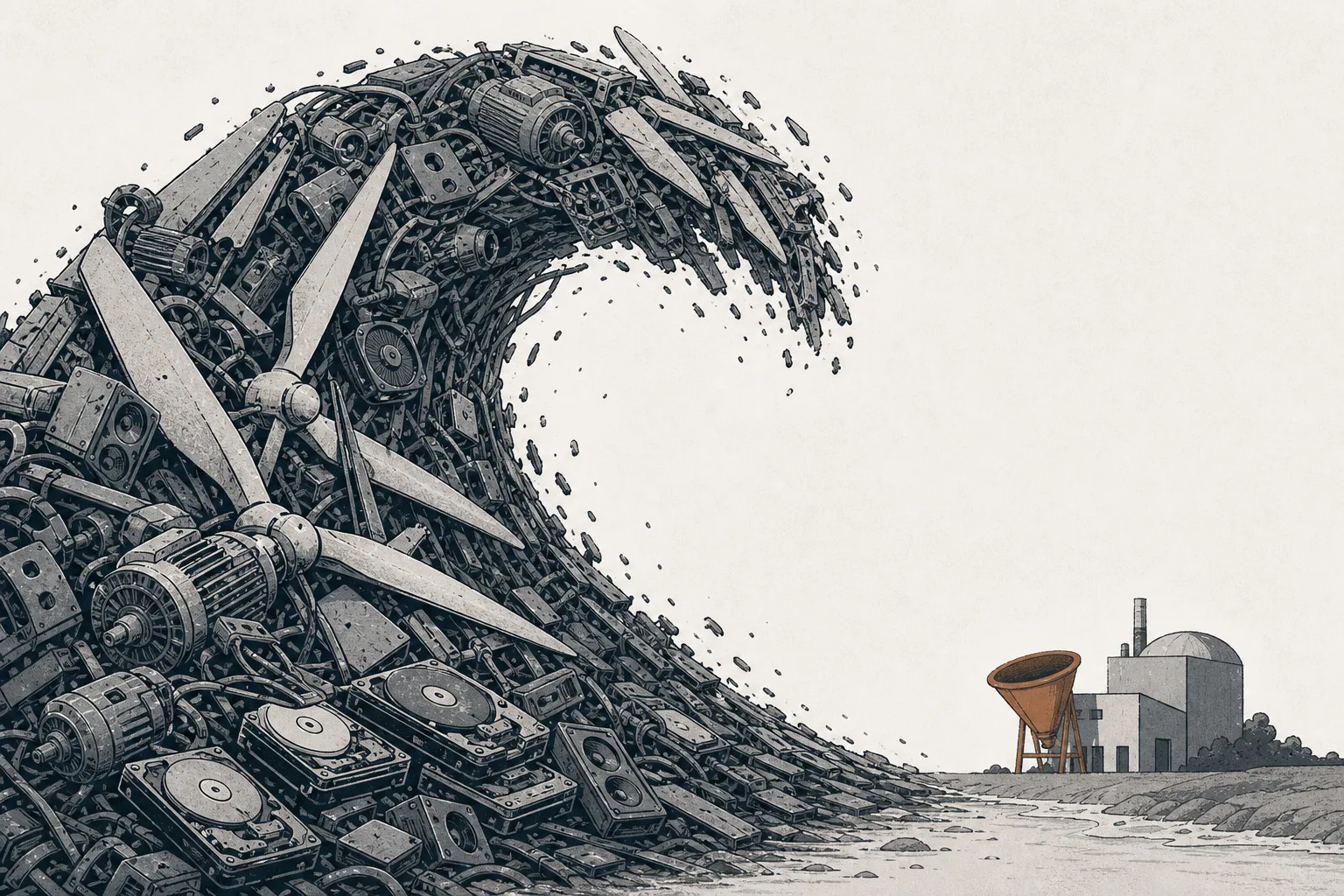
McKinsey research estimates that by 2035 the magnet chain will generate about 81,000 tons/year of recyclable scrap (split into ~40,000 tons of manufacturing scrap and ~41,000 tons of end-of-life magnets), against demand of about 176,000 tons of rare earths for magnets that same year — meaning that if fully collected and recycled, this scrap could cover nearly half of demand.
But here's the honest truth: recycling alone can't close the whole gap. Even if you collect nearly every scrap piece, the volume of magnets reaching end of life each year still can't keep up with demand growing that fast. The world needs new mines, new separation plants, and recycling together. Recycling isn't a "replacement" for mining, but an indispensable "ally" — and one that's cleaner, faster, and less exposed to geopolitics.
07Challenges & risks
Getting the magnets out is a nightmare. Unlike copper wire, which is easy to strip, NdFeB magnets are usually buried deep and glued in inside motors, turbines, or hard drives, designed to "stay put," not to be removed. Pulling them out without breaking or contaminating them takes a lot of labor and time. This is the industry's real chokepoint — not the recycling, but the "collecting and removing" in enough volume and quality.
There isn't enough material to recycle yet. The big end-of-life wave arrives around 2035, which means today the main feedstock is still just manufacturing scrap, which is limited. So many players have to "build the plant and wait" years ahead of the real material flowing in — burning cash while they wait, and risking that the wave comes later than expected.
Prices are tied to China's political game. A recycler's profit depends on the world rare-earth price, and China can control that price. In the past China has "crushed" rare-earth prices to knock out rivals outside China. If China opens the export tap and pushes prices back down, higher-cost recycling projects could lose money until they can't go on — which is why the state has to step in to subsidize and prop up prices, just as it does for mines and separation plants outside China.
Lab ≠ factory. Technologies like HPMS and long-loop have proven they work at demonstration scale, but scaling up to high volume, consistent quality, and a cost that can truly compete with Chinese magnets is still a gate to clear. Many companies in this field are still "burning cash" and not yet profitable — its appeal is that demand and politics clearly back it, but the risk is who actually scales from demo plant to full factory first.